WeChat コードをスキャンしてご連絡ください
WeChat コードをスキャンしてご連絡ください
お気軽にメールをお送りください。できるだけ早くご返信させていただきます.
心と魂で未来を創る


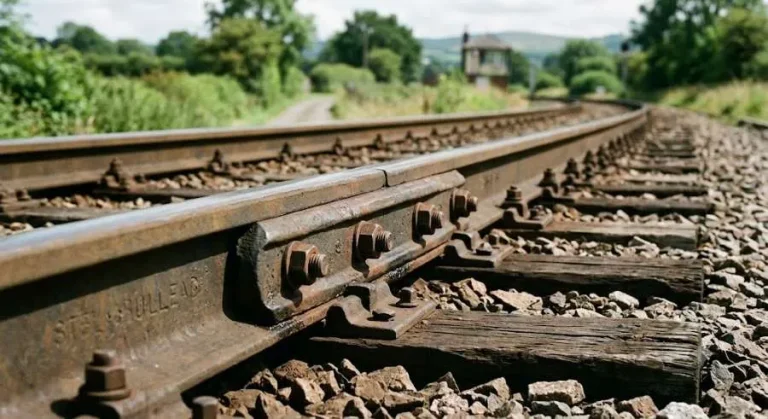
人々が鉄道を買うとき, 最初の質問は通常プロフィールに関するものです, 重さと長さ. どのセクションが必要ですか? 1メートルあたり何キログラム? プロジェクトではどのような真直度クラスが必要ですか? レール鋼材のグレードは後から来ることが多い.
それは理解できる. R260などのコード, R350HT, U71Mn と U75V は、実際の回線でどちらかを選択するまではあまり意味がありません。. その時点で, グレードはレールの摩耗に影響するため重要になります。, 輪荷重が繰り返された場合にどのように動作するか, どのように溶接できるのか、そして, 結局のところ, トラックのメンテナンスが必要な頻度.
実用的なエンジニアリング目的のため, レール鋼は大きく 4 つのカテゴリに分類できます: R260などの炭素マンガングレード, U71Mn および 900A; U75Vなどのマイクロアロイグレード; R350HT、AREMA HHなどの熱処理および頭部硬化材; より要求の厳しいトラック向けの合金またはベイナイトグレード.
これは正式な分類法ではなく実用的な分類です. 正確なグレード, 化学および機械的要件は、該当するものと常に照合する必要があります。 で 13674-1 そして ギガバイト/トン 2585-2021 要件.
このガイドでは、入札や鉄道プロジェクトで一般的に発生する鉄道グレードについて説明します。, 特にR260に注目, R350HT, U71Mn および U75V. さらに重要なことは, どちらかを選択するときに実際に何が重要かを説明します.
レールは一度荷重を加えると元の状態に戻ることはありません。. レールの同じセクションには、その耐用年数を通じて何度も輪荷重がかかります。.
この繰り返しの接触がレール鋼と普通の構造用鋼の違いです。.
梁に使用される形鋼, プレートやその他の構造コンポーネントは通常、強度を重視して設計されています, 意図した荷重条件下での延性と溶接性. 鉄道には解決すべき別の問題がある: 車輪とレールの間の小さな接触面積は、繰り返し転がりや滑りの力を受けます。.
これが、レール鋼に通常の構造用鋼よりもかなり多くの炭素が含まれている理由です。. 従来の幹線レールには、次のようなものが含まれる可能性があります。 0.62 に 0.80% 炭素, 一方、一般的な構造用鋼は多くの場合、 0.12 に 0.25% 範囲.
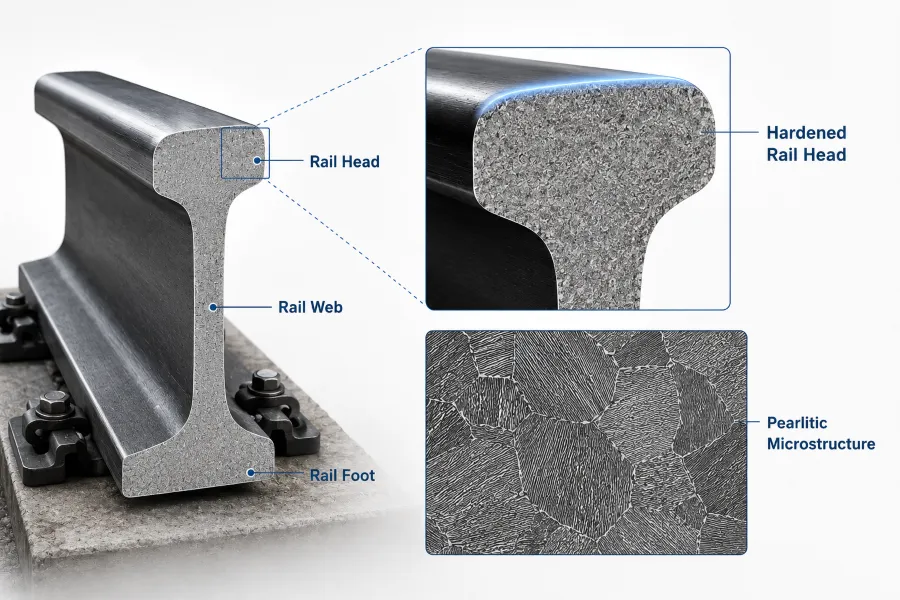
適切な圧延および冷却プロセスにより、, 高炭素レール鋼は主にパーライト組織を発達させます. フェライトとセメンタイトが細かく配置されているため、硬度のバランスが取れています。, 耐摩耗性と靭性.
数字を見れば違いがすぐにわかります:
最後のポイントはトラック上で最も重要なポイントです. レールは摩耗に耐えなければなりません, 非常に多くの荷重サイクルにわたる塑性変形と転がり接触疲労. したがって、鋼材グレードはトラック設計の一部です。, 単なる材料の指定ではなく.
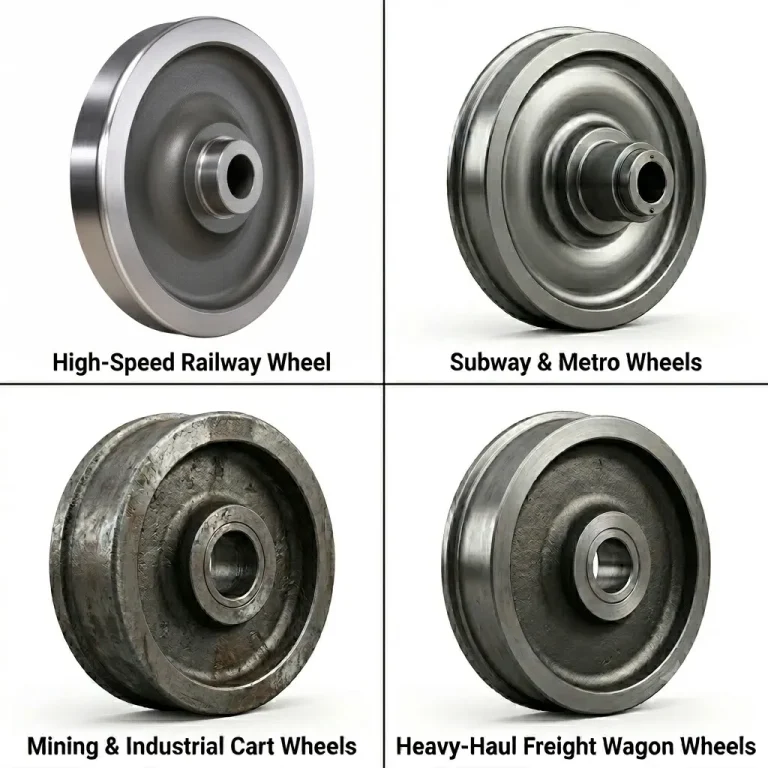
ホイールも同時に考慮する必要があります. ホイールの材質とホイールのプロファイルは、接触面とレールに伝わる応力に影響します。. 言い換えると, 鉄道グレードを単独で完全に評価することはできません. ホイールとレールの接触ペアの残りの半分にホイールの材質とプロファイルが重要である理由をご覧ください.
すべての鉄道規格をまったく同じ方法でカバーする単一の分類システムはありません。. 実用的なエンジニアリング作業用, しかし, 4つのグループが便利です: カーボンマンガンレール, マイクロアロイレール, 熱処理されたレール, 合金またはベイナイトレール.
これらのグループ間の重要な違いは、単に化学組成だけではありません。. 製造ルートとその結果生じる微細構造は、同じ基本的な鋼の化学反応がトラック上でどのように機能するかを変える可能性があります.
炭素マンガングレードは、強度の実用的なバランスを提供するため、依然として広く使用されています。, 耐摩耗性, 溶接性とコスト.
EN の R260 13674-1 おなじみのヨーロッパグレードです, おおよそで 880 MPa の最小引張強さと約 260 ~ 300 HB の硬度範囲. 一般に、従来の幹線および混合トラフィックのアプリケーションで考慮されています。.
GB/T 未満の U71Mn 2585 これも広く見られる炭素マンガングレードです. マンガン濃度は R260 よりも高い, そしてそれは一般的に次のものと関連付けられています 50 kg/m と 60 中国仕様のkg/mレール.
900A は古いグレードの指定であり、現在でも鉄道入札や技術文書に記載されている可能性があります。. R260などの従来のグレードとほぼ同様の強度および硬度特性を備えています。, ただし、正確な要件は該当する仕様によって異なります.
アレマグレード 260 北米仕様で使用されるもう1つの従来のオプション, 周囲の引張強度を最小限に抑えた 980 MPaとそのあたりの硬さ 300 HB.
重要な点は、これらのグレードが自動的に「低パフォーマンス」レールになるわけではないということです。. 回線のトラフィックが中程度の場合, 適切な軸荷重と重大な摩耗問題がないこと, 高級熱処理グレードにお金を払う工学的正当性はほとんどないかもしれない.
マイクロアロイには少し異なるアプローチが取られます.
バナジウムなどの元素を少量添加することで、より高い炭素含有量や別個のヘッド硬化処理に完全に依存することなく、微細構造を微細化し、強度を向上させることができます。.
U75Vが良い例です. GB/T未満 2585, 微小合金範囲のバナジウムが含まれており、およそ 980 MPa の最小引張強さ、硬度は約 280 ~ 320 HB. 従来のカーボンマンガングレードよりも優れた強度と耐疲労性が必要な場合に使用されます。.
別の例は900ACrVです, 一部のヨーロッパのメーカーから入手可能なクロムバナジウムの変種. その正確な化学的性質と特性は製造者の仕様によって異なります, ただし、従来のカーボンレールと完全に熱処理されたグレードの間の高性能範囲に位置します。.
これらのレールの場合, アップグレードの理由は動作条件にあるはずです. トラフィックが多い, 要求の厳しいカーブや既存の摩耗の問題により、追加のパフォーマンスが正当化される場合があります。. 仕様書に高い強度数値が記載されているというだけの理由でグレードを選択しないでください。.
特定のルートの割り当ては、鉄道事業者とインフラ所有者によってプロジェクトの決定が行われます。. したがって、その適用が関連する技術文書によって確認されない限り、グレードを特定の高速ルートや幹線ルートに関連付けるべきではありません。.
製造プロセスが化学と同じくらい重要になるため、熱処理されたレールは議論を変える.
巻いた後, 制御された加速冷却により、パーライト組織を微細化し、レール頭部の硬度を高めることができます。. その結果、レールセクションの残りの部分で必要な特性を維持しながら、より硬い走行面が得られます。.
R350HT(EN) 13674-1 身近な例です. おおよそあります 1175 MPa minimum tensile strength and a hardness range around 350–390 HB.
This makes it attractive for sections where rail wear is a persistent problem, particularly high-wear curves and heavy-haul applications.
R350LHT is another heat-treated grade with a small chromium addition. AREMA HH represents the high-hardness approach used in North American specifications, with hardness typically around 388 HB or above depending on the specific product.
There is an important practical point here: a harder rail is not automatically the better rail for every location.
If a conventional grade is already giving acceptable wear life on tangent track, upgrading the whole line to a premium grade may add cost without solving a real problem. Heat-treated rail makes the most sense when the operating conditions justify it.
When conventional pearlitic rail is no longer enough, manufacturers can use alloying and different cooling strategies to push the performance further.
クロム, モリブデン, ニッケル, boron and other alloying elements can be used depending on the grade and manufacturing route. Some of these steels are designed to develop bainitic microstructures, which can provide a useful combination of strength, hardness and fracture toughness.
Examples include BH Rail, R370CrHT and U78CrV, although their exact requirements depend on the relevant standard and manufacturer specification.
These grades are normally considered for demanding conditions such as small-radius curves, very high axle loads, severe wear or documented rolling contact fatigue.
They also come with a trade-off. The material cost is higher, welding becomes more specialized, and the benefit needs to be demonstrated by the actual track conditions.
For a rail buyer, that means the question should not simply be “What is the hardest grade available?」
A better question is:
What degradation mechanism are we trying to control?
The following comparison gives a practical starting point for four grades commonly encountered in railway specifications.
The values below are typical published values. Always confirm the current standard revision and the mill certificate for the actual delivery.
| 学年 | 標準 | 炭素 (%) | マンガン (%) | Key Alloying | 抗張力 (MPa, 分) | 硬度 (HB) | Manufacturing Route |
|---|---|---|---|---|---|---|---|
| R260 | で 13674-1 | 0.62–0.80 | 0.70–1.20 | None | 880 | 260–300 | As rolled |
| R350HT | で 13674-1 | 0.72–0.80 | 0.70–1.20 | Cr ≤ 0.15 | 1175 | 350–390 | Heat treated |
| U71Mn | ギガバイト/トン 2585 | 0.65–0.77 | 1.10–1.40 | None | 880 | 260–300 | As rolled |
| U75V | ギガバイト/トン 2585 | 0.67–0.77 | 0.70–1.00 | V 0.04–0.12 | 980 | 280–320 | Microalloyed / as rolled |
One point about the names is worth clearing up. In grades such as R260 and R350HT, the number is closely associated with the specified hardness class. It does not mean that every section of rail will have exactly that hardness. R260, 例えば, is specified within a hardness range of roughly 260–300 HB, while R350HT is around 350–390 HB.
The table also cannot tell you which grade is correct for a particular railway. That decision comes from the operating conditions.
For a closer comparison, see our separate guides on R260 vs R350HT and U71Mn vs U75V.
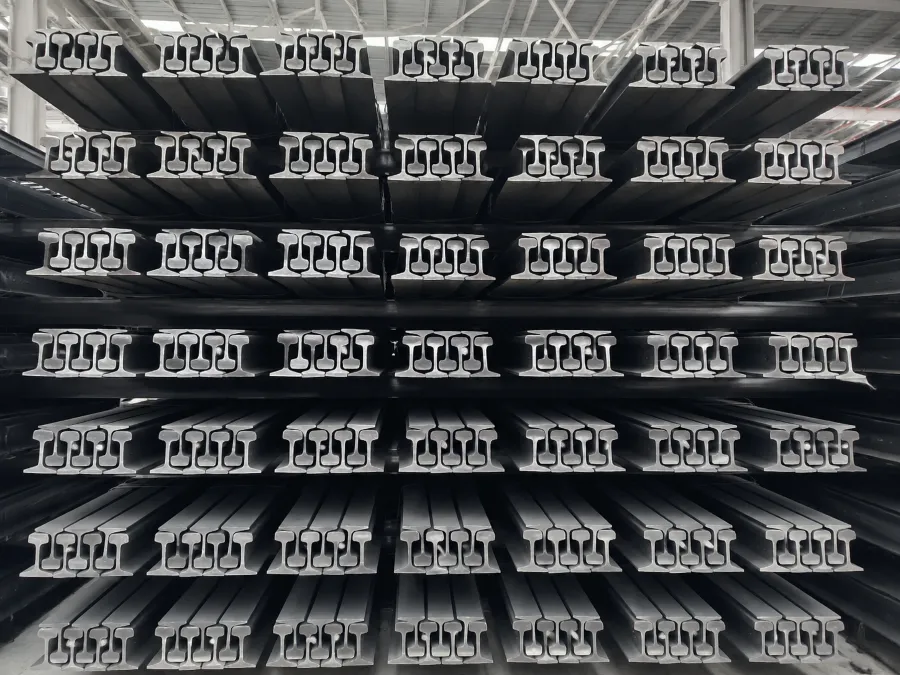
This is where rail steel selection becomes an engineering problem rather than a catalogue comparison.
I would not start by asking which grade has the highest tensile strength. I would start by asking what is actually damaging the rail.
Is the rail wearing at the gauge corner? Is rolling contact fatigue appearing on the head? Is plastic flow becoming a problem under high axle loads? Is the rail being ground frequently? Is lubrication effective on the curves?
Those questions tell you much more than a single hardness number.
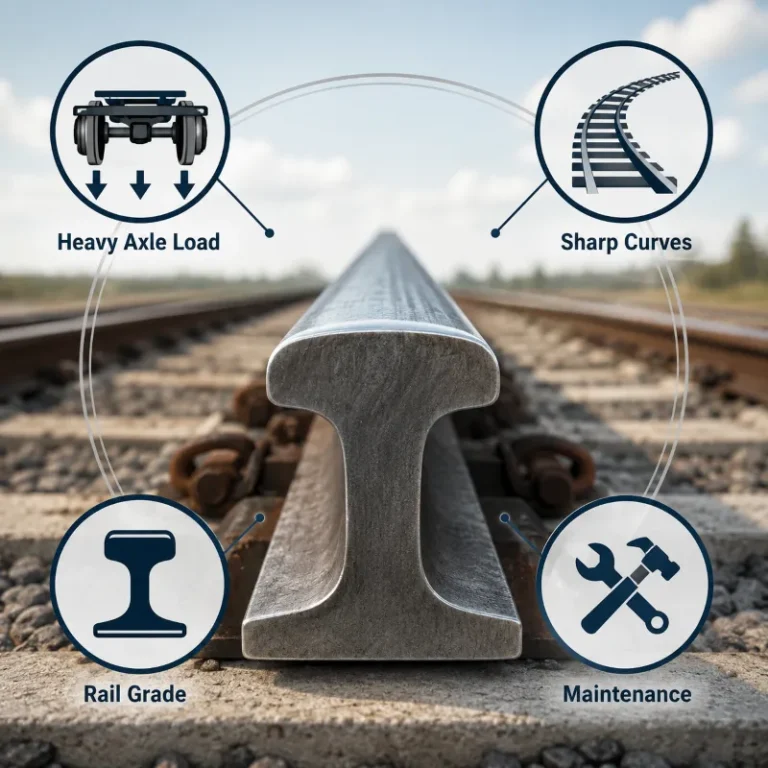
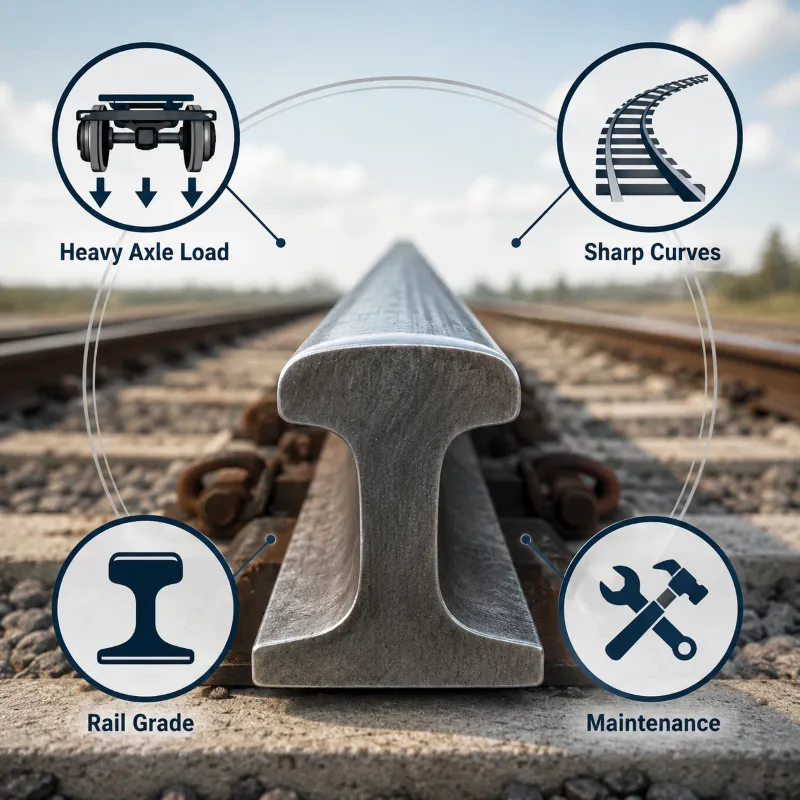
The main factors to review are:
Higher axle loads increase the forces acting at the wheel-rail contact and can accelerate wear and plastic deformation.
As a rough starting point:
These are not design limits. Two railways with the same axle load can need different rail grades because their curve radii, annual tonnage, wheel condition and maintenance practices are different.
Curve radius is one of the factors that can turn an otherwise acceptable rail grade into a maintenance problem.
On tangent track, wheel-rail contact is relatively stable. On a tight curve, the gauge corner sees greater lateral loading and the contact conditions become more severe. Wear and rolling contact fatigue can then develop much faster.
As a general guide, standard carbon-manganese grades often perform well on large-radius tangent and gentle curves. As the radius decreases and the wear problem becomes more pronounced, microalloyed or heat-treated grades may be considered. Very tight curves with heavy traffic can justify specialist alloy or bainitic grades.
There is no useful universal rule saying that a particular radius must use a particular steel grade. Traffic tonnage, wheel profile, 潤滑, grinding and actual wear measurements all matter.
That is why I would treat curve radius as a reason to investigate an upgrade, not as an automatic grade-selection formula.
This is one of the easiest mistakes to make when comparing rail specifications.
A higher hardness number looks attractive on paper. But the wheel and rail work as a pair. The difference in hardness, the wheel profile, contact stress and maintenance regime all influence what happens at the contact patch.
There is also the question of cost.
If a standard rail is already delivering acceptable wear life on a lightly loaded tangent section, replacing it with a premium heat-treated grade may not produce a useful return. On a heavy-haul curve where rail wear is driving frequent grinding or replacement, the calculation can be completely different.
そのため, wear data is more useful than a generic claim about percentage life improvement. If possible, compare wear rates under operating conditions close to the actual line—for example, millimetres of wear per 100 MGT.
A rail specification is only as good as the product delivered against it.
When reviewing a rail supplier, I would not look at tensile strength alone. The first question is whether the material, test results and physical rail can all be traced back to the same production heat.
The MTC should identify the applicable standard, heat number, chemical composition and mechanical properties. Where EN 10204 タイプ 3.1 または 3.2 certification is required by the project, the certificate should match that requirement.
The important point is traceability. The heat number on the certificate should be consistent with the marking and documentation for the delivered rail.
For critical rail products, UT provides information about internal soundness.
The report should be traceable to the applicable acceptance criteria rather than simply saying “UT passed.” The actual standard and testing requirements should be clear.
レールプロファイル, 真直度, surface condition and end tolerances should be checked against the specified rail section.
A rail can have the correct steel grade and still fail to meet the dimensional requirements of the project.
For heat-treated rail, hardness should not be treated as a single number taken from the surface.
A hardness traverse from the rail head toward the depth of the section can show whether the hardening profile is consistent with the specified grade.
This is one of the areas where the manufacturing process matters just as much as the final certificate value.
If the rails will be welded on site, confirm that the selected grade has a qualified welding procedure for the method being used, such as aluminothermic or flash-butt welding.
Do not assume that a welding procedure qualified for one rail grade can automatically be transferred to another grade.
ついに, check that the grade and rail profile are actually produced to the standard specified in the tender.
A supplier offering an “equivalent” grade may be technically reasonable in some projects, but equivalence should be established by the project specification or engineering authority—not assumed from a similar hardness or tensile-strength value.
There are some simple things worth checking before placing an order.
A price far below the market level for a specified grade should prompt questions about material, process and certification.
The rail should also have clear identification markings that allow the manufacturer, grade and production information to be traced.
Another thing I would look at is the MTC itself. If certificates from many different heats show exactly the same chemical and mechanical values with no normal production variation, it is worth asking for clarification.
These checks do not replace formal inspection, but they can reveal problems early.
はい. It is possible to use harder rail in high-wear curves and a conventional grade on tangent sections.
The important issue is not simply whether two grades can physically be connected. The welding procedure, transition requirements and maintenance strategy also have to be considered.
Where different grades are used on the same route, confirm the requirements against the applicable railway standard and qualified welding procedure. The maintenance team should also understand that different grades may wear at different rates.
A rail grade is only one part of the wheel-rail system.
The wheel matters because its material and profile determine the contact conditions at the rail head. A worn wheel profile can change the contact patch and increase local stress even if the rail grade itself is suitable.
This is why 鉄道の車輪 should be considered together with the rail specification and operating conditions.
The fastening system matters as well. 弾性レールクリップ provide rail restraint, その間 レールパッド influence the stiffness of the rail-seat area and the way loads are transferred into the sleeper.
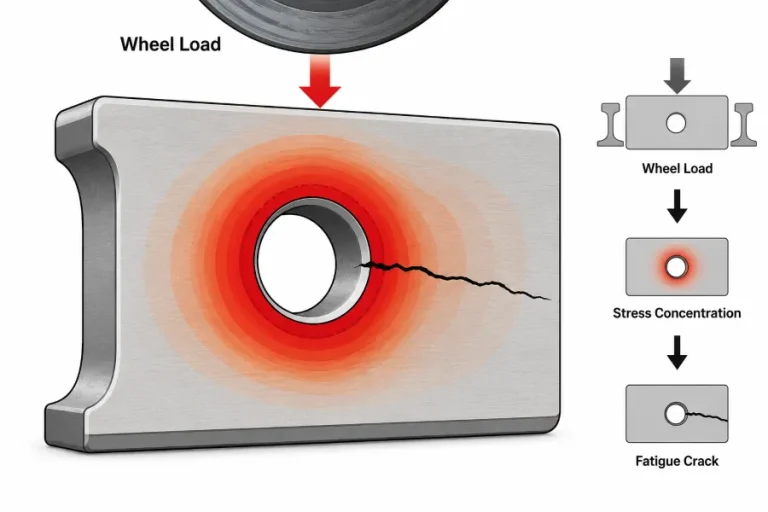
At rail joints, 魚皿 provide a mechanical connection where continuous welded rail is not used or where a joint is otherwise required.
The practical lesson is simple: upgrading the rail alone does not automatically solve a track problem.
A premium rail running with a poorly matched wheel profile, unsuitable fastening stiffness or inadequate maintenance will not necessarily deliver the service life expected from its material specification.
There is no single “best” rail steel grade.
R260 and U71Mn remain practical choices for many conventional applications. U75V provides a higher-strength microalloyed option, while R350HT and other heat-treated grades become more attractive when wear and heavy loading justify the additional cost. Alloy and bainitic grades are further options for particularly demanding conditions.
The right choice depends on what is happening on the track.
Axle load matters, but so do annual tonnage, 曲線半径, wheel condition, contact stress, 潤滑, grinding and maintenance access. That is why a rail grade should be selected from actual operating conditions rather than from the hardness column of a material table alone.
When purchasing rail, ask for traceable heat-level test certificates, UT results and dimensional inspection data. For heat-treated grades, look beyond the surface hardness and check the hardness profile. And if the rail will be welded, make sure the welding procedure is qualified for the grade you are buying.
If you are sourcing rail together with 鉄道の車輪, rail steel pads, elastic rail clips or other track components, the same engineering approach should be applied across the complete wheel-rail system.
洛陽豊洋重工業株式会社, 株式会社. supplies 鉄道の車輪 and track components with material certification, inspection documentation and OEM support. If you have a rail profile, annual tonnage, axle load or application requirement, you can contact our エンジニアリングチーム to discuss the appropriate specification.
テクニカルノート: Grade designations, chemical limits and mechanical requirements can vary by standard revision and product specification. Always verify the latest applicable standard and project specification before procurement.
U71Mn is a conventional carbon-manganese rail grade, while U75V uses vanadium microalloying. U71Mn is commonly specified with around 0.65–0.77% carbon and 1.10–1.40% manganese, while U75V contains roughly 0.67–0.77% carbon and 0.04–0.12% vanadium.
U75V has a higher typical minimum tensile strength and hardness range. Whether that difference is useful depends on the operating conditions. It is not simply a matter of choosing the grade with the higher number.
Sometimes they are, and sometimes they are not.
On a heavily loaded curve with significant rail wear, the additional hardness of a grade such as R350HT can make a meaningful difference to maintenance requirements. On a lightly loaded or relatively low-wear section, the additional cost may not provide the same benefit.
The best way to make the decision is to compare actual wear and maintenance data from the line.
はい. It is common in some applications to use harder rail in curves and conventional grades on tangent sections.
The grades should not simply be mixed without checking welding compatibility, transition requirements and the applicable railway standard. Maintenance planning should also account for different wear rates.
At a minimum, check the required material certificate, 化学組成, 機械的特性, heat number and traceability. プロジェクトに応じて, you may also need UT reports, dimensional inspection records and hardness data.
For heat-treated rail, a hardness-depth profile is particularly useful. If the rail will be welded on site, confirm that a qualified welding procedure is available for the selected grade.
Because the loading conditions are fundamentally different.
Structural steel is not designed for repeated wheel-rail rolling contact. Rail steel has a higher carbon content and a controlled microstructure designed to provide the hardness, wear resistance and fatigue performance required for railway service.
Using a material simply because its tensile strength looks acceptable on a datasheet ignores the contact conditions that actually govern rail performance.
いいえ.
Hardness is important, but rail life also depends on wheel hardness and profile, 軸重, traffic tonnage, 曲線半径, contact stress, 潤滑, grinding and other maintenance conditions.
A harder rail can be the right solution for a high-wear location, but it should not be treated as a universal upgrade for every section of track.