WeChat 코드를 스캔하여 문의하세요
WeChat 코드를 스캔하여 문의하세요
이메일을 보내주시면 최대한 빨리 답변해 드리겠습니다..
마음과 영혼을 다해 미래를 창조하다


When people buy rail, the first questions are usually about profile, weight and length. Which section is required? How many kilograms per metre? What straightness class does the project call for? The rail steel grades often comes later.
That is understandable. Codes such as R260, R350HT, U71Mn and U75V do not mean much until you have to choose one for an actual line. 그 시점에서, the grade becomes important because it affects how the rail wears, how it behaves under repeated wheel loading, how it can be welded and, ultimately, how often the track needs maintenance.
For practical engineering purposes, rail steel can be grouped into four broad categories: carbon-manganese grades such as R260, U71Mn and 900A; microalloyed grades such as U75V; heat-treated and head-hardened grades such as R350HT and AREMA HH; 더욱 까다로운 트랙을 위한 합금 또는 베이나이트 등급.
이는 공식 분류가 아닌 실제 분류입니다.. 정확한 등급, 화학 및 기계적 요구 사항은 항상 해당 사항과 비교하여 확인되어야 합니다. 안에 13674-1 그리고 GB/T 2585-2021 요구 사항.
이 가이드에서는 입찰 및 철도 프로젝트에서 일반적으로 접하게 되는 철도 등급을 살펴봅니다., R260에 특히 주의를 기울여, R350HT, U71Mn 및 U75V. 더 중요한 것은, 둘 중 하나를 선택할 때 실제로 중요한 것이 무엇인지 설명합니다..
레일은 한 번 하중을 싣고 다시 원래 상태로 돌아가는 것이 아닙니다.. 레일의 동일한 섹션은 서비스 수명 동안 계속해서 바퀴 하중을 받습니다..
이러한 반복적인 접촉이 레일강이 일반 구조용강과 다른 점입니다..
빔에 사용되는 구조용 강재, 플레이트 및 기타 건축 구성 요소는 일반적으로 강도를 중심으로 설계됩니다., 의도된 하중 조건 하에서 연성 및 용접성. 철도에는 해결해야 할 또 다른 문제가 있습니다: 바퀴와 레일 사이의 작은 접촉 면적은 반복적인 롤링 및 슬라이딩 힘을 받습니다..
이것이 바로 레일 강이 일반적인 구조용 강보다 훨씬 더 많은 탄소를 함유하는 이유입니다.. 기존의 본선 레일에는 대략 다음과 같은 내용이 포함될 수 있습니다. 0.62 에게 0.80% 탄소, 일반적인 구조용 강철은 종종 0.12 에게 0.25% 범위.
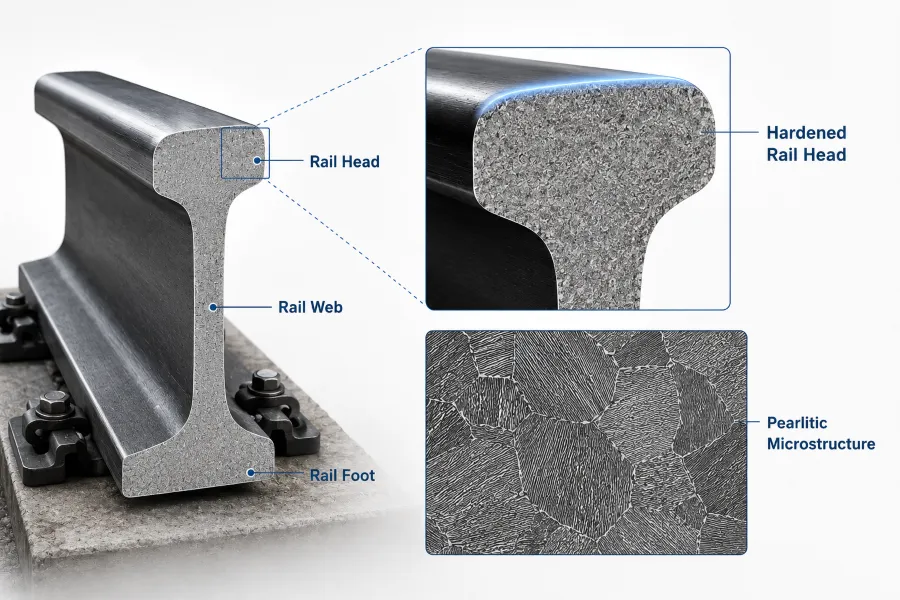
올바른 압연 및 냉각 공정을 통해, 고탄소 레일강은 주로 펄라이트 미세구조를 형성합니다.. 페라이트와 시멘타이트의 미세한 배열은 경도 간의 유용한 균형을 제공합니다., 내마모성과 인성.
숫자를 보면 차이점을 빠르게 알 수 있습니다.:
마지막 포인트는 트랙에서 가장 중요한 포인트입니다.. 레일은 마모에 저항해야 합니다., 매우 많은 수의 하중 사이클에 대한 소성 변형 및 구름 접촉 피로. 따라서 강철 등급은 트랙 설계의 일부입니다., 단순한 재료 명칭이 아닌.
휠도 동시에 고려해야 합니다.. 휠 재질과 휠 프로파일은 접촉 패치와 레일로 전달되는 응력에 영향을 미칩니다.. 다시 말해서, 철도 등급은 자체적으로 완전히 평가할 수 없습니다.. 휠-레일 접촉 쌍의 나머지 절반에 휠 재질과 프로파일이 중요한 이유를 확인하세요..
모든 철도 표준을 정확히 동일한 방식으로 포괄하는 단일 분류 시스템은 없습니다.. 실용적인 엔지니어링 작업을 위해, 하지만, 네 그룹이 유용하다: 탄소-망간 레일, 미세 합금 레일, 열처리 레일, 합금 또는 베이나이트 레일.
이들 그룹 간의 중요한 차이점은 단순히 화학적 조성이 아닙니다.. 제조 경로와 그에 따른 미세 구조는 동일한 기본 철강 화학이 트랙에서 수행되는 방식을 변경할 수 있습니다..
탄소-망간 등급은 실용적인 강도 균형을 제공하기 때문에 널리 사용됩니다., 내마모성, 용접성 및 비용.
EN의 R260 13674-1 친숙한 유럽 등급입니다, 대략적으로 880 MPa 최소 인장 강도 및 약 260-300HB의 경도 범위. 이는 일반적으로 기존의 간선 및 혼합 트래픽 애플리케이션에 대해 고려됩니다..
GB/T 미만의 U71Mn 2585 널리 사용되는 또 다른 탄소-망간 등급입니다.. 망간 범위는 R260보다 높습니다., 그리고 그것은 일반적으로 다음과 관련이 있습니다. 50 kg/m 및 60 중국 사양의 kg/m 레일.
900A는 철도 입찰 및 기술 문서에 여전히 나타날 수 있는 이전 등급 지정입니다.. R260과 같은 기존 등급과 대체로 유사한 강도 및 경도 특성을 가지고 있습니다., 정확한 요구 사항은 해당 사양에 따라 다르지만.
AREMA등급 260 북미 사양에 사용되는 또 다른 기존 옵션입니다., 주위에 최소 인장 강도 980 MPa 및 주변 경도 300 HB.
중요한 점은 이러한 등급이 자동으로 "저성능" 레일이 되지 않는다는 것입니다.. 회선의 교통량이 보통인 경우, 적절한 축중 및 심각한 마모 문제 없음, 프리미엄 열처리 등급에 대한 비용을 지불하는 데 대한 엔지니어링 정당성이 거의 없을 수 있습니다..
미세합금은 약간 다른 접근 방식을 취합니다..
바나듐과 같은 원소를 조금만 추가하면 더 높은 탄소 함량이나 별도의 헤드 경화 처리에 전적으로 의존하지 않고도 미세 구조를 개선하고 강도를 향상시킬 수 있습니다..
U75V가 좋은 예입니다.. GB/T 미만 2585, 이는 미세합금 범위의 바나듐을 함유하고 있으며 대략 980 경도가 약 280-320 HB인 MPa 최소 인장 강도. 기존의 탄소-망간 등급보다 더 큰 강도와 피로 저항이 필요한 곳에 사용됩니다..
또 다른 예는 900ACrV입니다., 일부 유럽 생산업체에서 구할 수 있는 크롬-바나듐 변형. 정확한 화학적 성질과 특성은 생산자의 사양에 따라 다릅니다., 하지만 기존 카본 레일과 완전 열처리 등급 사이의 고성능 범위에 속합니다..
이 레일의 경우, 업그레이드 이유는 작동 조건에서 비롯되어야 합니다.. 더 높은 트래픽, 까다로운 곡선이나 기존 마모 문제로 인해 추가 성능이 정당화될 수 있습니다.. 사양서에 더 높은 강도 수치가 포함되어 있다는 이유만으로 등급을 선택해서는 안 됩니다..
특정 경로 할당은 철도 운영자 및 인프라 소유자가 내리는 프로젝트 결정입니다.. 따라서 관련 엔지니어링 문서에 의해 해당 적용이 확인되지 않는 한 등급은 특정 고속 또는 간선 노선과 연관되어서는 안 됩니다..
열처리 레일은 제조 공정이 화학만큼 중요해지기 때문에 논의를 변화시킵니다..
롤링 후, 제어된 가속 냉각은 펄라이트 구조를 개선하고 레일 헤드의 경도를 높일 수 있습니다.. 그 결과 레일 섹션의 나머지 부분을 통해 필요한 특성을 유지하면서 주행 표면이 더욱 단단해졌습니다..
EN의 R350HT 13674-1 익숙한 예이다. 대략적으로 있습니다 1175 MPa 최소 인장 강도 및 경도 범위 약 350-390 HB.
이는 레일 마모가 지속적인 문제가 되는 구간에 매력적입니다., 특히 마모가 심한 곡선 및 중량물 운반 응용 분야.
R350LHT는 크롬을 약간 첨가한 또 다른 열처리 등급입니다.. AREMA HH는 북미 사양에 사용되는 고경도 접근 방식을 나타냅니다., 일반적으로 경도가 약함 388 특정 제품에 따라 HB 이상.
여기에는 중요한 실무적 포인트가 있습니다.: 더 단단한 레일이 자동으로 모든 위치에 더 나은 레일은 아닙니다..
기존 등급이 이미 접선 트랙에서 허용 가능한 마모 수명을 제공하는 경우, 전체 라인을 프리미엄 등급으로 업그레이드하면 실제 문제를 해결하지 않고도 비용이 추가될 수 있습니다.. 열처리 레일은 작동 조건이 정당화될 때 가장 적합합니다..
When conventional pearlitic rail is no longer enough, manufacturers can use alloying and different cooling strategies to push the performance further.
Chromium, 몰리브덴, 니켈, boron and other alloying elements can be used depending on the grade and manufacturing route. Some of these steels are designed to develop bainitic microstructures, which can provide a useful combination of strength, hardness and fracture toughness.
Examples include BH Rail, R370CrHT and U78CrV, although their exact requirements depend on the relevant standard and manufacturer specification.
These grades are normally considered for demanding conditions such as small-radius curves, very high axle loads, severe wear or documented rolling contact fatigue.
They also come with a trade-off. The material cost is higher, welding becomes more specialized, and the benefit needs to be demonstrated by the actual track conditions.
For a rail buyer, that means the question should not simply be “What is the hardest grade available?”
A better question is:
What degradation mechanism are we trying to control?
The following comparison gives a practical starting point for four grades commonly encountered in railway specifications.
The values below are typical published values. Always confirm the current standard revision and the mill certificate for the actual delivery.
| 등급 | 기준 | 탄소 (%) | 망간 (%) | Key Alloying | 인장강도 (MPa, min) | 경도 (HB) | Manufacturing Route |
|---|---|---|---|---|---|---|---|
| R260 | 안에 13674-1 | 0.62-0.80 | 0.70–1.20 | None | 880 | 260–300 | As rolled |
| R350HT | 안에 13674-1 | 0.72-0.80 | 0.70–1.20 | Cr ≤ 0.15 | 1175 | 350–390 | Heat treated |
| U71Mn | GB/T 2585 | 0.65–0.77 | 1.10–1.40 | None | 880 | 260–300 | As rolled |
| U75V | GB/T 2585 | 0.67–0.77 | 0.70–1.00 | V 0.04–0.12 | 980 | 280-320 | Microalloyed / as rolled |
One point about the names is worth clearing up. In grades such as R260 and R350HT, the number is closely associated with the specified hardness class. It does not mean that every section of rail will have exactly that hardness. R260, 예를 들어, is specified within a hardness range of roughly 260–300 HB, while R350HT is around 350–390 HB.
The table also cannot tell you which grade is correct for a particular railway. That decision comes from the operating conditions.
For a closer comparison, see our separate guides on R260 vs R350HT and U71Mn vs U75V.
This is where rail steel selection becomes an engineering problem rather than a catalogue comparison.
I would not start by asking which grade has the highest tensile strength. I would start by asking what is actually damaging the rail.
Is the rail wearing at the gauge corner? Is rolling contact fatigue appearing on the head? Is plastic flow becoming a problem under high axle loads? Is the rail being ground frequently? Is lubrication effective on the curves?
Those questions tell you much more than a single hardness number.
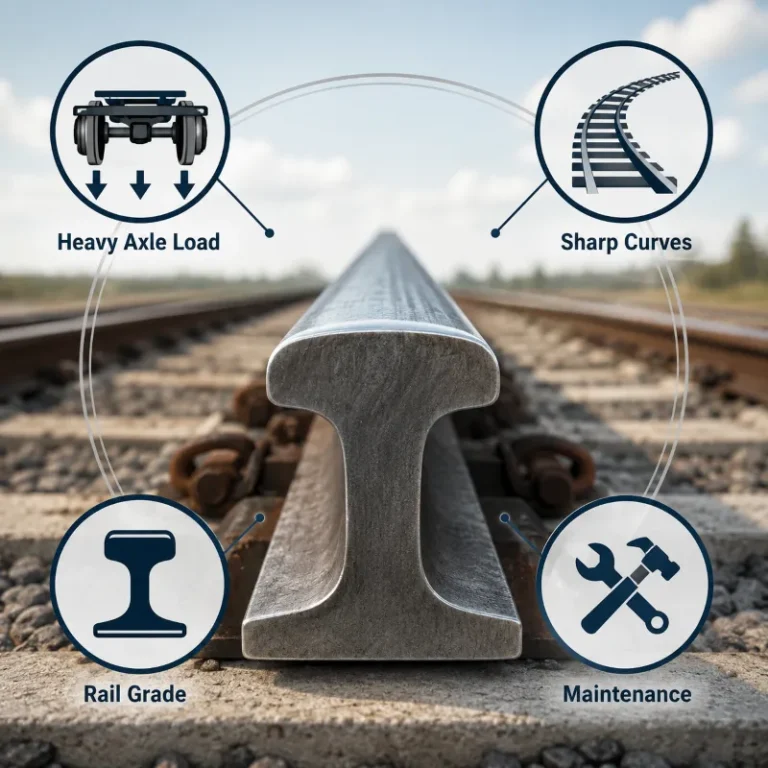
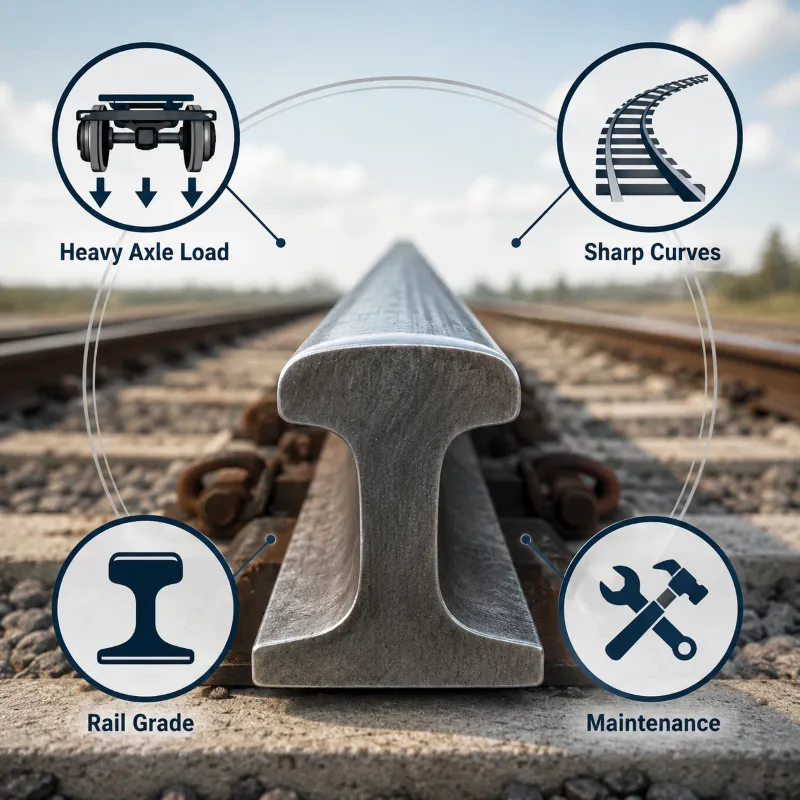
The main factors to review are:
Higher axle loads increase the forces acting at the wheel-rail contact and can accelerate wear and plastic deformation.
As a rough starting point:
These are not design limits. Two railways with the same axle load can need different rail grades because their curve radii, annual tonnage, wheel condition and maintenance practices are different.
Curve radius is one of the factors that can turn an otherwise acceptable rail grade into a maintenance problem.
On tangent track, wheel-rail contact is relatively stable. On a tight curve, the gauge corner sees greater lateral loading and the contact conditions become more severe. Wear and rolling contact fatigue can then develop much faster.
As a general guide, standard carbon-manganese grades often perform well on large-radius tangent and gentle curves. As the radius decreases and the wear problem becomes more pronounced, microalloyed or heat-treated grades may be considered. Very tight curves with heavy traffic can justify specialist alloy or bainitic grades.
There is no useful universal rule saying that a particular radius must use a particular steel grade. Traffic tonnage, wheel profile, 매끄럽게 하기, grinding and actual wear measurements all matter.
That is why I would treat curve radius as a reason to investigate an upgrade, not as an automatic grade-selection formula.
This is one of the easiest mistakes to make when comparing rail specifications.
A higher hardness number looks attractive on paper. But the wheel and rail work as a pair. The difference in hardness, the wheel profile, contact stress and maintenance regime all influence what happens at the contact patch.
There is also the question of cost.
If a standard rail is already delivering acceptable wear life on a lightly loaded tangent section, replacing it with a premium heat-treated grade may not produce a useful return. On a heavy-haul curve where rail wear is driving frequent grinding or replacement, the calculation can be completely different.
그런 이유로, wear data is more useful than a generic claim about percentage life improvement. If possible, compare wear rates under operating conditions close to the actual line—for example, millimetres of wear per 100 MGT.
A rail specification is only as good as the product delivered against it.
When reviewing a rail supplier, I would not look at tensile strength alone. The first question is whether the material, test results and physical rail can all be traced back to the same production heat.
The MTC should identify the applicable standard, 열 번호, chemical composition and mechanical properties. Where EN 10204 유형 3.1 또는 3.2 certification is required by the project, the certificate should match that requirement.
The important point is traceability. The heat number on the certificate should be consistent with the marking and documentation for the delivered rail.
For critical rail products, UT provides information about internal soundness.
The report should be traceable to the applicable acceptance criteria rather than simply saying “UT passed.” The actual standard and testing requirements should be clear.
Rail profile, straightness, surface condition and end tolerances should be checked against the specified rail section.
A rail can have the correct steel grade and still fail to meet the dimensional requirements of the project.
For heat-treated rail, hardness should not be treated as a single number taken from the surface.
A hardness traverse from the rail head toward the depth of the section can show whether the hardening profile is consistent with the specified grade.
This is one of the areas where the manufacturing process matters just as much as the final certificate value.
If the rails will be welded on site, confirm that the selected grade has a qualified welding procedure for the method being used, such as aluminothermic or flash-butt welding.
Do not assume that a welding procedure qualified for one rail grade can automatically be transferred to another grade.
마지막으로, check that the grade and rail profile are actually produced to the standard specified in the tender.
A supplier offering an “equivalent” grade may be technically reasonable in some projects, but equivalence should be established by the project specification or engineering authority—not assumed from a similar hardness or tensile-strength value.
There are some simple things worth checking before placing an order.
A price far below the market level for a specified grade should prompt questions about material, process and certification.
The rail should also have clear identification markings that allow the manufacturer, grade and production information to be traced.
Another thing I would look at is the MTC itself. If certificates from many different heats show exactly the same chemical and mechanical values with no normal production variation, it is worth asking for clarification.
These checks do not replace formal inspection, but they can reveal problems early.
예. It is possible to use harder rail in high-wear curves and a conventional grade on tangent sections.
The important issue is not simply whether two grades can physically be connected. The welding procedure, transition requirements and maintenance strategy also have to be considered.
Where different grades are used on the same route, confirm the requirements against the applicable railway standard and qualified welding procedure. The maintenance team should also understand that different grades may wear at different rates.
A rail grade is only one part of the wheel-rail system.
The wheel matters because its material and profile determine the contact conditions at the rail head. A worn wheel profile can change the contact patch and increase local stress even if the rail grade itself is suitable.
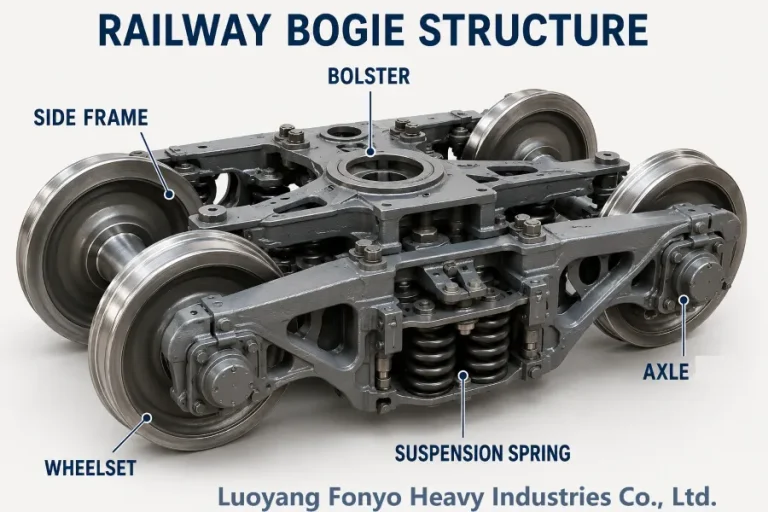
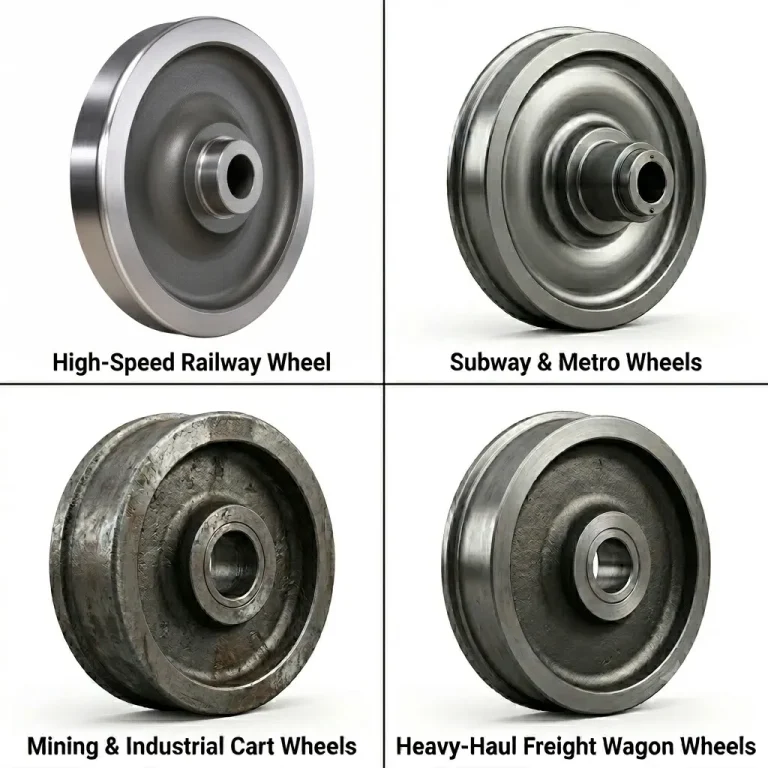
This is why 철도 바퀴 should be considered together with the rail specification and operating conditions.
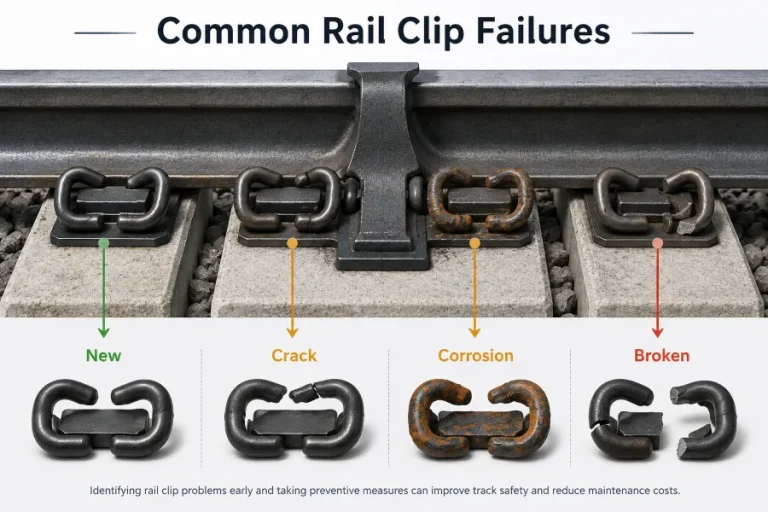
The fastening system matters as well. 탄성 레일 클립 provide rail restraint, while 레일 패드 influence the stiffness of the rail-seat area and the way loads are transferred into the sleeper.
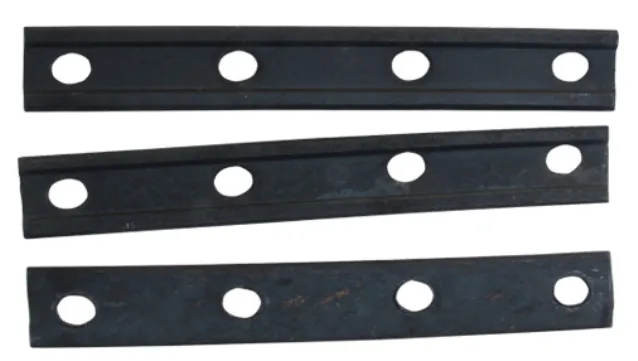
At rail joints, 생선 접시 provide a mechanical connection where continuous welded rail is not used or where a joint is otherwise required.
The practical lesson is simple: upgrading the rail alone does not automatically solve a track problem.
A premium rail running with a poorly matched wheel profile, unsuitable fastening stiffness or inadequate maintenance will not necessarily deliver the service life expected from its material specification.
There is no single “best” rail steel grade.
R260 and U71Mn remain practical choices for many conventional applications. U75V provides a higher-strength microalloyed option, while R350HT and other heat-treated grades become more attractive when wear and heavy loading justify the additional cost. Alloy and bainitic grades are further options for particularly demanding conditions.
The right choice depends on what is happening on the track.
Axle load matters, but so do annual tonnage, 곡선 반지름, wheel condition, contact stress, 매끄럽게 하기, grinding and maintenance access. That is why a rail grade should be selected from actual operating conditions rather than from the hardness column of a material table alone.
When purchasing rail, ask for traceable heat-level test certificates, UT results and dimensional inspection data. For heat-treated grades, look beyond the surface hardness and check the hardness profile. And if the rail will be welded, make sure the welding procedure is qualified for the grade you are buying.
If you are sourcing rail together with 철도 바퀴, rail steel pads, elastic rail clips or other track components, the same engineering approach should be applied across the complete wheel-rail system.
뤄양포뇨중공업(Luoyang Fonyo Heavy Industries), 주식회사. supplies 철도 바퀴 and track components with material certification, inspection documentation and OEM support. If you have a rail profile, annual tonnage, axle load or application requirement, you can contact our 엔지니어링 팀 to discuss the appropriate specification.
Technical note: Grade designations, chemical limits and mechanical requirements can vary by standard revision and product specification. Always verify the latest applicable standard and project specification before procurement.
U71Mn is a conventional carbon-manganese rail grade, while U75V uses vanadium microalloying. U71Mn is commonly specified with around 0.65–0.77% carbon and 1.10–1.40% manganese, while U75V contains roughly 0.67–0.77% carbon and 0.04–0.12% vanadium.
U75V has a higher typical minimum tensile strength and hardness range. Whether that difference is useful depends on the operating conditions. It is not simply a matter of choosing the grade with the higher number.
Sometimes they are, and sometimes they are not.
On a heavily loaded curve with significant rail wear, the additional hardness of a grade such as R350HT can make a meaningful difference to maintenance requirements. On a lightly loaded or relatively low-wear section, the additional cost may not provide the same benefit.
The best way to make the decision is to compare actual wear and maintenance data from the line.
예. It is common in some applications to use harder rail in curves and conventional grades on tangent sections.
The grades should not simply be mixed without checking welding compatibility, transition requirements and the applicable railway standard. Maintenance planning should also account for different wear rates.
At a minimum, check the required material certificate, 화학 성분, 기계적 성질, heat number and traceability. 프로젝트에 따라, you may also need UT reports, dimensional inspection records and hardness data.
For heat-treated rail, a hardness-depth profile is particularly useful. If the rail will be welded on site, confirm that a qualified welding procedure is available for the selected grade.
Because the loading conditions are fundamentally different.
Structural steel is not designed for repeated wheel-rail rolling contact. Rail steel has a higher carbon content and a controlled microstructure designed to provide the hardness, wear resistance and fatigue performance required for railway service.
Using a material simply because its tensile strength looks acceptable on a datasheet ignores the contact conditions that actually govern rail performance.
아니요.
Hardness is important, but rail life also depends on wheel hardness and profile, 축중, traffic tonnage, 곡선 반지름, contact stress, 매끄럽게 하기, grinding and other maintenance conditions.
A harder rail can be the right solution for a high-wear location, but it should not be treated as a universal upgrade for every section of track.