Scansiona il codice WeChat per contattarci
Scansiona il codice WeChat per contattarci
Sentiti libero di inviarci un'e-mail e ti risponderemo il prima possibile.
Creare il futuro con cuore e anima


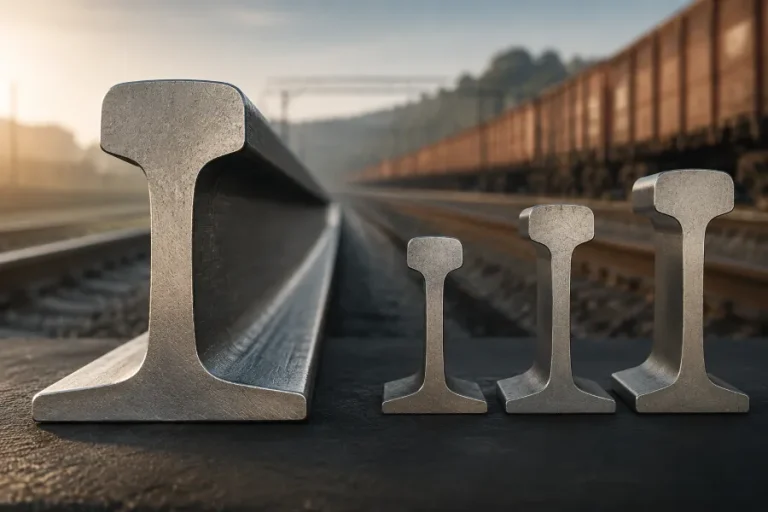
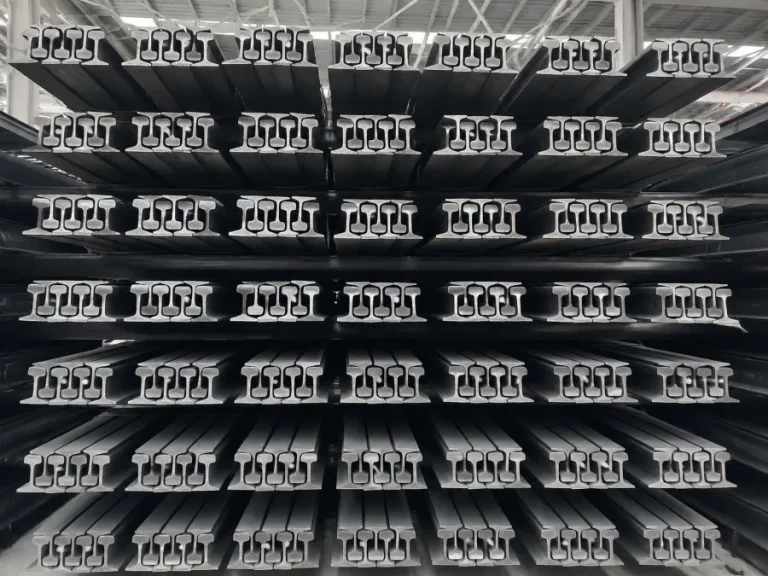
Quando la gente compra la ferrovia, le prime domande riguardano solitamente il profilo, peso e lunghezza. Quale sezione è richiesta? Quanti chilogrammi al metro? Quale classe di rettilineità richiede il progetto?? Le qualità dell'acciaio ferroviario spesso vengono fornite successivamente.
Questo è comprensibile. Codici come R260, R350HT, U71Mn e U75V non significano molto finché non devi sceglierne uno per una linea vera e propria. A quel punto, la pendenza diventa importante perché influisce sull'usura della rotaia, come si comporta sotto carichi ripetuti sulle ruote, come può essere saldato e, in definitiva, quanto spesso la pista necessita di manutenzione.
Per scopi pratici di ingegneria, l'acciaio per rotaie può essere raggruppato in quattro grandi categorie: gradi di carbonio-manganese come R260, U71Mn e 900A; gradi microlegati come U75V; gradi trattati termicamente e temprati come R350HT e AREMA HH; e gradi legati o bainitici per piste più impegnative.
Questa è una classificazione operativa piuttosto che una tassonomia ufficiale. Il voto esatto, I requisiti chimici e meccanici devono essere sempre confrontati con quelli applicabili IN 13674-1 E GB/T 2585-2021 requisiti.
Questa guida esamina le qualità ferroviarie comunemente riscontrate nelle gare d'appalto e nei progetti ferroviari, con particolare attenzione all'R260, R350HT, U71Mn e U75V. Ancora più importante, spiega cosa conta realmente quando si sceglie tra di loro.
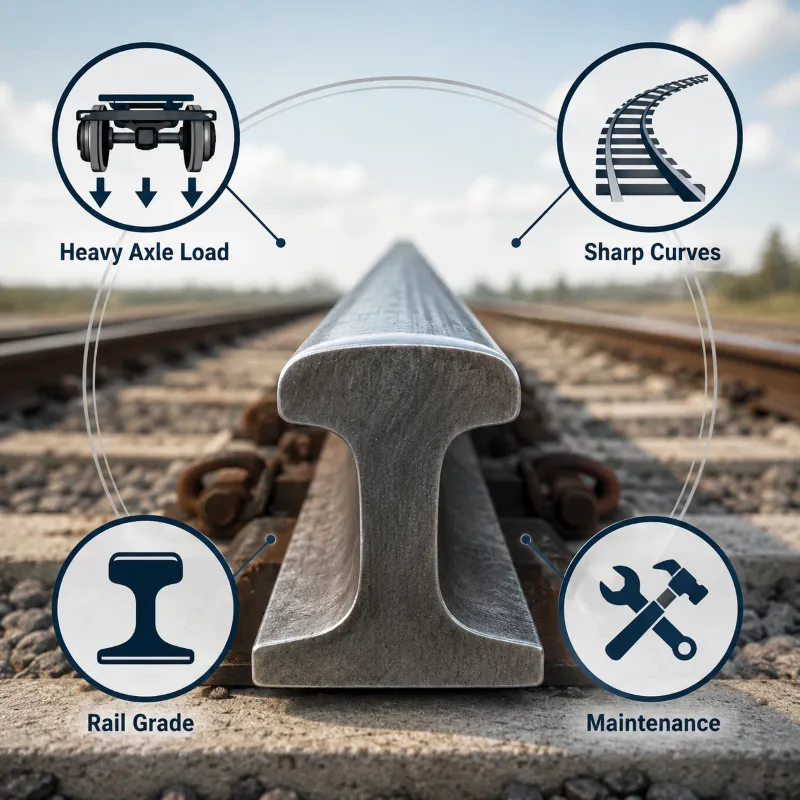
Una rotaia non trasporta un carico una volta e poi ritorna alla sua condizione originale. La stessa sezione di rotaia è sottoposta ripetutamente a carichi di ruote per tutta la sua vita utile.
Questo contatto ripetuto è ciò che rende l’acciaio ferroviario diverso dal normale acciaio strutturale.
Acciaio strutturale utilizzato per le travi, piastre e altri componenti costruttivi sono generalmente progettati in base alla resistenza, duttilità e saldabilità nelle condizioni di carico previste. Le ferrovie hanno un altro problema da risolvere: la piccola area di contatto tra ruota e rotaia è soggetta a ripetute forze di rotolamento e scorrimento.
Questo è il motivo per cui l’acciaio ferroviario contiene molto più carbonio rispetto al tipico acciaio strutturale. Una linea ferroviaria principale convenzionale può contenere circa 0.62 A 0.80% carbonio, mentre gli acciai strutturali comuni sono spesso nel 0.12 A 0.25% allineare.
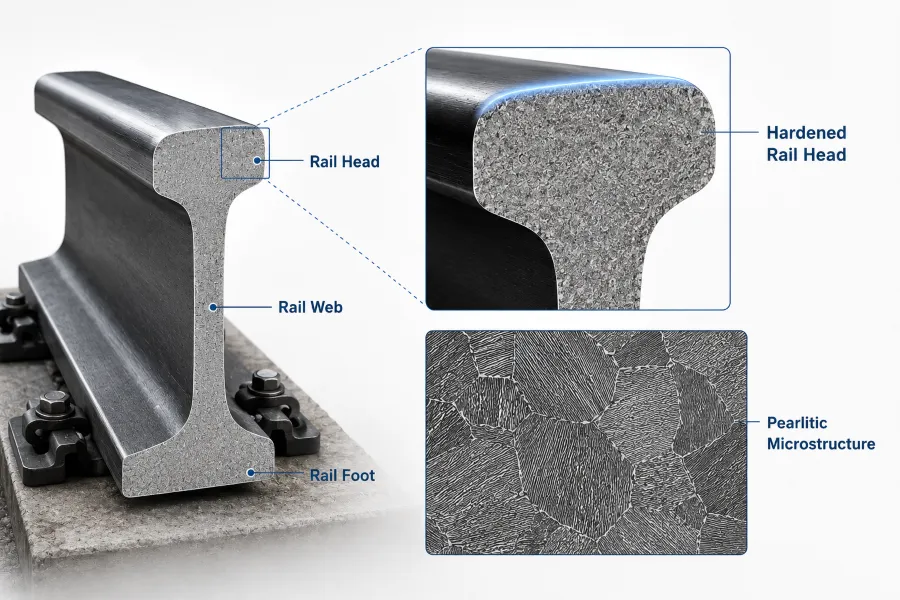
Con il giusto processo di laminazione e raffreddamento, l'acciaio per rotaie ad alto tenore di carbonio sviluppa una microstruttura prevalentemente perlitica. La disposizione fine di ferrite e cementite fornisce un utile equilibrio tra durezza, resistenza all'usura e tenacità.
I numeri danno una rapida idea della differenza:
L’ultimo punto è quello che conta di più in pista. Una rotaia deve resistere all'usura, deformazione plastica e fatica da contatto volvente su un numero molto elevato di cicli di carico. La qualità dell'acciaio è quindi parte della progettazione del binario, non semplicemente una designazione materiale.
La ruota deve essere considerata allo stesso tempo. Il materiale e il profilo della ruota influiscono sulla zona di contatto e sulle sollecitazioni trasferite sulla rotaia. In altre parole, una qualità ferroviaria non può essere valutata completamente da sola. Scopri perché il materiale e il profilo della ruota sono importanti per l'altra metà della coppia di contatto ruota-rotaia.
Non esiste un unico sistema di classificazione che copra tutti gli standard ferroviari esattamente allo stesso modo. Per lavori pratici di ingegneria, Tuttavia, quattro gruppi sono utili: rotaia in carbonio-manganese, rotaia microlegata, binario trattato termicamente, e rotaia in lega o bainitica.
La differenza importante tra questi gruppi non è semplicemente la composizione chimica. Il percorso di produzione e la microstruttura risultante possono cambiare il modo in cui la stessa chimica di base dell'acciaio si comporta in pista.
I gradi di carbonio-manganese rimangono ampiamente utilizzati perché forniscono un pratico equilibrio di resistenza, resistenza all'usura, saldabilità e costo.
R260 secondo EN 13674-1 è un grado europeo familiare, con approssimativamente 880 Resistenza alla trazione minima MPa e intervallo di durezza di circa 260–300 HB. È comunemente considerato per le applicazioni convenzionali sulla linea principale e sul traffico misto.
U71Mn sotto GB/T 2585 è un altro grado di carbonio-manganese ampiamente diffuso. La sua gamma di manganese è superiore a quella di R260, ed è comunemente associato a 50 kg/m e 60 kg/m rotaia nelle specifiche cinesi.
900A è una designazione di grado precedente che può ancora apparire nelle gare d'appalto ferroviarie e nei documenti tecnici. Ha caratteristiche di resistenza e durezza sostanzialmente simili ai gradi convenzionali come R260, sebbene i requisiti esatti dipendano dalle specifiche applicabili.
Grado AREMA 260 è un'altra opzione convenzionale utilizzata nelle specifiche nordamericane, con una resistenza alla trazione minima intorno 980 MPa e durezza intorno 300 HB.
Il punto importante è che queste qualità non sono automaticamente rotaie a “basse prestazioni”.. Se la linea ha traffico moderato, carichi sugli assi adeguati e nessun grave problema di usura, potrebbe esserci poca giustificazione ingegneristica per pagare un grado premium trattato termicamente.
La microlega adotta un approccio leggermente diverso.
Piccole aggiunte di elementi come il vanadio possono affinare la microstruttura e migliorare la resistenza senza fare affidamento interamente su un contenuto di carbonio più elevato o su un trattamento separato di indurimento della testa.
U75V è un buon esempio. Sotto GB/T 2585, contiene vanadio nella gamma delle microleghe e ha approssimativamente 980 Resistenza alla trazione minima MPa con durezza intorno a 280–320 HB. Viene utilizzato laddove sono richieste maggiore robustezza e resistenza alla fatica rispetto a quanto può fornire un grado convenzionale di carbonio-manganese.
Un altro esempio è 900ACrV, una variante al cromo-vanadio disponibile presso alcuni produttori europei. La sua chimica e le sue proprietà esatte dipendono dalle specifiche del produttore, ma si colloca nella gamma di prestazioni più elevate tra i tradizionali binari in carbonio e i gradi completamente trattati termicamente.
Per questi binari, il motivo dell'aggiornamento dovrebbe derivare dalle condizioni operative. Traffico più elevato, curve impegnative o un problema di usura esistente possono giustificare prestazioni aggiuntive. Il grado non dovrebbe essere selezionato semplicemente perché la sua scheda tecnica contiene un numero di resistenza più elevato.
Le assegnazioni di percorsi specifici sono decisioni di progetto prese dagli operatori ferroviari e dai proprietari dell'infrastruttura. Una qualità non dovrebbe pertanto essere associata a una particolare tratta ad alta velocità o linea principale a meno che tale applicazione non sia confermata dalla pertinente documentazione tecnica.
La rotaia trattata termicamente cambia la discussione perché il processo di produzione diventa importante quanto la chimica.
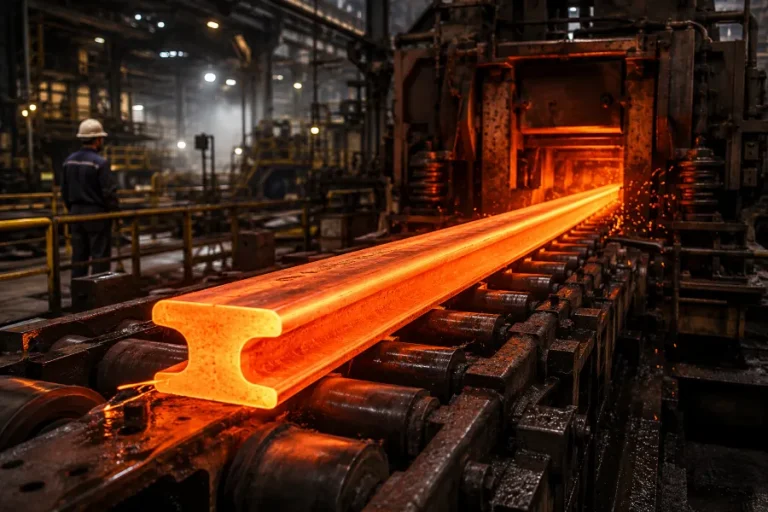
Dopo aver rotolato, il raffreddamento accelerato e controllato può affinare la struttura perlitica e aumentare la durezza della testa della rotaia. Il risultato è una superficie di scorrimento più dura pur mantenendo le proprietà richieste per il resto della sezione della rotaia.
R350HT secondo EN 13674-1 è un esempio familiare. Ha più o meno 1175 MPa minimum tensile strength and a hardness range around 350–390 HB.
This makes it attractive for sections where rail wear is a persistent problem, particularly high-wear curves and heavy-haul applications.
R350LHT is another heat-treated grade with a small chromium addition. AREMA HH represents the high-hardness approach used in North American specifications, with hardness typically around 388 HB or above depending on the specific product.
There is an important practical point here: a harder rail is not automatically the better rail for every location.
If a conventional grade is already giving acceptable wear life on tangent track, upgrading the whole line to a premium grade may add cost without solving a real problem. Heat-treated rail makes the most sense when the operating conditions justify it.
When conventional pearlitic rail is no longer enough, manufacturers can use alloying and different cooling strategies to push the performance further.
Cromo, molybdenum, nichel, boron and other alloying elements can be used depending on the grade and manufacturing route. Some of these steels are designed to develop bainitic microstructures, which can provide a useful combination of strength, hardness and fracture toughness.
Examples include BH Rail, R370CrHT and U78CrV, although their exact requirements depend on the relevant standard and manufacturer specification.
These grades are normally considered for demanding conditions such as small-radius curves, very high axle loads, severe wear or documented rolling contact fatigue.
They also come with a trade-off. The material cost is higher, welding becomes more specialized, and the benefit needs to be demonstrated by the actual track conditions.
For a rail buyer, that means the question should not simply be “What is the hardest grade available?"
A better question is:
What degradation mechanism are we trying to control?
The following comparison gives a practical starting point for four grades commonly encountered in railway specifications.
The values below are typical published values. Always confirm the current standard revision and the mill certificate for the actual delivery.
| Grado | Standard | Carbonio (%) | Manganese (%) | Key Alloying | Resistenza alla trazione (MPa, min) | Durezza (HB) | Manufacturing Route |
|---|---|---|---|---|---|---|---|
| R260 | IN 13674-1 | 0.62–0.80 | 0.70–1.20 | None | 880 | 260–300 | As rolled |
| R350HT | IN 13674-1 | 0.72–0.80 | 0.70–1.20 | Cr ≤ 0.15 | 1175 | 350–390 | Heat treated |
| U71Mn | GB/T 2585 | 0.65–0.77 | 1.10–1.40 | None | 880 | 260–300 | As rolled |
| U75V | GB/T 2585 | 0.67–0.77 | 0.70–1.00 | V 0.04–0.12 | 980 | 280–320 | Microalloyed / as rolled |
One point about the names is worth clearing up. In grades such as R260 and R350HT, the number is closely associated with the specified hardness class. It does not mean that every section of rail will have exactly that hardness. R260, Per esempio, is specified within a hardness range of roughly 260–300 HB, while R350HT is around 350–390 HB.
The table also cannot tell you which grade is correct for a particular railway. That decision comes from the operating conditions.
For a closer comparison, see our separate guides on R260 vs R350HT and U71Mn vs U75V.
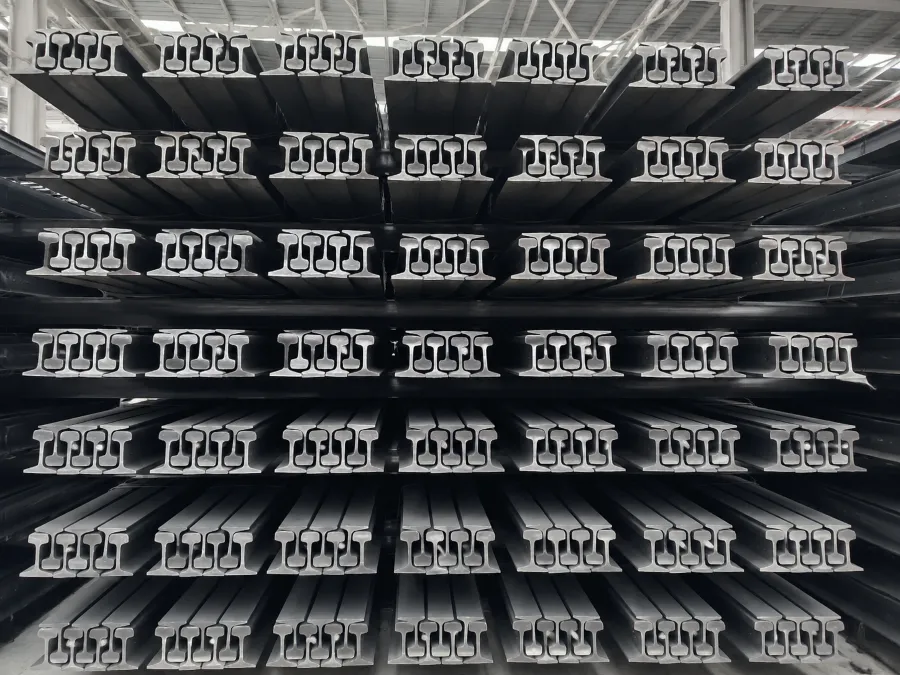
This is where rail steel selection becomes an engineering problem rather than a catalogue comparison.
I would not start by asking which grade has the highest tensile strength. I would start by asking what is actually damaging the rail.
Is the rail wearing at the gauge corner? Is rolling contact fatigue appearing on the head? Is plastic flow becoming a problem under high axle loads? Is the rail being ground frequently? Is lubrication effective on the curves?
Those questions tell you much more than a single hardness number.
The main factors to review are:
Higher axle loads increase the forces acting at the wheel-rail contact and can accelerate wear and plastic deformation.
As a rough starting point:
These are not design limits. Two railways with the same axle load can need different rail grades because their curve radii, annual tonnage, wheel condition and maintenance practices are different.
Curve radius is one of the factors that can turn an otherwise acceptable rail grade into a maintenance problem.
On tangent track, wheel-rail contact is relatively stable. On a tight curve, the gauge corner sees greater lateral loading and the contact conditions become more severe. Wear and rolling contact fatigue can then develop much faster.
As a general guide, standard carbon-manganese grades often perform well on large-radius tangent and gentle curves. As the radius decreases and the wear problem becomes more pronounced, microalloyed or heat-treated grades may be considered. Very tight curves with heavy traffic can justify specialist alloy or bainitic grades.
There is no useful universal rule saying that a particular radius must use a particular steel grade. Traffic tonnage, wheel profile, lubrificazione, grinding and actual wear measurements all matter.
That is why I would treat curve radius as a reason to investigate an upgrade, not as an automatic grade-selection formula.
This is one of the easiest mistakes to make when comparing rail specifications.
A higher hardness number looks attractive on paper. But the wheel and rail work as a pair. The difference in hardness, the wheel profile, contact stress and maintenance regime all influence what happens at the contact patch.
There is also the question of cost.
If a standard rail is already delivering acceptable wear life on a lightly loaded tangent section, replacing it with a premium heat-treated grade may not produce a useful return. On a heavy-haul curve where rail wear is driving frequent grinding or replacement, the calculation can be completely different.
Per questo motivo, wear data is more useful than a generic claim about percentage life improvement. If possible, compare wear rates under operating conditions close to the actual line—for example, millimetres of wear per 100 MGT.
A rail specification is only as good as the product delivered against it.
When reviewing a rail supplier, I would not look at tensile strength alone. The first question is whether the material, test results and physical rail can all be traced back to the same production heat.
The MTC should identify the applicable standard, numero di calore, chemical composition and mechanical properties. Where EN 10204 Tipo 3.1 O 3.2 certification is required by the project, the certificate should match that requirement.
The important point is traceability. The heat number on the certificate should be consistent with the marking and documentation for the delivered rail.
For critical rail products, UT provides information about internal soundness.
The report should be traceable to the applicable acceptance criteria rather than simply saying “UT passed.” The actual standard and testing requirements should be clear.
Profilo della rotaia, rettilineità, surface condition and end tolerances should be checked against the specified rail section.
A rail can have the correct steel grade and still fail to meet the dimensional requirements of the project.
For heat-treated rail, hardness should not be treated as a single number taken from the surface.
A hardness traverse from the rail head toward the depth of the section can show whether the hardening profile is consistent with the specified grade.
This is one of the areas where the manufacturing process matters just as much as the final certificate value.
If the rails will be welded on site, confirm that the selected grade has a qualified welding procedure for the method being used, such as aluminothermic or flash-butt welding.
Do not assume that a welding procedure qualified for one rail grade can automatically be transferred to another grade.
Finalmente, check that the grade and rail profile are actually produced to the standard specified in the tender.
A supplier offering an “equivalent” grade may be technically reasonable in some projects, but equivalence should be established by the project specification or engineering authority—not assumed from a similar hardness or tensile-strength value.
There are some simple things worth checking before placing an order.
A price far below the market level for a specified grade should prompt questions about material, process and certification.
The rail should also have clear identification markings that allow the manufacturer, grade and production information to be traced.
Another thing I would look at is the MTC itself. If certificates from many different heats show exactly the same chemical and mechanical values with no normal production variation, it is worth asking for clarification.
These checks do not replace formal inspection, but they can reveal problems early.
SÌ. It is possible to use harder rail in high-wear curves and a conventional grade on tangent sections.
The important issue is not simply whether two grades can physically be connected. The welding procedure, transition requirements and maintenance strategy also have to be considered.
Where different grades are used on the same route, confirm the requirements against the applicable railway standard and qualified welding procedure. The maintenance team should also understand that different grades may wear at different rates.
A rail grade is only one part of the wheel-rail system.
The wheel matters because its material and profile determine the contact conditions at the rail head. A worn wheel profile can change the contact patch and increase local stress even if the rail grade itself is suitable.
This is why ruote ferroviarie should be considered together with the rail specification and operating conditions.
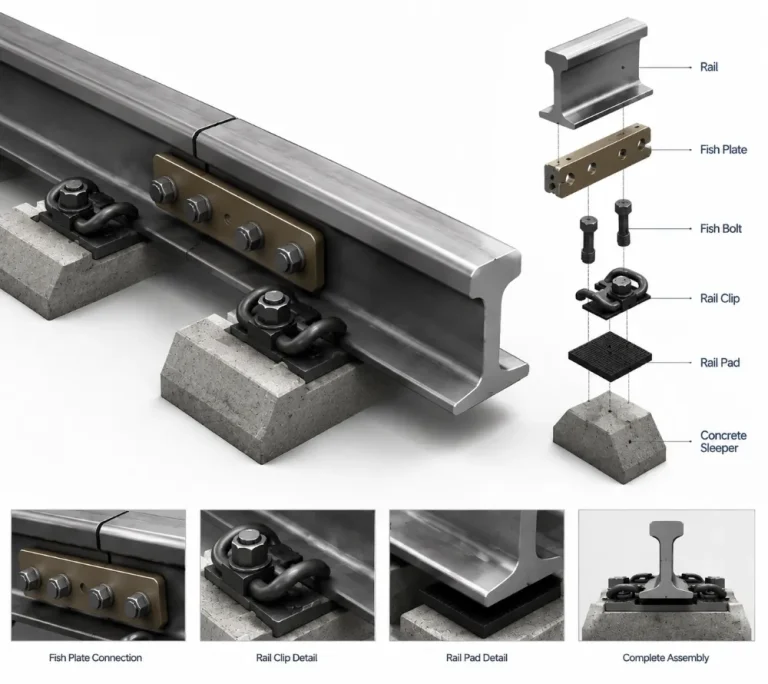
The fastening system matters as well. Elastic rail clips provide rail restraint, Mentre cuscinetti ferroviari influence the stiffness of the rail-seat area and the way loads are transferred into the sleeper.
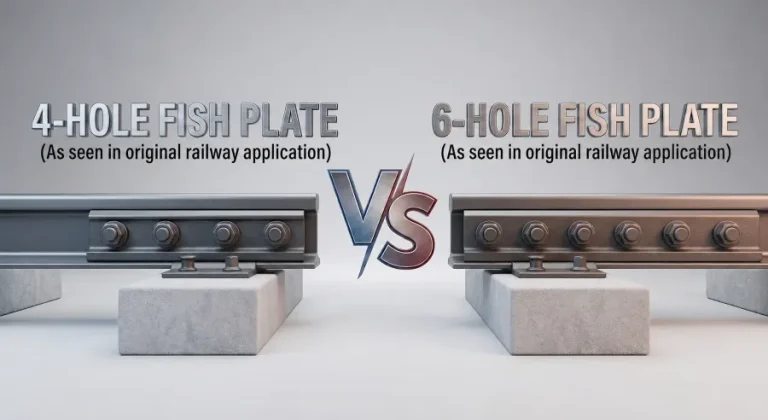
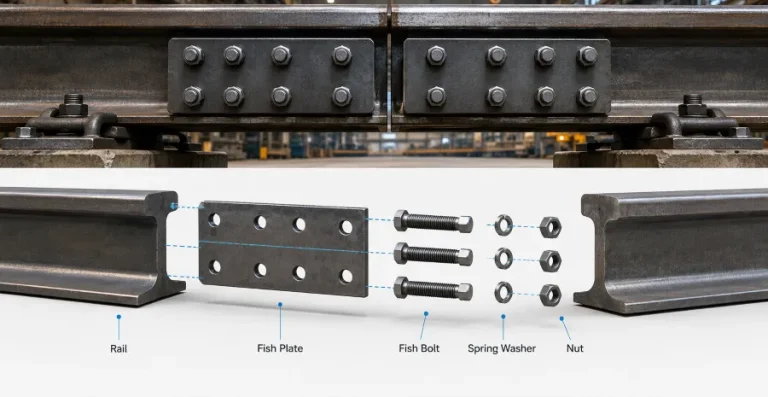
At rail joints, piatti di pesce provide a mechanical connection where continuous welded rail is not used or where a joint is otherwise required.
The practical lesson is simple: upgrading the rail alone does not automatically solve a track problem.
A premium rail running with a poorly matched wheel profile, unsuitable fastening stiffness or inadequate maintenance will not necessarily deliver the service life expected from its material specification.
There is no single “best” rail steel grade.
R260 and U71Mn remain practical choices for many conventional applications. U75V provides a higher-strength microalloyed option, while R350HT and other heat-treated grades become more attractive when wear and heavy loading justify the additional cost. Alloy and bainitic grades are further options for particularly demanding conditions.
The right choice depends on what is happening on the track.
Axle load matters, but so do annual tonnage, raggio della curva, wheel condition, contact stress, lubrificazione, grinding and maintenance access. That is why a rail grade should be selected from actual operating conditions rather than from the hardness column of a material table alone.
When purchasing rail, ask for traceable heat-level test certificates, UT results and dimensional inspection data. For heat-treated grades, look beyond the surface hardness and check the hardness profile. And if the rail will be welded, make sure the welding procedure is qualified for the grade you are buying.
If you are sourcing rail together with ruote ferroviarie, rail steel pads, elastic rail clips or other track components, the same engineering approach should be applied across the complete wheel-rail system.
Luoyang Fonyo Heavy Industries Co., Ltd. supplies ruote ferroviarie and track components with material certification, inspection documentation and OEM support. If you have a rail profile, annual tonnage, axle load or application requirement, you can contact our squadra di ingegneri to discuss the appropriate specification.
Nota tecnica: Grade designations, chemical limits and mechanical requirements can vary by standard revision and product specification. Always verify the latest applicable standard and project specification before procurement.
U71Mn is a conventional carbon-manganese rail grade, while U75V uses vanadium microalloying. U71Mn is commonly specified with around 0.65–0.77% carbon and 1.10–1.40% manganese, while U75V contains roughly 0.67–0.77% carbon and 0.04–0.12% vanadium.
U75V has a higher typical minimum tensile strength and hardness range. Whether that difference is useful depends on the operating conditions. It is not simply a matter of choosing the grade with the higher number.
Sometimes they are, and sometimes they are not.
On a heavily loaded curve with significant rail wear, the additional hardness of a grade such as R350HT can make a meaningful difference to maintenance requirements. On a lightly loaded or relatively low-wear section, the additional cost may not provide the same benefit.
The best way to make the decision is to compare actual wear and maintenance data from the line.
SÌ. It is common in some applications to use harder rail in curves and conventional grades on tangent sections.
The grades should not simply be mixed without checking welding compatibility, transition requirements and the applicable railway standard. La pianificazione della manutenzione dovrebbe tenere conto anche dei diversi tassi di usura.
Come minimo, verificare il certificato del materiale richiesto, composizione chimica, proprietà meccaniche, numero di calore e tracciabilità. A seconda del progetto, potresti anche aver bisogno di rapporti UT, registrazioni di ispezioni dimensionali e dati di durezza.
For heat-treated rail, un profilo di durezza-profondità è particolarmente utile. Se il binario verrà saldato in loco, confermare che è disponibile una procedura di saldatura qualificata per il grado selezionato.
Perché le condizioni di carico sono fondamentalmente diverse.
L'acciaio strutturale non è progettato per il contatto volvente ripetuto ruota-rotaia. L'acciaio per rotaie ha un contenuto di carbonio più elevato e una microstruttura controllata progettata per fornire la durezza, resistenza all'usura e prestazioni a fatica richieste per il servizio ferroviario.
L'utilizzo di un materiale semplicemente perché la sua resistenza alla trazione appare accettabile su una scheda tecnica ignora le condizioni di contatto che effettivamente governano le prestazioni ferroviarie.
NO.
La durezza è importante, ma la durata della rotaia dipende anche dalla durezza e dal profilo della ruota, carico sull'asse, tonnellaggio di traffico, raggio della curva, contact stress, lubrificazione, macinazione e altre condizioni di manutenzione.
Una guida più dura può essere la soluzione giusta per un luogo ad alta usura, ma non dovrebbe essere trattato come un aggiornamento universale per ogni sezione del binario.