Scansiona il codice WeChat per contattarci
Scansiona il codice WeChat per contattarci
Sentiti libero di inviarci un'e-mail e ti risponderemo il prima possibile.
Creare il futuro con cuore e anima


Cast steel bogie frames (telai laterali e imbottiture) dominate heavy-haul freight because they are economical in large volumes and proven over decades of service. Fabricated bogie frames dominate locomotives and high-speed trains because they are lighter, more precise and easier to design around traction equipment. The right choice depends on your duty, volume and standard system — not on which process is “better.”
Every procurement review for a new wagon, locomotive or coach eventually hits the same wall: two completely different ways of building the same thing, both with decades of proven service behind them. Cast steel side frames and bolsters on one side. Welded, fabricated bogie frames on the other. And the internet, predictably, is full of articles written by suppliers who only make one of them.
We make both. That’s not a marketing line — we cast side frames and bolsters, and we weld complete bogie frames, so we have no reason to talk you out of either process. The cast steel vs fabricated bogie frames question deserves a straight engineering answer, not a sales pitch. This guide is the comparison we’d give you in person: what each process actually is, where each one wins, and how to decide based on your railway project rather than on a supplier’s catalogue.
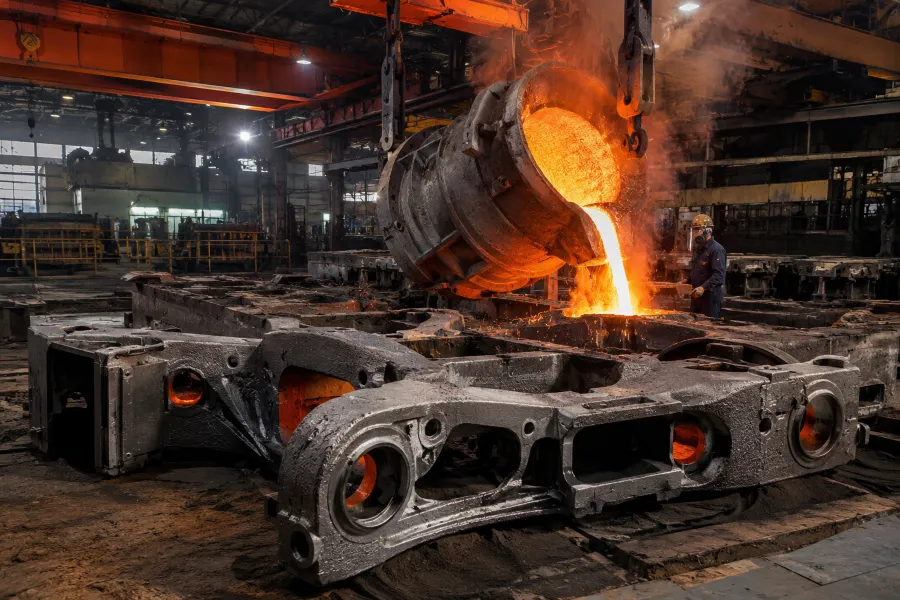
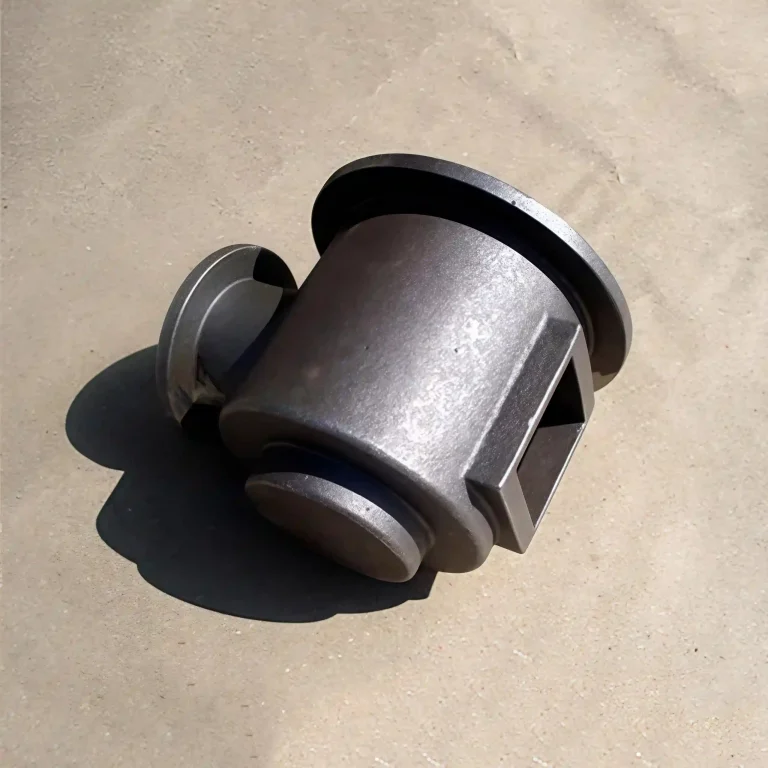
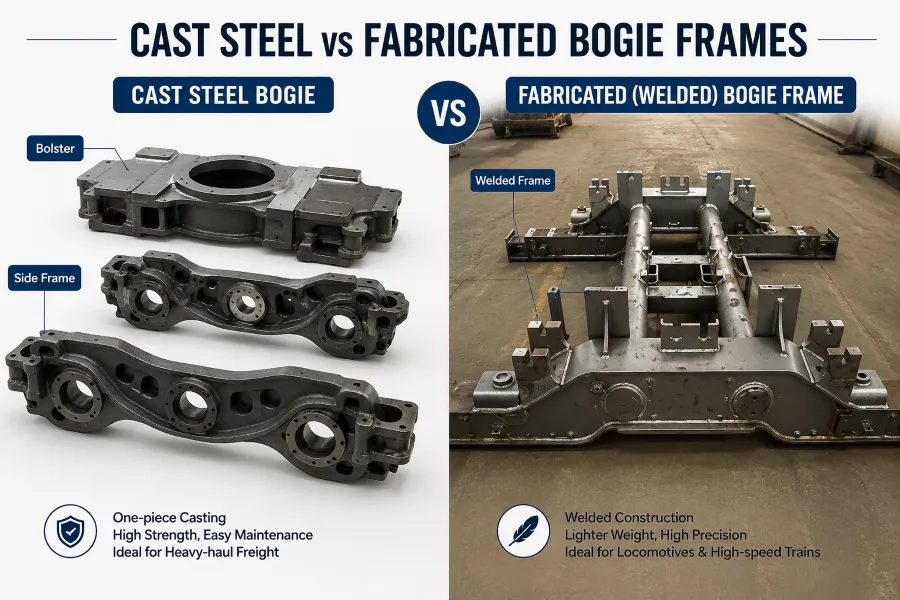
Start with the geometry, because the difference is visible. A cast steel bogie — the classic three-piece design — is two side frames and a bolster, each one poured as a single piece of steel. Molten metal fills a mould, solidifies, and out comes a component with curved spring seats, pedestal jaws and load shoulders already formed. No welds, no joints, no assembly. That’s why the three-piece bogie conquered global freight: simple, difficile, cheap to make in quantity, and cheap to maintain in the field.
A fabricated bogie frame is the opposite idea. Instead of one big casting, you start with steel plate. Laser or plasma cut it into shapes, bend it where it needs curves, weld the pieces together in a fixture, stress-relieve the assembly, then machine the critical surfaces. What you get is a box-section frame built exactly where the load paths are — thick plate where the stresses are high, thinner where they aren’t.
Both approaches work. They work differently, they fail differently, and they cost differently. That’s the whole argument, really.
Cast steel side frames and bolsters are the default answer for freight — the highest-volume of allrailway casting products — and the reasons are solid engineering ones, not nostalgia.
Volume economy. The mould is the expensive part. Once it exists, every casting after it gets cheaper. Pour a thousand side frames from one mould pattern and the unit cost drops to a fraction of what a welded frame would cost at the same volume. On a 5,000-wagon order, that arithmetic decides everything.
One-piece integrity. There are no welds to inspect, no heat-affected zones, no residual stress from welding. A good casting is a continuous structure, and its fatigue behaviour is set by the internal soundness of the steel — which is why the entire AAR M-211 standard for cast steel side frames and bolsters revolves around material grade, heat treatment and internal quality.
Field maintenance. Three-piece bogies are maintained the way they’re built: in pieces. A damaged side frame is swapped on its own, the bolster stays, and the wagon goes back to work. For a fleet operator, that simplicity is worth real money.
The limitations are just as real. Castings shrink and trap gas; internal defects are a fact of the process, which is why ultrasonic and radiographic testing are mandatory, not optional. The mould locks your design in — iterate after production starts and you pay for new tooling. And in small volumes, the mould cost kills you. Cast one prototype side frame and it will cost several times what a welded one would.
I’ll add a personal note here. In my experience, the casting’s fatigue life is decided long before it reaches the foundry floor — by the mould design, the gating and the heat treatment cycle. A foundry that treats UT inspection as a formality will produce castings that pass certificates and fail in service. Ask for the probe records, not just the signed sheet.
Modern locomotives are why thefabricated bogie frame exists — and we’ve written about that shift separately. A high-power locomotive carries traction motors, riduttori, brake units and a mountain of auxiliary equipment — and the old bolster-type design simply cannot fit them. The welded frame is designed from the first line of CAD around the equipment it has to carry, and that single fact drove the industry’s shift.
Design freedom. No mould. You change the design, you change the CAD file. Plate thickness goes where the stress analysis says it should. Mounting points for motors, dampers and brake rigging are positioned precisely, not approximated by what a casting pattern will allow.
Precisione. This is the advantage that doesn’t get enough credit. A fabricated frame is machined after welding, so the finished dimensions are the machined ones. The frame’s accuracy directly controls wheel-rail geometry, and better geometry means less wheel and rail wear — the same battlefights from the track side. I’d rather pay for accuracy at the frame than for premature wheel turning later.
Peso. Designers can use thin plate in low-stress zones and thick plate where the load demands it. A welded frame is typically lighter than an equivalent casting, which matters for unsprung mass and ride quality at speed.
The price of all this is the weld. Every weld is a potential crack starter, every heat-affected zone is a metallurgical change, and the assembly carries residual stress until it’s stress-relieved. That’s why the European system built around EN 13749 (structural requirements for bogie frames) e EN 15085 (welding quality for railway vehicles) is so demanding: the process is only as good as the welding procedure, the welder’s qualification and the inspection. There are published studies showing all-welded side frames achieving significantly higher fatigue life than cast ones — and the reverse can be true with poor welding. The process doesn’t decide; the quality control does.

| Criterion | Acciaio fuso (telai laterali + rafforzare) | Fabricated (welded frame) |
| Processo di produzione | Mould pouring, near-net shape | Plate cutting, formando, saldatura, lavorazione |
| Tooling investment | Alto (mould/pattern) | Basso (no mould) |
| Volume economics | Best at high volume | Best at low to medium volume |
| Design flexibility | Limited by mould | Alto, CAD-driven |
| Precisione dimensionale | Bene, casting tolerances | Eccellente, machined after welding |
| Fatigue failure mode | Internal casting defects growing under load | Weld toe / heat-affected zone cracking |
| Key inspections | UT, radiography, heat treatment verification | Weld UT/MT, stress relief records, WPQR |
| Standard | AAR M-211 (NA freight) | IN 13749, IN 15085, UIC 615-4 |
| Applicazioni tipiche | Carri merci, trasporto pesante, bulk fleets | Locomotive, treni ad alta velocità, special vehicles |
Both columns are honest. Neither process is a shortcut — each one moves the engineering difficulty to a different place.
There’s no universal answer, and any supplier who gives you one without asking about your project is selling you their process. The cast steel vs fabricated bogie frames decision falls into place once you answer three questions.
What are you building? Freight wagons running heavy-haul corridors in the AAR or Chinese standard world? Cast steel three-piece bogies are the proven, economical answer, and interchangeability across a fleet is a genuine operational advantage. Locomotives or high-speed coaches? Fabricated frames, because the equipment layout and precision demand them. There’s a reason the same industry that casts freight bogies welds locomotive frames.
What’s your volume? Tooling economics are brutal below a few hundred units. If you’re talking about a prototype, a rebuild programme or a specialised vehicle in small series, a fabricated frame avoids the mould entirely and lets you iterate. If you’re building thousands, casting wins on unit cost.
What’s your maintenance philosophy? Three-piece cast bogies are maintained by component swap. Welded frames are maintained as structures — inspection-led, with weld repairs under controlled procedures. Both are valid; they require different workshop capabilities.
One more thing worth saying, because it’s the part most comparison articles skip: this is not a binary. Many operators run both. A freight fleet on cast bogies, a locomotive fleet on fabricated frames, and a maintenance regime that treats them differently. The question isn’t which process is superior. It’s which one fits the duty, the volume and the standards you actually work to.
A bogie frame is a safety-critical component bought on a certificate you can’t read and a report you won’t see. Change that. Whatever process you choose, the paperwork is where the quality lives.
Percast steel side frames and bolsters: ask for AAR M-211 conformity (or the equivalent national standard), material certificates with heat traceability, and — most important — the ultrasonic and radiographic test reports, not just the signed release. Ask how many castings per heat are tested, and what the rejection rate is. A supplier who doesn’t know their own rejection rate doesn’t know their process.
Perfabricated bogie frames: ask for EN 13749 structural verification, IN 15085 certification with the actual welding procedure qualification records (WPQR), the stress-relief heat treatment records, and weld UT/MT reports. Ask who holds the welder qualifications — the subcontractor’s name on a certificate tells you less than the welder’s own stamp on the work.
For both: third-party inspection, batch consistency data, and a clear answer on spare parts strategy. And ask to see fatigue test evidence. Ten million cycles in the lab doesn’t guarantee ten years in service, but no test data at all is a far worse sign.
A bogie frame looks like a simple structural part, and it is anything but. It carries the vehicle, guides theabsorbs the track and takes a fatigue beating measured in millions of cycles. Whether it’s cast or fabricated, its real quality is decided in the foundry or the welding bay — and verified in the inspection reports — long before it reaches your railway.
So choose by the numbers: duty, volume, standard, maintenance capability. Cast steel three-piece bogies for heavy-haul fleets in volume. Fabricated frames for locomotives, high-speed and specialised vehicles. And treat the inspection paperwork as part of the component, because it is.
AFONYO, we cast side frames and bolsters and we weld complete bogie frames, so our engineers don’t have a process to defend — they have a project to solve. Send us your specification or drawings, and we will review the duty, the volumes and the applicable standards, and come back with a technical assessment on which approach fits your railway project.
Cast steel bogie frames are the three-piece design: two side frames and a bolster, each poured as a single casting. Fabricated bogie frames are welded from steel plate into a one-piece box-section frame. Casting suits high-volume freight fleets; fabrication suits locomotives, high-speed trains and low-volume or custom projects.
Not inherently. A cast frame’s strength and fatigue life depend on internal soundness and heat treatment; a welded frame’s depend on welding quality and residual stress control. Both are capable of decades of service when made to their standards — AAR M-211 for castings, IN 13749 e EN 15085 for welded frames.
The three-piece cast bogie is cheap to produce in large volumes, simple to maintain by component replacement, and proven across the world’s freight networks for over a century. The mould cost is justified by fleet sizes that run into the thousands.
It depends on volume. Castings need expensive mould tooling, so they are economical at high volume. Fabricated frames have no mould cost and become competitive or cheaper at low and medium volumes, especially for prototypes and specialised vehicles.
Cast frames can be repaired by controlled weld build-up under strict procedures and re-inspection, but the repair must be approved by engineering and is limited by the original design life. Welded frames can have weld defects repaired and re-tested. In both cases, fatigue cracks in critical zones often mean replacement.