Escanea el código WeChat para contactarnos
Escanea el código WeChat para contactarnos
No dudes en enviarnos un correo electrónico y te responderemos lo antes posible.
Creando el futuro con corazón y alma


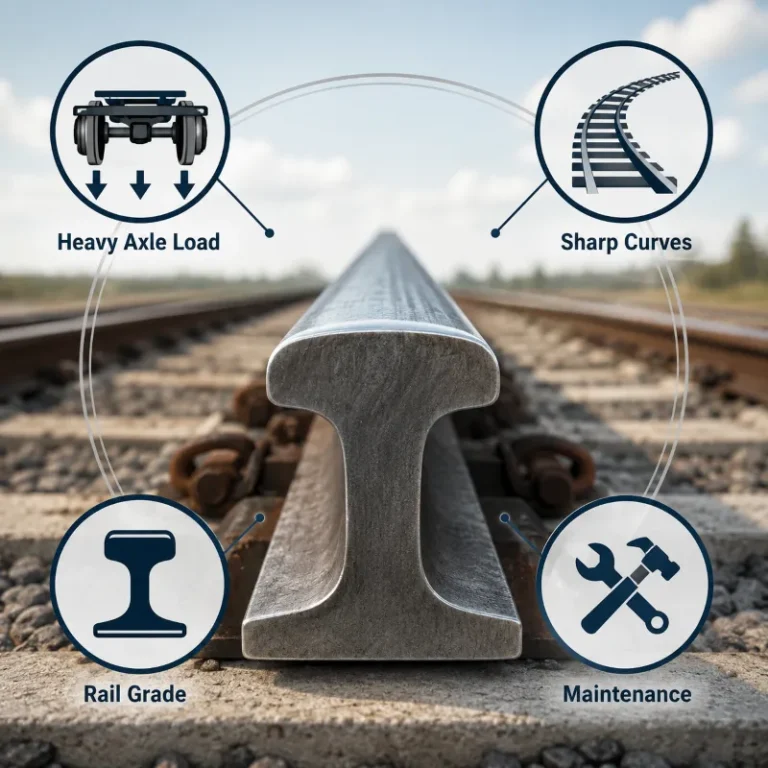
When people buy rail, the first questions are usually about profile, weight and length. Which section is required? How many kilograms per metre? What straightness class does the project call for? The rail steel grades often comes later.
That is understandable. Codes such as R260, R350HT, U71Mn and U75V do not mean much until you have to choose one for an actual line. At that point, the grade becomes important because it affects how the rail wears, how it behaves under repeated wheel loading, how it can be welded and, ultimately, how often the track needs maintenance.
For practical engineering purposes, rail steel can be grouped into four broad categories: carbon-manganese grades such as R260, U71Mn and 900A; microalloyed grades such as U75V; heat-treated and head-hardened grades such as R350HT and AREMA HH; and alloy or bainitic grades for more demanding track.
This is a working classification rather than an official taxonomy. The exact grade, chemistry and mechanical requirements should always be checked against the applicable EN 13674-1 y GB/T 2585-2021 requirements.
This guide looks at the rail grades commonly encountered in tenders and railway projects, with particular attention to R260, R350HT, U71Mn and U75V. Más importante aún, it explains what actually matters when choosing between them.
A rail does not carry a load once and then return to its original condition. The same section of rail sees wheel loads again and again throughout its service life.
That repeated contact is what makes rail steel different from ordinary structural steel.
Structural steel used for beams, plates and other construction components is generally designed around strength, ductility and weldability under its intended loading conditions. Rail has another problem to solve: the small contact area between the wheel and rail is subjected to repeated rolling and sliding forces.
This is why rail steel contains considerably more carbon than typical structural steel. A conventional mainline rail may contain roughly 0.62 a 0.80% carbón, while common structural steels are often in the 0.12 a 0.25% rango.
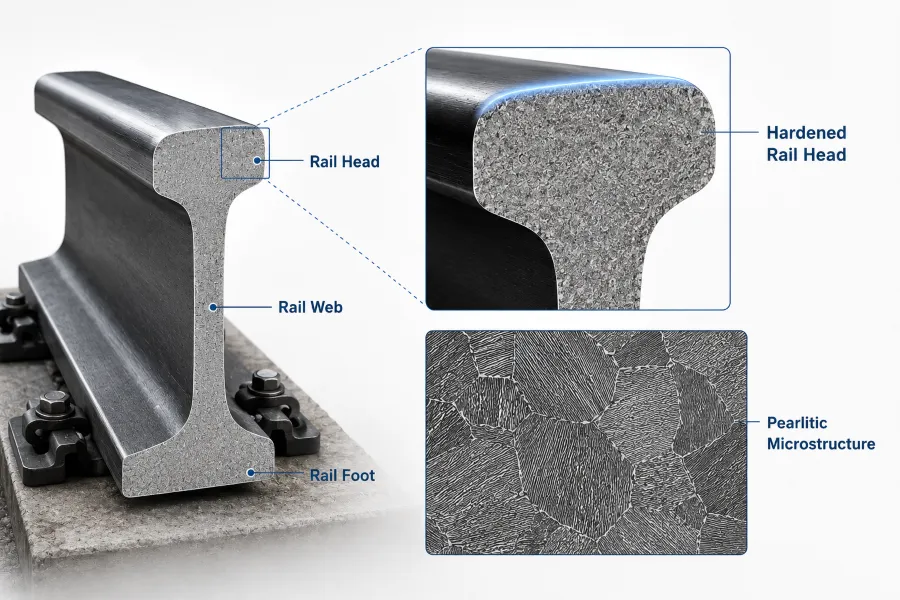
With the right rolling and cooling process, the higher-carbon rail steel develops a predominantly pearlitic microstructure. The fine arrangement of ferrite and cementite provides a useful balance between hardness, wear resistance and toughness.
The numbers give a quick idea of the difference:
The last point is the one that matters most on track. A rail has to resist wear, plastic deformation and rolling contact fatigue over a very large number of load cycles. The steel grade is therefore part of the track design, not simply a material designation.
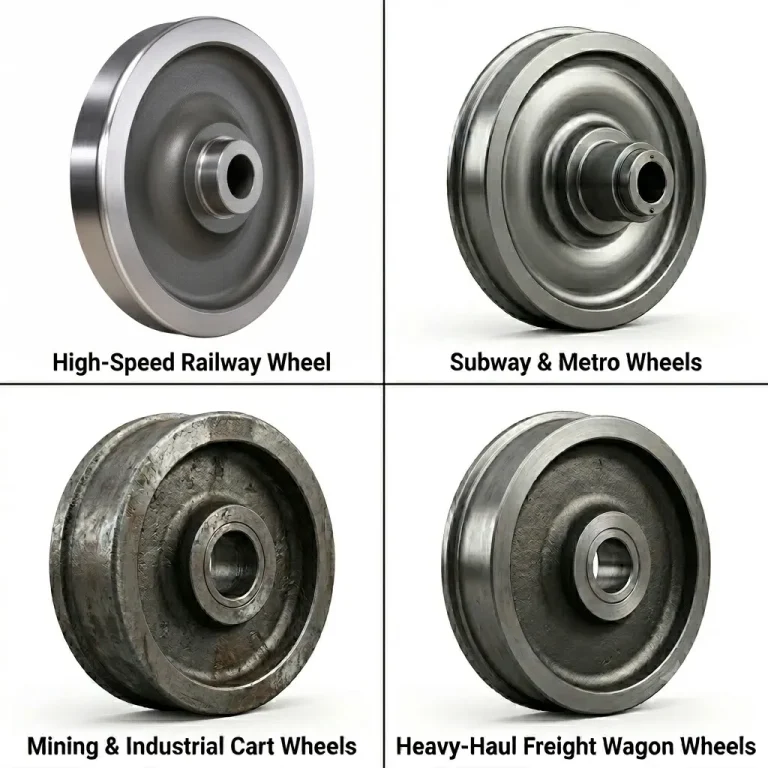
The wheel has to be considered at the same time. Wheel material and wheel profile affect the contact patch and the stresses transferred into the rail. En otras palabras, a rail grade cannot be evaluated completely on its own. See why wheel material and profile matter for the other half of the wheel-rail contact pair.
There is no single classification system that covers every rail standard in exactly the same way. For practical engineering work, sin embargo, four groups are useful: carbon-manganese rail, microalloyed rail, heat-treated rail, and alloy or bainitic rail.
The important difference between these groups is not simply the chemical composition. Manufacturing route and resulting microstructure can change the way the same basic steel chemistry performs on track.
Carbon-manganese grades remain widely used because they provide a practical balance of strength, resistencia al desgaste, weldability and cost.
R260 under EN 13674-1 is a familiar European grade, with roughly 880 MPa minimum tensile strength and a hardness range of about 260–300 HB. It is commonly considered for conventional mainline and mixed-traffic applications.
U71Mn under GB/T 2585 is another widely encountered carbon-manganese grade. Its manganese range is higher than that of R260, and it is commonly associated with 50 kg/m and 60 kg/m rail in Chinese specifications.
900A is an older grade designation that can still appear in rail tenders and technical documents. It has broadly similar strength and hardness characteristics to conventional grades such as R260, although the exact requirements depend on the applicable specification.
AREMA Grade 260 is another conventional option used in North American specifications, with minimum tensile strength around 980 MPa and hardness around 300 media pensión.
The important point is that these grades are not automatically “low performance” rails. If the line has moderate traffic, suitable axle loads and no severe wear problem, there may be little engineering justification for paying for a premium heat-treated grade.
Microalloying takes a slightly different approach.
Small additions of elements such as vanadium can refine the microstructure and improve strength without relying entirely on higher carbon content or a separate head-hardening treatment.
U75V is a good example. Under GB/T 2585, it contains vanadium in the microalloying range and has roughly 980 MPa minimum tensile strength with hardness around 280–320 HB. It is used where greater strength and fatigue resistance are required than a conventional carbon-manganese grade can provide.
Another example is 900ACrV, a chromium-vanadium variant available from some European producers. Its exact chemistry and properties depend on the producer’s specification, but it sits in the higher-performance range between conventional carbon rail and fully heat-treated grades.
For these rails, the reason for upgrading should come from the operating conditions. Higher traffic, demanding curves or an existing wear problem may justify the additional performance. The grade should not be selected simply because its specification sheet contains a higher strength number.
Specific route assignments are project decisions made by railway operators and infrastructure owners. A grade should therefore not be associated with a particular high-speed or mainline route unless that application is confirmed by the relevant engineering documentation.
Heat-treated rail changes the discussion because the manufacturing process becomes just as important as the chemistry.
After rolling, controlled accelerated cooling can refine the pearlitic structure and increase hardness in the rail head. The result is a harder running surface while maintaining the required properties through the rest of the rail section.
R350HT under EN 13674-1 is a familiar example. It has roughly 1175 MPa minimum tensile strength and a hardness range around 350–390 HB.
This makes it attractive for sections where rail wear is a persistent problem, particularly high-wear curves and heavy-haul applications.
R350LHT is another heat-treated grade with a small chromium addition. AREMA HH represents the high-hardness approach used in North American specifications, with hardness typically around 388 HB or above depending on the specific product.
There is an important practical point here: a harder rail is not automatically the better rail for every location.
If a conventional grade is already giving acceptable wear life on tangent track, upgrading the whole line to a premium grade may add cost without solving a real problem. Heat-treated rail makes the most sense when the operating conditions justify it.
When conventional pearlitic rail is no longer enough, manufacturers can use alloying and different cooling strategies to push the performance further.
Cromo, molybdenum, níquel, boron and other alloying elements can be used depending on the grade and manufacturing route. Some of these steels are designed to develop bainitic microstructures, which can provide a useful combination of strength, hardness and fracture toughness.
Examples include BH Rail, R370CrHT and U78CrV, although their exact requirements depend on the relevant standard and manufacturer specification.
These grades are normally considered for demanding conditions such as small-radius curves, very high axle loads, severe wear or documented rolling contact fatigue.
They also come with a trade-off. The material cost is higher, welding becomes more specialized, and the benefit needs to be demonstrated by the actual track conditions.
For a rail buyer, that means the question should not simply be “What is the hardest grade available?"
A better question is:
What degradation mechanism are we trying to control?
The following comparison gives a practical starting point for four grades commonly encountered in railway specifications.
The values below are typical published values. Always confirm the current standard revision and the mill certificate for the actual delivery.
| Calificación | Estándar | Carbón (%) | Manganeso (%) | Key Alloying | Resistencia a la tracción (MPa, min) | Dureza (media pensión) | Manufacturing Route |
|---|---|---|---|---|---|---|---|
| R260 | EN 13674-1 | 0.62–0.80 | 0.70–1.20 | None | 880 | 260–300 | As rolled |
| R350HT | EN 13674-1 | 0.72–0.80 | 0.70–1.20 | Cr ≤ 0.15 | 1175 | 350–390 | Heat treated |
| U71Mn | GB/T 2585 | 0.65–0.77 | 1.10–1.40 | None | 880 | 260–300 | As rolled |
| U75V | GB/T 2585 | 0.67–0.77 | 0.70–1.00 | V 0.04–0.12 | 980 | 280–320 | Microalloyed / as rolled |
One point about the names is worth clearing up. In grades such as R260 and R350HT, the number is closely associated with the specified hardness class. It does not mean that every section of rail will have exactly that hardness. R260, Por ejemplo, is specified within a hardness range of roughly 260–300 HB, while R350HT is around 350–390 HB.
The table also cannot tell you which grade is correct for a particular railway. That decision comes from the operating conditions.
For a closer comparison, see our separate guides on R260 vs R350HT and U71Mn vs U75V.
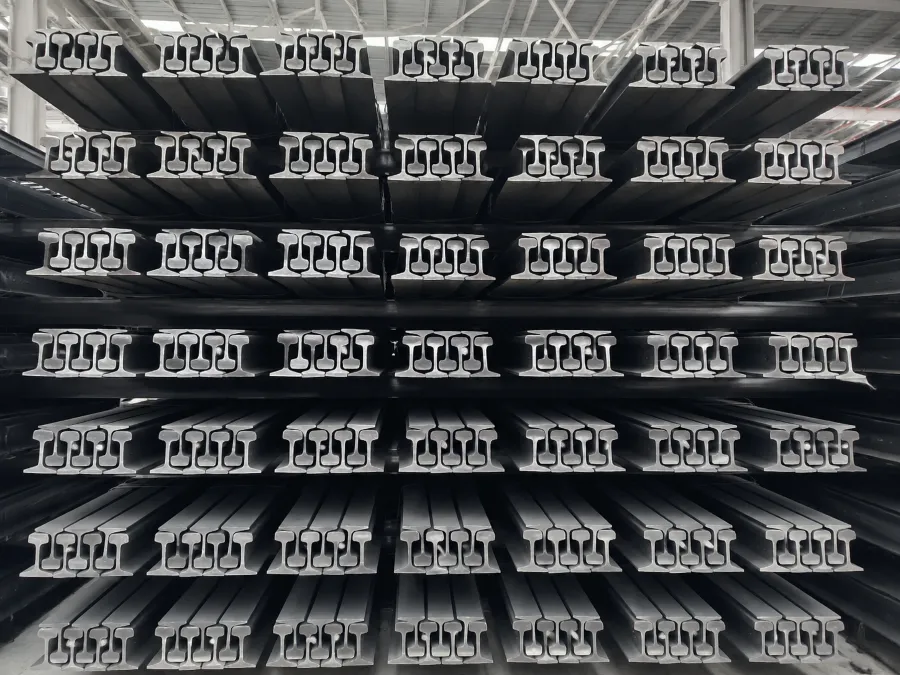
This is where rail steel selection becomes an engineering problem rather than a catalogue comparison.
I would not start by asking which grade has the highest tensile strength. I would start by asking what is actually damaging the rail.
Is the rail wearing at the gauge corner? Is rolling contact fatigue appearing on the head? Is plastic flow becoming a problem under high axle loads? Is the rail being ground frequently? Is lubrication effective on the curves?
Those questions tell you much more than a single hardness number.
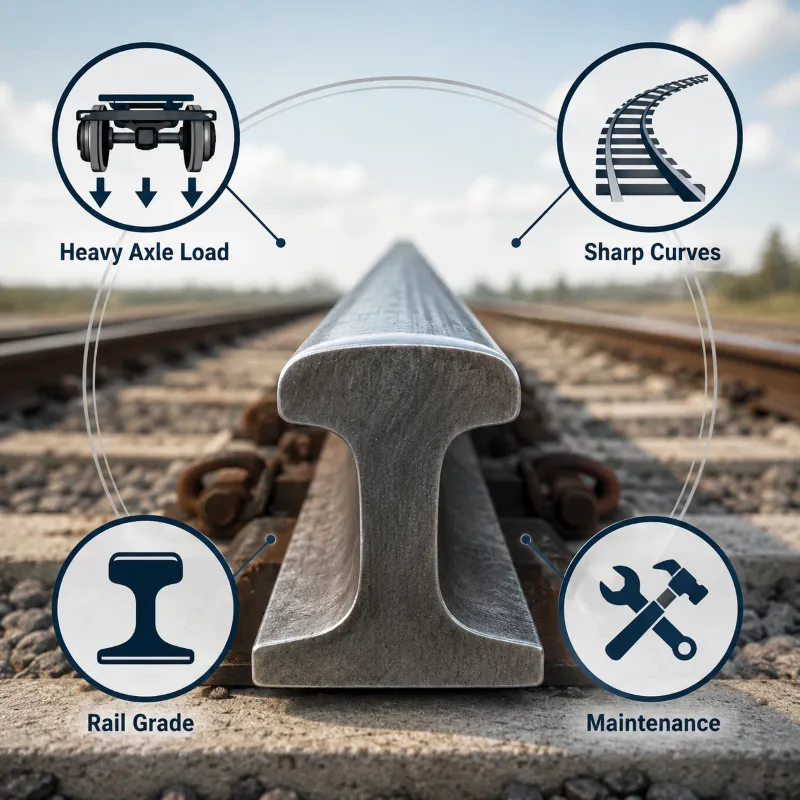
The main factors to review are:
Higher axle loads increase the forces acting at the wheel-rail contact and can accelerate wear and plastic deformation.
As a rough starting point:
These are not design limits. Two railways with the same axle load can need different rail grades because their curve radii, annual tonnage, wheel condition and maintenance practices are different.
Curve radius is one of the factors that can turn an otherwise acceptable rail grade into a maintenance problem.
On tangent track, wheel-rail contact is relatively stable. On a tight curve, the gauge corner sees greater lateral loading and the contact conditions become more severe. Wear and rolling contact fatigue can then develop much faster.
As a general guide, standard carbon-manganese grades often perform well on large-radius tangent and gentle curves. As the radius decreases and the wear problem becomes more pronounced, microalloyed or heat-treated grades may be considered. Very tight curves with heavy traffic can justify specialist alloy or bainitic grades.
There is no useful universal rule saying that a particular radius must use a particular steel grade. Traffic tonnage, wheel profile, lubricación, grinding and actual wear measurements all matter.
That is why I would treat curve radius as a reason to investigate an upgrade, not as an automatic grade-selection formula.
This is one of the easiest mistakes to make when comparing rail specifications.
A higher hardness number looks attractive on paper. But the wheel and rail work as a pair. The difference in hardness, the wheel profile, contact stress and maintenance regime all influence what happens at the contact patch.
There is also the question of cost.
If a standard rail is already delivering acceptable wear life on a lightly loaded tangent section, replacing it with a premium heat-treated grade may not produce a useful return. On a heavy-haul curve where rail wear is driving frequent grinding or replacement, the calculation can be completely different.
Por esa razón, wear data is more useful than a generic claim about percentage life improvement. If possible, compare wear rates under operating conditions close to the actual line—for example, millimetres of wear per 100 mgt.
A rail specification is only as good as the product delivered against it.
When reviewing a rail supplier, I would not look at tensile strength alone. The first question is whether the material, test results and physical rail can all be traced back to the same production heat.
The MTC should identify the applicable standard, número de calor, chemical composition and mechanical properties. Where EN 10204 Tipo 3.1 o 3.2 certification is required by the project, the certificate should match that requirement.
The important point is traceability. The heat number on the certificate should be consistent with the marking and documentation for the delivered rail.
For critical rail products, UT provides information about internal soundness.
The report should be traceable to the applicable acceptance criteria rather than simply saying “UT passed.” The actual standard and testing requirements should be clear.
Rail profile, straightness, surface condition and end tolerances should be checked against the specified rail section.
A rail can have the correct steel grade and still fail to meet the dimensional requirements of the project.
For heat-treated rail, hardness should not be treated as a single number taken from the surface.
A hardness traverse from the rail head toward the depth of the section can show whether the hardening profile is consistent with the specified grade.
This is one of the areas where the manufacturing process matters just as much as the final certificate value.
If the rails will be welded on site, confirm that the selected grade has a qualified welding procedure for the method being used, such as aluminothermic or flash-butt welding.
Do not assume that a welding procedure qualified for one rail grade can automatically be transferred to another grade.
Finalmente, check that the grade and rail profile are actually produced to the standard specified in the tender.
A supplier offering an “equivalent” grade may be technically reasonable in some projects, but equivalence should be established by the project specification or engineering authority—not assumed from a similar hardness or tensile-strength value.
There are some simple things worth checking before placing an order.
A price far below the market level for a specified grade should prompt questions about material, process and certification.
The rail should also have clear identification markings that allow the manufacturer, grade and production information to be traced.
Another thing I would look at is the MTC itself. If certificates from many different heats show exactly the same chemical and mechanical values with no normal production variation, it is worth asking for clarification.
These checks do not replace formal inspection, but they can reveal problems early.
Sí. It is possible to use harder rail in high-wear curves and a conventional grade on tangent sections.
The important issue is not simply whether two grades can physically be connected. The welding procedure, transition requirements and maintenance strategy also have to be considered.
Where different grades are used on the same route, confirm the requirements against the applicable railway standard and qualified welding procedure. The maintenance team should also understand that different grades may wear at different rates.
A rail grade is only one part of the wheel-rail system.
The wheel matters because its material and profile determine the contact conditions at the rail head. A worn wheel profile can change the contact patch and increase local stress even if the rail grade itself is suitable.
This is why ruedas de ferrocarril should be considered together with the rail specification and operating conditions.
The fastening system matters as well. Elastic rail clips provide rail restraint, mientras almohadillas de riel influence the stiffness of the rail-seat area and the way loads are transferred into the sleeper.
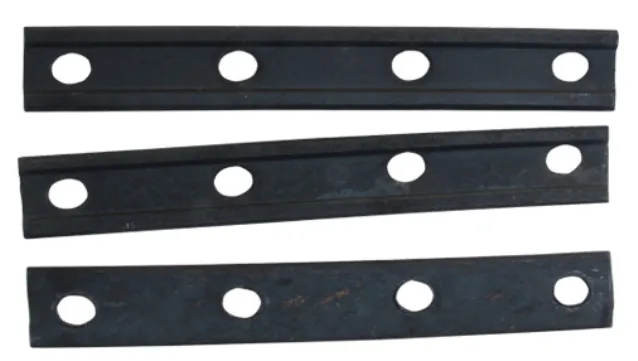
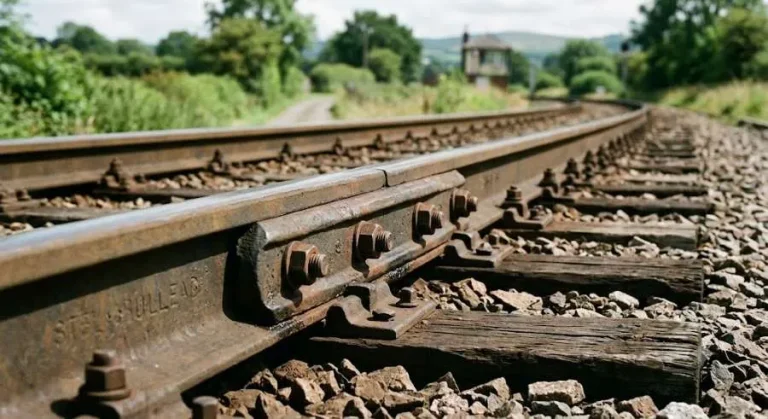
At rail joints, platos de pescado provide a mechanical connection where continuous welded rail is not used or where a joint is otherwise required.
The practical lesson is simple: upgrading the rail alone does not automatically solve a track problem.
A premium rail running with a poorly matched wheel profile, unsuitable fastening stiffness or inadequate maintenance will not necessarily deliver the service life expected from its material specification.
There is no single “best” rail steel grade.
R260 and U71Mn remain practical choices for many conventional applications. U75V provides a higher-strength microalloyed option, while R350HT and other heat-treated grades become more attractive when wear and heavy loading justify the additional cost. Alloy and bainitic grades are further options for particularly demanding conditions.
The right choice depends on what is happening on the track.
Axle load matters, but so do annual tonnage, radio de curva, wheel condition, contact stress, lubricación, grinding and maintenance access. That is why a rail grade should be selected from actual operating conditions rather than from the hardness column of a material table alone.
When purchasing rail, ask for traceable heat-level test certificates, UT results and dimensional inspection data. For heat-treated grades, look beyond the surface hardness and check the hardness profile. And if the rail will be welded, make sure the welding procedure is qualified for the grade you are buying.
If you are sourcing rail together with ruedas de ferrocarril, rail steel pads, elastic rail clips or other track components, the same engineering approach should be applied across the complete wheel-rail system.
Industrias pesadas Co. de Luoyang Fonyo., Limitado. supplies ruedas de ferrocarril and track components with material certification, inspection documentation and OEM support. If you have a rail profile, annual tonnage, axle load or application requirement, you can contact our equipo de ingeniería to discuss the appropriate specification.
Nota técnica: Grade designations, chemical limits and mechanical requirements can vary by standard revision and product specification. Always verify the latest applicable standard and project specification before procurement.
U71Mn is a conventional carbon-manganese rail grade, while U75V uses vanadium microalloying. U71Mn is commonly specified with around 0.65–0.77% carbon and 1.10–1.40% manganese, while U75V contains roughly 0.67–0.77% carbon and 0.04–0.12% vanadium.
U75V has a higher typical minimum tensile strength and hardness range. Whether that difference is useful depends on the operating conditions. It is not simply a matter of choosing the grade with the higher number.
Sometimes they are, and sometimes they are not.
On a heavily loaded curve with significant rail wear, the additional hardness of a grade such as R350HT can make a meaningful difference to maintenance requirements. On a lightly loaded or relatively low-wear section, the additional cost may not provide the same benefit.
The best way to make the decision is to compare actual wear and maintenance data from the line.
Sí. It is common in some applications to use harder rail in curves and conventional grades on tangent sections.
The grades should not simply be mixed without checking welding compatibility, transition requirements and the applicable railway standard. Maintenance planning should also account for different wear rates.
At a minimum, check the required material certificate, composición química, propiedades mecánicas, heat number and traceability. Depending on the project, you may also need UT reports, dimensional inspection records and hardness data.
For heat-treated rail, a hardness-depth profile is particularly useful. If the rail will be welded on site, confirm that a qualified welding procedure is available for the selected grade.
Because the loading conditions are fundamentally different.
Structural steel is not designed for repeated wheel-rail rolling contact. Rail steel has a higher carbon content and a controlled microstructure designed to provide the hardness, wear resistance and fatigue performance required for railway service.
Using a material simply because its tensile strength looks acceptable on a datasheet ignores the contact conditions that actually govern rail performance.
No.
Hardness is important, but rail life also depends on wheel hardness and profile, carga por eje, traffic tonnage, radio de curva, contact stress, lubricación, grinding and other maintenance conditions.
A harder rail can be the right solution for a high-wear location, but it should not be treated as a universal upgrade for every section of track.