WeChat コードをスキャンしてご連絡ください
WeChat コードをスキャンしてご連絡ください
お気軽にメールをお送りください。できるだけ早くご返信させていただきます.
心と魂で未来を創る


Railway bogies are among the most important structural systems in modern rail vehicles. 貨車で使用されるかどうか, 客車, 地下鉄の電車, または重量物機関車, 台車は車両の荷重をサポートします, ガイドホイールセット, absorb track irregularities, and ensure safe operation under demanding service conditions.
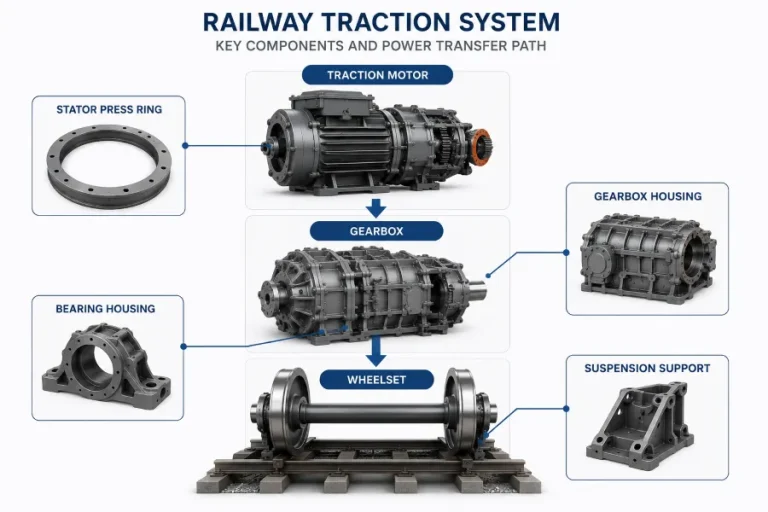
A railway bogie is more than just a wheel-supporting structure. It is an integrated system consisting of サイドフレーム, ボルスター, 軸箱ハウジング, サスペンションコンポーネント, braking elements, and various structural parts that work together to maintain stability, 乗り心地, 運用上の安全性.
Because these components operate under continuous dynamic loading, 衝撃力, and long-term fatigue cycles, their design, 材料の選択, 製造工程, and inspection procedures must meet strict engineering requirements.
This guide explains the key railway bogie and running gear components, the materials commonly used in their production, の casting manufacturing, 機械加工, and heat treatment processes behind their performance, そして 品質検査 control measures required to ensure reliability throughout their service life.
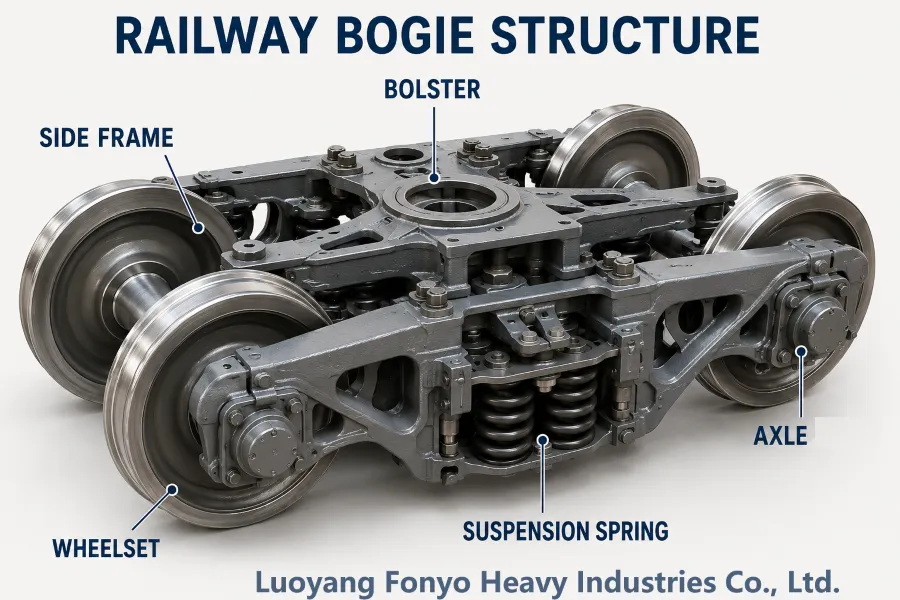
The bogie is the wheel-mounted chassis located beneath a rail vehicle. Its primary functions include supporting vehicle weight, transmitting traction and braking forces, guiding wheelsets along the track, and reducing vibration generated during operation.
Depending on the vehicle type, a bogie may include:
Suspension systems
Brake beams
Structural brackets and supports
一緒に, these components form the running gear system responsible for maintaining safety, 安定性, and ride comfort.
For a detailed overview of how these components interact, 見る 走行装置の鉄道部品がどのように安全を確保するか, 安定性, 滑らかさと.
Why Railway Bogie Structures Must Withstand Extreme Loads
Railway bogie components operate under some of the most demanding loading conditions in the rail industry. Unlike static structural components, bogie structures experience: Continuous cyclic loading, Dynamic impact forces, Braking and traction loads, Curving forces Wheel-rail interaction stresses, and Long-term fatigue loading
In heavy-haul freight operations, a single bogie may support axle loads exceeding dozens of tonnes while remaining reliable over millions of kilometers of service.
This is why structural integrity, 疲労耐性, and material toughness are critical engineering considerations.
Learn more in 鉄道台車構造物が極度の荷重を倒壊することなく耐えられる理由.
Material selection directly affects the strength, 靭性, 疲労寿命, 耐摩耗性, and service reliability of railway bogie components.
For critical load-bearing parts such as サイドフレーム, ボルスター, そして 軸箱ハウジング, medium-carbon cast steel remains one of the most widely used materials because it offers an excellent balance between strength and toughness.
Read more:
一部のアプリケーションでは, ductile iron may also be used for selected railway and industrial components where good castability, 振動減衰, and cost efficiency are required.
Further reading:
スチール vs. ダクタイル鋳鉄: 信頼性の高い鉄道部品のための適切な材料の選択
Material performance is also strongly influenced by microstructure, grain size, alloy composition, および熱処理工程, all of which play an important role in long-term fatigue resistance.
Large railway bogie castings require precise control throughout the manufacturing process.
Production typically involves:
Among these stages, casting quality is particularly important because internal defects can significantly affect structural performance and service life.
Related resources:
Modern foundries may utilize different molding technologies depending on casting size, complexity, と品質要件.
Additional resources:
ロストフォームキャスティングとは何か、鉄道および重機部品におけるその応用
鉄道用砂型鋳造: 水ガラス vs. Furan Resin – What Actually Works
High-quality castings alone cannot guarantee long-term railway performance.
Heat treatment is essential for achieving the mechanical properties required by railway standards and customer specifications.
Proper heat treatment helps improve: 強さ, toughness ductility, fatigue resistance and structural stability of casting bogie parts.
The final microstructure of the material plays a decisive role in crack resistance and long-term reliability.
Recommended reading:
1. Why Heat Treatment Is Essential for Reliable Railway Castings
2. 鉄道鋳物の熱処理: プロセス, Purpose and Quality Control
3. 工業用鋳物の内部: 鉄道鋳鋼においてオーステナイトと熱処理が重要な理由
5. 鉄道および風力発電用ダクタイル鋳鉄のフェライトとパーライトのバランスを理解する
After casting and heat treatment, railway bogie components must undergo precision machining to achieve the dimensional accuracy required for assembly and long-term operation.
Railway bogie components require tight tolerances to ensure proper fit and reliable load transfer. Because even small dimensional deviations will affect bearing performance, wheelset alignment, suspension behavior, as well as the fatigue life and maintenance intervals of railway parts.
大型構造部品用, machining quality is often as important as casting quality itself.
Further reading:
1. 鉄道部品の高精度加工: 品質と効率に対するエンジニアリングアプローチ
2. Why Precision Machining Matters for Railway Parts
3. 加工公差: 振れとは, Surface Finish and Specs Really Mean
Railway bogie components are classified as safety-critical parts because their failure can directly affect vehicle stability and operational safety.
結果として, manufacturers implement comprehensive inspection procedures throughout production, from raw material verification to final dimensional inspection.
非破壊検査は、コンポーネントに損傷を与えることなく内部および表面の欠陥を特定するのに役立ちます.
Common inspection methods include 超音波検査 (ユタ州), 磁粉試験 (MT) and Visual Testing (VT)
Each method is designed to detect different types of discontinuities and plays an important role in ensuring structural integrity.
Recommended reading:
Mechanical properties are closely linked to microstructure.
Manufacturers often perform metallographic analysis to verify grain structure, phase distribution, and heat treatment effectiveness.
Further reading:
微細構造から性能まで: 鉄道鋳物の品質評価における金属組織学的分析の応用
Modern railway components require strict dimensional control.
Coordinate measuring machines (三次元測定機), precision gauges, and advanced machining inspection systems are commonly used to verify critical dimensions and geometric tolerances before shipment.
Producing high-quality railway bogie components requires controlling numerous variables throughout casting, 熱処理, 機械加工, そして検査.
Several manufacturing challenges can directly affect structural reliability.
Large steel castings are particularly susceptible to shrinkage defects during solidification.
Proper feeding design and process control are necessary to achieve sound internal structures.
関連記事:
Rapid cooling, uneven section thickness, and improper heat treatment can generate residual stresses that increase cracking risk.
関連記事:
鉄道鋳物の熱応力と亀裂: 冷却制御により長期的な信頼性を確保する方法
Surface defects may affect inspection results, machining efficiency, and fatigue performance.
関連記事:
Successful bogie manufacturing depends on preventing defects rather than correcting them after production.
関連記事:
Railway bogie components must comply with strict technical standards that define material properties, 寸法公差, テスト要件, and acceptance criteria.
Depending on the target market and application, manufacturers may need to meet requirements from AAR規格, 標準, AREMA standards, TB/T規格, or some customer specific specifications.
These standards ensure that components can withstand demanding railway service conditions while maintaining safety and interchangeability.
Recommended reading:
1. 鉄道サイドフレームとボルスターの規格とエンジニアリング慣行
2. 英語の通訳, AREMA and GB Compliance Requirements for Railway Accessories Under Global Standards
A bogie is not just a supporting structure beneath a rail vehicle. It is a core system that directly affects safety, 安定性, 乗り心地, and long-term operating cost. From the frame and suspension to the braking interface and wheelset interaction, every component must work together under continuous dynamic loads and harsh service conditions.
で フォニョ, we focus on the manufacturing quality of key bogie components, including bogie frames, サイドフレーム, ボルスター, and other structural castings. With controlled materials, 精密加工, and strict inspection processes, we aim to ensure consistent performance under real railway operating environments.
If you are sourcing reliable bogie components or looking for a manufacturing partner for custom railway castings, feel free to contact our engineering team for technical discussion and quotation support.