Digitalize o código WeChat para entrar em contato conosco
Digitalize o código WeChat para entrar em contato conosco
Sinta-se à vontade para nos enviar um e-mail e responderemos o mais breve possível.
Criando o futuro com coração e alma


Railway bogies are among the most important structural systems in modern rail vehicles. Seja usado em vagões de carga, ônibus de passageiros, trens do metrô, ou locomotivas de transporte pesado, bogies suportam cargas de veículos, rodados guia, absorb track irregularities, and ensure safe operation under demanding service conditions.
A railway bogie is more than just a wheel-supporting structure. It is an integrated system consisting of molduras laterais, reforços, caixas de caixa de eixo, suspension components, braking elements, and various structural parts that work together to maintain stability, qualidade de passeio, e segurança operacional.
Because these components operate under continuous dynamic loading, forças de impacto, and long-term fatigue cycles, their design, seleção de materiais, processos de fabricação, and inspection procedures must meet strict engineering requirements.
This guide explains the key railway bogie and running gear components, the materials commonly used in their production, o casting manufacturing, usinagem, and heat treatment processes behind their performance, e o quality inspection control measures required to ensure reliability throughout their service life.
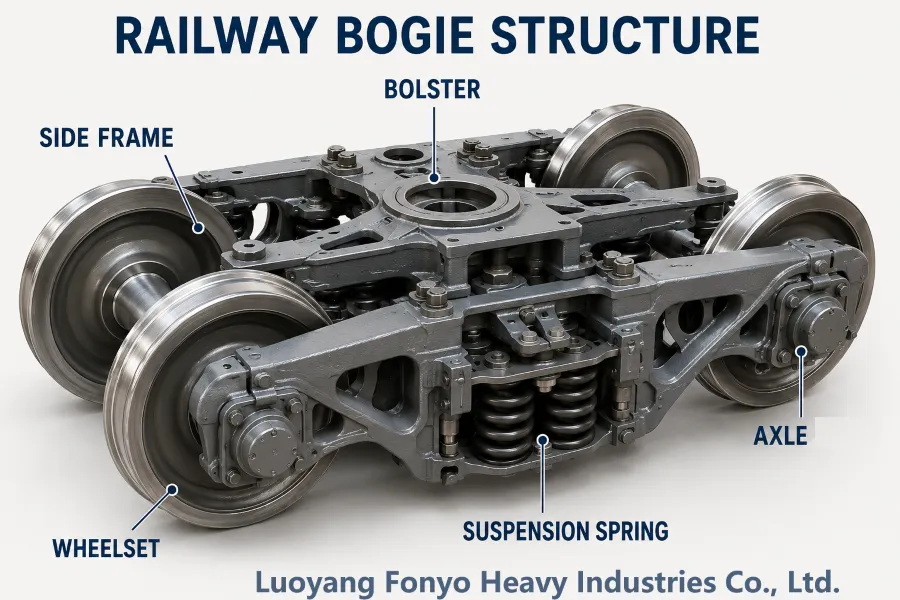
The bogie is the wheel-mounted chassis located beneath a rail vehicle. Its primary functions include supporting vehicle weight, transmitting traction and braking forces, guiding wheelsets along the track, and reducing vibration generated during operation.
Depending on the vehicle type, a bogie may include:
Suspension systems
Brake beams
Structural brackets and supports
Junto, these components form the running gear system responsible for maintaining safety, estabilidade, and ride comfort.
For a detailed overview of how these components interact, ver Como as peças ferroviárias nas engrenagens de rolamento garantem a segurança, Estabilidade, e Suavidade.
Why Railway Bogie Structures Must Withstand Extreme Loads
Componentes do bogie ferroviário operate under some of the most demanding loading conditions in the rail industry. Unlike static structural components, bogie structures experience: Continuous cyclic loading, Dynamic impact forces, Braking and traction loads, Curving forces Wheel-rail interaction stresses, and Long-term fatigue loading
In heavy-haul freight operations, a single bogie may support axle loads exceeding dozens of tonnes while remaining reliable over millions of kilometers of service.
This is why structural integrity, resistência à fadiga, and material toughness are critical engineering considerations.
Learn more in Por que as estruturas de bogies ferroviários podem suportar cargas extremas sem entrar em colapso.
Material selection directly affects the strength, resistência, vida de fadiga, resistência ao desgaste, and service reliability of railway bogie components.
For critical load-bearing parts such as molduras laterais, reforços, e caixas de caixa de eixo, medium-carbon cast steel remains one of the most widely used materials because it offers an excellent balance between strength and toughness.
Read more:
Onde o aço fundido de médio carbono é usado na indústria ferroviária?
Manganês em aço fundido ferroviário: Propriedades e função
Em algumas aplicações, ductile iron may also be used for selected railway and industrial components where good castability, amortecimento de vibrações, and cost efficiency are required.
Leitura adicional:
Fundições de ferro dúctil na indústria pesada: Vantagens e aplicações
Aço versus. Ferro Dúctil: Escolhendo os materiais certos para peças ferroviárias confiáveis
Material performance is also strongly influenced by microstructure, tamanho do grão, alloy composition, e processos de tratamento térmico, all of which play an important role in long-term fatigue resistance.
Large railway bogie castings require precise control throughout the manufacturing process.
Production typically involves:
Among these stages, casting quality is particularly important because internal defects can significantly affect structural performance and service life.
Related resources:
Fundição da estrutura lateral do bogie ferroviário: Processo, Desafios e Controle de Defeitos
Como produzir excelentes estruturas laterais e reforços do bogie
O guia completo para fundições ferroviárias
Modern foundries may utilize different molding technologies depending on casting size, complexidade, e requisitos de qualidade.
Recursos adicionais:
V Processo de Fundição: Processo, Vantagens e aplicações
O que é fundição de espuma perdida e suas aplicações em peças ferroviárias e de equipamentos pesados
Fundição em areia para ferrovia: Copo de água vs.. Furan Resin – What Actually Works
High-quality castings alone cannot guarantee long-term railway performance.
Heat treatment is essential for achieving the mechanical properties required by railway standards and customer specifications.
Proper heat treatment helps improve: força, toughness ductility, fatigue resistance and structural stability of casting bogie parts.
The final microstructure of the material plays a decisive role in crack resistance and long-term reliability.
Recommended reading:
1. Why Heat Treatment Is Essential for Reliable Railway Castings
2. Tratamento térmico de peças fundidas ferroviárias: Processo, Purpose and Quality Control
4. Por que o tamanho do grão é importante em peças fundidas de aço para peças ferroviárias
5. Compreendendo o equilíbrio ferrita-perlita em ferro dúctil para ferrovias e energia eólica
After casting and heat treatment, railway bogie components must undergo precision machining to achieve the dimensional accuracy required for assembly and long-term operation.
Railway bogie components require tight tolerances to ensure proper fit and reliable load transfer. Because even small dimensional deviations will affect bearing performance, wheelset alignment, suspension behavior, as well as the fatigue life and maintenance intervals of railway parts.
For large structural components, machining quality is often as important as casting quality itself.
Leitura adicional:
2. Por que a usinagem de precisão é importante para peças ferroviárias
3. Tolerâncias de usinagem: Que esgotamento, Surface Finish and Specs Really Mean
Railway bogie components are classified as safety-critical parts because their failure can directly affect vehicle stability and operational safety.
Como resultado, manufacturers implement comprehensive inspection procedures throughout production, from raw material verification to final dimensional inspection.
Testes não destrutivos ajudam a identificar defeitos internos e superficiais sem danificar o componente.
Common inspection methods include Teste ultrassônico (EUA), Teste de partículas magnéticas (MT) and Visual Testing (TV)
Each method is designed to detect different types of discontinuities and plays an important role in ensuring structural integrity.
Recommended reading:
1. UT x MT: Qual é a diferença na inspeção de componentes ferroviários?
2. Explorando as três principais técnicas de testes não destrutivos para peças fundidas ferroviárias
Mechanical properties are closely linked to microstructure.
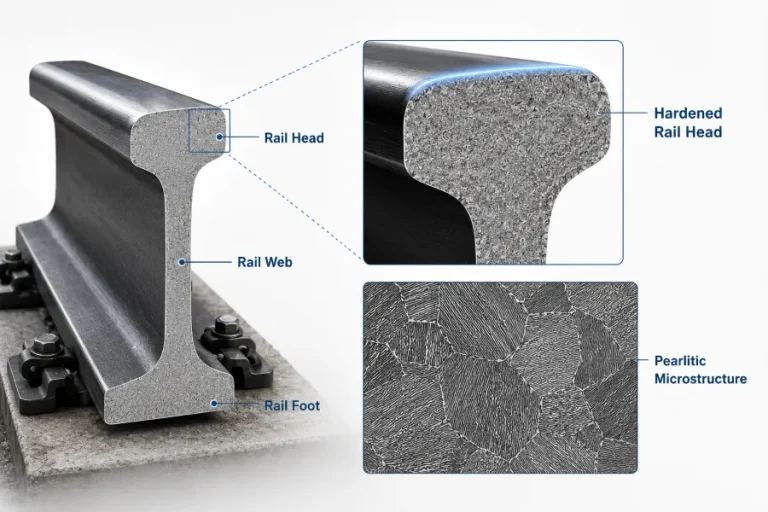
Manufacturers often perform metallographic analysis to verify grain structure, phase distribution, and heat treatment effectiveness.
Leitura adicional:
Modern railway components require strict dimensional control.
Coordinate measuring machines (CMM), precision gauges, and advanced machining inspection systems are commonly used to verify critical dimensions and geometric tolerances before shipment.
Producing high-quality railway bogie components requires controlling numerous variables throughout casting, tratamento térmico, usinagem, e inspeção.
Several manufacturing challenges can directly affect structural reliability.
Large steel castings are particularly susceptible to shrinkage defects during solidification.
Proper feeding design and process control are necessary to achieve sound internal structures.
Artigo relacionado:
Rapid cooling, uneven section thickness, and improper heat treatment can generate residual stresses that increase cracking risk.
Artigo relacionado:
Surface defects may affect inspection results, machining efficiency, and fatigue performance.
Artigo relacionado:
O que afeta a qualidade da superfície das peças fundidas de aço? Um guia prático
Successful bogie manufacturing depends on preventing defects rather than correcting them after production.
Artigo relacionado:
Um guia prático para solucionar defeitos em peças fundidas ferroviárias
Railway bogie components must comply with strict technical standards that define material properties, tolerâncias dimensionais, testing requirements, e critérios de aceitação.
Depending on the target market and application, manufacturers may need to meet requirements from AAR standards, Um padrão, AREMA standards, Padrões TB/T, or some customer specific specifications.
These standards ensure that components can withstand demanding railway service conditions while maintaining safety and interchangeability.
Recommended reading:
1. Padrões e práticas de engenharia para estruturas e reforços laterais de ferrovias
A bogie is not just a supporting structure beneath a rail vehicle. It is a core system that directly affects safety, estabilidade, conforto de condução, and long-term operating cost. From the frame and suspension to the braking interface and wheelset interaction, every component must work together under continuous dynamic loads and harsh service conditions.
No FONYO, we focus on the manufacturing quality of key bogie components, including bogie frames, molduras laterais, reforços, and other structural castings. With controlled materials, usinagem precisa, and strict inspection processes, we aim to ensure consistent performance under real railway operating environments.
If you are sourcing reliable bogie components or looking for a manufacturing partner for custom railway castings, feel free to contact our engineering team for technical discussion and quotation support.