Scan the WeChat code to contact us
Scan the WeChat code to contact us
Feel free to send us a email and we will reply to you as soon as possible.
Creating the future with heart and soul


Rail pads crack for four main reasons: compression set, fatigue, abrasion, and aging. The most common failure is not the crack you can see, but the loss of thickness you cannot, which quietly lets the rail pound the sleeper.
A rail pad is one of the cheapest components on the track and one of the easiest to ignore. It sits under the rail, out of sight, doing a job nobody notices until it stops. Then the sleeper starts chipping at the rail seat, the fastening loses toe load, and a maintenance crew finds itself changing pads in the middle of a possession window.
The strange part is how often the wrong question gets asked. People see a cracked pad and ask “what is wrong with this rubber?” The better question is what happened to this pad long before the crack appeared.
A pad rarely fails suddenly. It fails in stages, and the visible crack is normally the final stage of something that started years earlier as a slow, invisible loss of elasticity. By the time you can see a crack, the pad stopped doing its job some time ago.
Think of it this way. A pad has two ways to fail. It can get thinner and stiffer, or it can tear. The first one is silent. The pad loses thickness through compression set, the rail drops a little, the impact forces on the sleeper climb, and the pad gets hit harder every cycle. The crack is just the point where the material finally gave up under the repeated beating.
That ordering matters for procurement. If you treat a cracked pad as a material defect, you will buy a harder rubber and think you solved it. You did not. You just moved the problem around.
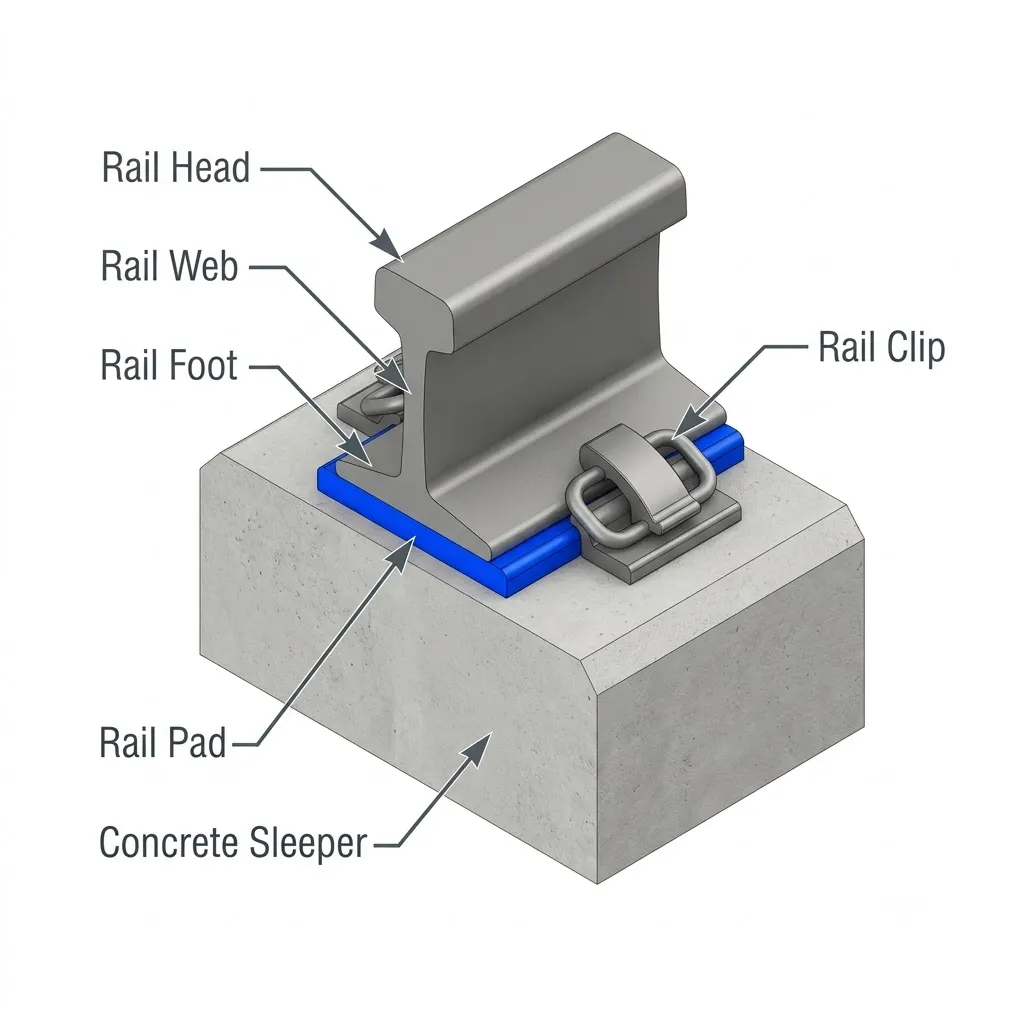
The rail pad sits between the rail foot and the sleeper or baseplate. Its job splits into four parts: distribute the wheel load over the rail seat so the concrete does not crush, damp the impact and vibration so the sleeper and ballast do not take the full hit, keep the rail electrically isolated from the sleeper where track circuits are in use, and hold just enough stiffness to keep the fastening clamped and the gauge stable.
Those four jobs pull in opposite directions, which is exactly why one material cannot do everything. A soft pad cushions well but squashes and loses gauge control. A hard pad holds gauge but transmits impact straight into the sleeper. The specification is always a compromise, and the crack you find later is usually the compromise failing.
This is the most common cause of rail pad failure on heavy lines, and it never announces itself. Under sustained load the pad takes a permanent deformation and does not rebound. A new pad might be 10 mm thick; a pad with severe compression set comes back at 7 mm and stays there.
A well-compounded pad holds compression set below roughly 15 percent. Cheap compounds can exceed 30 to 40 percent and lose their rebound within a few years. Once the pad is thinner, the rail foot sits lower, the fastening relaxes, and every wheel pass hammers the sleeper through a thinner cushion. The crack follows, but it is the consequence, not the cause.
If you want the full picture on how this ties into heavy-haul selection, the companion piece on rail pad material for heavy haul goes into the stiffness side in detail.
Pads are not smooth sheets. Most have grooves or studs on the underside to drain water and tune stiffness. Those grooves are stress raisers. Under millions of load cycles, a crack starts at the root of a groove and works its way through.
Water and debris make it worse. A grain of grit caught in a groove acts like a wedge, and water trapped under the pad accelerates the tearing. Fatigue cracks in rubber look clean and progressive, often starting at an edge or a groove corner, and they grow a little with every train.
The rail is never perfectly still. It expands and contracts with temperature and flexes under every axle. That micro-movement rubs the underside of the rail foot against the top face of the pad, wearing it away over time. On a curve or a joint the movement is bigger, and the abrasion concentrates in the same spot.
A rail pad with poor abrasion resistance wears thin where it matters most, and the wear is not uniform. The pad ends up wedge-shaped, and a wedge-shaped pad concentrates load on the thick edge, which is its own route to cracking.
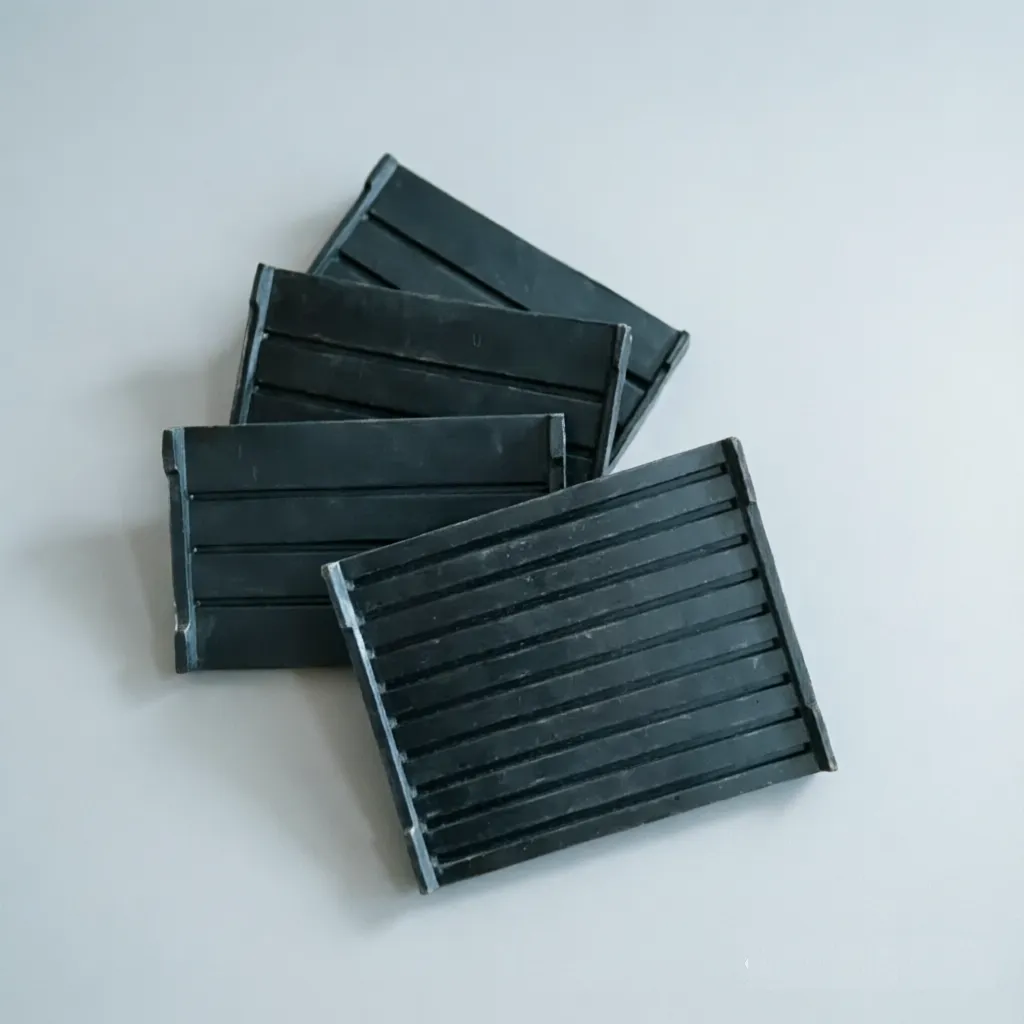
Rubber ages. Ultraviolet light and ozone attack the surface of compounds that are not stabilised against them, and the rail pad surface first hardens, then cracks in a characteristic crazed pattern. Heat accelerates every part of this, which is why the same pad lasts far longer in a temperate climate than on a hot, sunny line.
Then there is the chemical side. Diesel, oil and grease drip from locomotives onto the track, and these attack natural rubber specifically, swelling and softening it. Water trapped under the pad adds hydrolysis for some compounds. None of this is a defect in the rubber; it is a mismatch between the compound and the environment.
The crack is a symptom. The material is the disease. When I see a pad that cracked after two years, I do not start by blaming the rubber. I ask where it was installed and what it was specified for, because most premature cracking is a compound put in the wrong place.
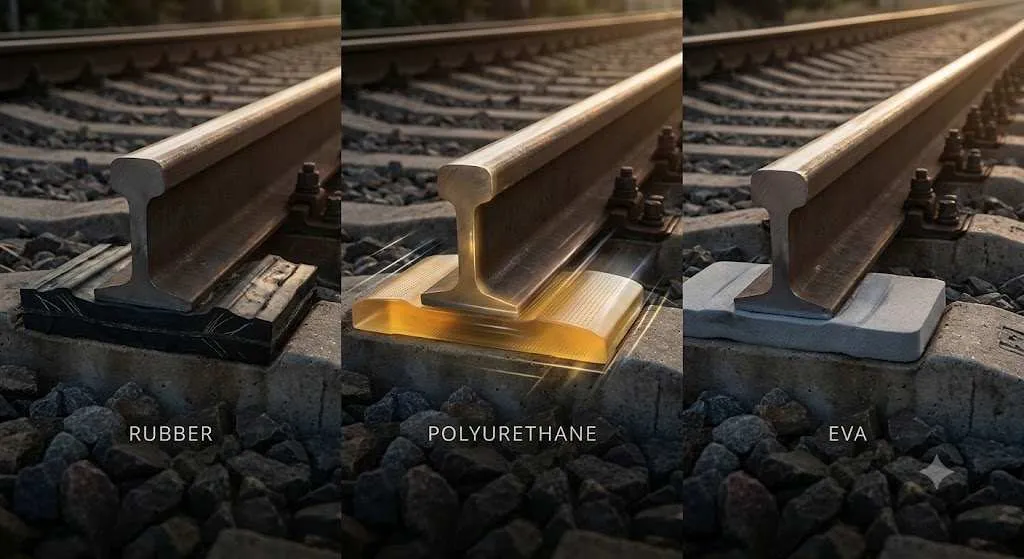
The rough map is this. Natural rubber or NR/BR blends give high resilience and fatigue life, so they suit high-speed passenger work where comfort matters. EPDM resists ozone, UV and heat, which makes it the workhorse for mainline and outdoor track. Chloroprene or nitrile compounds hold up where diesel and oil are present. The table is a starting point, not a universal specification, but it is the frame most failures fit into.
| Compound | Best for | Weakness |
| Natural rubber / NR-BR | High-speed passenger, resilience | Poor oil and ozone resistance |
| EPDM | Mainline, outdoor, heavy haul | Slightly lower resilience than NR |
| Chloroprene (CR) | Diesel and oily areas | Cost, low-temperature stiffness |
| Nitrile (NBR) | Oil and fuel exposure | Higher cost, less elastic |
A rail pad is not good or bad in the abstract. It is right or wrong for a location, and the crack is how the mismatch shows up.
The useful skill is catching the rail pad while it is still only half dead, before the sleeper takes damage. The checks are visual and cheap, which is why the inspection cycle matters more than the pad spec.
The maintenance habit that catches these is simple: compare a suspect pad against a new one from the stores. Thickness and stiffness tell you more in five seconds than a visual crack inspection does, because a pad can look perfect and be functionally dead.
The fixes split into the obvious and the less obvious. The obvious one is to match the compound to the location, and to replace the whole block of pads on a section together so they age uniformly rather than in patches. The less obvious ones are where most of the failure actually comes from.
Keep the rail seat clean and dry at installation. A single grain of grit under a pad becomes a stress point, and water sitting under the pad is a slow-rot condition. Tighten the fastening to the specified toe load, no more and no less: over-tightening crushes the pad and under-tightening lets it move and wear. Both shorten its life.
On the procurement side, ask the supplier for the compression set figure and the fatigue test result, not just the hardness and the price. Hardness is the number everyone quotes because it is easy to measure. Compression set is the number that predicts the crack, and it is the one nobody reads.
Whether you are re-railing a section or chasing a maintenance problem, the pad is part of the railway track fastening system, and it should be specified and replaced as part of that system, not as an afterthought. A pad that fails early drags the rail, the sleeper and the fastening down with it, which is why a few dollars of rubber can become a much larger repair.
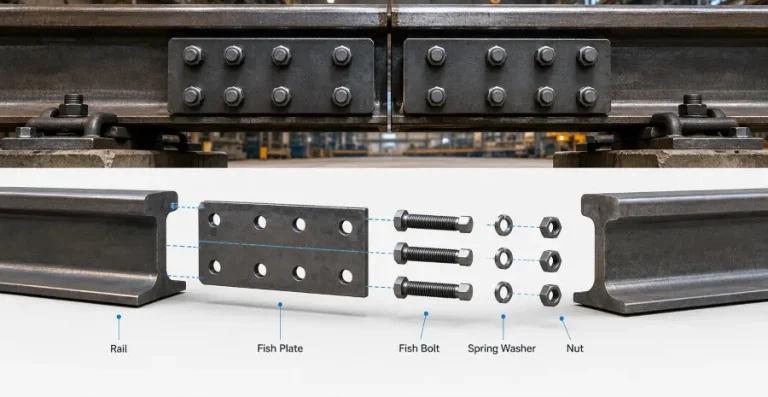
At Luoyang Fonyo Heavy Industries Co., Ltd. we manufacture rail pads alongside fish plates, fish bolts, elastic rail clips and the rest of the fastening system, and we quote pads against the compound and the performance figures, not just the dimensions. If you have a pad that is failing early, send us the installation details and we will look at whether the compound matches the service before we quote a replacement.
How long should a rail pad last before it cracks?
It depends on the line. A rail pad on a light industrial siding can go ten years or more, where the same pad under heavy-haul traffic in a hot climate may need replacement in five to eight years. The inspection result always overrules the calendar.
Is a cracked pad always a material defect?
Usually not. Most premature cracking is a compound installed in the wrong environment, an over-tightened fastening, or debris under the pad. The crack is the symptom, not the diagnosis.
Can a rail pad be reused after re-railing?
Generally no. A pad is a low-cost item, and a used pad has already taken permanent set and lost some elasticity. Reusing it risks a weak rail seat, so re-railing projects normally fit new pads as part of the fastening set.
Does a harder pad last longer?
Sometimes, but harder is not the same as longer-lived. A hard pad holds gauge well but transmits more impact into the sleeper and can crack the concrete. The right answer is the stiffness the fastening was designed around, not the highest hardness you can buy.
What triggers replacement before the pad cracks?
Permanent compression of roughly 20 percent or more, hardening well above the specified range, or a through-crack are the usual triggers. A pad that has lost its elasticity no longer protects the sleeper even if it has not yet cracked.
Do oil and diesel really crack pads?
They do not crack them directly; they soften and swell the rubber first. Natural rubber is especially vulnerable, which is why oily locomotive areas are specified with chloroprene or nitrile compounds instead.