Scan the WeChat code to contact us
Scan the WeChat code to contact us
Feel free to send us a email and we will reply to you as soon as possible.
Creating the future with heart and soul


If you are specifying rail pad for a heavy haul line, the short answer is this: there is no single “best” material, but for axle loads of 25 t and above the working choices are a high-stiffness HDPE pad, a thick high-density rubber pad, or a polyurethane pad. What actually decides the answer is the pad stiffness the track design calls for, not the material name printed on the drawing.
That said, the question is the wrong one to start with. A heavy haul pad has a different job from the pad on a passenger line, and if you pick the material before you understand that job, you will buy the wrong thing. For the broader material-by-material rundown, we have a separate rail pad materials comparison; this article narrows the choice down to the heavy haul case and assumes you are choosing for load, not for a metro ride.
On a metro or high-speed line, the pad is there to soften the ride and cut noise. On a heavy haul line, a soft pad is a liability.
Think about what a 30 t axle does at the rail seat. The wheel hits the rail, the rail pushes down, and if the pad under it compresses too much, the rail rolls. It tilts outward. The gauge widens. A soft pad that is perfect for passenger comfort becomes a gauge-holding problem when a loaded ore car sits on top of it.
This is the part that surprises people coming from passenger rail. Heavy haul is not about making the track gentle. It is about keeping the geometry locked down under a load that never really goes away. The pad’s first job is stiffness and stability. Damping comes second.
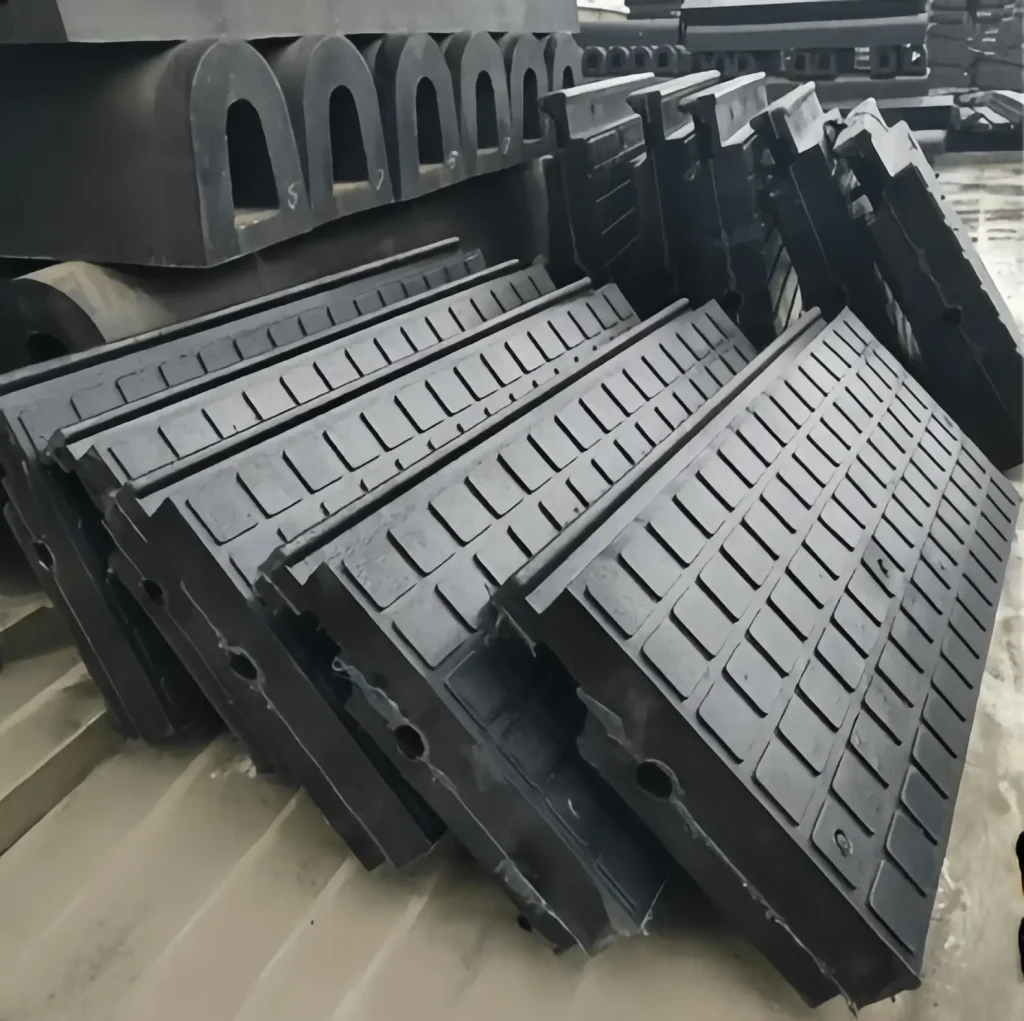
A rail pad on a heavy haul line is beaten in ways a transit pad never is.
First, the load. Heavy haul axle loads run from about 25 t up to 35 t or more depending on the network, and the dynamic wheel-rail force spikes well above the static axle load every time a wheel hits a joint or a wheel flat. A pad on a heavy haul line is expected to hold up under rail seat loads of roughly 120 kN and up, cycle after cycle, for millions of cycles.
Second, the shear. Freight trucks steer hard through curves and brake hard, and that drags the pad sideways. A pad that creeps or extrudes out from under the rail foot is a failed pad even if it never cracks.
Third, compression set. This is the one that kills soft pads quietly. A pad that is too soft gets squeezed past its recovery point and stays squashed. Once it takes a permanent set, the fastening loses its grip, and the sleeper starts eating the impact directly. This is also the single most common reason a pad gets replaced ahead of schedule, which is covered in our track maintenance guide.
So when you pick a material, you are picking for three things at once: enough stiffness to hold gauge, enough shear resistance to stay put, and low enough compression set to survive years of repeated load. The same three concerns drive every other component in a heavy haul fastening system, not just the pad.
Oddly enough, the most useful thing to pin down is not the material at all. It is the stiffness.
Heavy haul track is typically designed for a pad stiffness in the region of 25 to 35 kN/mm. Conventional mixed-traffic lines sit lower, often 10 to 20 kN/mm, and high-speed lines lower still. The heavier the axle load, the higher the stiffness the design calls for, because the whole point is to keep vertical deflection small so the rail does not pump and the geometry does not walk.
These are typical design ranges, not a universal specification. Your project may call for something different, and a pad is always specified to the load-deflection curve your fastening system was designed around. But if you are comparing materials and nobody has told you the target stiffness, that is the first question to ask. A pad is not good or bad in the abstract. It is right or wrong for a number, and that number is set by the wider railway track fastening system, not by the pad alone.
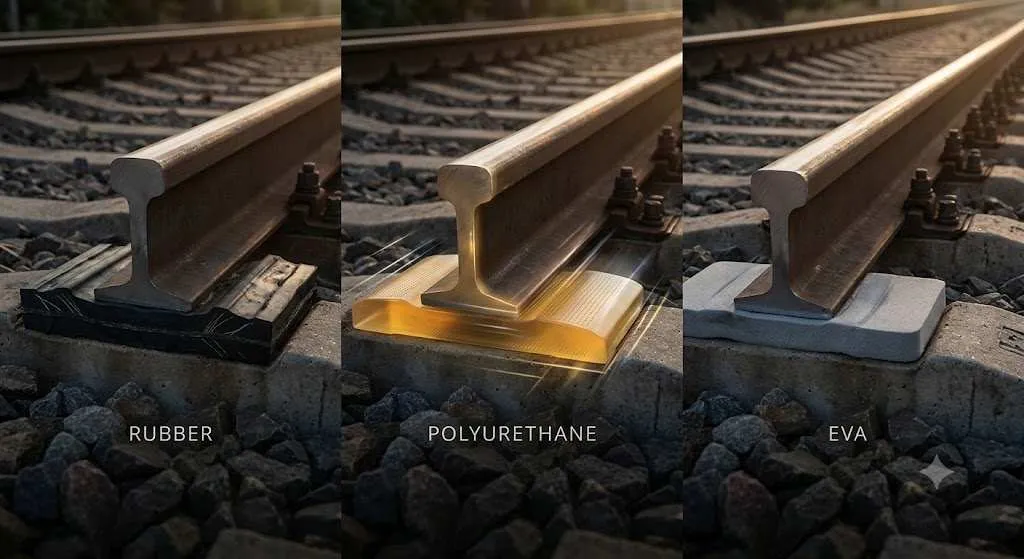
Here is where the material choice finally enters. The four materials you will see quoted behave differently, and the difference is mostly about how they trade stiffness against damping.
| Material | Typical stiffness character | Where it fits in heavy haul | Notes |
| HDPE | High, rigid | Gauge-critical freight and industrial lines | Acts as a rigid shield against rail-to-sleeper abrasion, not as a cushion |
| Rubber (high-density compound) | Medium-high, tunable | General heavy haul, thick sections (15–20 mm) | Best damping of the group; needs the right compound for load and climate |
| EVA | Medium | Mixed traffic, lighter freight | Balances damping and durability; softer than HDPE |
| Polyurethane | High, long life | Harsh environments, long service intervals | Highest load bearing and aging resistance; highest cost |
This is a starting point, not a universal specification. Every value depends on the compound, the thickness, and the groove design, and two pads can carry the same material name and behave differently.
HDPE is worth a closer look because it is the one people misunderstand. It barely cushions. Its job is to sit between the steel rail and the concrete sleeper and stop the rail from grinding the sleeper away, while holding gauge under a huge load. If your line is heavy freight and gauge stability is the priority, HDPE is often the cheapest way to get that stability. If you need vibration control too, HDPE alone will not give it to you.
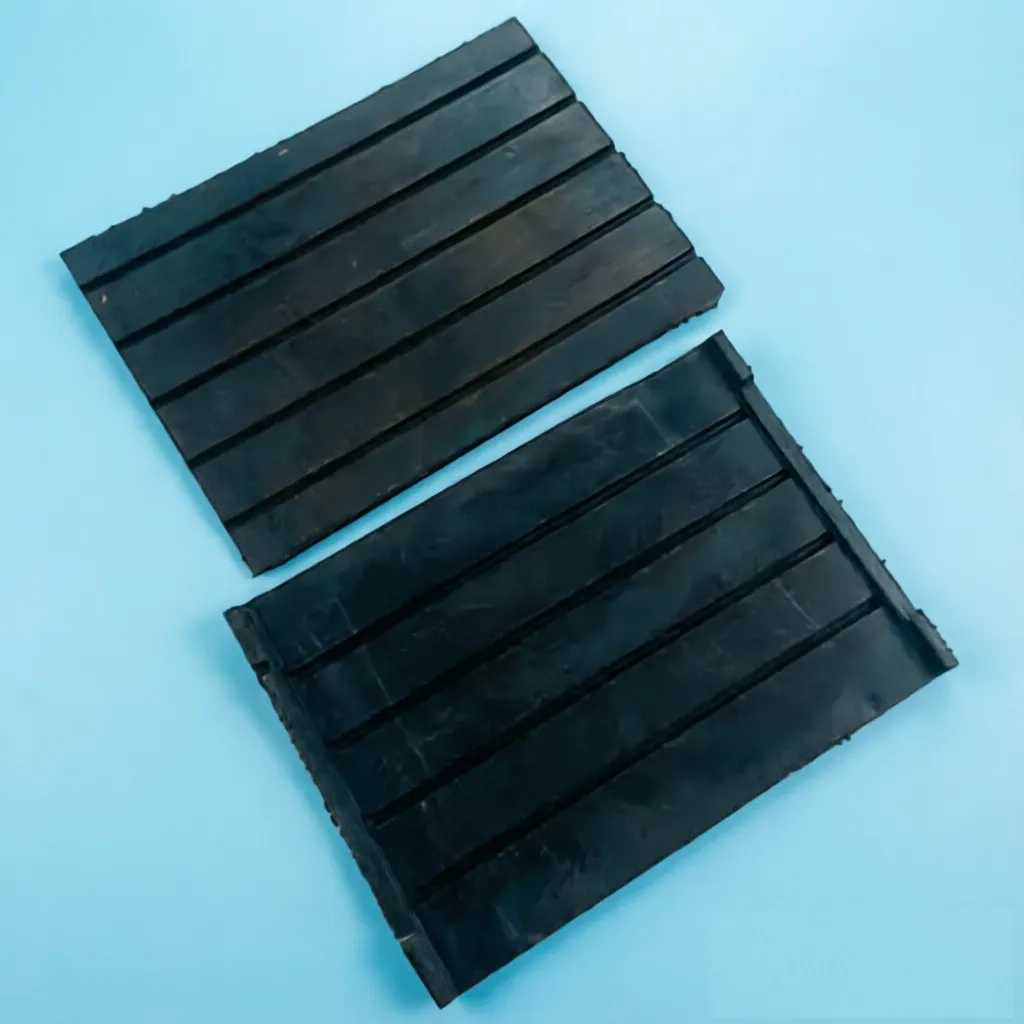
Rubber is the other common answer, and it is the honest compromise. A thick, high-density rubber pad in the 15 to 20 mm range gives real damping and, with the right compound, enough load capacity for heavy haul. The catch is compression set and aging. A natural-rubber pad may age out in five to eight years under load, where a modified or neoprene compound can push past ten. In a heavy haul environment, compound choice matters as much as the material family.
There is a newer route that is worth knowing about if you are designing rather than just replacing: composite and graded pads.
A composite pad layers a reinforcement, often a fiber or fabric interlayer, inside the rubber to stop shear creep and hold the pad’s shape under millions of heavy cycles. The practical result is a pad that keeps its stiffness longer and lasts longer, sometimes in the 12 to 18 year range on heavy haul, where a plain single-layer rubber pad might last six to ten. The numbers come with conditions attached, but the direction is clear: reinforcement buys fatigue life.
A graded or gradient pad goes further and stacks layers of different stiffness, a softer face for damping over a harder base for load. It is an answer to the exact problem heavy haul presents, which is that you want soft for the impact and stiff for the load at the same time. I would not say every heavy haul line needs one. I would say that if your current pads are failing by compression set or shear creep, a graded or reinforced pad is the place to look next rather than just ordering the same thing again.
When you sit down to order, the material is only one line on the spec. The lines that actually protect you are these.
Specify the rail section, because the pad has to match the rail foot and the sleeper rail seat. Specify the axle load and the required static stiffness, and the dynamic-to-static ratio if your spec calls for it. Specify the thickness, and the groove or drainage pattern if it matters for your climate. Specify the temperature range the pad has to survive, because a pad that goes brittle at minus 20 is useless on a northern freight line. And specify the standard you are working to, whether that is EN 13481, UIC 864, AREMA practice, or a national spec like TB/T 2626.
When I review a supplier’s pad, I do not stop at the material name. I check the stiffness test result against the design value, and I check the compression set and the insulation resistance, because those are the numbers that tell you whether the pad will still be doing its job in five years. A pad that meets the stiffness on day one and takes a permanent set in year two is a cheap pad, not a good one.
If you buy pads rather than design them, three questions will sort the serious suppliers from the rest.
First, ask for the test report, not the brochure. A pad is specified by stiffness, compression set, insulation resistance, and fatigue behavior, and a supplier who cannot show you the EN 13146 or equivalent test results is asking you to take the material name on faith.
Second, ask how the stiffness is tuned. A supplier who can adjust the compound, thickness, or reinforcement to hit your target stiffness is a manufacturer. A supplier who only sells a fixed catalogue is a trader, which is fine if your spec is standard and less useful if it is not.
Third, ask about traceability. The batch on the pad should tie back to a material certificate the same way a rail or a bolt does. If the pad carries no batch marking and the supplier shrugs when you ask, treat that as a signal.
A rail pad looks like one of the simplest of all the railway track components, a rectangle of plastic or rubber that nobody notices until it fails. The reason heavy haul lines still get it wrong is that people treat it as a commodity and skip straight to the cheapest quote.
Whether you are designing a new heavy haul line or replacing pads that are taking a set, the decision is not really about the material. It is about the stiffness the track needs, the load it has to survive, and whether the pad will still be doing that job in ten years rather than two.
At Luoyang Fonyo Heavy Industries Co., Ltd., we manufacture rail pads in HDPE, EVA, rubber, and polyurethane to UIC, EN, and AREMA practice, and we adjust compound, thickness, and reinforcement to the stiffness your design specifies. If you send us the rail section, axle load, and target stiffness, we will confirm the material and the test values against your specification before quoting, not after delivery.
It depends on the design stiffness and the priority. For gauge-critical freight, HDPE is the common choice. For a balance of damping and load, a thick high-density rubber pad works. There is no single answer that fits every heavy haul line.
Because it is stiff. HDPE holds gauge and stops the rail from abrading the concrete sleeper under high axle loads. It is a rigid shield more than a cushion, which is exactly what a heavily loaded line often needs.
A typical design range is 25 to 35 kN/mm, higher than mixed-traffic or high-speed lines. The exact value is set by the fastening system and the axle load, so it is a design target, not a universal number.
Sometimes, but not automatically. A thicker or reinforced pad can last longer if it resists compression set and shear creep. Thickness alone does not help if the compound is wrong for the load or the climate.
would be cautious. A pad that is too soft takes a permanent set and lets the rail deflect too far, which hurts gauge. If vibration control matters, a graded or reinforced pad gets you damping without giving up stiffness.
The common references are EN 13481 for fastening system requirements, EN 13146 for the test methods, UIC 864 for rubber track components, and AREMA practice in North America. Always verify the current edition against your project spec.
It depends on load, climate, and compound. A plain single-layer rubber pad might last six to ten years, where a reinforced composite pad can reach the 12 to 18 year range under heavy haul conditions. These are typical figures, not guarantees.