Scan the WeChat code to contact us
Scan the WeChat code to contact us
Feel free to send us a email and we will reply to you as soon as possible.
Creating the future with heart and soul


The short answer: It depends on the bolt diameter, the grade, whether the threads are lubricated, and the standard the joint is built to. As a working range, M22 fish bolts in grade 8.8 run around 220 to 270 N·m, M24 in 8.8 around 250 to 350 N·m, and the heavier 10.9 grade higher again. On the North American side, AREMA joint bolts are specified in foot-pounds: a 1-inch bolt around 800 to 900 ft-lb, developing roughly 45,000 pounds of tension. The torque is not the goal. The clamp it produces is.
Ask five people how tight a fish bolt should be and you can get five different numbers, all of them defensible, because they are answering for different bolts. The question only becomes precise when you attach the details: what diameter, what grade, which standard, lubricated or dry. Strip those away and any single number is a guess.
But there is a cleaner way to think about it, and it is the one that stops the guessing. You are not tightening to a torque. You are tightening to a clamp.
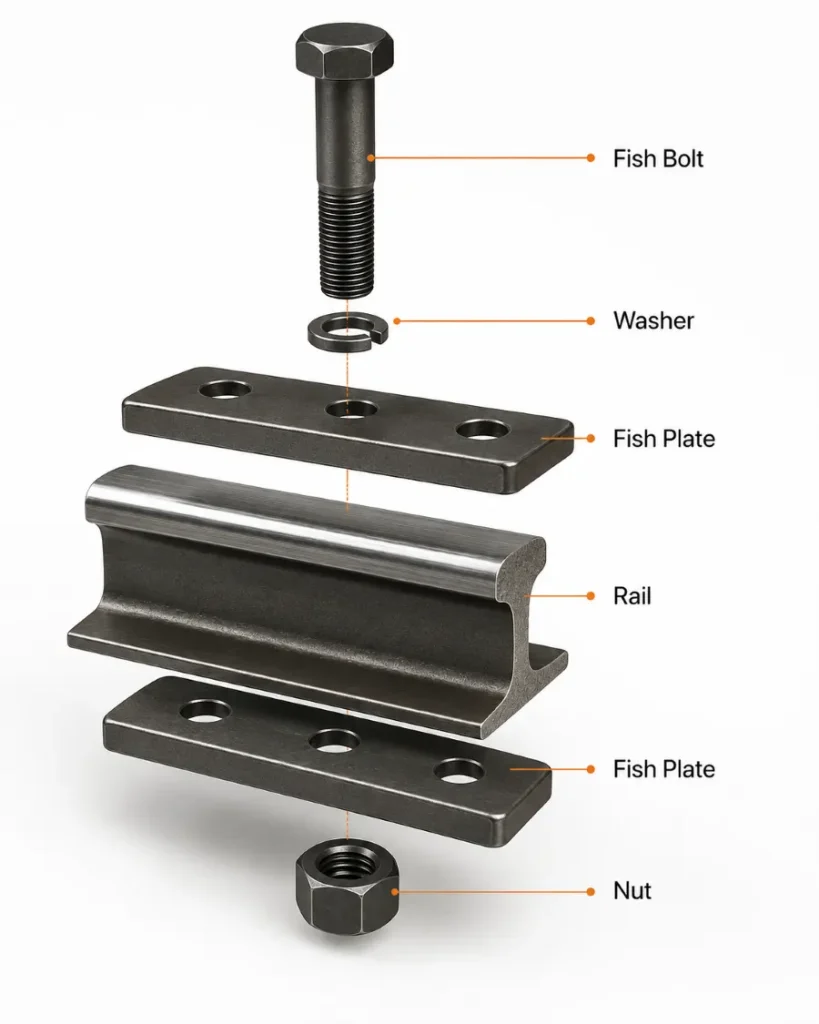
Here is the thing that reframes the whole question. A fish bolt’s job is not to have a certain torque reading on the wrench. Its job is to produce a certain clamping force, the tension that pulls the two fish plates hard against the rail web so the joint cannot work or hammer.
Torque is just the lever you use to get there. And the relationship between the two is not one-to-one, which is why the question is slippery. Two identical bolts, tightened to the same torque, can land at very different clamping forces if one pair of threads is lubricated and the other is dry.
The standard equation ties it together: torque equals a friction coefficient, times the preload, times the bolt diameter. The friction coefficient, usually called the nut factor, typically sits somewhere between about 0.15 and 0.25. The practical meaning is simple. A lubricated thread converts torque into clamp more efficiently than a dry one, so it reaches the same clamp at a lower torque. That is the whole reason you cannot borrow a torque number from one job and apply it to another without knowing the thread condition.
So the correct answer to “how tight” is never a bare number. It is: tighten until the bolt reaches the specified preload, using the torque value that your standard says corresponds to that preload under the thread condition you actually have.

For metric fish bolts, the numbers most people actually work with fall into a tight, repeatable pattern. Here is the working range, graded by diameter and strength class.
| Bolt size | Grade 8.8 (typical) | Grade 10.9 (typical) |
| M20 | ~160-200 N·m | ~240-300 N·m |
| M22 | ~220-270 N·m | ~330-400 N·m |
| M24 | ~250-350 N·m | ~420-500 N·m |
This is a starting point, not a universal specification. These are typical working ranges for lubricated threads, and they shift with the thread condition, the fish plate material, and the standard in force. The value in your project drawing wins over any number in a table.
A few things to notice. The torque climbs steeply with diameter, because the bigger bolt is being stretched to a higher preload. And the jump from 8.8 to 10.9 matters, because the higher-grade bolt is meant to be tensioned harder. If you install a 10.9 bolt but only tighten it to an 8.8 value, you have paid for a stronger bolt and left most of its clamp on the table. How those grades map to service, and where each one belongs, is in our railway bolt grade guide.
The fish plate material matters too. A heavier, high-strength fish plate on a heavy-haul line is specified to a higher torque than a light carbon-steel plate, because the joint is designed to hold a higher bending moment and needs the extra clamp to do it.
AREMA joint bolts are a different world, and the numbers look big only because they are imperial and the bolts are larger. The specification works on tension as the primary quantity, with torque as the way to reach it.
| Bolt diameter | Typical torque | Developed tension |
| 7/8 inch | ~600-700 ft-lb | ~35,000 lb |
| 1 inch | ~800-900 ft-lb | ~45,000 lb |
| 1-1/8 inch | ~1,000-1,200 ft-lb | ~55,000 lb |
Typical working values, not a universal specification. Confirm against the AREMA chapter and the project drawing in force.
Those tension figures are the point of the exercise. A one-inch AREMA joint bolt is expected to develop on the order of 45,000 pounds of clamp, and the torque value is simply whatever it takes, with proper lubrication, to get there. That is a much higher clamp than a metric M22 sees, and it is why the numbers do not compare across the two systems. Different bolts, different joints, different intent.
A fish joint fails at installation as often as it fails in service, and the cause is usually a bad sequence, not a wrong number.
The rule is: work from the centre bolts outward, alternating sides, and do it in stages. Hand-tighten everything first so both plates seat. Then bring the bolts to roughly half to three-quarters of the target, centre out, alternating. Then make a second pass to the full value in the same order. The idea is to pull the plate flat against the web evenly, instead of bowing it by hammering one corner tight while the rest is slack.
For a four-hole plate, tighten the diagonal pairs together. For a six-hole plate, work out from the centre pair. The exact numbering matters less than the principle: no bolt reaches full torque before its neighbours have been brought partway, and the plate is never left twisted against the rail. If you are weighing four-hole against six-hole fish plates, the hole count also changes the load distribution, not just the sequence. And if you want the full installation from surface prep to final pass, our fish plate installation guide walks through it step by step.
After the final pass, the nut should show one or two threads beyond its face, and the whole joint should be re-checked. Not next year. Soon.
The torque you set on installation day is not the torque the joint has a week later. The plates bed in, the coating on the threads compresses, and the preload quietly relaxes under the first traffic. This is the single biggest reason joints come back loose.
So the schedule matters as much as the initial number. Re-tighten after the initial settlement, then on the routine inspection cycle, and again before winter if the line has a real seasonal swing. A joint that was torqued correctly and then abandoned will loosen just as surely as one that was never torqued at all. This is the part that connects to our companion piece on why fish bolts loosen: the preload leaves quietly, and only the re-torque brings it back.
I have lost count of how many “torqued” joints were actually tightened by feel. A fish bolt needs a calibrated torque wrench, not an arm and an opinion. Under-tightening leaves the clamp short and the joint free to work. Over-tightening stretches the bolt past its yield or damages the thread, and a yielded bolt can never hold its preload again.
The wrench also has to be in calibration. A torque wrench that reads 400 N·m but actually delivers 350 is not a small error on a joint that depends on the clamp. Check it against a reference, and treat the reading as what it is: a means to the preload, not an end in itself.
The torque question is really a specification question, and a few things should be pinned down before anyone tightens anything.
A fish bolt’s torque value is only meaningful as a stand-in for the clamp it produces, and the clamp only survives if the joint is re-tightened on schedule. Get the diameter, grade, standard, and thread condition right, tighten from the centre out in stages with a calibrated wrench, and then come back and re-torque after the joint settles. That is the whole discipline, and it is the difference between a joint that holds and one that hammers itself loose.
If you are speccing fish bolts, or if a joint keeps loosening and you want to get the torque right, send us the bolt diameter, the grade, and the standard you are working to. At FONYO, we manufacture fish bolts and fish plates alongside rail clips, rail pads, and the rest of the railway track components, and we quote with full material traceability. We will confirm the correct preload and torque against the applicable standard before we put a number on it.
What torque should I use for an M24 fish bolt?
Around 250 to 350 N·m for a grade 8.8 bolt, and roughly 420 to 500 N·m for a grade 10.9, on lubricated threads. These are typical working ranges, and the value in the project specification wins over any table.
Why are AREMA bolt torques so much higher than metric ones?
Because AREMA joint bolts are larger and are specified to a much higher developed tension, on the order of 45,000 pounds for a one-inch bolt. The torque is just the lever to reach that clamp, so the imperial numbers look big in comparison.
Does lubrication change the torque value?
Yes, and it matters more than most people think. A lubricated thread reaches the same clamp at a lower torque than a dry one, because the nut factor drops. You cannot take a torque value from a lubricated job and apply it to dry threads.
Is it better to over-tighten than under-tighten?
Neither. Over-tightening yields the bolt or damages the thread, and a yielded bolt can never hold its preload again. Under-tightening leaves the clamp short. The correct value, with a calibrated wrench, is the only good answer.
How long after installation should fish bolts be re-tightened?
After the initial settlement period, typically within the first days to weeks of traffic, and then on the routine inspection cycle. A joint that is not re-torqued after it beds in will loosen no matter how carefully it was tightened the first time.
Can I tighten fish bolts with an impact gun?
Not as the final step. An impact gun set to “feel” does not give a controlled, repeatable preload. Use a calibrated torque wrench for the final value, and if an impact gun is used, use it only to run the nuts down before the wrench takes over.
Do I tighten from the centre or the outside?
From the centre outward, alternating sides, in stages. This pulls the plate flat against the rail web evenly and avoids bowing it. The final pass follows the same order.