Scan the WeChat code to contact us
Scan the WeChat code to contact us
Feel free to send us a email and we will reply to you as soon as possible.
Creating the future with heart and soul

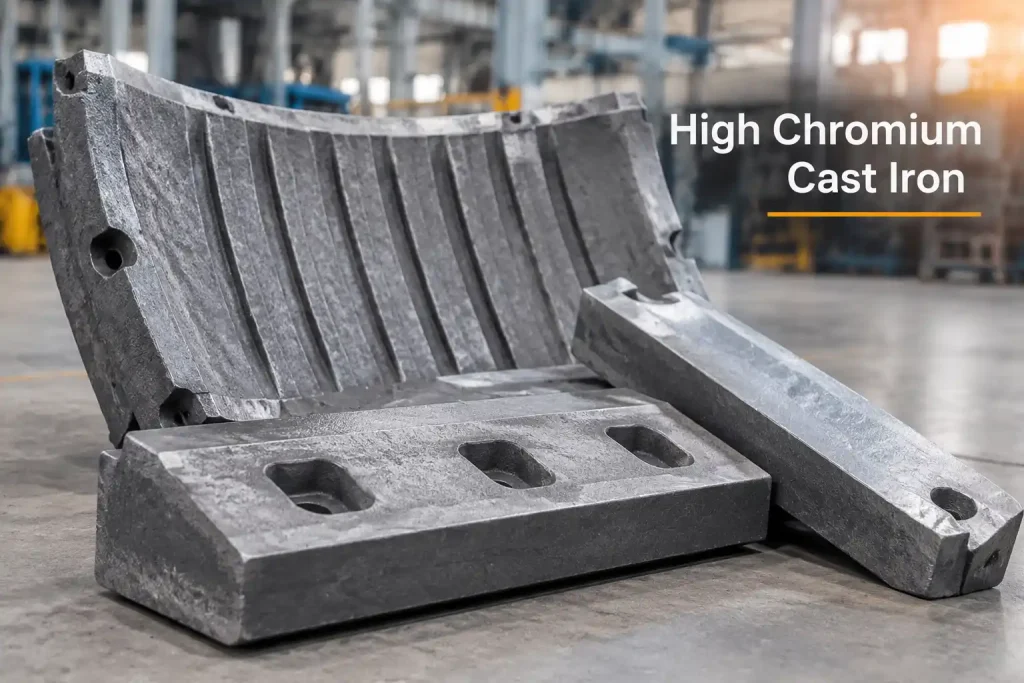
High chromium cast iron wear parts are designed for applications where abrasion is the main cause of material loss. When a component is continuously rubbed, scraped, or ground by hard materials, its surface needs to resist wear over a long period of operation. This is where high chromium cast iron is often a good choice.
Unlike high manganese steel castings which develop higher surface hardness under impact and work hardening, high chromium cast iron already has high hardness after proper casting and heat treatment. Its performance does not depend on repeated impact to develop hardness.
The main reason for its wear resistance is the formation of chromium-rich carbides during solidification. These carbides, mainly of the M7C3 type, are extremely hard and provide resistance against abrasive particles. They are distributed throughout the metallic matrix, which supports the carbides and helps maintain the structure during service.
For buyers, however, selecting high chromium cast iron is not simply a matter of choosing a material with a high hardness value. The actual performance depends on the chemical composition, carbide structure, heat treatment, and working conditions of the component.
High chromium cast iron and hardened steel achieve their hardness in different ways.
In hardened steel, hardness mainly comes from changes in the metallic microstructure through heat treatment. High chromium cast iron, on the other hand, obtains much of its abrasion resistance from hard chromium-rich carbides formed during solidification. Heat treatment is still important, but its main purpose is to improve the supporting matrix and control the final microstructure.
This difference is particularly relevant in abrasive applications. When ore, clinker, coal, or other hard materials continuously slide across a component, the carbides help resist material removal. The metallic matrix holds these carbides in place and supports them as the working surface gradually wears.
However, high hardness does not mean unlimited wear resistance under every operating condition. High chromium cast iron is relatively brittle compared with manganese steel. Under severe impact or sudden shock loading, it can crack or chip instead of deforming.
This is why material selection should begin with the actual wear mechanism. If a component mainly experiences sliding and grinding, high chromium cast iron may be suitable. If it receives repeated heavy impacts, high manganese steel may be a better option.
High chromium cast iron wear parts are widely used in mining, mineral processing, cement production, and other industries where abrasive materials cause continuous wear.
Some common applications include:
These applications are examples rather than fixed rules. Even within the same machine, different components may experience different combinations of abrasion and impact. A material that performs well in one position may not be suitable for another.
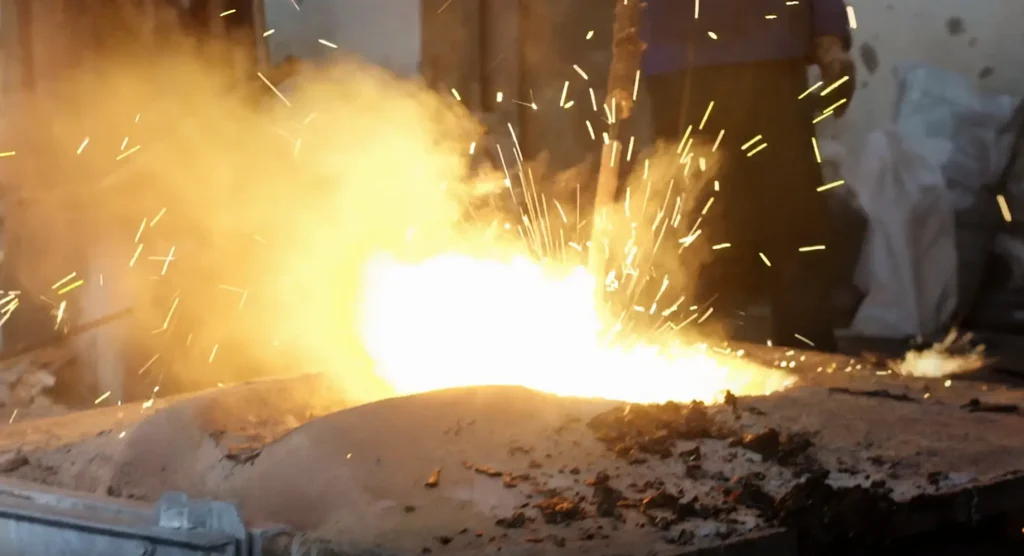
One common mistake when purchasing high chromium cast iron is assuming that a higher chromium percentage always means better quality.
Chromium content has a direct influence on carbide formation and wear resistance, but it is only one part of the material composition. Carbon, molybdenum, and other alloying elements also affect the microstructure and mechanical properties.
For example, commonly used high chromium cast iron grades include KmTBCr15, KmTBCr20, and KmTBCr26. These designations are often used in Chinese material specifications and industrial applications.
The following table provides a general comparison. The composition ranges are indicative only and should not be treated as universal acceptance limits.
| Grade | Typical chromium content | General application |
|---|---|---|
| KmTBCr15 / Cr15 | Around 14–18% | General abrasive wear applications |
| KmTBCr20 / Cr20 | Around 18–23% | More demanding abrasive wear conditions |
| KmTBCr26 / Cr26 | Around 23–30% | Severe abrasion applications requiring high carbide content |
The actual chemical composition should follow the applicable material standard or the customer’s technical specification.
Heat treatment is another important consideration. Two castings with similar chromium content can show different hardness and wear performance if their matrix structures and carbide distributions are different.
For this reason, experienced foundries do not select a grade based on chromium content alone. They consider the component’s dimensions, working conditions, expected wear mechanism, and required service life before determining the appropriate material.
Two high chromium cast iron components may look almost identical and even have similar hardness readings, but their performance in service can be very different.
The difference often comes down to casting quality and process control.
The first factor is the carbide structure. High chromium cast iron contains hard chromium-rich carbides, but their distribution and morphology matter. A well-controlled microstructure helps the carbides resist abrasive wear while remaining properly supported by the metallic matrix. Poor carbide distribution, excessive carbide networks, or local defects can reduce the reliability of the casting.
For certain wear components, such as crusher blow bars, directional solidification and control of the solidification process may also be used to improve the carbide distribution and orientation in relation to the working surface.
The second factor is heat treatment. Although high chromium cast iron contains hard carbides after solidification, the metallic matrix still needs to be properly controlled.
A typical heat treatment process may involve destabilization, hardening, and tempering, depending on the material grade and required properties. During destabilization, secondary carbides can precipitate from the matrix, changing its composition and transformation behaviour. Subsequent cooling and tempering help establish the required matrix structure.
If heat treatment is not properly controlled, the casting may have an unsuitable matrix hardness or develop cracks due to thermal stress. The principles of controlling casting properties through heat treatment are also discussed in our article on Heat Treatment of Railway Castings: Process, Purpose, and Quality Control.
The third factor is inspection. High chromium cast iron is relatively brittle, so cracks and casting defects need particular attention. Shrinkage defects, hot tears, and heat-treatment cracks can affect the service life of a component.
Depending on the casting geometry and inspection requirements, different non-destructive testing methods may be applied. MT is suitable for detecting surface and near-surface cracks in ferromagnetic cast iron, while PT can identify surface-breaking defects. UT may be used to examine internal discontinuities, although its suitability depends on the casting structure, geometry, and examination procedure.
Hardness testing and metallographic examination are also important. A hardness result gives useful information about the material, but it cannot show the complete carbide structure or identify every internal defect.
For a reliable casting, chemical composition, heat treatment, hardness, metallographic structure, and appropriate inspection results should be considered together. This is why metallographic analysis and NDT methods are important parts of casting quality control.
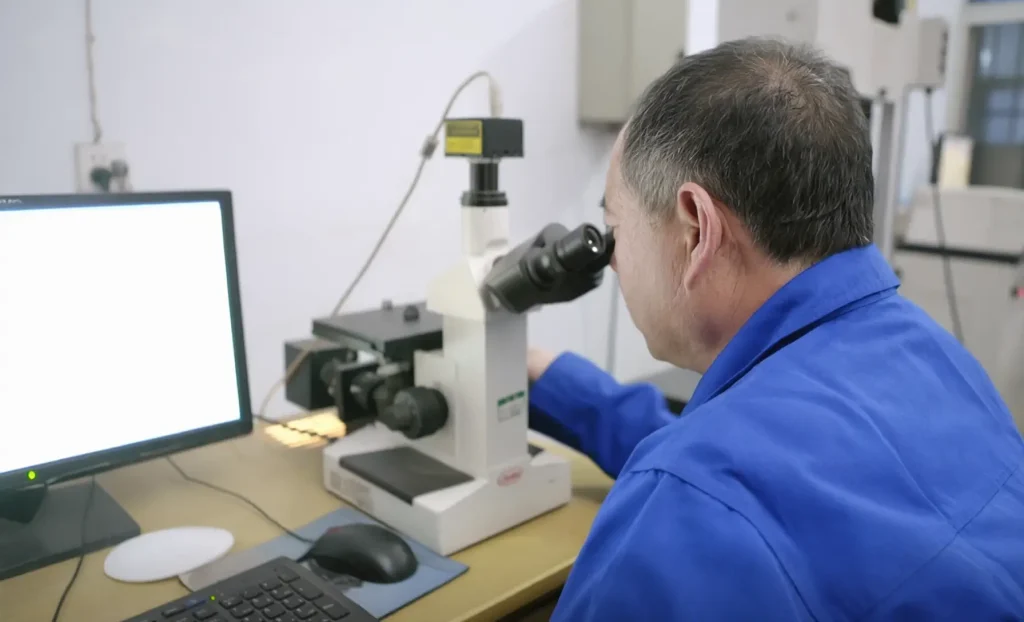
When purchasing high chromium cast iron wear parts, buyers should look beyond the quoted price and hardness value. The manufacturing process and inspection records are equally important.
Before placing an order, I would recommend discussing the following points with the foundry:
These questions help buyers understand whether a foundry has proper control over material composition, casting, heat treatment, and final inspection.
For custom wear parts, it is also useful to provide the supplier with information about the material being processed, operating temperature, impact conditions, and expected service life. This information helps the foundry recommend a suitable grade rather than simply offering the highest chromium content available.
If you are still comparing different casting materials, our article on How to Select the Right Materials for Railway Castings provides further information about material selection and its influence on casting performance.
Hardness is one of the most commonly used indicators when comparing high chromium cast iron wear parts. It is also one of the easiest properties to misunderstand.
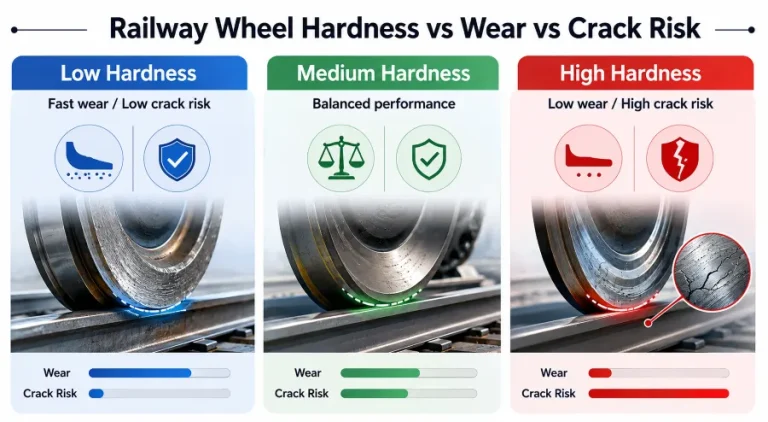
A high hardness value is important for abrasion resistance, but it does not tell the whole story. Two castings may have similar HRC readings but different wear performance because their carbide distribution, matrix structure, and casting quality are not the same.
There is also the question of impact. A very hard high chromium cast iron component may perform well in a grinding application but fail prematurely if it is installed in a position exposed to severe shock loading.
This is where buyers need to look beyond the material certificate. Hardness should be considered together with the actual working conditions and the expected failure mechanism.
The same principle applies when comparing high chromium cast iron with manganese steel Manganese steel is designed to withstand impact and work-harden under suitable loading conditions, while high chromium cast iron is designed primarily to resist abrasive wear.
Neither material is universally better. The right choice depends on how the component works.
High chromium cast iron wear parts are widely used in applications where abrasion is the main cause of component failure. Their wear resistance comes from hard chromium-rich carbides supported by a properly controlled metallic matrix.
However, good wear performance does not come from chromium content or hardness alone. Chemical composition, solidification, heat treatment, carbide structure, and inspection all influence the final quality of the casting.
For buyers, the first step should always be to understand the actual working conditions of the component. Is it mainly exposed to sliding abrasion, grinding, erosion, or repeated impact? Once this is clear, it becomes much easier to select the appropriate material and grade.
At FONYO, we manufacture high chromium cast iron wear parts and high manganese steel castings for mining, engineering machinery, and railway applications. Our manufacturing capabilities cover casting, machining, heat treatment, and quality inspection.
If you have a technical drawing or an existing worn component, you can send it to us for evaluation. We can review the material requirements, manufacturing process, and working conditions to help determine whether high chromium cast iron or another casting material is more suitable for your application.
High chromium cast iron is a type of wear-resistant white cast iron containing a relatively high proportion of chromium and carbon. During solidification, chromium-rich carbides, mainly M7C3, form in the microstructure. These hard carbides provide excellent resistance to abrasive wear.
Not necessarily. Higher chromium content can promote the formation of chromium-rich carbides, but wear resistance also depends on carbon content, carbide distribution, matrix structure, and heat treatment. The correct grade should be selected according to the actual working conditions.
It can withstand some impact, but its toughness is relatively limited compared with manganese steel. Under severe impact or shock loading, it may crack or chip. For applications involving repeated heavy impacts, manganese steel is often a more suitable choice.
The main difference is their wear mechanism and working behaviour. High chromium cast iron contains hard carbides and provides good abrasion resistance from the beginning of service. Manganese steel develops higher surface hardness through work hardening when subjected to sufficient impact and deformation. High chromium cast iron is generally preferred for abrasive conditions, while manganese steel is commonly used for impact-dominated applications.
The chromium-rich carbides provide much of the material’s wear resistance, but the metallic matrix surrounding them also affects performance. Heat treatment helps control the matrix structure, secondary carbide precipitation, and final hardness. An unsuitable heat treatment process can reduce performance or introduce cracking.
Common applications include ball mill liners, selected SAG mill liners, impact crusher blow bars, impact plates, slurry pump impellers and casings, grinding rolls, grinding rings, chute liners, and other abrasion-resistant components.
ASTM A532 and GB/T 8263 are commonly referenced standards for abrasion-resistant white cast iron. The applicable grade, chemical composition, hardness requirements, and testing criteria should be confirmed against the relevant standard edition and the customer’s technical specification.