Scan the WeChat code to contact us
Scan the WeChat code to contact us
Feel free to send us a email and we will reply to you as soon as possible.
Creating the future with heart and soul

When people talk about railway wheels, they often focus on strength. Harder steel, higher grade, longer life — that sounds logical, right?
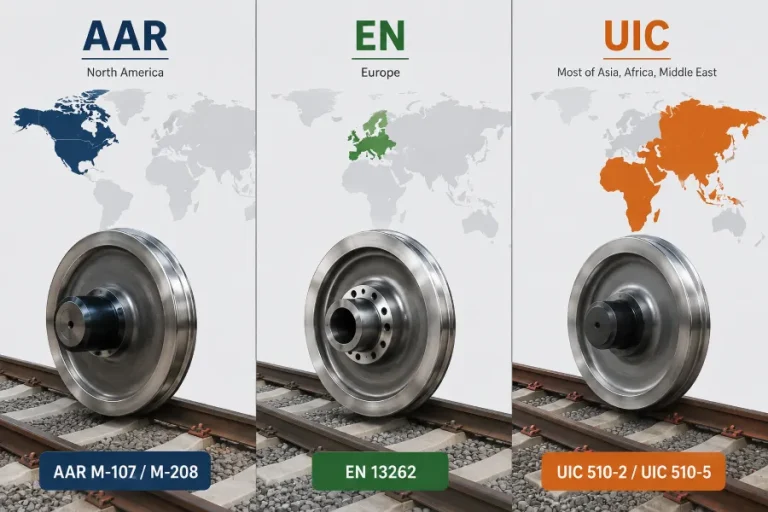
In our previous articles, we explored how different countries define wheel material standards and how wheel materials are chosen for various applications. This article focuses on how those material choices influence wear, cracking, and service life.
From an engineer’s point of view, things are a bit more complicated.
In real railway operations, the wheels that last the longest are not always the strongest ones on paper. What really matters is how the wheel material responds to wear, heat, and repeated contact with the rail, day after day, brake after brake.
Let’s break this down in plain terms.
You may notice that some railway wheels wear relatively quickly, yet almost never develop cracks or serious defects.
This is usually not an accident.
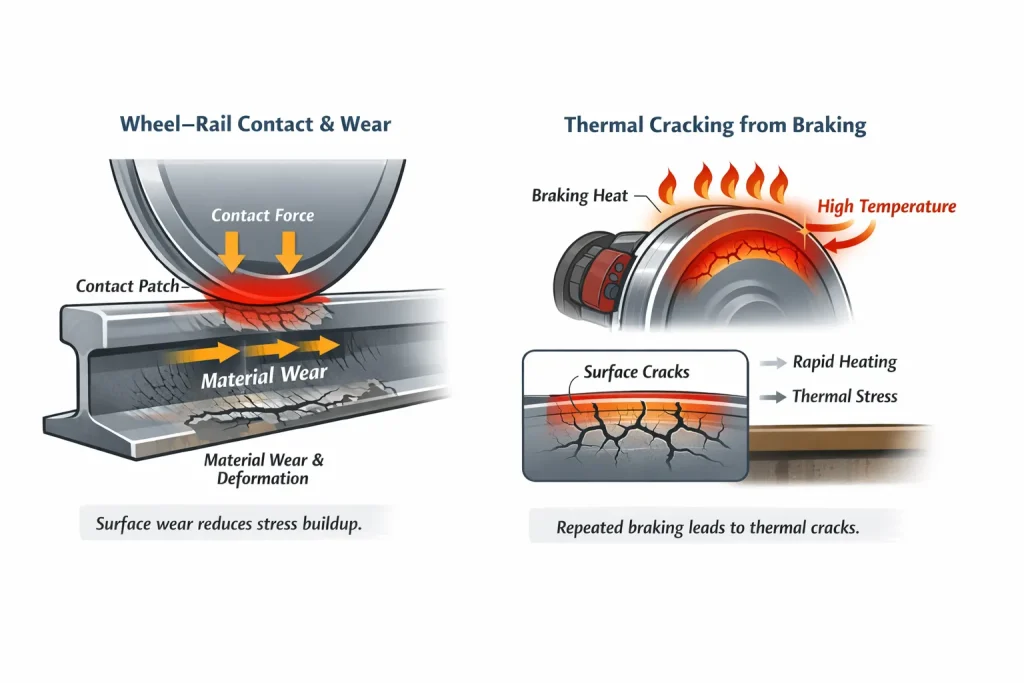
Softer or medium-hard railway wheel materials tend to absorb stress better. Under wheel and rail contact, the surface deforms slightly instead of resisting everything rigidly.
Softer or medium-hard railway wheel materials tend to absorb stress better. Under wheel and rail contact, the surface deforms slightly instead of resisting everything rigidly, as we discussed in Engineering Logic Behind Railway Wheel Material Selection. That controlled deformation helps release internal stress, so that it will not turn into cracks.
From a maintenance perspective, this means:
In many urban rail and metro systems, this trade-off is intentional. Engineers accept faster wear in exchange for stable, crack-resistant behaviour, especially on lines with frequent braking and tight curves.

Now let’s look at the opposite case.
High-strength wheel materials are excellent at resisting wear. On paper, they look ideal for heavy loads and long mileage. But there’s a catch — heat.
During braking, especially emergency or repeated braking, wheel tread temperature can rise rapidly. Harder materials have less ability to relieve thermal stress through deformation. Instead, stress accumulates near the surface.
Over time, this can lead to:
That’s why in some freight or high-speed applications, engineers have to carefully balance strength and thermal behaviour. Too hard, and the wheel survives wear but suffers from heat-related cracking. Too soft, and wear becomes excessive.
The “best” material is rarely the hardest one — it’s the one that manages heat and stress together.
Material selection directly affects the type of damage a wheel is most likely to experience in service.
Shelling happens when small pieces of material detach from the wheel tread surface.
This is strongly influenced by:
Materials that are too brittle or poorly heat-treated tend to accumulate subsurface fatigue cracks. Over time, these cracks link up and cause surface material to break away.
A well-chosen wheel material minimises this risk by maintaining a stable microstructure under repeated contact stress.
Thermal cracks are mainly caused by:
Material hardness alone does not prevent thermal cracking. In fact, materials with limited stress-relief capability may crack sooner under the same braking conditions.
This is why different rail networks — even using the same standards — may specify different material grades based on braking patterns and operating speed.
Flange wear is closely related to material hardness, work-hardening behaviour, curve radius and track conditions. Previous analysis on different rail applications (How Railway Wheel Materials Are Chosen for Various Applications) shows why softer materials often perform better in tight urban curves, reducing flange wear and surface defects.
In tight curves and urban environments, slightly softer materials often perform better. They wear gradually instead of chipping or cracking at the flange, resulting in more stable long-term performance.
Again, faster wear does not automatically mean shorter service life — if the wear is uniform and predictable.
From an engineering perspective, wheel service life is the result of material + operating conditions + maintenance strategy.
Two wheels made to the same standard can behave very differently if:
That’s why experienced wheel manufacturers don’t just ask, “Which standard do you need?”
They ask, “How will this wheel actually be used?”
In real railway operations, wheel performance is never determined by material grade alone. Wear behavior, thermal response, and crack resistance must all match the actual service conditions of the line.
At Luoyang Fonyo Heavy Industries Co., Ltd., we support customers by selecting and manufacturing railway wheels based on specific applications, operating environments, and relevant international standards. Our engineering team works closely with clients to ensure that material choice, heat treatment, and quality control align with long-term service performance — not just compliance on paper.
If you have any requirement for railway wheels or other railway parts, please contact us. Our engineering team will be glad to discuss your operating conditions and technical requirements.
Please visit our website to get more information about us. To understand the full picture of railway wheel materials, standards, and applications, you can also read:
Railway Wheel Material Standards Across Countries