Scan the WeChat code to contact us
Scan the WeChat code to contact us
Feel free to send us a email and we will reply to you as soon as possible.
Creating the future with heart and soul


Rolling stock components are the parts that make a railway vehicle move, carry load and stop safely. Wheels, axles, wheelsets and bogies are the main ones, but couplers, axle boxes, gearbox housings and brake parts are just as critical, and each has to be matched to the vehicle type and its operating conditions.
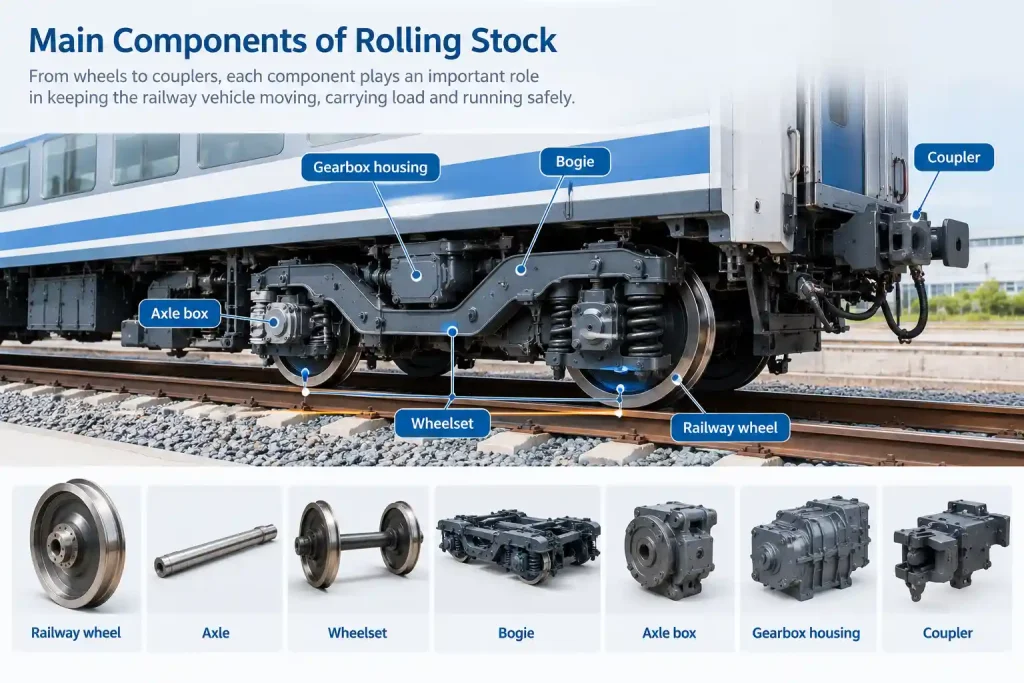
When you look at a locomotive, freight wagon or passenger train, it is easy to see it as one complete machine. In reality, a railway vehicle is made up of hundreds of individual parts and assemblies. Some carry the vehicle load, some transmit forces, and others guide, connect or protect the running system.
These parts are what we call rolling stock components.
The design of any given component changes with the type of vehicle and where it runs. A freight wagon has different requirements from a high-speed EMU. Even when two parts look similar from the outside, their material, dimensions, heat treatment and inspection requirements can be quite different.
I have seen this play out with parts that should have been interchangeable but were not. The outside dimensions matched. The material line on the drawing did not. That is the difference between a part that fits and a part that belongs on the vehicle.
Rolling stock means railway vehicles that operate on rails. This includes locomotives, freight wagons, passenger coaches, metro vehicles, EMUs and high-speed trains.
The individual parts used on these vehicles are known as rolling stock components, or railway vehicle components.
Some are directly related to the running gear, such as wheels, axles and wheelsets. Others are part of the bogie, vehicle structure, braking system or coupling system.
Common rolling stock components include:
The list gets much longer once individual assemblies and smaller components are included.
For a component manufacturer, though, the important question is not simply what the part is called. We also need to know where it is used, what loads it will see, which material is specified and what standard controls its manufacture.
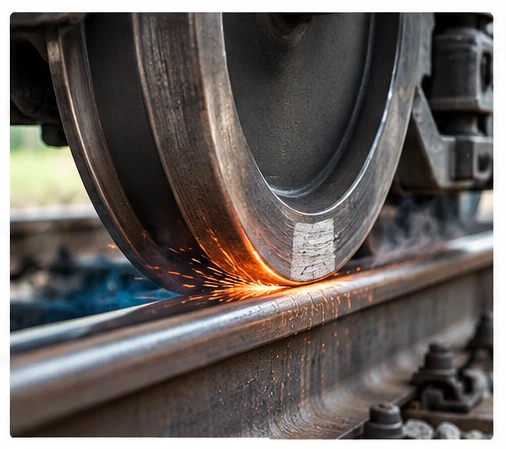
Railway wheels are among the rolling stock components most directly exposed to the operating environment. They carry the vehicle load and maintain contact with the rail while the train is moving.
A wheel has several functional areas: the tread, flange, rim, plate and hub. The geometry of each area matters. The tread and flange, for example, affect wheel-rail contact and vehicle guidance.
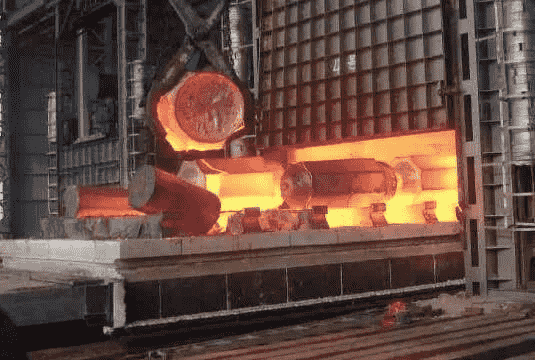
For many heavy-duty railway applications, wheels are produced by forging and forming, followed by heat treatment and machining. The exact production route depends on the wheel design and the applicable specification.
The machining stage is not simply about making the wheel look accurate. The final profile, bore, rim dimensions and other critical areas must meet the drawing and tolerance requirements.
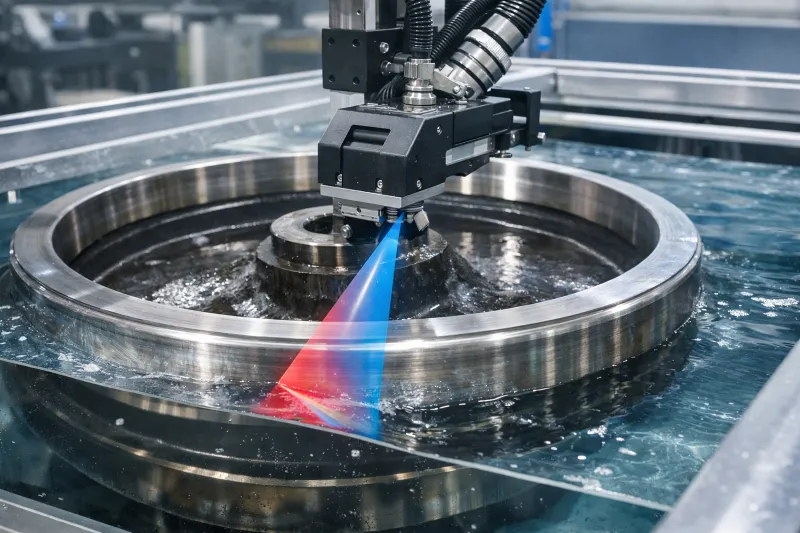
Inspection matters too. Depending on the specification, a forged railway wheel may require chemical analysis, mechanical testing, hardness testing, dimensional inspection and non-destructive testing such as ultrasonic testing.
When ordering wheels, giving only the wheel diameter is not enough. The supplier normally needs the drawing, material grade, wheel profile, bore dimensions, heat-treatment requirements and applicable standard.
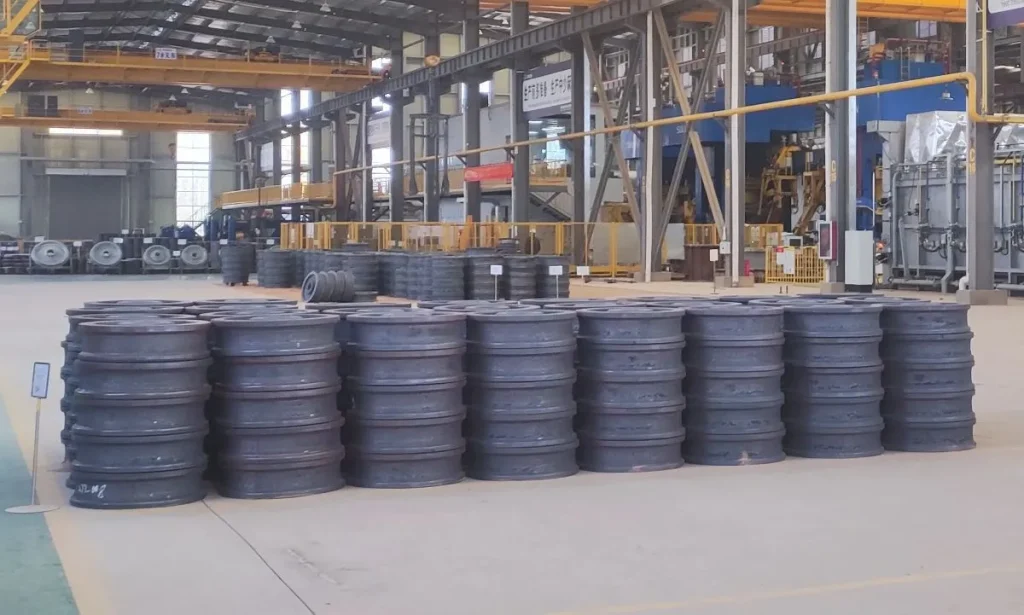
A railway axle connects the two wheels of a wheelset and transfers loads between the wheels and the vehicle.
Several areas of an axle have different functions. The wheel seats are used for wheel mounting, while the axle journals and bearing seats are associated with the bearing arrangement. Fillets and transition areas also need careful attention, because changes in geometry can affect local stress.
Railway axles are commonly produced from specified steel grades through forging, heat treatment and machining.
The machining tolerances can be quite different from one section of the axle to another. Bearing seats and wheel seats, in particular, require controlled dimensions and surface finish.
Internal quality is another concern. Ultrasonic testing is commonly used to inspect forged axles for internal discontinuities. Other inspections are carried out according to the applicable specification.
For this reason, an axle should be manufactured from a controlled drawing and specification, not from dimensions copied from a similar-looking product.
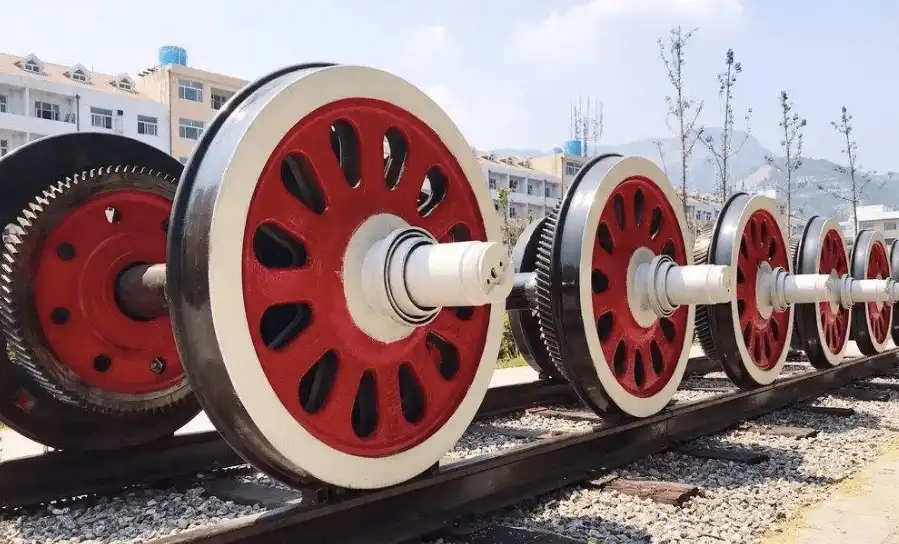
A wheelset normally consists of two railway wheels mounted on one axle.
The assembly looks simple, but the relationship between the three parts is closely controlled. Wheel bore dimensions, axle wheel-seat dimensions, press-fitting requirements and final wheelset geometry all have to work together.
After assembly, the wheelset may require dimensional checks and other inspections specified by the customer or the applicable railway standard.
Wheelsets are used on many types of rolling stock, but they are not interchangeable simply because they share the same basic arrangement.
A freight wagon wheelset and a high-speed train wheelset can have very different dimensions, loads, materials, wheel profiles and maintenance requirements. That is why the vehicle application should always be considered when selecting or manufacturing a wheelset.
The bogie sits underneath the vehicle body and supports it through the suspension and bogie structure. It also carries the wheelsets.
A typical bogie can contain bogie frames, side frames, bolsters, wheelsets, axle boxes, bearings, suspension components, brake components and other mounting and connecting parts.
Bogie construction varies considerably between different types of rolling stock. A freight wagon bogie is designed around relatively high axle loads and the operating conditions of freight service. A high-speed passenger bogie has different requirements related to speed, stability, ride quality and weight.
Some bogie components are cast steel parts. Side frames and bolsters are common examples in certain freight and railway applications. Other components may be forged, welded or machined.
For cast or forged bogie parts, dimensional control is only one part of quality control. Material properties, heat treatment and non-destructive testing may also be specified.

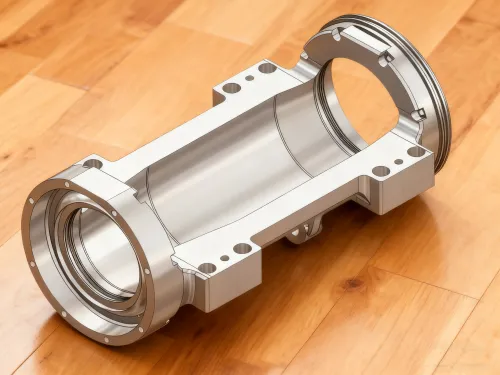
The axle box forms part of the connection between the axle bearings and the bogie structure.
Its exact design depends on the axle, the bearing arrangement and the bogie design. In service, it has to accommodate the loads transmitted through the wheelset while protecting and supporting the bearing arrangement.
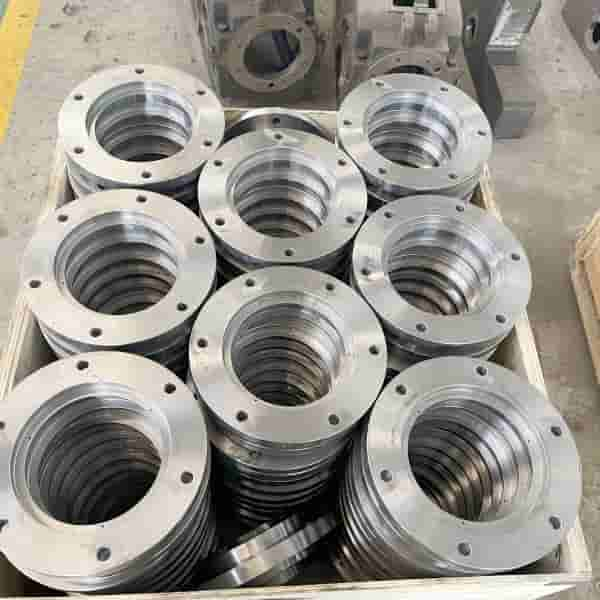
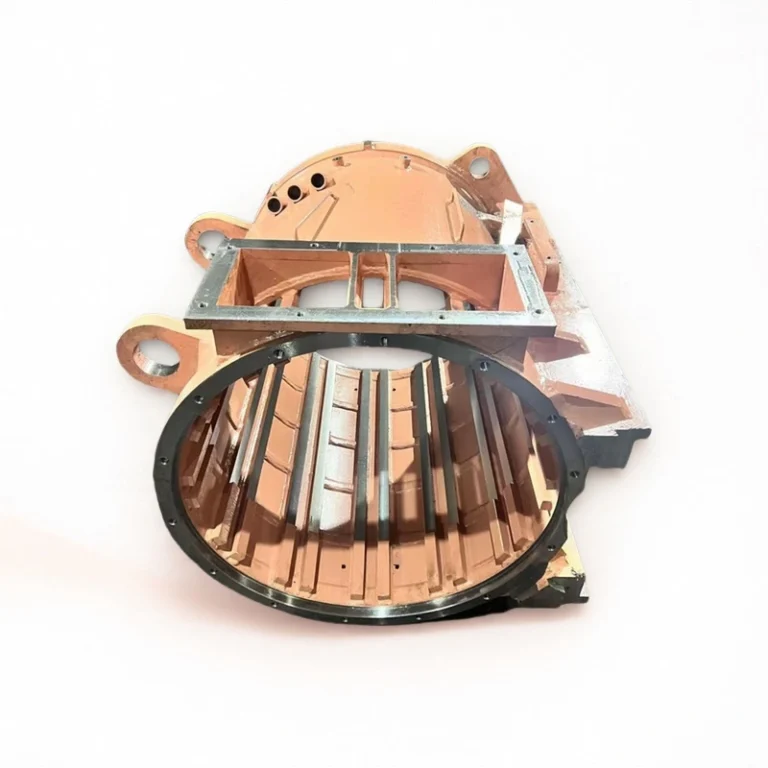
Axle boxes and related housings can be manufactured by casting, forging or other processes, depending on their shape and requirements. Machining is normally required on surfaces that mate with bearings, covers or other components.
When replacing an existing part, the bearing model and mating dimensions should be checked along with the main outside dimensions. Two housings can look almost identical while having different internal dimensions or mounting arrangements.
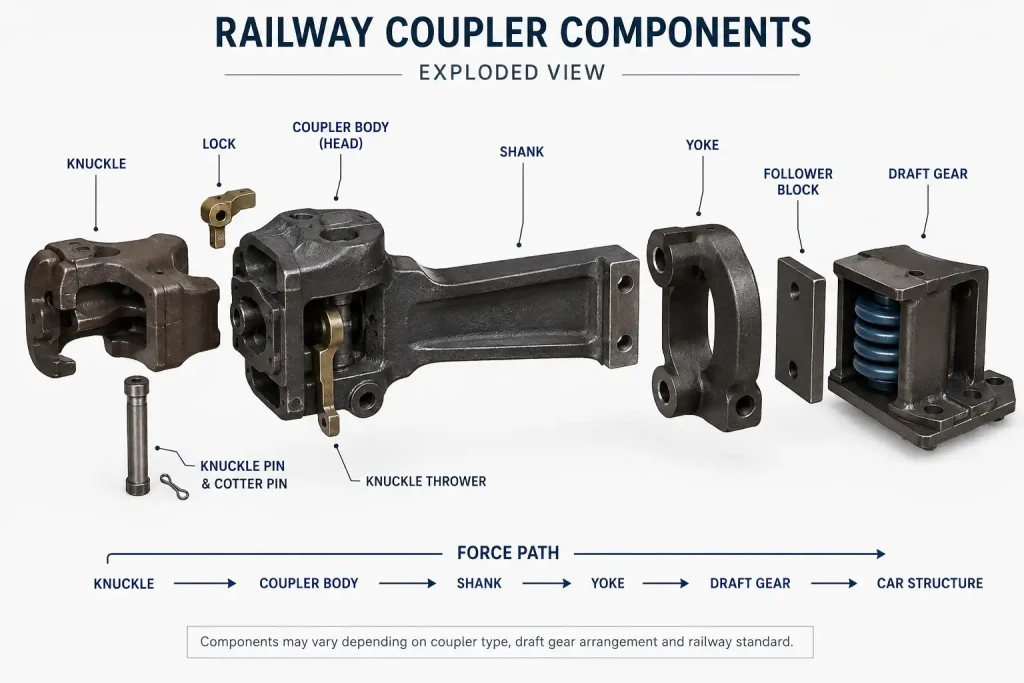
Railway couplers connect vehicles together. They transmit longitudinal forces when a train starts, stops, brakes or operates through shunting movements.
There are several coupler designs used in different railway systems. The requirements for a freight wagon coupler are not necessarily the same as those for a passenger or metro vehicle.
Depending on the design, coupler bodies and related parts may be cast or forged and then machined. Material properties and inspection requirements matter, because couplers can experience repeated tensile and compressive loads during service.
For a replacement coupler or coupler component, the drawing and applicable standard should be confirmed before production. Small differences in dimensions or connection details can prevent an otherwise correctly manufactured part from fitting the vehicle.
There is no single manufacturing process suitable for every railway component.
Forging is commonly used for components that require high strength and good fatigue performance. Wheels and axles are typical examples.
Casting becomes useful when the component has a large or complicated shape that would be difficult or uneconomical to produce by forging. Depending on the design, bogie side frames, bolsters and housings may be produced as cast steel components.
Machining is often used after either forging or casting to produce the final dimensions and surface finish. Heat treatment can also be an important stage, used to obtain the required combination of strength, hardness and toughness.
So when we talk about a “forged component” or a “cast component,” that describes only part of the production route. The finished part may still go through heat treatment, machining and several inspection processes before it is accepted.
Material selection depends mainly on the component’s function and its service conditions.
Steel is widely used in railway applications because many components have to withstand repeated loading, impact, vibration and, in some cases, wear. Depending on the component, materials may include forged carbon steel, forged alloy steel, cast steel, heat-treated steel, ductile iron for selected applications, and other specified engineering materials.
The material should always be selected according to the drawing and the applicable specification. The material requirements for a railway wheel cannot simply be transferred to a bogie casting, because the two components work under different conditions and have different manufacturing and inspection requirements.
When purchasing a component, it is useful to confirm the complete material requirement rather than only the material name. Chemical composition, mechanical properties, hardness and heat-treatment condition may all be specified.
Railway components are manufactured according to different national and international standards. Depending on the component and the market, buyers may work with standards or specifications from systems such as EN, AAR, UIC, ISO, JIS and GOST.
For example, EN 13262 is associated with railway wheel requirements, while AAR specifications are widely used for railway equipment in North American applications.
The same type of component can also have different requirements in different markets. This is why saying that a part should meet an “international standard” is usually not enough information for a manufacturer.
For a quotation or production order, it is better to provide the exact standard and revision, together with the drawing, material grade and technical requirements.
Railway components are subjected to repeated loading during their service life, so inspection is an important part of the manufacturing process.
The inspection plan depends on the component and the specification. It may include chemical analysis to confirm the material composition, mechanical testing to determine properties such as tensile strength and yield strength, hardness testing, dimensional inspection, ultrasonic testing to check for internal discontinuities, and magnetic particle testing to detect surface and near-surface indications in ferromagnetic materials.
For some products, the customer may also require heat-treatment records, material certificates, inspection reports or other quality documents. It is better to define these requirements before production starts, so the manufacturing and inspection process can be planned around them.
The type of rolling stock has a direct effect on the components used and their requirements.
Locomotives may contain railway wheels, axles and wheelsets, bogies, couplers, axle boxes, gearbox housings, motor-related components and cast and forged structural parts. Traction and braking forces can be significant, so the components have to be selected for the actual operating conditions of the locomotive.
Freight wagons typically use freight wagon wheels, axles, wheelsets, bogie side frames, bolsters, axle boxes, couplers and brake components. Axle load, cargo weight, operating speed and maintenance conditions all affect the design of these parts.
Passenger coaches and EMUs use many of the same basic component groups, but the requirements can be different. For higher-speed applications, wheel geometry, balance, material properties and inspection requirements become particularly important.
Metro vehicles typically experience frequent acceleration and braking cycles, with short intervals between stations and high annual mileage. For this type of application, the wheel profile, axle design, bogie arrangement and other running components need to be matched to the operating conditions of the metro system.
From a manufacturing point of view, a good starting point is always the drawing. The drawing tells the supplier what the finished component actually needs to be, and it can define dimensions, tolerances, material, heat treatment, surface finish and other requirements that cannot be understood from the product name alone.
It is also worth checking the supplier’s manufacturing capability. Can they handle forging or casting when required? Can they perform machining in-house? How is heat treatment controlled? What non-destructive testing is available? Can they provide material certificates and inspection records?
For OEM or replacement parts, drawings and samples can both be useful. A sample can help the manufacturer understand the physical shape, while the drawing provides the dimensions and technical requirements needed for production.
For larger or more complicated components, it is useful to discuss the manufacturing process before placing the order. This can identify potential issues with tooling, machining allowances, inspection points or material selection before production begins.
Rolling stock components cover a wide range of railway parts, from forged wheels and axles to cast bogie components and couplers.
Although these parts are different in shape and function, the same basic principle applies to all of them: the component needs to be designed and manufactured for its actual service conditions.
For a buyer, the drawing, material specification, manufacturing process, heat treatment, inspection requirements and applicable railway standard should all be considered together. That is particularly important when sourcing custom or OEM railway components, because the details that are not visible from the outside often determine whether a part will work correctly in the final vehicle.
At FONYO, we manufacture forged railway wheels, cast and forged railway components, and machined parts, with heat treatment and inspection in-house. If you have a drawing or sample for a rolling stock component, send us the requirements and we will review the material, process and specification together before quotation.
Rolling stock components are the individual parts used on railway vehicles, from wheels, axles and wheelsets to bogie parts, couplers, axle boxes and brake components. Some carry load, some transmit force, and others guide, connect or protect the running system.
Rolling stock is the broader term for all railway vehicles that run on rails, including locomotives, freight wagons, passenger coaches, metro vehicles, EMUs and high-speed trains. A locomotive is one powered type of rolling stock.
A wheelset consists of two wheels mounted on one axle. The relationship between the wheel bores, the axle wheel seats and the final press-fit geometry is closely controlled, which is why wheelsets are not interchangeable just because they look similar.
Because the service conditions differ. A freight wagon runs at high axle loads, while a high-speed passenger vehicle prioritizes speed, stability and ride quality. Even similar-looking parts can have different materials, dimensions and inspection requirements.
It depends on the design. Side frames and bolsters are often cast steel parts in certain freight applications, while other bogie components may be forged, welded or machined. The choice depends on shape, loads and the applicable specification.
Send the drawing and the complete specification: material grade, heat-treatment condition, mechanical properties, tolerances, testing and certification requirements, and the applicable standard and revision. A part name or a diameter alone is not enough.
The inspection plan depends on the specification, but it commonly includes chemical analysis, mechanical and hardness testing, dimensional inspection, and ultrasonic testing for internal discontinuities. Magnetic particle testing may also apply to surface indications.