Scan the WeChat code to contact us
Scan the WeChat code to contact us
Feel free to send us a email and we will reply to you as soon as possible.
Creating the future with heart and soul


Railway fasteners for heavy haul railways are not just bigger versions of the clips on a passenger line. They are specified around a different problem entirely: not vibration at speed, but sustained clamping under an axle load of 25 to 35 tonnes, year after year, at 50 to 100 million gross tonnes of annual traffic. The clip, the pad, the shoulder and the insulator have to be chosen as one matched system, because a fastener that holds a high-speed line beautifully will let a heavy-haul rail creep and roll within a few years.
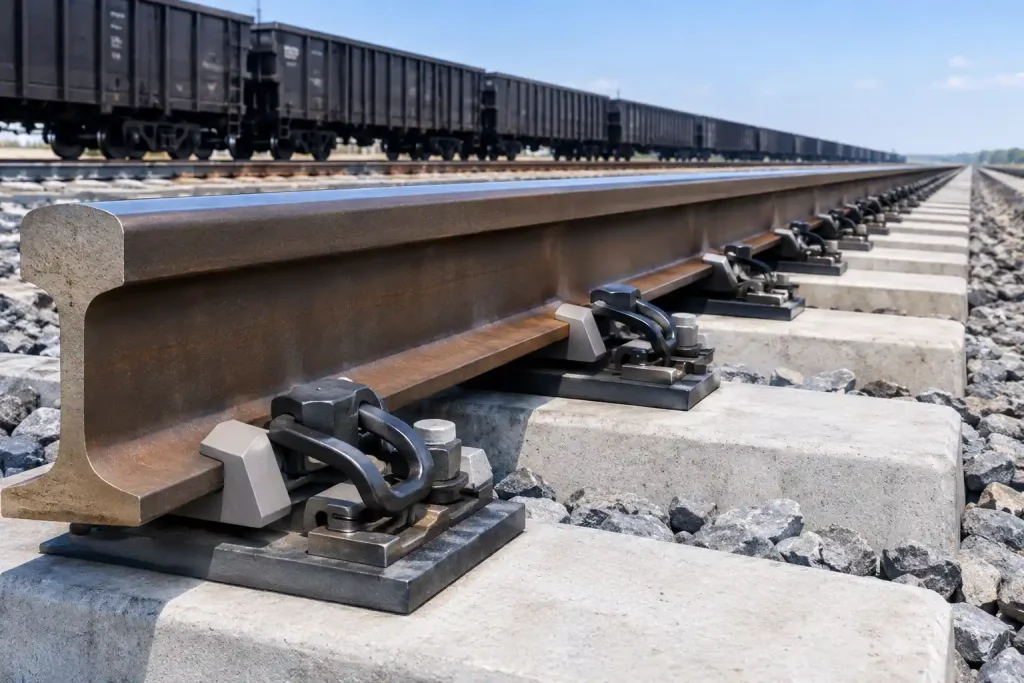
Most fastening failures on a heavy-haul corridor are not caused by a defective component. They are caused by a component that was specified for the wrong load profile.
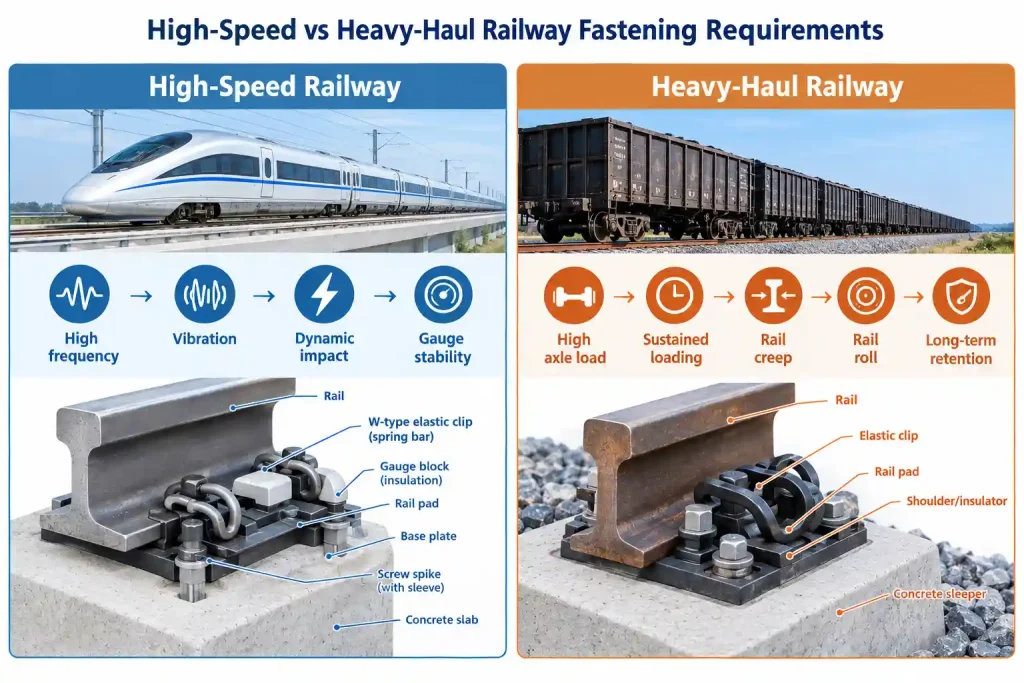
A high-speed line punishes a fastener with vibration. At 200 km/h and above, the wheel strikes the rail with a dynamic impact two to three times the static load, hundreds of times a minute. The fastener has to damp that energy and hold gauge to within fractions of a millimetre. It is a fight against high frequency and small amplitude.
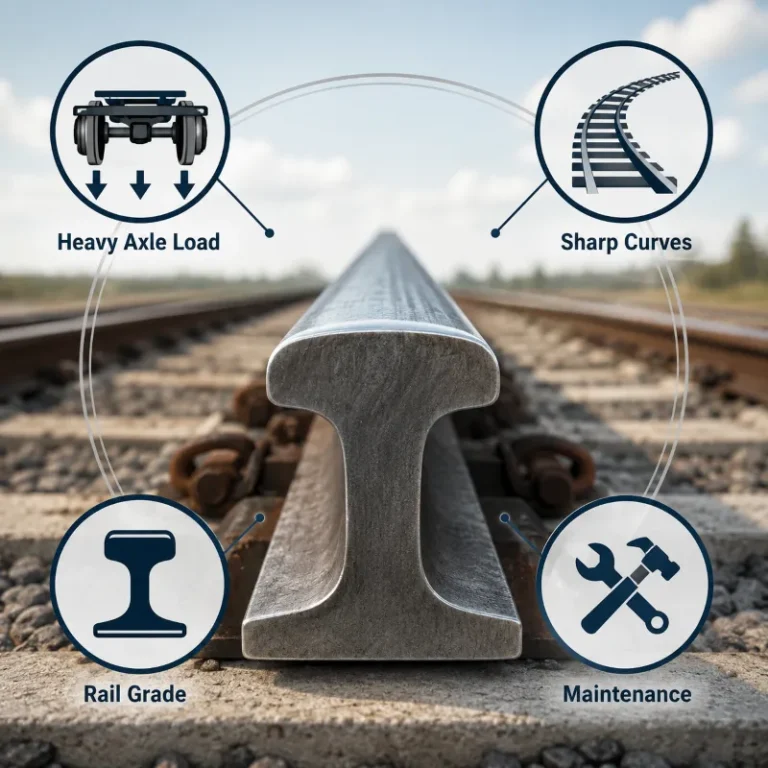
A heavy-haul line is the opposite. Axle loads of 25 to 35 tonnes arrive at 60 to 100 km/h. The impact factor is lower, but the load is enormous and it stays there. The fastener is not fighting vibration, it is fighting two slow forces: rail creep, the longitudinal movement of the rail under repeated braking and traction, and rail roll, the tendency of the rail to rotate out of gauge under a heavy wheel. It is a fight against high amplitude and low frequency.
That is why you cannot take a fastener system designed for one and expect it to last on the other. The requirements pull in opposite directions, and a specification that tries to satisfy both with a single number usually satisfies neither.
Before you compare toe loads, it is worth asking what is actually killing the components on a heavy-haul line.
The answer, most of the time, is not peak load. It is creep. On spike-fastened timber track, a rail can move five to eight millimetres a year under repeated braking. That movement grinds the fastening, hammers the ballast, and pushes the neutral temperature of continuous welded rail somewhere it should not be. A properly specified elastic fastening system holds the same rail to under a millimetre a year.
The second killer is pad failure. A pad on a heavy-haul line is not really there to soften the ride the way it is on a passenger line. It is there to protect the concrete sleeper from the impact of a 30-tonne axle and to stop the rail from crushing down through it.
Get the pad too soft, and the rail deflects too much under load. Get it too hard, and you lose the small amount of resilience that stops the sleeper cracking. On a heavy-haul line the pad runs stiff, typically 400 kN/mm and up, and it has to keep that stiffness for years, not months.
The third is fatigue in the clip. A heavy-haul clip does not see the millions of small cycles a high-speed clip sees. It sees fewer cycles, but each one is a full-amplitude deflection under a heavy wheel. The spring steel has to resist relaxation, the slow loss of clamping force over time, more than it has to resist outright breakage. When that relaxation is ignored, the result is rail clip failure that only shows up once gauge has already started to drift.
Here is the part that surprises people. A heavy-haul line does not always need a higher initial toe load than a high-speed line. It needs a toe load that survives.
Imagine two clips. One is specified for 16 kN on a high-speed line. The other is specified for 12.5 kN on a heavy-haul line. On paper the high-speed clip looks stronger. But what matters on the heavy-haul line is not the number the clip starts at, it is what the clip still holds after 50 million gross tonnes of traffic have passed over it. A clip with a low creep rate in its spring steel, one that keeps its force as the pad takes set and the rail works, will hold gauge longer than a clip with a higher initial number and a steeper relaxation curve.
This changes the material conversation. For heavy haul, I would be cautious about choosing a clip simply because it has the highest initial clamping force. I would want to see the relaxation data, the fatigue evidence under full-deflection cycling, and the spring steel grade the clip is made from. Stronger is not automatically better. Retention is better.
On a passenger line the rail pad is often picked for vibration damping. On a heavy-haul line that logic is backwards.
A heavy-haul pad is a load-carrying component. Under a 32.5-tonne axle it has to limit rail deflection, spread the load over the rail seat, and protect the concrete sleeper from impact damage, all while resisting the crushing that comes from a heavy wheel pressing down through the rail foot. Polyurethane pads have earned their place here because they hold their stiffness over time better than standard rubber under sustained compression.
The stiffness is usually specified, not guessed. A heavy-haul pad might be specified at 400 to 600 kN/mm of static stiffness, and the point of that number is to keep rail deflection within a few millimetres under load. That is a very different job from the soft, damping pad under a high-speed rail. When a pad is chosen only because it is cheap or because it worked on a passenger line, it tends to crush, take a permanent set, and quietly change the rail height and the clamping force. Nobody notices until the gauge starts to drift.
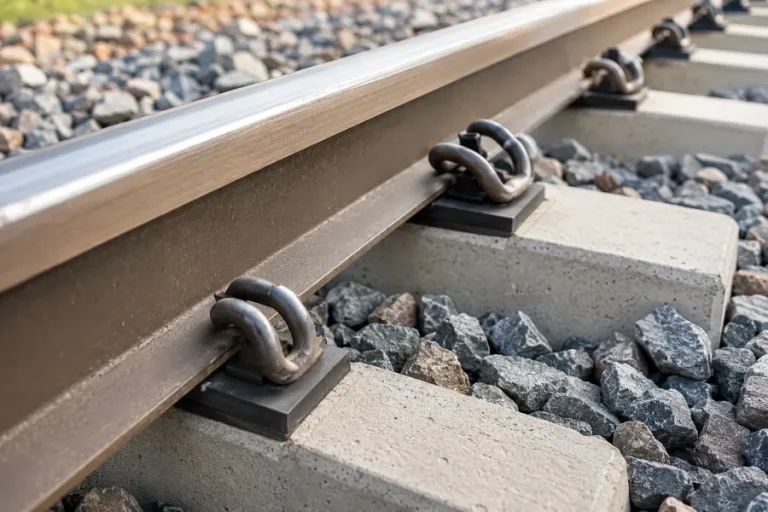
The elastic rail clip on a heavy-haul line does two jobs at once. It holds the rail down against the pad, and it holds the rail against longitudinal creep.
That second job is where a lot of systems fall short. The clip’s toe load pushes down, but creep resistance comes from the whole assembly working together: the clip gripping the rail foot, the shoulder or insert anchoring into the sleeper, and the pad providing the friction surface that resists the rail sliding. A system with a nominal creep resistance of 9 kN or more per fastening point is what holds a heavy-haul rail still under braking. Below that, the rail walks.
This is also why the shoulder matters. On concrete sleepers the shoulder is usually cast in, and it has to be ductile enough to absorb impact without cracking and strong enough to anchor the clip through years of lateral load. A cast-iron shoulder on a timber tie, or a cast-in shoulder on a concrete tie, is not a detail. It is the part that transfers the clip’s force into the ground.
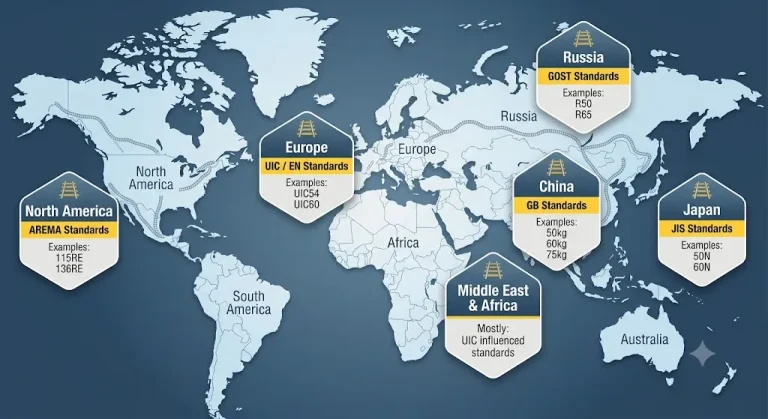
If you are writing a specification for railway fasteners for heavy haul, the standards are your friend, because they give you numbers you can put in a contract.
EN 13481-2 is the performance standard for fastening systems on ballasted track with concrete sleepers, and heavy-haul systems are tested and homologated against it. The individual performance tests are set out in the EN 13146 series: creep resistance per EN 13146-1, toe load per EN 13146-7, electrical resistance per EN 13146-5, and pad static stiffness per EN 13146-9.
In North America, AREMA Chapter 30 plays the same role for freight track, and a system like Vossloh’s System W 14 in heavy-haul configuration carries homologation against both EN 13481-2 and AREMA Chapter 30. The point of citing these is not to name-drop. It is that a heavy-haul fastener should come with test evidence against a named standard, not with a claim that it is “heavy duty”. The word “heavy duty” is not a specification. The numbers from a homologated system are.
This is the part I keep coming back to, because it is where procurement goes wrong most often.
A fastening system is not a shopping list of parts you can pick from different catalogues. The clip toe load, the pad stiffness, the shoulder geometry and the insulator material are designed together, and they are matched to a specific rail section and sleeper. Change the pad to a stiffer one from another supplier and you have quietly changed the rail height, the clamping force and the gauge. Buy a clip that does not match the shoulder and it will not seat. Railway fasteners for heavy haul are bought as a system, from one design family, homologated together against a standard.
The same discipline applies to the joints. On a heavy-haul line the fish bolts and fish plates at the rail joints take the full creep and impact load, and their grade has to match the joint load, not just be “high strength”. A bolt grade specified for a light rail will work loose under a 30-tonne axle and take the joint with it.
If you are putting railway fasteners for heavy haul out to tender, there are a few questions that separate a real supplier from a reseller.
Ask for the homologation evidence against a named standard, EN 13481-2 or AREMA Chapter 30, for the complete system, not for each part in isolation. Ask for the toe load retention data, so you know what the clip holds after cycling, not just what it holds when new. Ask for the creep resistance figure, measured per EN 13146-1. Ask for the pad stiffness and its long-term retention, because a pad that loses stiffness under sustained load is a future gauge problem. And ask for traceability, so any batch of clips, pads or bolts can be followed back to its heat number and its inspection record.
A supplier who can only tell you the fastener is “for heavy haul” is not telling you much. A supplier who can show you the homologation report, the retention curves and the material certificates is giving you what you actually need.
A heavy-haul fastener is one of the least glamorous parts of a railway, and one of the most consequential. It is the point where a 35-tonne axle load meets the ground, and everything about it, the clip, the pad, the shoulder, the insulator, has to hold that load still, year after year, without the rail creeping out of gauge.
Whether you are specifying railway fasteners for heavy haul on a new line or replacing worn components on an existing one, the worthwhile questions are about retention and creep resistance, not about peak numbers. Get those right and the fastening does its quiet job for decades. Get them wrong and the rail starts walking, and no amount of re-tightening brings it back.
At FONYO, we manufacture elastic rail clips, rail pads, fish plates and fish bolts for rail fastening systems, produced to the material, heat treatment and performance requirements of standards like EN 13481 and AREMA. If you are specifying railway fasteners for heavy haul line, send us your rail section, axle load and sleeper type, and we will come back with a technical assessment of the right system for the job, not a sales pitch.
Heavy-haul fastening systems are typically designed for axle loads of 25 to 35 tonnes. Systems like Vossloh’s System W 14 in heavy-haul configuration are homologated for up to 35 tonnes, and heavy-haul corridors commonly carry 25 to 32.5 tonnes with annual tonnage of 50 to 100 million gross tonnes.
Not necessarily. A heavy-haul line needs a toe load that survives sustained load, not a higher initial number. What matters is retention after cycling and resistance to relaxation in the spring steel, which is a different requirement from the peak clamping force a high-speed line asks for.
Rail creep is the slow longitudinal movement of the rail under repeated braking and traction. On heavy-haul lines it accumulates quickly, and if the fastening cannot resist it, the rail walks out of neutral and stresses the continuous welded rail. A proper elastic fastening system holds creep to under a millimetre a year.
Heavy-haul pads run stiffer than passenger pads, typically around 400 to 600 kN/mm of static stiffness, to limit rail deflection and protect the concrete sleeper. The exact figure is set by the system design and verified against EN 13146-9.
I would not recommend it. The two applications pull the fastening in opposite directions, vibration control against creep resistance, and a system specified for one will degrade early on the other. Fasteners should be specified against the axle load and traffic profile of the line they will actually run on.