Scan the WeChat code to contact us
Scan the WeChat code to contact us
Feel free to send us a email and we will reply to you as soon as possible.
Creating the future with heart and soul


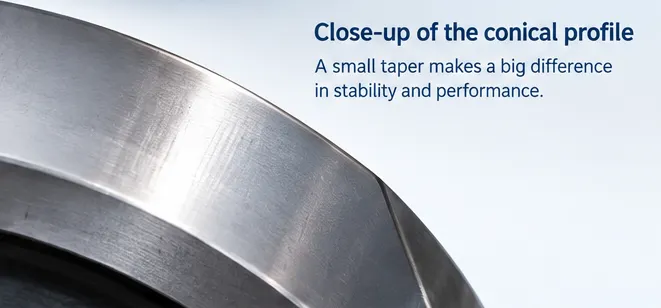
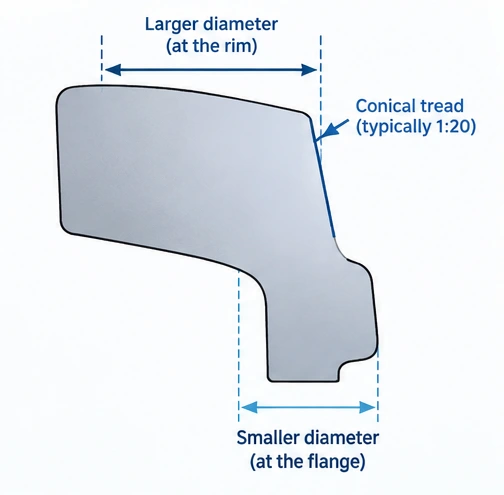
Railway wheels are not a cylinder. The surface that runs on the rail, the tread, is machined into a very slight cone, larger in diameter near the flange and smaller toward the outside.
The nominal tread conicity of many conventional railway wheels is 1 in 20, meaning that in an ideal conical profile the rolling radius changes with lateral displacement. Real wheel profiles are more complex, so the effective, or equivalent, conicity also depends on the railway wheels and rail profiles, the track gauge, and the rail inclination.
That slope is not a manufacturing convenience. It is the geometry that helps a rigid wheelset steer itself through a curve without a differential and without relying on the flange.
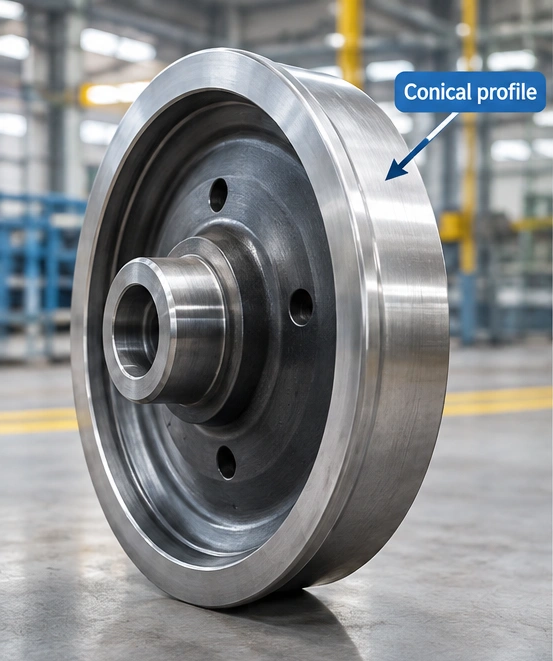
Most people assume the flange steers a train. It does not, at least not in normal running. If you look closely at a wheel that has been in service, the tread is burnished and shiny, but the flange is not.
In normal running the tread carries the load and does the steering, while flange contact depends on the curve and the operating conditions. When the flange does touch the rail, most of the contact is sliding, which is why it produces that harsh metallic squeal in sharp curves. The real job of railway wheel flanges is as a fail-safe, not a steering mechanism.
The actual steering happens through the cone.
Imagine two wheels pressed onto the same solid axle. Because they are fixed together, they must rotate at exactly the same angular speed, one revolution together. On a straight, centred track, both wheels touch the rail at the same rolling radius, so they travel the same distance and the wheelset runs true.
Now push that wheelset a little to one side. The wheel nearest the flange now rides on a larger diameter, while the other wheel rides on a smaller one. Same rotation, different rolling radii, different distances travelled. That difference in rolling radius creates a yawing tendency that steers the wheelset and helps it follow the track. The actual motion also depends on the suspension and the wheel–rail contact conditions, but the geometry does the heavy lifting, and it costs nothing in moving parts.
A road vehicle solves the problem of a corner differently. The outer wheel has to travel further than the inner wheel, so a car uses a differential, a gearbox that lets the two drive wheels spin at different speeds.
A conventional railway wheelset gets the same effect without one. Because the two wheels are rigid on the axle, the wheel–rail geometry itself provides the differential action: the outer wheel rides on a larger rolling radius and the inner on a smaller one. A mechanical differential would add weight, complexity, and a point of failure exactly where you least want one, so the tapered wheelset remains the simpler, more robust answer. There are no moving parts to wear out, no lubrication, nothing to jam.
The cone does not work alone. The rail is not flat-topped either. It is canted inward, commonly at 1 in 40, although some railways use other values such as 1 in 20. The rail inclination and the wheel profile are not a simple fixed pair. They have to be considered together with the rail profile and the track gauge, because those parameters jointly decide the wheel–rail contact conditions.
That inward cant does two useful things. It moves the contact point away from the gauge corner of the rail and toward the centre of the rail head, which spreads the load better and lets the wheel cone make clean contact with a surface that is itself slightly tilted.
This is also why rail grinding and wheel reprofiling matter so much. The wheel and the rail are a matched pair of shapes. Let either one drift far from its designed profile and the other starts to suffer.
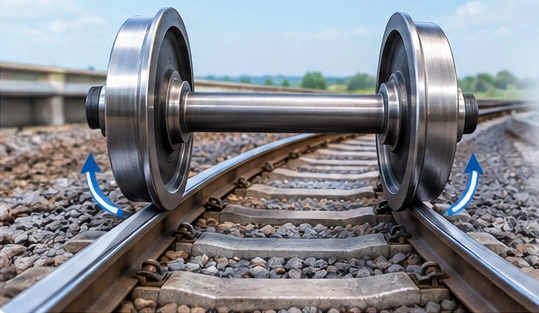
Here is the part most explanations skip. The conical wheel gives you self-steering, but it also introduces a stability problem.
Hunting is a lateral and yawing oscillation of a wheelset or a bogie. It can develop when the dynamic interaction between the wheel–rail contact geometry, the vehicle inertia, and the suspension characteristics becomes unstable. Its onset depends on the vehicle design, the wheel and rail profiles, and the operating conditions. At low speed the movement is a gentle, almost imperceptible sway. Above a critical speed it can build, and excessive hunting increases wheel and rail wear and, under severe conditions, can contribute to derailment risk.
The wavelength of that oscillation was worked out by Klingel back in 1883. For an ideal conical wheelset it depends on the rolling radius, the effective gauge, and the conicity, so a steeper cone gives a shorter and more energetic hunting. Real analysis also has to account for the nonlinear wheel–rail contact and the suspension.
That tension between curving and stability is the central question in every wheel profile decision. It is also the same tread that suffers damage like railway wheel flat spots when a wheel locks and slides, because any damage to the tread disturbs the very profile the steering depends on.
Which brings us to the real engineering trade-off, and the reason not every railway wheel is a 1 in 20 cone.
A steep cone steers well through curves but tends to hunt harder at speed. A shallow cone is more stable at speed but does less self-steering, so it relies more on the flange in curves.
High-speed railway wheels therefore often use specially designed, non-linear tread profiles to control the equivalent conicity and keep the vehicle stable, rather than adopting a single universal taper. The right profile is chosen against the operating speed, the suspension, the track geometry, and the wheel–rail contact requirements. A freight wagon that spends its life on winding, lower-speed track can afford a fuller taper.
There is a subtlety here that is easy to miss. As a wheel wears, its conicity changes, and the direction of that change depends on the original profile and how the railway wheel was used. Wear can increase the equivalent conicity or reduce it, so the outcome is not the same for every wheel.
That is one reason modern wheels use a “worn” profile rather than a pure geometric cone. The profile is shaped to the form a wheel settles into anyway, which balances contact stress, wear, fatigue and vehicle dynamics, at the cost of needing a controlled reprofiling regime to keep it there. Choosing that profile, and matching it to the rail and the duty, is the core of railway wheel design.
The cone is so fundamental that the railways that tried to do without it are instructive. The examples below are worth keeping, though they are individual cases rather than a universal rule.
The Bay Area Rapid Transit system in San Francisco was built with cylindrical railway wheels and flat-topped rails. It worked, after a fashion, but passengers complained for years about the squeal, and in 2016 BART began re-profiling its wheels to conical treads. Queensland Railways in Australia ran cylindrical wheels on vertical rails until the mid-1980s, when rising axle loads made the practice untenable and it moved to coned wheels.
Neither system was wrong in a simple way. Cylindrical railway wheels are stable at speed because they do not hunt. The price was that every curve became a flange problem. Conical railway wheels trade a little straight-line stability for a lot of curve capability, and most railways have decided that is the better bargain.
If you specify or buy wheels, the taper is not a detail you can ignore.
The conicity is a designed parameter, not a generic slope. It has to match the rail profile, the rail cant, the track gauge, and the intended speed and axle load. A wheel reprofiled to the wrong taper can hunt on straight track or grind its flange through curves. The correct figure comes from the network standard and the vehicle dynamics work, not from habit.
This is also why dimensional inspection matters as much as material quality. The taper is small, a matter of a millimetre or two across the tread, and it is easy to get subtly wrong. A railway wheel that looks round and fine at a glance can have a conicity that is a long way from what the vehicle was designed around.
The railway wheel has to be measured, not eyeballed. The taper is one of the first things a proper dimensional check confirms, which is why it sits at the heart of railway wheel dimensional inspection. Get the profile wrong and the best steel in the world will still hunt or grind its flange.
At Luoyang Fonyo Heavy Industries Co., Ltd., we manufacture railway wheels to the specified wheel profile, dimensions, and the applicable product requirements, and depending on the project the inspection can include tread profile and dimensional verification against the agreed technical specification. If you are specifying wheels, or want a technical view on the right profile and conicity for your track and operating speed, send us your rail profile, gauge and duty. We will come back with an engineering assessment, not a sales pitch.
Because the taper is what lets a rigid wheelset steer itself. When the wheelset shifts sideways, the two wheels ride on different rolling radii, travel different distances per revolution, and the axle curves back toward centre without any moving parts. A cylindrical railway wheels cannot do this, so every curve becomes a flange-grinding problem.
Not in normal running. The flange is a fail-safe. It only contacts the rail on tight curves or when something goes wrong, and that contact is mostly sliding, which is why it squeals. The conical tread does the actual steering.
Many conventional wheels use a nominal tread conicity of 1 in 20, and the rail is commonly canted inward at 1 in 40, although some railways use other values such as 1 in 20. High-speed wheels often use specially designed tread profiles to control equivalent conicity rather than a single fixed taper.
It is a lateral and yawing oscillation of a wheelset or bogie that can develop when the wheel–rail geometry, the vehicle inertia and the suspension interact unstably. It is gentle at low speed but can build above a critical speed, and controlling it is a central part of wheel and suspension design.
A conventional railway wheelset gets the differential effect through the wheel–rail geometry itself, so a mechanical differential would add weight, complexity and a failure point without much benefit.
No. As a wheel wears, its conicity changes, and it can increase or decrease depending on the original profile and the service conditions. That is why profile design and reprofiling schedules have to consider both stability and wheel–rail contact performance.