Scan the WeChat code to contact us
Scan the WeChat code to contact us
Feel free to send us a email and we will reply to you as soon as possible.
Creating the future with heart and soul


A railway wheel flat spots, sometimes called a wheel flat spot or skid flat, is a flattened patch worn into the tread of a railway wheel when the wheel locks up and slides along the rail instead of rolling. It is one of the most common and most easily recognised forms of wheel damage, and it produces the rhythmic “thump-thump-thump” that passengers hear most often in autumn.
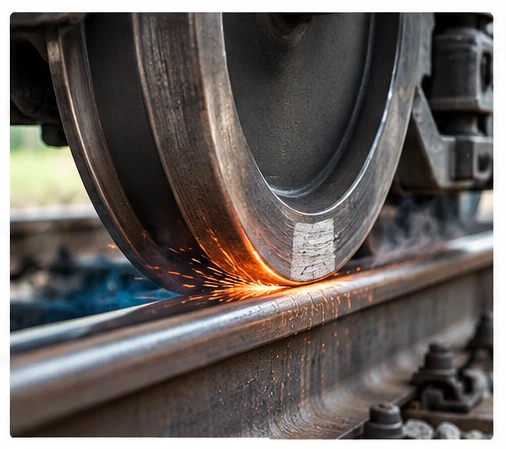
That is the whole mechanism in one line. railway wheel flat spots are not something that grows slowly over months. It happens in seconds, during a single slide.
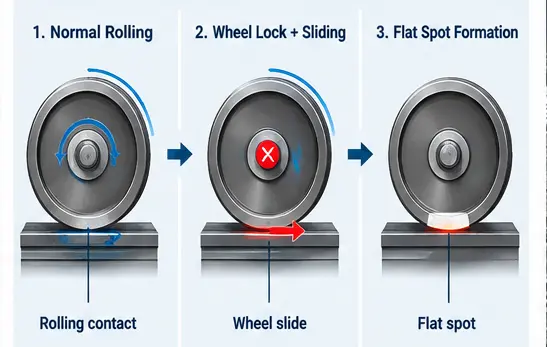
Picture a wheelset rolling normally. The wheel tread and the rail are in rolling contact, so the surface of the wheel moves at the same speed as the train. Now something locks that wheel. The brake stays applied, or the axle seizes, or the adhesion at the contact patch drops below the braking force. The wheel stops rotating, but the train has momentum and keeps going. The locked wheel is dragged along the rail, and the rail grinds a flat into the tread at the point where the wheel is touching it.
It sounds obvious. What nobody tells you is how quickly it happens and how much damage a single event can do.
There are really two different ways a wheel ends up sliding. The first is low adhesion. Wet leaves, oil, grease, or a thin film of water lower the friction between wheel and rail, so the wheel slips under braking even though nothing is mechanically wrong. The second is a mechanical lock: a brake that fails to release, a seized bearing, or a handbrake left applied on a freight wagon. In the first case the slide is usually brief and recovers when the wheel reaches dry rail. In the second it can continue for miles.
I have lost count of the number of times “railway wheel flat spots” was reported and the real cause turned out to be a handbrake that never fully released. The wheel was fine. The brake was the problem.
Autumn is when the phones start ringing. It is not a coincidence.
When leaves fall onto the rail, they are crushed by passing wheels into a hard, black, slippery layer that can cling to the railhead. This layer has a coefficient of friction far below what a bare steel rail offers. It also does not wash off easily. A mature tree can drop tens of thousands of leaves, and across a network the total is measured in thousands of tonnes. The result is a stretch of rail where braking distance is much longer and wheels lock up far more easily.
The same effect appears in winter with snow and ice, and in summer with oil, grease, and industrial or agricultural contamination that gets onto the railhead. The common factor is never the season itself. It is that something has dropped the available adhesion below the traction or braking force being asked of the wheel.
This is worth saying plainly: railway wheel flat spots are not a sign the wheel was poorly made. It is a sign the wheel-rail interface lost grip. You can machine a wheel to a perfect profile and still put a flat in it on the first wet autumn morning if the braking system cannot manage the slide.
Here is the part most explanations skip, and it matters for anyone deciding whether a wheel can stay in service.
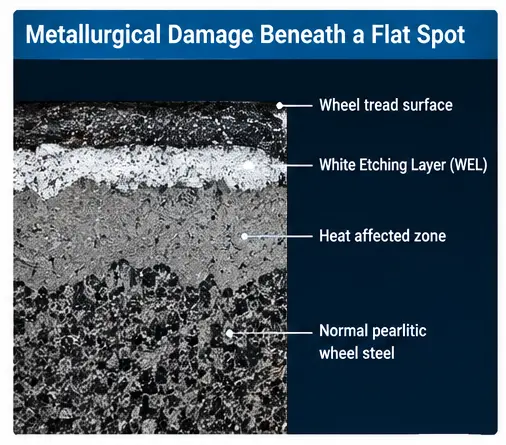
When a locked wheel slides, the friction generates intense local heat at the contact patch. That heat can be enough to austenitise a very thin layer of the tread surface. When the slide ends and the metal cools rapidly, that layer can transform into martensite, a hard but brittle structure. Under a microscope this shows up as a white etching layer, often shortened to WEL.
This is not the heat treatment the wheel was given at the factory. It is an accidental, uncontrolled re-heating of the tread surface, and it sits on top of the steel’s intended microstructure. How the wheel responds to this depends on how it was heat treated in the first place, which is why railway wheel heat treatment matters when you are specifying a wheel that will run in low-adhesion conditions.
A WEL is not neutral. It is harder and more brittle than the pearlitic wheel steel around it, and the boundary between the two is where rolling contact fatigue cracks like to start. Once the railway wheel flat spots are created, every rotation hammers that brittle layer and the material around it. Cracks initiate at the back edge of the flat zone and can grow with continued running. A flat that looks small on the surface may already be carrying the beginnings of fatigue damage underneath it. This is the same mechanism I cover in more depth in my article on railway wheel cracks, where the fatigue crack starts and why it is often invisible until it is too late.
This is why I am always cautious about a wheel that “only has a small flat.” The visible flat is one thing. The heat-affected zone beneath it is another, and you cannot see that with the naked eye.
The immediate symptom is noise and vibration. The flat means the wheel is no longer perfectly round, so every revolution delivers an impact to the rail instead of a smooth load. The larger the flat, the larger the impact.
That impact travels. It goes up through the axle and into the axle box, into the bearings, into the bogie frame. It also goes down into the rail, the fastenings, and the sleepers. A wheelset with an untreated flat does not just wear itself out faster. It accelerates wear and fatigue on every component around it.
There is also the metallurgical legacy I mentioned. The heat from the slide changes the steel, and the repeated impacts afterwards grow cracks. So a flat is a mechanical problem, a noise problem, and a fatigue problem all at once. It is one member of a wider family of railway wheel defects, and it rarely exists on its own. A wheel that has flat-spotted has often picked up the conditions for other damage too.
In the worst cases the consequences are not gradual. In 2018 a rail head treatment train derailed near Dunkeld and Birnam in Scotland. The Rail Accident Investigation Branch found that a wheelset had slid and developed large flats, and continued running had worn a groove and a “false flange” into the wheel. That false flange caught in a set of points and the wheelset derailed. It is an extreme example, but it shows what the chain from a locked wheel to a derailment looks like when nobody catches it early.
Railways do not leave this to judgement. They set dimensional limits.
Different networks express the limit differently, but the principle is consistent: there is a flat length above which the wheelset must come out of service, and below which it may be allowed to run, sometimes under a speed restriction, until it reaches the workshop. In the UK, the relevant railway group standard requires wheelsets with flats of a certain length to be withdrawn. The numbers that appear in maintenance manuals typically sit in the tens of millimetres, and the threshold depends on wheel diameter. A smaller wheel simply cannot tolerate as long a flat as a larger one.
The exact figure you apply should come from the network standard and the vehicle maintenance plan for your fleet, not from a general article. What matters more than the precise number is that the limit exists and that it is tied to impact force, not just to appearance. If you want the full picture of how railway wheel standards set these limits, the governing documents are the place to look, and they are worth reading before you accept any wheel into your fleet.
The table below is a simplified guide to the thinking, not a replacement for your governing standard.
| Wheel diameter | Typical flat length considered severe | Typical response |
| Large diameter (freight/locomotive) | Roughly 60 mm or more | Withdraw for re-profiling |
| Smaller diameter (metro/light rail) | Roughly 30 mm or more | Withdraw for re-profiling |
| Below the threshold | Short flat, often with a speed restriction | Schedule re-profiling at next maintenance |
This is a starting point, not a universal railway specification. Always apply the limit stated in your network standard and vehicle maintenance plan.
A flat spot announces itself as a rhythmic thump, but by the time a human ear reliably notices it, the damage may already be significant. Worse, as the sharp edges of the flat wear round, the noise actually decreases, which makes the problem easier to ignore exactly when it should be getting attention.
That is why modern fleets rely on trackside and onboard detection rather than listening alone. Wayside impact detectors measure the wheel load as each wheelset passes and flag wheels that deliver an abnormal impact. Some systems count the impact energy across several wheel rotations and can estimate how recently a flat was formed. Onboard systems look at wheel-rail forces and axle acceleration. Together they catch flats early, while they are still cheap to fix.
For freight operations and yards, a roll-by inspection on departure is still one of the simplest and most effective checks. A person watching the wheels of a departing train can spot a non-rotating wheel, which is the single most important precursor of a flat. After the Dunkeld and Birnam derailment, RAIB specifically recommended roll-by examinations to detect non-rotating wheels before a train leaves a yard.
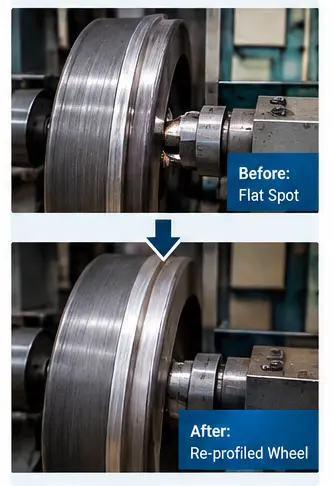
The repair is always the same in principle: remove the flat and make the wheel round again.
A wheelset lathe, sometimes called a wheel truing machine, cuts the tread back until the flat is gone and the profile is restored. This is routine, but it is not free. Every re-profiling removes a layer of material and shortens the wheel’s service life. A wheel can only be trued so many times before it reaches a minimum diameter and must be replaced entirely.
The decision between truing and replacement depends on how deep the flat is and how much material is left. A shallow flat on a wheel with plenty of tread life is a straightforward re-profile. A deep flat, or a wheel that has already been trued several times, may be a replacement.
There is one more thing to consider before the wheel goes back out. If the flat came from a mechanical lock, the wheel is only half the story. You have to find and fix the brake or the bearing that caused the slide, otherwise the freshly trued wheel simply comes back with a new flat in a few weeks.
You cannot stop leaves falling, and you cannot stop the weather. What you can do is manage the two things that actually cause a slide: adhesion and braking.
On the adhesion side, the tools are railhead treatment and sanding. Cleaning trains jet or scrub the contamination off the rail. Sanding systems on locomotives and multiple units apply a fine layer of sand to the railhead to restore grip at the moment of braking or acceleration. These are old ideas, but they are still the most reliable ones.
On the braking side, the key device is wheel slide protection, usually shortened to WSP. WSP works like anti-lock braking on a car. It senses when a wheelset is about to lock, momentarily releases the brake on that axle, and lets the wheel keep rotating so a slide never fully develops. It cannot create adhesion that is not there, but it stops a momentary loss of grip from turning into a permanent flat.
Driver technique matters too. Braking earlier and more gently in low-adhesion conditions, and releasing handbrakes fully before departure, remove two of the most common sources of flats without any new equipment.
From a maintenance and procurement view, prevention also means keeping the brake system in good adjustment and making sure handbrake interlocks and release mechanisms are working. A lot of flats are not weather at all. They are a brake that did not let go.
A flat spot is largely an operating and maintenance problem, not a manufacturing defect, but the wheel itself still has a role in how it behaves. The right questions focus on material, heat treatment, and documentation.
Ask about the wheel steel grade and the standard it is made to, because the material’s response to the heat of a slide is part of what determines whether a small flat stays small or turns into cracking. This is where railway wheel material selection comes in, because the steel grade is not a single number. It is a set of properties that decide how the wheel behaves when adhesion is lost. Ask about the heat treatment process and how the supplier verifies hardness and microstructure. And ask for the traceability records, so that any wheel can be followed back to its heat number, its inspection certificate, and its manufacturing batch.
A supplier who can only tell you the wheel is “high quality” is not telling you much. A supplier who can show you the steel grade, the heat treatment record, and the inspection certificate is giving you what you actually need to manage railway wheel flat sports over the life of the fleet.
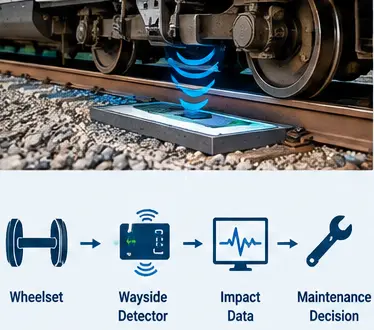
Railway wheel flat spots looks like one of the simplest things that can go wrong with a railway wheel. A patch worn flat, a bit of noise, a trip to the lathe. In practice it is a chain: a loss of adhesion, a locked wheel, a heat-affected zone, a fatigue risk, and a load that hammers every component around the wheel.
Whether you are specifying new wheels or managing a fleet, the worthwhile work is in the prevention and the early detection. Wheel slide protection, railhead treatment, sanding, and a disciplined roll-by check do more to control railway wheel flat spots than any amount of re-profiling after the fact.
At Luoyang Fonyo Heavy Industries Co., Ltd., we manufacture railway wheels and wheel-related products to the material and heat treatment requirements that influence how a wheel behaves when adhesion is lost. If you are reviewing wheel specifications or want a technical assessment of the steel grade, heat treatment, and inspection records for your fleet, send us your requirements and drawings. We will come back with an engineering view, not a sales pitch.
A flat spot forms when a wheel locks up and slides along the rail instead of rolling. The slide grinds a flat patch into the tread. It is usually triggered by low adhesion, such as wet leaves, oil, or ice on the rail, or by a mechanical lock like a brake that fails to release.
The thumping is the sound of a wheel with a flat spot striking the rail once on every rotation. It is more common in autumn because wet leaves create a slippery layer on the rail, which makes wheels lock up and slide more easily under braking.
Yes, in extreme cases. A large flat changes the wheel profile, and continued running can wear a groove and a “false flange” into the wheel. That false flange can catch in points and switches and derail the wheelset. This is rare, but it is exactly why flat spots have strict size limits.
The wheelset is re-profiled on a wheelset lathe, which cuts the tread back until the flat is removed and the wheel is round again. Deep flats, or wheels already near their minimum diameter, require replacement instead.
Small flats are sometimes allowed to continue in service, often under a speed restriction, until the next maintenance. Flats above the network’s size limit must be withdrawn for re-profiling. The exact threshold depends on wheel diameter and is set by the governing standard.
Not usually. A flat spot is almost always an operating problem, caused by a slide during braking or by a stuck brake or bearing. The wheel material and heat treatment still matter, because they affect how the heat-affected zone beneath the flat behaves over time.