Scan the WeChat code to contact us
Scan the WeChat code to contact us
Feel free to send us a email and we will reply to you as soon as possible.
Creating the future with heart and soul


Railway castings can pass inspection and still fail in service because inspection acceptance limits are not the same as service-life requirements. A defect below the acceptance limit on the inspection report can still act as a stress concentration point under fatigue loading, and inspection sampling cannot cover every risk inside a complex casting. The question is not only whether a casting passed inspection, but what the inspection actually verified and what the service conditions demanded.
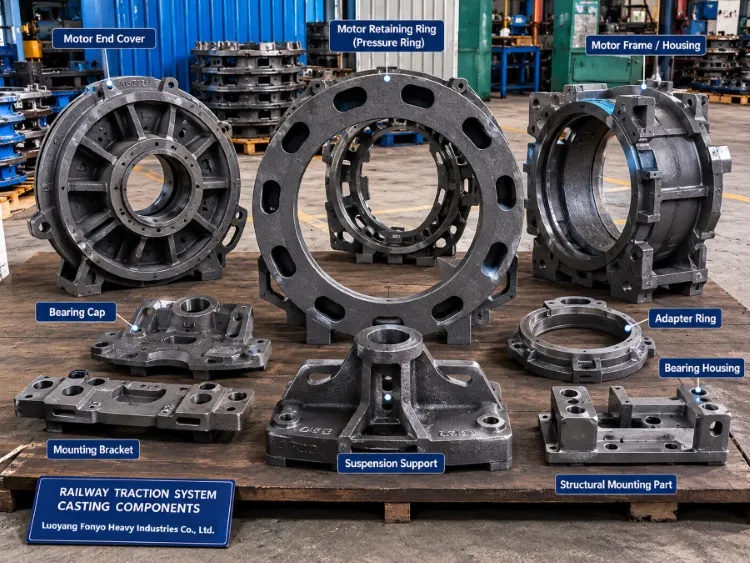
If you have ever approved a batch of railway castings based on railway casting inspection reports, only to hear about premature cracks later, you are not alone. The castings passed. The certificates were signed. The parts went into service. Then, months or years later, a fatigue crack appears where nobody expected one.
At first glance, the logic seems simple: if the casting passed inspection, it should survive in service.
In practice, railway casting quality is not quite that straightforward.
An inspection report is a snapshot of what was checked, to what limit, on which sample, at one moment in time. Service is years of cyclic loading, thermal cycling, moisture and impact, applied to every single casting in the batch. The gap between those two realities is where failures hide.
So how should you interpret inspection results for railway castings, and when should you worry about what the report does not say?
Inspection of railway castings follows a layered system: visual inspection, dimensional checks, mechanical testing on test bars, and non-destructive testing such as ultrasonic testing, magnetic particle testing or radiography. Each layer of railway casting inspection checks something different.
What this system confirms is that the castings checked met the acceptance criteria of the applicable standard at the time of inspection. Standards such as AAR M-211 for freight car castings, AAR M-201 for couplers and AAR M-203 for yokes define not only material properties but also acceptance limits for internal and surface discontinuities.
Here is the point that is sometimes missed:
Passing railway casting inspection does not mean the casting is defect-free. It means that no discontinuity was found above the acceptance limit, in the locations that were examined, on the samples that were tested.
A casting can be perfectly acceptable by the standard and still contain small discontinuities that the inspection was never designed to find. That is not an inspection failure. It is the design of the system.
The practical question is whether those small discontinuities matter in service. Sometimes they do. Sometimes they do not. It depends on where the discontinuity sits, what the casting is asked to carry, and how the loads are applied.
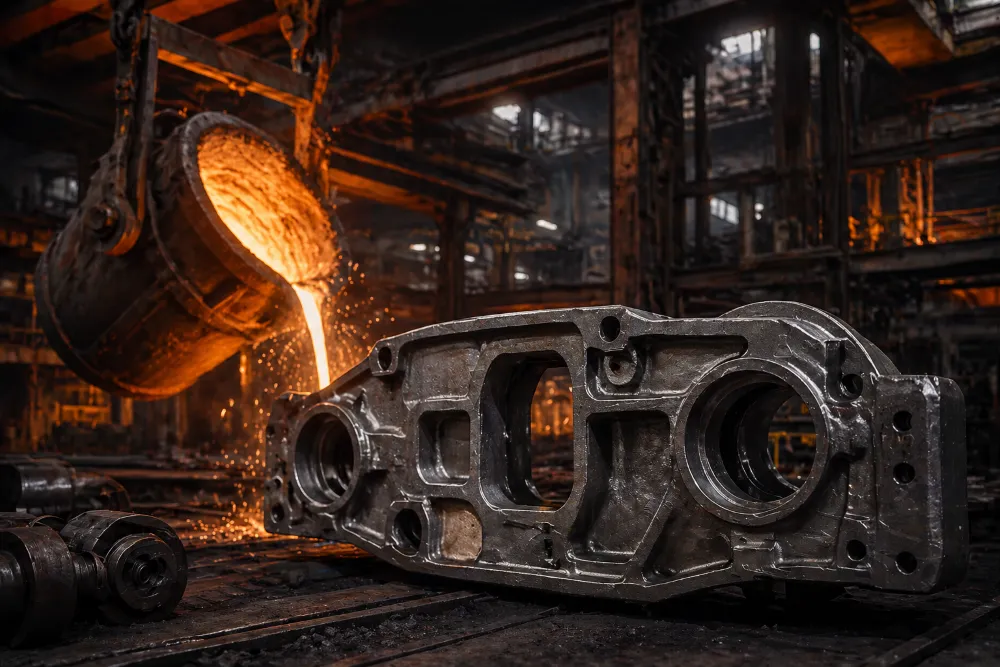
Imagine two railway castings, both from the same batch, both with the same inspection certificate. One serves quietly for decades. The other develops a fatigue crack after a few years.
What is different? The answer is often not in the inspection report but in the geometry of the defect and the stress it creates.
A discontinuity in a casting is a stress concentration. In a region of high cyclic stress, even a small internal void or inclusion can raise the local stress far above the nominal value of the surrounding section. Fatigue cracks initiate at stress concentrations, and they propagate from there with every load cycle.
Two factors decide whether a sub-limit defect becomes a failure:
Location. A defect in a highly stressed region, such as a pedestal jaw corner, a transition radius or a section change in a side frame, behaves differently from the same defect in a low-stressed area. The same size of discontinuity can be harmless in one location and critical in another.
Geometry. A rounded void behaves differently from a sharp, irregular inclusion. Sharp geometry concentrates stress more severely. This is one reason why two castings with “similar” inspection findings can have very different service lives.
This is also why I would be cautious about comparing castings by railway casting inspection report alone. The report tells you the size class of discontinuities found, but it does not tell you the local stress field they sit in. That is the engineer’s job to evaluate against the design.
Most railway casting inspection is not 100% volumetric examination of every casting. In practice:
None of this means the inspection is inadequate. It means the railway casting inspection is a sampling strategy designed to give confidence, not a guarantee that every cubic millimetre of every casting is sound.
A defect that sits just below the acceptance limit, in a zone that was not fully covered by the inspection volume, at a stress concentration, is the combination that shows up in service and not in the report. This is the scenario railway casting inspection is most often blamed for, and the least often explained.
For a deeper look at how the full inspection system is built, our overview of inspection standards and procedures for railway castings walks through each layer of the process.
Castings fail in service most often by fatigue, and fatigue is a process, not an event.
The first stage is crack initiation. Under cyclic loading, the highest-stressed location in the casting, often at a stress concentration, begins to develop a microcrack. If that location coincides with a discontinuity, initiation can start far earlier than in sound material.
The second stage is crack propagation. With each load cycle, the crack grows a little. The growth rate depends on the stress range, the geometry of the crack and the material’s resistance. What looks like a minor surface crack in year one can be a critical crack by year five.
The third stage is final failure, when the remaining section can no longer carry the load.
This is why service failures can happen years after the casting passed railway casting inspection. The inspection found nothing above the limit. The defect was small, or the crack had not yet initiated. The casting then spent years accumulating fatigue damage before the crack became visible or critical.
This is also why maintenance inspection matters as much as foundry inspection. Periodic railway track maintenance and vehicle inspection catch cracks that were never going to appear on the original casting certificate.
An inspection report is a technical document, and like all technical documents, it answers the questions railway casting inspection was designed to answer. There are several things it does not tell you, and understanding them changes how you read the report:
Process consistency. A batch of castings can pass inspection while the foundry process drifts between batches. The report proves what was delivered, not how stable the process is that produced it. The casting that fails in service is often from a batch where process control was weaker, even if the sampled castings passed.
Heat treatment condition. Mechanical properties depend heavily on heat treatment. If heat treatment is inconsistent, test bars can pass while production castings vary. Heat treatment records matter, and they are not always part of the final inspection certificate.
Residual stress. Castings carry residual stress from solidification, cooling and heat treatment. Residual stress can combine with service loads to push local stress higher than the design calculation assumed. Inspection reports rarely quantify it.
Traceability gaps. A certificate that cannot be traced to the specific heat, batch and casting number limits what you can investigate later. If a casting fails in service, traceability is what allows you to find the sibling castings from the same batch before they fail too.
This connects to a broader point about casting suppliers: the inspection report is the last line of defence, not the first. Process control, heat treatment and traceability are what determine whether the inspection report was ever in danger of finding something.

When comparing suppliers for railway castings, I would not stop at asking whether they do railway casting inspection. Ask what the inspection includes, and what sits behind it.
A reliable supplier should be able to provide:
For larger projects, traceability is particularly important. If a casting fails in service, the ability to trace it back to the heat, the batch and the inspection records is what makes the investigation possible and limits the exposure to the rest of the fleet. This is why railway casting inspection records should always be kept linked to the specific batch and casting numbers.
If you are evaluating casting quality from the design side, our guide to the critical dimensions of a railway side frame covers the features that determine whether a casting fits and carries load correctly. For the process comparison, our guide to cast steel bogie frames explains how casting quality sits inside the wider bogie design decision. And if you are looking at the wheel side of the system, our guide to railway wheels covers how the wheel and the casting interact under load.
Railway castings pass inspection and fail in service because the two things measure different realities. Railway casting inspection verifies that samples met acceptance limits at a point in time. Service demands that every casting survive years of cyclic loading without a critical crack.
Neither of those realities is wrong. They are simply different.
That is why I would not recommend choosing a railway casting supplier based on railway casting inspection certificates alone. Start with the process. Check the heat treatment and traceability. Understand what the inspection actually covered, and what it could not cover. Then compare suppliers on the system behind the certificate, not the certificate itself.
At Luoyang Fonyo Heavy Industries Co., Ltd., we manufacture railway casting products including side frames, bolsters and other cast components for locomotives and rolling stock, according to customer drawings, applicable standards and project requirements. For castings, we can review the required material grade, heat treatment, inspection and testing requirements before production.
If you have a drawing, specification or an existing casting sample, send us the details. Our engineering team can help check the required standard, inspection scope and production requirements before quotation.
Why do railway castings fail in service even after passing inspection?
Because inspection confirms that samples met acceptance limits at a point in time, while service demands that every casting survive years of cyclic loading. A small defect below the acceptance limit, located in a highly stressed zone, can initiate a fatigue crack that propagates over time.
Can ultrasonic testing find all internal casting defects?
No. Ultrasonic testing is applied to critical zones and its sensitivity depends on section thickness, surface condition and operator skill. Very small discontinuities or defects in locations that are not fully covered can remain undetected. This is why inspection is designed as a sampling strategy, not a guarantee.
What casting defects are hardest to detect?
Small internal voids and inclusions below the acceptance limit are the hardest to detect, especially in thick or complex sections. They may not be found by inspection but can still act as stress concentrations under fatigue loading.
Is 100% inspection better than sampling?
Not necessarily. Full coverage of every cubic millimetre of a complex casting is rarely practical with current NDT methods. The quality of the inspection plan, the coverage of critical zones and the process control behind it matter more than the percentage claim.
Why do defects at the acceptance limit still cause failures?
Acceptance limits are defined by standards for producibility and general service. A defect just below the limit can still be critical if it sits at a stress concentration in a highly loaded region. Location and geometry matter as much as size.
What should I ask a casting supplier about inspection?
Ask which standard applies, which NDT methods are used, what acceptance criteria are applied, whether heat treatment records are available, and whether inspection records can be traced to the specific batch and casting.
Why does traceability matter for railway castings?
If a casting fails in service, traceability from the heat and batch to the inspection records is what allows you to identify the cause, scope the exposure across the fleet, and find sibling castings from the same batch before they fail.