Scan the WeChat code to contact us
Scan the WeChat code to contact us
Feel free to send us a email and we will reply to you as soon as possible.
Creating the future with heart and soul


Modern railway vehicles depend on sophisticated traction systems to convert electrical energy into reliable motion. Whether it is a heavy-haul locomotive pulling thousands of tons of freight, a metro train accelerating between stations, or a high-speed EMU operating at over 300 km/h, the traction system is responsible for delivering power safely and efficiently.
Behind every traction motor is a series of critical railway traction parts that support, protect, and transmit that power. Components such as stator press rings, gearbox housings, end covers, traction support seat, and structural brackets may not be visible during operation, but they are essential to the reliability of the entire drivetrain.
These components must withstand vibration, impact loads, thermal cycling, fatigue stress, and harsh environmental conditions throughout decades of service. Their performance depends not only on design, but also on material selection, casting quality, heat treatment, machining precision, and inspection standards.
In this guide, we explore the key railway traction components, how they function within the traction system, and the manufacturing technologies used to ensure long-term reliability.
A railway traction system is the collection of electrical and mechanical components that generate and transmit power from the train’s energy source to its wheels.
In a modern rail vehicle, electrical energy is supplied to the traction motor. The motor converts this energy into rotational force, which is transferred through a gearbox, axle, and wheelset before reaching the rail.
The simplified power transmission path is:
Traction Motor → Gearbox → Axle → Wheel
While this process appears straightforward, numerous supporting components are required to ensure that power can be transmitted safely and efficiently. Structural castings, bearing supports, mounting brackets, gearbox housings, and motor components all contribute to maintaining alignment, controlling vibration, and protecting critical equipment.
For a deeper understanding of how traction systems generate and transfer power, see our article:
Related Reading:
How Powerful Railway Traction Power Moves a Train Efficiently
As railway operators demand greater efficiency, lower maintenance costs, and higher operating speeds, the quality of these supporting traction components becomes increasingly important.
Although traction motors receive much of the attention, many supporting components are equally critical to system performance. These parts ensure structural stability, protect rotating assemblies, and maintain precise mechanical alignment throughout operation.
The stator press ring, sometimes referred to as a compression ring or pressure ring, is an important structural component used within railway traction motors.
Its primary function is to secure the stator core and maintain dimensional stability under vibration, electromagnetic forces, and thermal expansion. Even small dimensional deviations can affect motor performance and assembly accuracy.
Because traction motors operate under demanding conditions, stator press rings often require carefully controlled casting processes, heat treatment, and precision machining to achieve the required mechanical properties and tolerances.
For readers interested in the engineering and manufacturing challenges behind these components, the following articles provide additional detail:
Related Reading:
The gearbox housing is one of the most important traction system castings. It protects gears, bearings, shafts, and lubrication systems while maintaining precise alignment between the traction motor and wheelset.
A gearbox housing must perform several functions simultaneously, for example, support dynamic mechanical loads, protect internal transmission components, retain lubrication oil, resist vibration and impact, and maintain dimensional accuracy over long service periods.
Because railway gearboxes experience continuous cyclic loading, material selection is particularly important. Depending on operating requirements, gearbox housings may be manufactured from ductile iron or cast steel to balance strength, vibration damping, machinability, and production cost.
The casting process also plays a major role in determining final quality, especially for large and complex housing structures.
Learn more about gearbox housing design and manufacturing:
Related Reading:
How Railway Castings Create Excellent Gearbox Housings To Protect Train
Why Ductile Iron is Wonderful for Gearbox Housings
Water Glass Sand Casting Build Stronger Gearbox Housing
Sand Casting: The Iron Cradle of High-Speed Rail Gearboxes
Bearing housings and end covers are responsible for protecting rotating assemblies and maintaining accurate bearing positioning throughout operation.
Although these parts may appear relatively simple, they often require extremely tight dimensional tolerances. Misalignment can lead to excessive vibration, accelerated bearing wear, lubrication problems, and reduced component life.
Many bearing-related components also require extensive machining after casting to achieve the required precision.
Additional resources:
Related Reading:
Why Axle-Hung Suspension Bearing Housings Need Excellent Precision Machining
Precision-Cast Axle Box: The Sodium Silicate Sand Casting Advantage
Why Railway Castings Axle Housings Are Important
Traction motors and gearboxes cannot simply be attached directly to the vehicle structure. A variety of support brackets, suspension ribs, reinforcement castings, and mounting structures are required to distribute loads and control vibration.
These structural components play an important role in protecting the traction system from dynamic forces generated during acceleration, braking, track irregularities, and long-term operation.
Unlike highly visible components such as wheels or bogies, traction support structures often work in the background. However, their fatigue resistance and structural integrity are critical to system reliability.
For further reading:
Related Reading:
Selecting the appropriate material is one of the most important engineering decisions in railway traction component manufacturing.
Different traction parts experience different combinations of load, vibration, wear, impact, and environmental exposure. As a result, no single material is suitable for every application.
The two most common material families used in railway traction castings are cast steel and ductile iron.
Cast steel is widely used for traction components that require high strength, impact resistance, weldability, and structural reliability.
Typical applications include Motor support structures, Heavy-duty brackets, Suspension components and Structural gearbox elements.
The final performance of cast steel depends heavily on alloy composition, heat treatment, grain size, and casting quality.
To understand how material composition affects performance, see:
Related Reading:
Ductile iron is commonly selected for gearbox housings, bearing housings, and structural enclosures because it combines good mechanical properties with excellent casting performance and vibration damping.
Compared with gray iron, ductile iron provides significantly higher strength and toughness while remaining cost-effective for large castings.
Achieving these properties requires careful control of sulfur content, nodularization, inoculation, microstructure, and heat treatment.
Related articles include:
Related Reading:
Material selection involves balancing multiple factors rather than simply choosing the strongest available material.
Engineers must consider:
Choosing between cast steel and ductile iron often requires evaluating the specific operating conditions of each component.
Further reading:
The reliability of railway traction components begins long before machining or assembly. It starts in the foundry.
Large traction castings such as gearbox housings, Stator Press Ring, bearing housings, suspension brackets, and traction motor end covers often feature complex geometries, varying wall thicknesses, and strict mechanical property requirements. Selecting the appropriate casting process is therefore critical to both product quality and manufacturing efficiency.
Different casting technologies offer different advantages in terms of dimensional accuracy, surface finish, tooling investment, and suitability for large-scale production.
Water glass sand casting remains one of the most widely used processes for railway traction castings due to its balance of quality, cost efficiency, and environmental performance.
The process is particularly suitable for medium and large castings that require good dimensional stability and consistent mechanical properties.
Learn more about this technology:
Related Reading:
For large and complex traction components requiring excellent dimensional accuracy and surface quality, furan resin sand casting is often preferred.
The process provides strong mold rigidity and excellent adaptability for complicated structures such as gearbox housings, bearing supports, and large railway cast steel parts.
Further reading:
Related Reading:
V Process Casting uses vacuum pressure to create molds without traditional binders, helping improve dimensional accuracy and surface quality while reducing casting defects.
This process is particularly attractive for structural railway castings that require clean surfaces and consistent geometry.
Related Reading:
Lost foam casting offers excellent design flexibility and is capable of producing highly complex components with fewer assembly requirements.
As railway equipment continues to evolve toward more integrated structures, lost foam technology is increasingly attracting attention for specialized railway and heavy equipment applications.
Related Reading:
Coated sand casting is commonly selected for smaller components that require higher dimensional precision and surface quality.
Although not typically used for the largest traction structures, it remains an important process within railway component manufacturing.
Related Reading:
Casting alone cannot deliver the mechanical properties required for demanding railway applications.
Heat treatment plays a critical role in improving strength, toughness, wear resistance, fatigue performance, and dimensional stability. For many railway traction parts, proper heat treatment is just as important as the casting process itself.
Whether manufacturing cast steel suspension structures or ductile iron gearbox housings, controlled heating and cooling help create the microstructures necessary for long service life.
To understand how heat treatment influences component performance:
Related Reading:
Heat treatment is closely linked to metallurgy. Grain size, microstructure, phase transformation, and chemical composition all influence final performance.
Even components produced from the same material can exhibit significantly different mechanical properties if metallurgical control is inadequate.
For a deeper understanding of railway metallurgy:
Related Reading:
Even the highest-quality casting cannot function properly without precision machining.
Railway traction components often contain critical interfaces such as bearing seats, mounting surfaces, shaft locations, sealing surfaces, and assembly references. These features require strict dimensional control to ensure proper alignment and reliable operation.
Modern railway manufacturing increasingly relies on CNC machining centers, vertical turning machines, gantry machining systems, and specialized inspection equipment to achieve these requirements.
Poor machining accuracy can lead to:
For this reason, dimensional control is considered a key quality characteristic for gearbox housings, bearing housings, stator press rings, and structural traction components.
Learn more about railway machining technologies:
Related Reading:
Railway traction components operate under continuous dynamic loading, making quality assurance essential throughout the manufacturing process.
Defects that remain undetected during production can eventually affect reliability, maintenance costs, and operational safety.
As a result, railway castings undergo multiple stages of inspection before entering service.
Non-destructive testing (NDT) allows manufacturers to evaluate component quality without damaging the product.
Common methods include:
These techniques help identify internal defects, surface discontinuities, and manufacturing inconsistencies before delivery.
For more information:
Related Reading:
In addition to NDT, railway components frequently undergo hardness testing, chemical composition analysis, metallographic examination, and mechanical property testing.
These evaluations help verify that the casting, heat treatment, and machining processes have achieved the intended results.
Additional resources:
Related Reading:
Modern railway traction systems are expected to operate reliably for decades while experiencing millions of load cycles.
Meeting these expectations requires more than good design. It also requires careful control of materials, manufacturing processes, and quality assurance procedures.
Repeated loading is one of the primary causes of long-term component degradation.
Support structures, suspension brackets, gearbox housings, and mounting components must be designed and manufactured to withstand continuous cyclic stress throughout their service life.
Related Reading:
Temperature changes during manufacturing and operation can generate significant thermal stresses.
If not properly controlled, these stresses may contribute to distortion, cracking, or reduced fatigue performance.
Related Reading:
Many reliability issues originate during manufacturing.
Defects such as shrinkage cavities, inclusions, poor feeding, and surface imperfections can often be prevented through proper process design and quality management.
Related Reading:
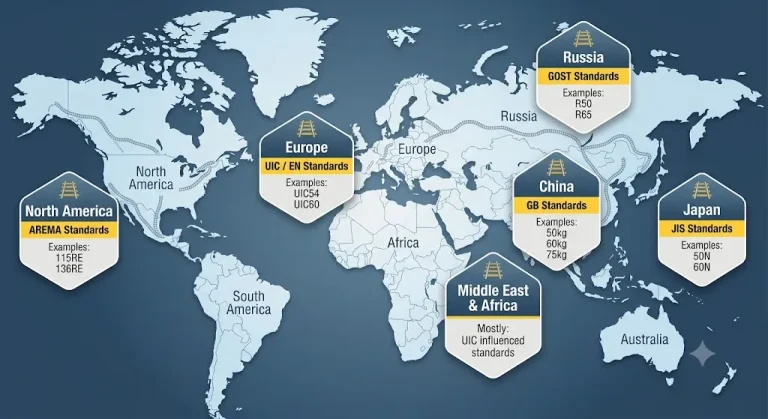
Railway traction components operate in one of the world’s most demanding industrial environments. Unlike general industrial castings, traction system components must meet strict requirements for safety, reliability, fatigue resistance, dimensional accuracy, and long-term performance.
Different countries and railway operators adopt different technical standards, but the underlying objectives remain the same: ensuring safe operation throughout the entire service life of the vehicle.
For manufacturers, compliance involves much more than meeting dimensional drawings. Material traceability, casting quality, heat treatment records, machining tolerances, non-destructive testing, and process control all contribute to final product qualification.
Understanding international railway standards is particularly important for suppliers serving multiple export markets.
Related Reading:
As railway systems continue to modernize, customers increasingly require suppliers to demonstrate not only manufacturing capability, but also quality management systems, process consistency, and long-term technical support.
FONYO manufactures a range of critical cast and machined components used in railway traction systems. Although each component performs a different function, all contribute to the safe and reliable transmission of power from the traction motor to the wheelset.
The gearbox housing protects gears and bearings while maintaining precise alignment throughout the drivetrain. It must provide excellent structural rigidity, dimensional accuracy, and long-term fatigue resistance.
Internal links (existing):
The stator press ring securely fixes the stator core inside the traction motor housing, ensuring stable motor performance under demanding railway operating conditions.
Because it requires excellent dimensional stability, selecting the appropriate casting process and machining method is critical.
Internal links (existing):
Bearing housings support rotating shafts while maintaining precise bearing alignment under continuous dynamic loading.
High machining accuracy and dimensional consistency are essential to maximize bearing life and minimize maintenance requirements.
Internal link (existing):
Suspension supports connect traction equipment to the bogie while absorbing vibration and distributing operational loads.
Although often overlooked, these structural components play an important role in protecting the traction system and improving long-term reliability.
Railway Suspension Support Explained
The traction motor housing protects the motor assembly while supporting internal components and resisting vibration, impact, and thermal stress during railway operation.
Manufacturing these large structural castings requires appropriate material selection, high casting quality, precision machining, and rigorous inspection.
Railway Traction Motor Housing: Design and Manufacturing
Choosing the right railway traction parts manufacturer is essential for ensuring long-term equipment reliability, operational safety, and lower lifecycle costs. Beyond production capacity, manufacturers should demonstrate expertise in railway standards, precision machining, quality control, and project experience.
When evaluating potential suppliers, consider the following factors.
Railway traction parts operate under demanding conditions involving high loads, vibration, fatigue, and continuous service. Manufacturers with dedicated experience in railway castings and machined components are more likely to understand these technical requirements and deliver consistent product quality.
Internal link (existing):
Different traction components require different materials depending on their structural function and operating environment.
For example:
A qualified supplier should recommend suitable materials based on both performance requirements and manufacturing efficiency.
Casting quality alone is not enough. Critical traction components require precision machining to achieve accurate dimensions, proper alignment, and reliable assembly.
Manufacturers should have the capability to perform:
Internal links (existing):
Reliable railway suppliers implement comprehensive inspection procedures throughout production rather than relying only on final inspection.
Typical inspection methods include:
These inspection processes help ensure every railway traction part meets customer specifications before shipment.
Future internal links:
Manufacturers that have supplied traction components for locomotives, metro systems, freight wagons, or high-speed rail projects typically possess stronger engineering capabilities and more mature production management systems.
Experience with international railway customers also helps ensure smoother communication, documentation, and quality assurance throughout the project lifecycle.
FONYO specializes in manufacturing precision railway castings and machined components for global railway equipment manufacturers.
Our capabilities include:
From gearbox housings and stator press rings to bearing housings and suspension supports, we provide reliable traction components designed for demanding railway applications.
Railway traction parts are the mechanical and structural components that transmit power from the traction motor to the train wheels. Typical examples include gearbox housings, stator press rings, bearing housings, suspension supports, traction motor housings, gears, and axle-related components.
A traction motor is the electric motor that generates rotational power. The railway traction system is the complete power transmission system, including the traction motor, gearbox, axle, wheelset, control equipment, and supporting structural components.
Common materials include ductile iron, cast steel, alloy steel, and forged steel. Material selection depends on component function, required strength, fatigue resistance, wear resistance, and manufacturing process.
Precision machining ensures correct alignment between components, minimizes vibration, reduces bearing wear, and improves the overall reliability and service life of the traction system.
Manufacturers typically perform dimensional inspection, chemical analysis, mechanical property testing, ultrasonic testing (UT), magnetic particle testing (MT), hardness testing, and CMM inspection depending on customer specifications.
Yes. Most railway traction components are manufactured according to customer drawings, technical standards, and project-specific requirements. OEM customization is common in the railway industry.
Railway traction parts are widely used in:
Railway traction parts are the foundation of every modern railway traction system. Components such as gearbox housings, stator press rings, bearing housings, suspension supports, and traction motor housings work together to transfer power safely and efficiently from the traction motor to the wheels.
Because these components operate under demanding mechanical and environmental conditions, their performance depends on high-quality casting, precision machining, appropriate material selection, and rigorous quality inspection. Choosing an experienced manufacturer helps improve equipment reliability, reduce maintenance costs, and extend service life.
Whether you are sourcing OEM railway traction castings or developing custom-engineered components for new railway projects, FONYO provides integrated casting, machining, and inspection services to support customers worldwide.
Looking for a reliable railway traction parts manufacturer?
Contact FONYO to discuss your project requirements. Our engineering team is ready to provide customized railway traction castings and precision-machined components that meet the performance and quality standards of today’s railway industry.