Scan the WeChat code to contact us
Scan the WeChat code to contact us
Feel free to send us a email and we will reply to you as soon as possible.
Creating the future with heart and soul


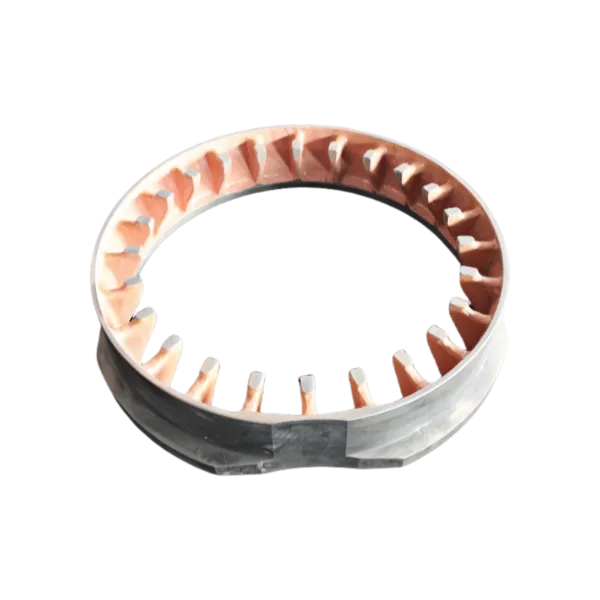
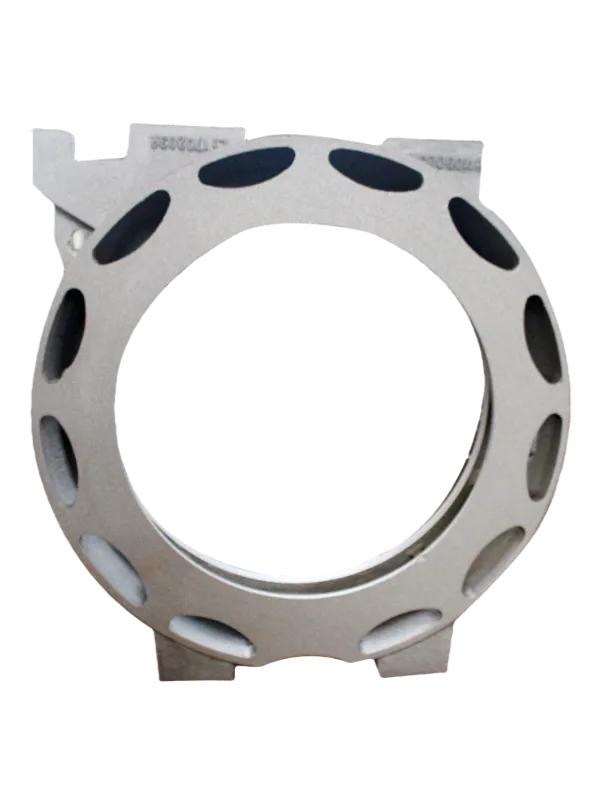
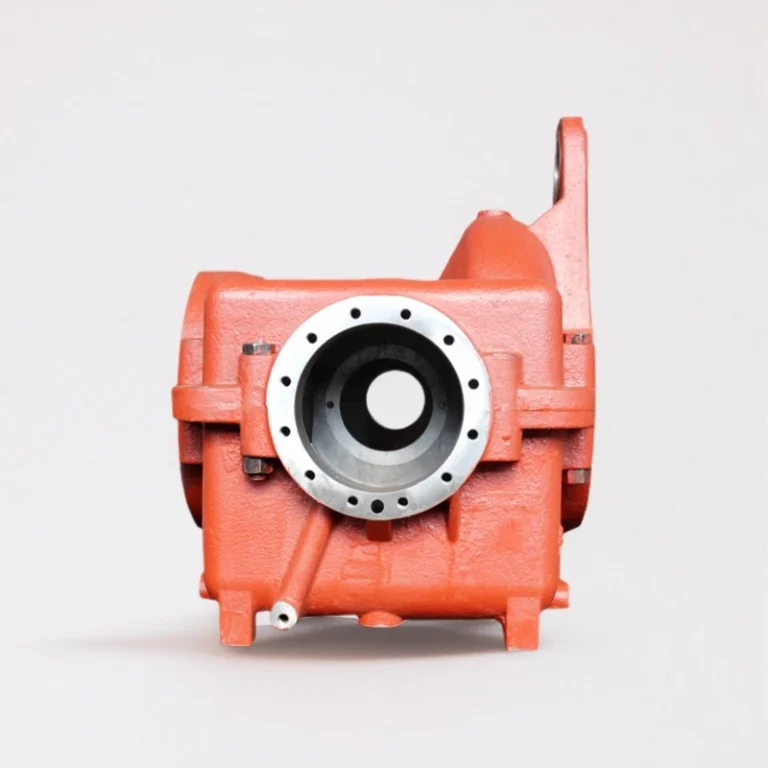
In heavy railway structures, welding problems rarely start at the welding machine itself. In many cases, the real issue begins much earlier — with the material selection. When large cast steel components are welded into railway assemblies, engineers are not only thinking about static strength. They also have to consider weldability, crack sensitivity, residual stress, fatigue resistance, and how the structure will behave after years of cyclic loading and wheel-rail impact. That is one of the main reasons low-carbon cast steel continues to be widely used in welded railway components. From bogie structures and side frames to coupler support castings and underframe brackets, low-carbon cast steel provides a practical engineering balance: strong enough for heavy rail service, but stable enough for reliable welding and long-term fatigue performance.
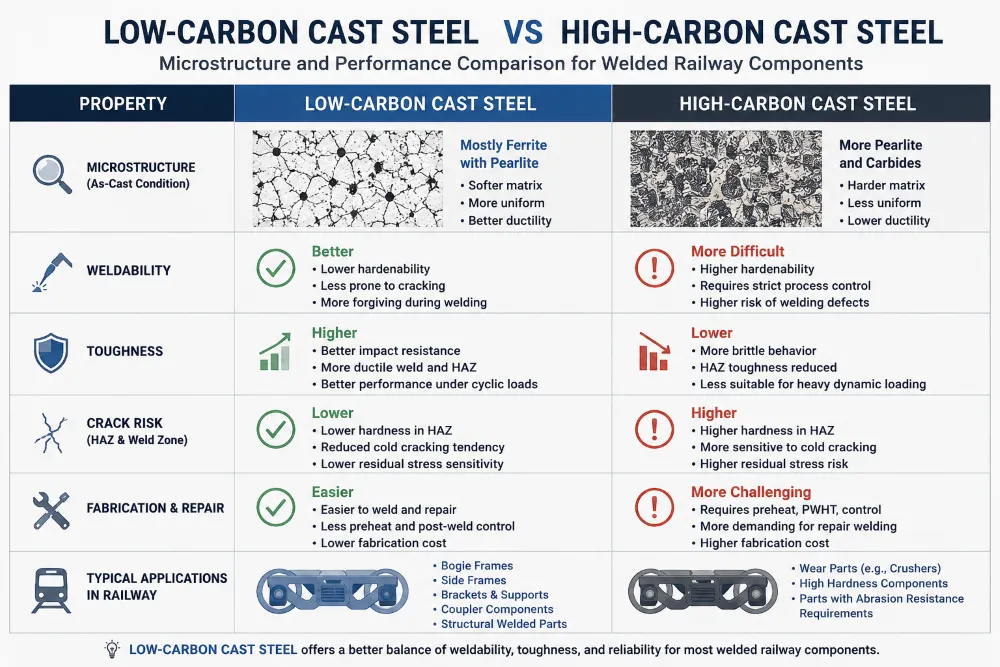
The biggest advantage of low-carbon cast steel is not simply that it is “softer.” What matters more is how the material behaves during the welding thermal cycle.
In cast steel, higher carbon content increases the likelihood of forming hard and brittle microstructures inside the heat-affected zone (HAZ). When the weld cools too quickly, localized hard zones can develop near the weld area, significantly increasing crack sensitivity.
Low-carbon cast steel helps reduce several common welding problems:
For welded railway structures that operate under continuous vibration and cyclic impact loading, these are not minor fabrication concerns. They directly affect service reliability and fatigue life.
That is why many railway manufacturers prefer low-carbon cast steel for welded structural components, especially where multi-pass welding or future repair welding may be required.
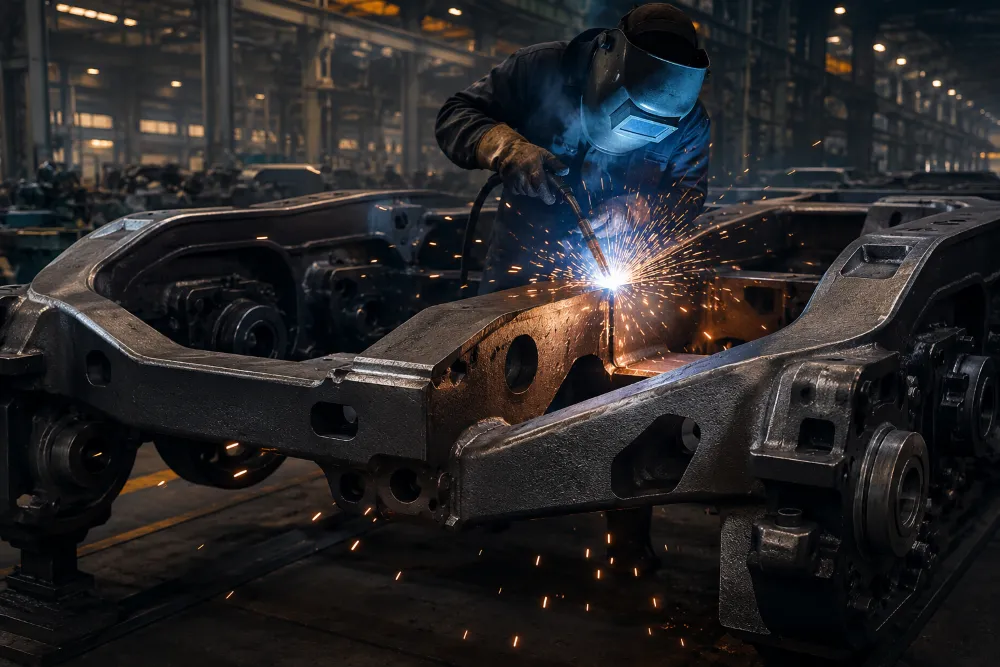
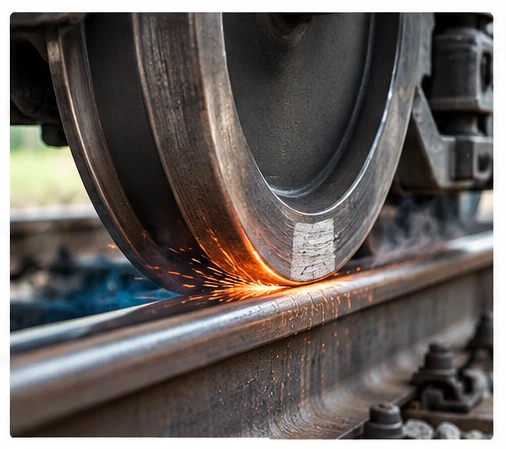
Railway structures operate under far harsher conditions than most industrial welded assemblies. A heavy freight bogie or underframe component may experience:
Because of these conditions, railway engineers often prefer materials that are more forgiving during both fabrication and long-term maintenance.
In heavy railway fabrication, the strongest material is not always the best material. A casting that offers slightly higher hardness but creates constant welding problems can quickly become an expensive production issue.
Low-carbon cast steel helps avoid many of those problems.
Large railway castings often contain thick sections, complex geometries, and uneven cooling zones. During welding, those areas naturally develop internal stress.
With higher-carbon cast steel, localized hardening near the weld becomes much more severe, increasing the risk of crack initiation inside the HAZ.
Low-carbon cast steel lowers that sensitivity and provides a more stable weld structure.
This is especially important for welded railway components such as:
In these applications, surviving millions of load cycles matters far more than achieving maximum hardness.
In railway engineering, fatigue failure is often a greater concern than single-event overload failure.
A welded component may survive one heavy impact but still fail years later if residual stress, weld hardness, or brittle zones gradually initiate cracking.
Low-carbon cast steel generally provides:
For welded railway castings, these characteristics are critical for long-term operational durability.
This becomes especially important in freight rail systems where components experience continuous wheel-rail impact, overload conditions, and long service intervals between maintenance cycles.
Higher carbon content can improve hardness and tensile strength, but it also creates significant manufacturing challenges.
When welding high-carbon cast steel, fabricators usually need additional process controls, including:
Without these controls, cracking risk increases sharply.
In real railway manufacturing environments, this often leads to:
A material that looks excellent on paper may still perform poorly in actual railway production if welding stability becomes difficult to control.
In many cases, sacrificing a small amount of hardness results in a much more reliable welded structure overall.
Producing reliable low-carbon cast steel railway components involves much more than simply lowering carbon content.
Experienced railway foundries focus on controlling the entire casting and heat treatment process to ensure both weldability and structural performance.
Stable Chemical Composition
Careful control of carbon, manganese, sulfur, and phosphorus helps maintain consistent welding behavior and reduces the risk of internal defects.
Stable chemistry is especially important in large railway castings where section thickness varies significantly.
Shrinkage cavities, porosity, and non-metallic inclusions can weaken welded areas and reduce fatigue life.
For structural railway castings, internal quality is just as important as external dimensions.
Good casting soundness improves:
Proper normalizing or quenching and tempering processes help balance:
In railway manufacturing, achieving balanced performance is usually more important than maximizing a single mechanical property.
Large railway castings often require machining and edge preparation before welding.
Good weld preparation helps:
For heavy welded railway structures, preparation quality can significantly influence long-term fatigue performance.
Modern railway systems continue demanding heavier axle loads, longer service life, and reduced maintenance downtime.
As a result, welded railway structures must deliver not only strength, but also stable manufacturability and reliable long-term fatigue performance.
Low-carbon cast steel remains widely used in railway manufacturing because it provides a practical combination of:
In heavy railway fabrication, the best material is rarely the hardest one. More often, it is the material that welds consistently, survives long-term service stress, and continues performing reliably after years of maintenance and repair welding.
For many welded railway components, that balance still points to low-carbon cast steel.
AtLuoyang Fonyo Heavy Industries, we manufacture railway cast steel components designed for demanding welded railway structures, including bogie systems, structural brackets, and heavy-duty rail assemblies. By combining controlled casting processes, stable material properties, and strict quality inspection, we help ensure reliable weldability and long-term fatigue performance for railway applications.
Learn more about our railway casting and forging capabilities at:
www.railwaypart.com