Scansiona il codice WeChat per contattarci
Scansiona il codice WeChat per contattarci
Sentiti libero di inviarci un'e-mail e ti risponderemo il prima possibile.
Creare il futuro con cuore e anima


Nelle strutture ferroviarie pesanti, i problemi di saldatura raramente iniziano dalla saldatrice stessa. In molti casi, il vero problema inizia molto prima: con la scelta del materiale. When large cast steel components are welded into railway assemblies, engineers are not only thinking about static strength. They also have to consider weldability, crack sensitivity, tensione residua, resistenza alla fatica, and how the structure will behave after years of cyclic loading and wheel-rail impact. That is one of the main reasons low-carbon cast steel continues to be widely used in welded railway components. From bogie structures and side frames to coupler support castings and underframe brackets, low-carbon cast steel provides a practical engineering balance: strong enough for heavy rail service, but stable enough for reliable welding and long-term fatigue performance.
The biggest advantage of low-carbon cast steel is not simply that it is “softer.” What matters more is how the material behaves during the welding thermal cycle.
In cast steel, higher carbon content increases the likelihood of forming hard and brittle microstructures inside the heat-affected zone (HAZ). When the weld cools too quickly, localized hard zones can develop near the weld area, significantly increasing crack sensitivity.
Low-carbon cast steel helps reduce several common welding problems:
For welded railway structures that operate under continuous vibration and cyclic impact loading, these are not minor fabrication concerns. They directly affect service reliability and fatigue life.
That is why many railway manufacturers prefer low-carbon cast steel for welded structural components, especially where multi-pass welding or future repair welding may be required.
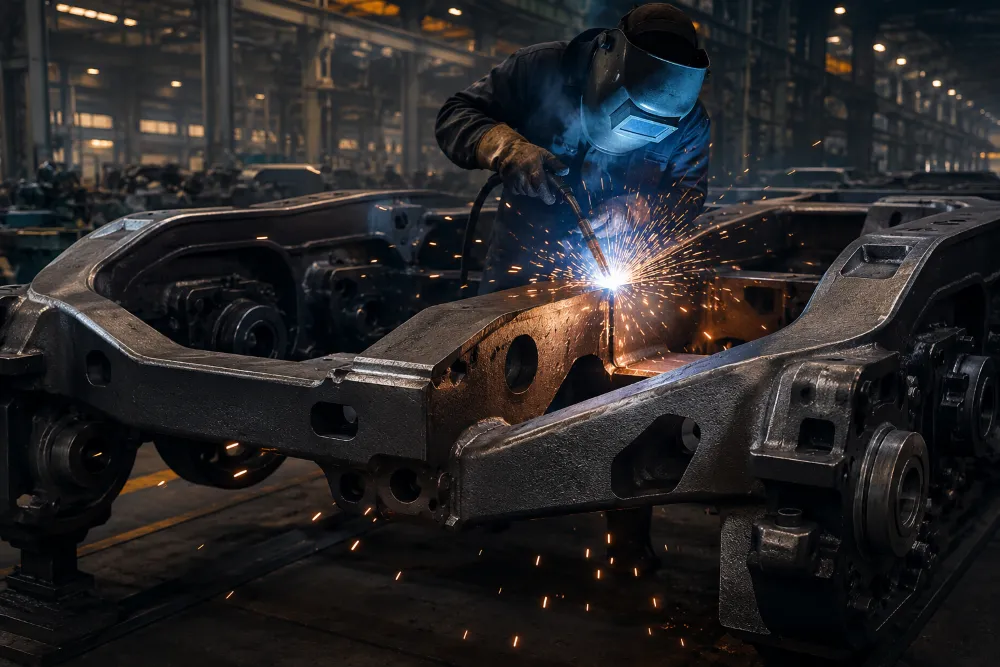
Railway structures operate under far harsher conditions than most industrial welded assemblies. A heavy freight bogie or underframe component may experience:
A causa di queste condizioni, gli ingegneri ferroviari spesso preferiscono materiali più tolleranti sia durante la fabbricazione che durante la manutenzione a lungo termine.
Nella fabbricazione ferroviaria pesante, il materiale più resistente non è sempre il materiale migliore. Una fusione che offre una durezza leggermente superiore ma crea costanti problemi di saldatura può rapidamente diventare un problema di produzione costoso.
L’acciaio fuso a basso tenore di carbonio aiuta a evitare molti di questi problemi.
I grandi getti ferroviari spesso contengono sezioni spesse, geometrie complesse, e zone di raffreddamento irregolari. Durante la saldatura, quelle aree sviluppano naturalmente lo stress interno.
Con acciaio fuso ad alto tenore di carbonio, l'indurimento localizzato in prossimità della saldatura diventa molto più grave, aumentando il rischio di innesco di crepe all’interno della ZTA.
L'acciaio fuso a basso tenore di carbonio riduce tale sensibilità e fornisce una struttura di saldatura più stabile.
This is especially important for welded railway components such as:
In these applications, surviving millions of load cycles matters far more than achieving maximum hardness.
Nell'ingegneria ferroviaria, fatigue failure is often a greater concern than single-event overload failure.
A welded component may survive one heavy impact but still fail years later if residual stress, weld hardness, or brittle zones gradually initiate cracking.
Low-carbon cast steel generally provides:
For welded railway castings, queste caratteristiche sono fondamentali per la durabilità operativa a lungo termine.
Ciò diventa particolarmente importante nei sistemi ferroviari merci in cui i componenti subiscono un impatto continuo ruota-rotaia, condizioni di sovraccarico, e lunghi intervalli di servizio tra i cicli di manutenzione.
Un contenuto di carbonio più elevato può migliorare la durezza e la resistenza alla trazione, ma crea anche sfide produttive significative.
Quando si salda acciaio fuso ad alto tenore di carbonio, i produttori di solito necessitano di ulteriori controlli di processo, compreso:
Senza questi controlli, il rischio di cracking aumenta notevolmente.
In ambienti reali di produzione ferroviaria, questo spesso porta a:
A material that looks excellent on paper may still perform poorly in actual railway production if welding stability becomes difficult to control.
In molti casi, sacrificing a small amount of hardness results in a much more reliable welded structure overall.
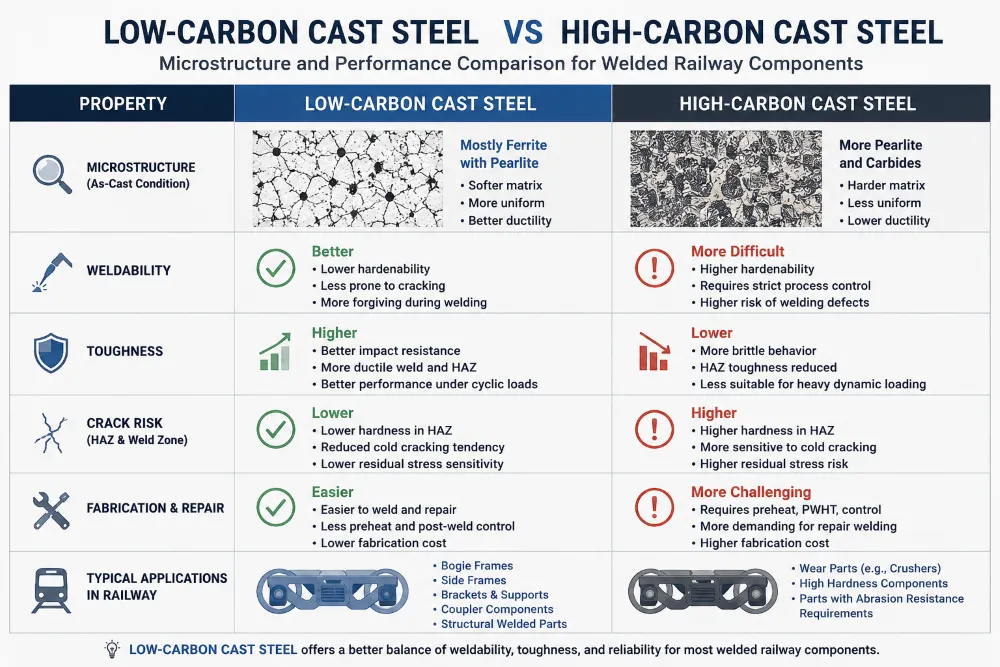
Producing reliable low-carbon cast steel railway components involves much more than simply lowering carbon content.
Le fonderie ferroviarie esperte si concentrano sul controllo dell'intero processo di fusione e trattamento termico per garantire sia la saldabilità che le prestazioni strutturali.
Composizione chimica stabile
Attento controllo del carbonio, manganese, zolfo, e il fosforo aiuta a mantenere un comportamento di saldatura coerente e riduce il rischio di difetti interni.
La stabilità chimica è particolarmente importante nei grandi getti ferroviari dove lo spessore della sezione varia in modo significativo.
Cavità da ritiro, porosità, e le inclusioni non metalliche possono indebolire le aree saldate e ridurre la durata a fatica.
Per getti strutturali ferroviari, la qualità interna è importante tanto quanto le dimensioni esterne.
La buona solidità del lancio migliora:
I processi di normalizzazione o tempra e rinvenimento adeguati aiutano l'equilibrio:
Nella produzione ferroviaria, achieving balanced performance is usually more important than maximizing a single mechanical property.
Large railway castings often require machining and edge preparation before welding.
Good weld preparation helps:
For heavy welded railway structures, preparation quality can significantly influence long-term fatigue performance.
Modern railway systems continue demanding heavier axle loads, durata di servizio più lunga, and reduced maintenance downtime.
Di conseguenza, welded railway structures must deliver not only strength, but also stable manufacturability and reliable long-term fatigue performance.
Low-carbon cast steel remains widely used in railway manufacturing because it provides a practical combination of:
Nella fabbricazione ferroviaria pesante, the best material is rarely the hardest one. Più spesso, it is the material that welds consistently, survives long-term service stress, and continues performing reliably after years of maintenance and repair welding.
For many welded railway components, that balance still points to low-carbon cast steel.
AIndustrie pesanti di Luoyang Fonyo, produciamo componenti ferroviari in acciaio fuso designed for demanding welded railway structures, compreso bogie systems, structural brackets, and heavy-duty rail assemblies. By combining controlled casting processes, stable material properties, and strict quality inspection, we help ensure reliable weldability and long-term fatigue performance for railway applications.
Learn more about our railway casting and forging capabilities at:
www.railwaypart.com