Scan the WeChat code to contact us
Scan the WeChat code to contact us
Feel free to send us a email and we will reply to you as soon as possible.
Creating the future with heart and soul


In railway wheel manufacturing, long-term wheel reliability depends on far more than chemical composition or hardness values alone. One of the most critical factors is the internal railway wheel microstructure of the wheel rim, especially in the tread area exposed to repeated rolling contact stress.
Under heavy axle loads, high-speed operation, and long service cycles, even small microstructural inconsistencies can influence wear behavior, crack resistance, and rolling contact fatigue performance. This is why railway wheel manufacturers place significant attention on heat treatment, cooling control, metallographic inspection, and abnormal layer management throughout the production process.
For modern railway wheels, stable microstructure control is not simply a laboratory requirement. It is directly connected to operational safety and wheel service life.
The ideal railway wheel microstructure for many freight and passenger applications is a stable ferrite-pearlite (F-P) structure throughout the wheel rim section.
Ferrite-pearlite microstructures provide a balanced combination of:
This balance is especially important because railway wheels operate under continuous rolling contact stress. Excessively hard microstructures may increase brittleness and crack sensitivity, while overly soft structures may reduce wear resistance and wheel life.
For this reason, many international railway wheel grades — including CL60, CL65, AAR Class C, ER7, ER8, and ER9 — rely on controlled ferrite-pearlite microstructures as part of their performance design.

One of the major concerns in railway wheel microstructure control is the formation of non-pearlitic structures near the tread surface after heat treatment.
These abnormal structures may include:
Although these abnormal layers are usually limited to shallow surface regions, they can still influence long-term wheel performance if not properly controlled.
In railway wheel applications, non-uniform microstructures may contribute to:
The key issue is not simply whether a small abnormal layer exists after heat treatment, but whether that layer remains inside the final finished wheel rim after machining.
This distinction is extremely important in railway wheel manufacturing.
Heat treatment plays a central role in railway wheel microstructure formation.
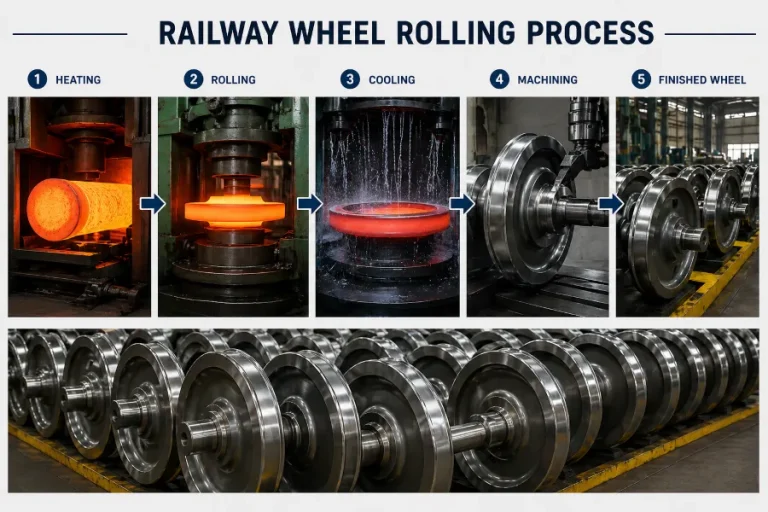
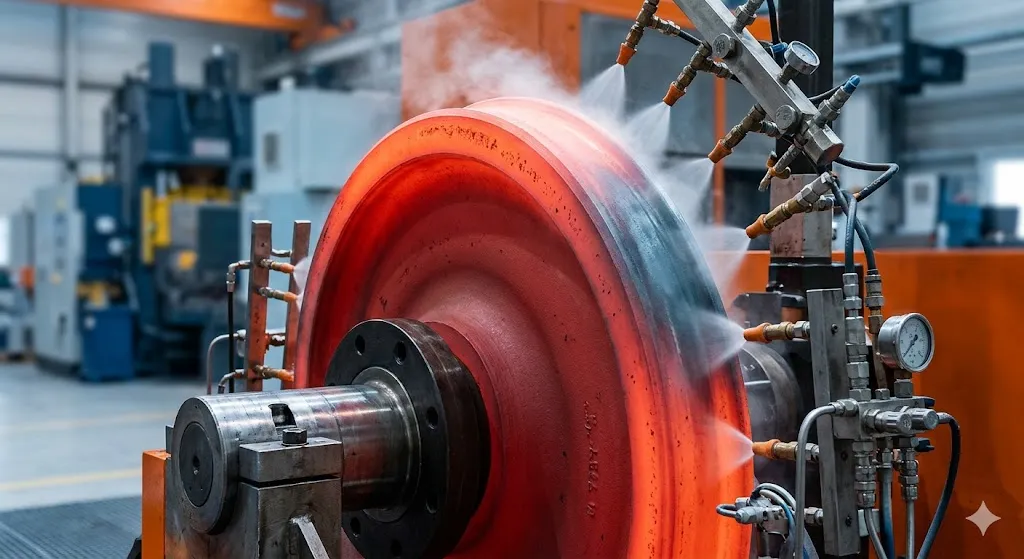
After forging and rolling, railway wheels undergo controlled heat treatment processes designed to achieve stable ferrite-pearlite transformation throughout the wheel rim.
In continuous cooling heat treatment, cooling speed and temperature distribution are carefully controlled to manage:
If cooling is excessively rapid near the tread surface, localized bainitic or non-pearlitic structures may form. If cooling is too slow, hardness and wear resistance may become insufficient.
For this reason, railway wheel heat treatment requires a balance between hardness, toughness, and microstructural stability. you can read another article Railway Wheel Heat Treatment Process: Annealing, Quenching and Tempering to know more about railway wheel heat treatment.
Stable process control is especially important for heavy-duty railway wheels operating under high contact stress conditions.
In practical railway wheel manufacturing, a shallow abnormal structure layer may occasionally appear near the tread surface after heat treatment. However, the critical engineering requirement is ensuring that the abnormal layer depth remains smaller than the tread machining allowance.
If the abnormal microstructure depth is fully removed during machining, the finished wheel rim can still maintain a complete ferrite-pearlite structure across the entire final section.
This is one of the most important aspects of railway wheel microstructure control.
For different railway wheel grades produced under continuous cooling heat treatment conditions, metallographic inspection results showed:
For CL60 railway wheels, the maximum depth of abnormal non-pearlitic structure remained within approximately 6–7 mm below the tread surface.
After machining allowance removal, the finished wheel rim maintained a full ferrite-pearlite structure throughout the section.
Minor bainitic structures could still be observed around 6 mm below the tread surface under 500× metallographic inspection, while complete ferrite-pearlite structures appeared at deeper positions.
For CL65 railway wheels, the abnormal structure layer depth remained within approximately 7.5–8.5 mm.
This depth remained below the tread machining allowance, ensuring that the final wheel rim section retained stable ferrite-pearlite microstructures after machining.
For AAR Class C (CL70) railway wheels, the abnormal microstructure depth did not exceed 8 mm.
This depth was significantly smaller than the tread machining allowance, allowing the finished wheel rim to maintain a complete ferrite-pearlite structure throughout the final cross section.
For ER7, ER8, and ER9 railway wheels, the abnormal structure layer depth remained below 7 mm.
All three European standard railway wheel grades demonstrated abnormal layer depths smaller than the machining allowance, ensuring full ferrite-pearlite structures across the finished rim sections.
These results demonstrate the importance of stable heat treatment control combined with proper machining allowance design in railway wheel manufacturing.
Railway wheel microstructure verification does not rely only on hardness testing. Metallographic inspection is equally important for evaluating transformation behavior and structural consistency.
After forging, rolling, and heat treatment, railway wheels undergo metallographic examination including:
Microstructural observations are commonly performed at magnifications such as 500× to identify ferrite-pearlite regions and possible abnormal transformation structures.
In addition, grain size control is another important quality indicator in railway wheel manufacturing. The inspected railway wheels maintained grain size ratings not lower than Grade 6, indicating stable metallurgical quality after thermal processing.
Stable railway wheel microstructure directly influences long-term operational performance.
Well-controlled ferrite-pearlite structures help improve:
As railway systems continue moving toward higher axle loads, longer maintenance intervals, and more demanding operating conditions, microstructure control becomes increasingly important for railway wheel reliability.
In modern railway wheel manufacturing, dimension accuracy and hardness values alone are no longer sufficient. Stable metallurgical control throughout rolling, heat treatment, machining, and inspection is equally essential for ensuring wheel safety and service life.
At Luoyang Fonyo Heavy Industries Co., Ltd., railway wheels production focuses not only on manufacturing precision, but also on stable railway wheel microstructure control throughout the entire process chain. Through continuous heat treatment optimization and metallographic verification, the goal is to ensure reliable wheel performance under demanding railway operating conditions.