Scansiona il codice WeChat per contattarci
Scansiona il codice WeChat per contattarci
Sentiti libero di inviarci un'e-mail e ti risponderemo il prima possibile.
Creare il futuro con cuore e anima


Durante il processo di produzione, bearing parts have to go through multiple processes such as forging, rotolamento, punzonatura, girando, macinazione, e trattamento termico, e possono verificarsi vari difetti. I difetti comuni sono i seguenti:
1.Forging defects
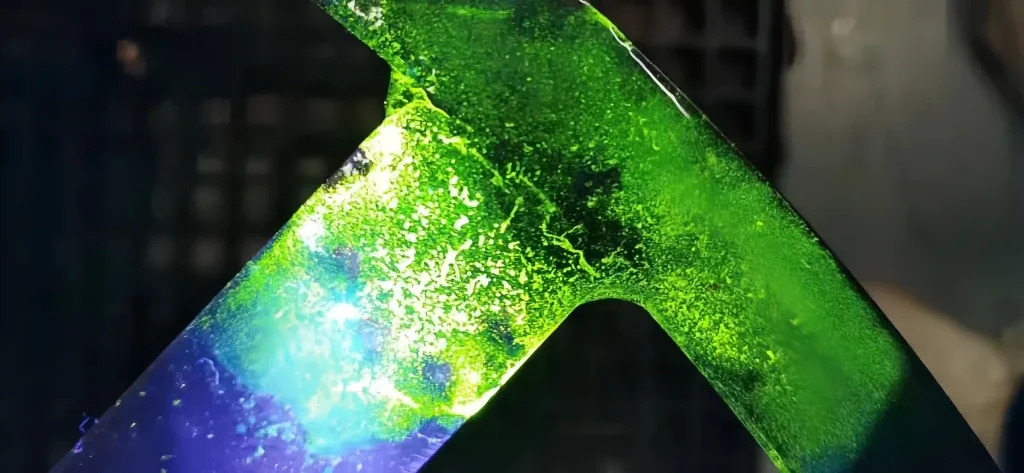
Due to uneven cutting, burrs, flash, ecc., folds are easily formed on the surface. Its characteristics are that the folds are relatively large and irregular in shape, and they are easy to see on the surface of the parts.
It is best to use fluorescent magnetic powder for flaw detection to make the defect display clearer and more intuitive. The magnetic traces of forging folds are generally linear, groove-shaped, and fish-scale-shaped at a certain angle to the surface.
The defect section is made into a metallographic specimen and observed under a microscope. The tail of the defect is round and blunt, the two sides are smooth, and there is obvious oxidation. No foreign matter, such as material inclusions, is found in the defect. After cold acid corrosion of the metallographic specimen, it is observed that there is severe decarburization and oxidation at the defect site and on both sides; the surface morphology of the defect layer is observed, and the plastic deformation marks are obvious, and there is no tear-like fracture morphology. After microhardness testing and metallographic observation, there are different degrees of carburization and hardening on the surface of the defect layer. The above analysis shows that the defect should have existed before the heat treatment quenching, and it is connected to the outside world, and the defect is determined to be forging folding.
2.Forging overburning
The forging heating temperature is too high, and the insulation time is too long to resulting in overheating. Nei casi più gravi, the grain boundaries are oxidized or even melted. Microscopic observation shows that not only are the surface metal grain boundaries oxidized and cracked to show sharp corners, ma anche, in areas where the internal components of the metal are more severely segregated, the grain boundaries begin to melt, e nei casi più gravi, sharp-angled caves are formed. Overburned materials are forged in this defective state, and are forged, punched and rolled by heavy hammers. The defective parts will tear here, forming larger defects. The surface morphology of severely overburned forging is like orange peel, with fine cracks and thick oxide scales distributed on it.
It is advisable to use fluorescent magnetic powder for flaw detection to make the defect display clearer. Pockmark holes are caused by forging overburning defects.
Metallographic specimens were made along the defective cross-section and observed under a microscope. It can be seen that holes are distributed on the surface and sub-surface. Some parts are sharp-angled, of varying sizes, and bottomless. There are fine cracks on the edges. Grain boundary oxidation and holes have appeared in some areas. Inoltre, after the fracture surface is observed after the fracture is made along the defective holes, it can be seen that the fracture is a stone-like fracture with a large number of holes and fine cracks distributed on it.

3.Estinguere le crepe
During the quenching process, when the quenching temperature is too high or the cooling speed is too fast, the internal stress is greater than the fracture strength of the material, quenching cracks will appear.
Fluorescent magnetic particle inspection should be used to improve sensitivity and reliability. The magnetic traces of quenching defects are generally oblique, arc-shaped, dendrite-shaped or mesh-shaped. The starting part is wide and gradually becomes thinner along the extension direction.
It is basically distributed along the circumferential direction, and the tail is sharp. After cutting the crack and making a metallographic specimen, it can be seen that the crack is very deep and basically perpendicular to the outer surface. No foreign matter, such as material inclusions, is found in it. After the fracture is observed along the crack, the fracture is brittle, and the fracture surface has an obvious tempering color.
4.Raw material defects
Durante il processo di macinazione, bearing parts are prone to grinding cracks due to excessive grinding wheel feed, grinding wheel shaft runout, insufficient cutting fluid supply and blunt grinding wheel grains. Inoltre, the quenching temperature is too high during heat treatment, resulting in overheating of the parts, coarse grains, a large amount of residual austenite, and mesh and coarse particles.
The magnetic traces of grinding defects are generally mesh, radial, parallel or cracked. The magnetic traces are thin and sharp, with clear contours, appearing in large numbers, usually perpendicular to the grinding direction. The magnetic traces are mostly concentrated in the middle part, along the circumferential direction, in the form of long lines or branches, with local bifurcations, and the magnetic traces converge.
Fornitore
Luoyang Fonyo Heavy Industries Co., Ltd,fondata nel 1998, è un produttore di parti ferroviarie in fusione. La nostra fabbrica copre un'area di 72.600㎡, con più di 300 dipendenti, 32 tecnici, compreso 5 ingegneri senior, 11 ingegneri assistenti, E 16 tecnici. La nostra capacità produttiva è 30,000 tonnellate all'anno. Attualmente, produciamo principalmente fusione, lavorazione, e assemblaggio per locomotiva,vagone ferroviario,treni ad alta velocità, attrezzature minerarie,energia eolica,ecc. I nostri prodotti sono stati esportati in Russia, gli Stati Uniti, Germania, Argentina, Giappone, Francia, Sudafrica,Italia e altri paesi.
Contatto: Stella Liu
E-mail:[email protected]
Mobile:+8615515351287