Scansiona il codice WeChat per contattarci
Scansiona il codice WeChat per contattarci
Sentiti libero di inviarci un'e-mail e ti risponderemo il prima possibile.
Creare il futuro con cuore e anima

Quando le persone guardano per la prima volta una ruota ferroviaria, il presupposto è spesso semplice: più la ruota è dura, meglio funzionerà. Dopotutto, ruote ferroviarie operate under heavy loads, constant rolling contact, and demanding environments. A harder surface seems like the obvious way to resist wear and extend service life.
But in real engineering practice, things are rarely that simple.
Over the years working with heavy industrial components and rail-mounted equipment, engineers often discover that pursuing maximum hardness can actually introduce new risks. A railway wheel that is too hard may resist wear well, but it can also become more vulnerable to cracking, fatigue damage, and even sudden failure.
Understanding why requires looking beyond hardness numbers on a specification sheet and considering the balance between hardness, forza, e tenacità.
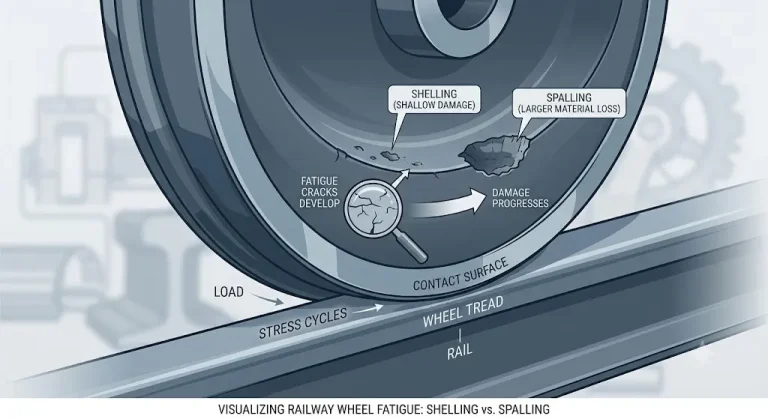
IL ruota ferroviaria operates in one of the most demanding mechanical environments in transportation. Every time a train moves, the wheel is subjected to a combination of forces:
In queste condizioni, the wheel rim must resist wear and surface fatigue. This is why railway wheels are typically designed with relatively high hardness in the rim area.
Higher hardness improves:
From a purely wear-resistance perspective, increasing hardness seems beneficial.
Tuttavia, a railway wheel is not simply a wear component. It is a structural component that must also absorb impact energy and resist crack propagation. This is where the balance between hardness and toughness becomes critical.
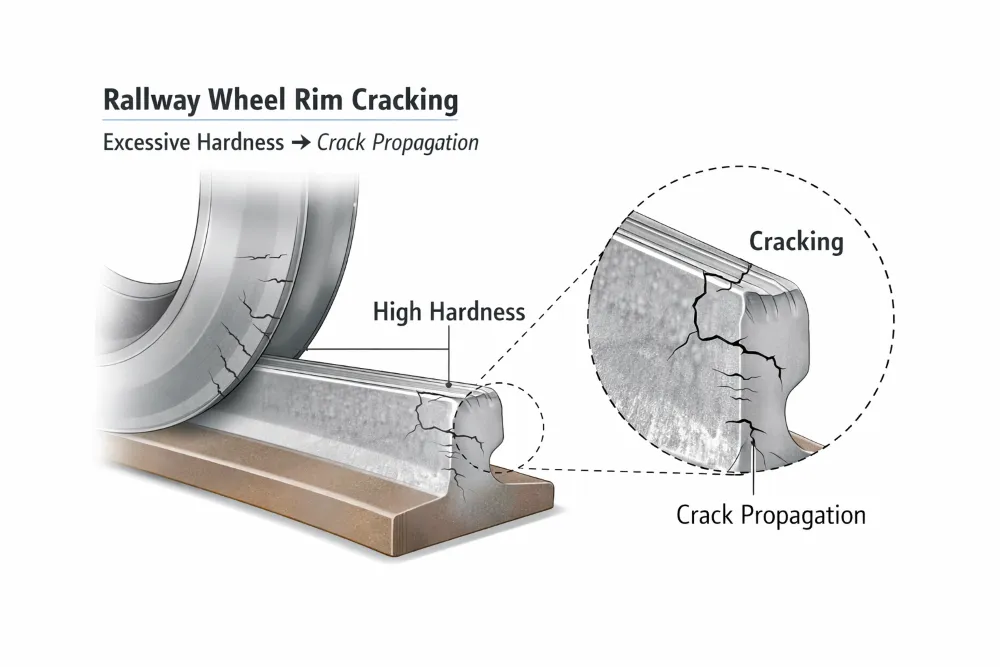
When hardness increases beyond the optimal range, the material behavior begins to change. Harder materials often have lower toughness, meaning they are less capable of absorbing energy before cracking.
In a railway wheel, this can create several potential problems.
Primo, the wheel becomes more sensitive to impact loading. Even small irregularities in the track can generate localized stresses at the wheel–rail contact area. If the material lacks sufficient toughness, these stresses may initiate microcracks in the rim.
Secondo, once a crack forms, a very hard material may allow the crack to propagate more quickly. Instead of slowly dissipating energy through plastic deformation, the material behaves in a more brittle manner.
This is why engineers often say that excessive hardness can trade wear resistance for fracture risk.
In extreme cases, a wheel that is too hard may show early signs of:
These failures are rarely caused by hardness alone, but excessive hardness can significantly increase the likelihood of crack propagation once damage begins.
Un affidabile ruota ferroviaria must do more than resist wear. It must also tolerate repeated mechanical shocks over millions of load cycles.
This is where toughness plays an essential role.
Toughness describes the material’s ability to absorb energy before fracturing. In railway wheels, sufficient toughness allows the material to:
Without adequate toughness, even small defects or surface damage can become starting points for fatigue cracks.
The relationship between hardness and toughness is often illustrated with a simple concept: as hardness increases, toughness tends to decrease. While this relationship is not perfectly linear, it highlights an important engineering reality.
A railway wheel cannot simply be designed for maximum hardness. Invece, it must achieve an optimal balance between hardness and toughness.
Another important factor engineers consider is hardness distribution within the wheel.
UN ruota ferroviaria is not designed to have the same hardness everywhere. Different regions of the wheel perform different mechanical functions.
The rim is the part that contacts the rail directly. This area experiences the highest contact stress and wear, so it is typically designed with higher hardness.
The web connects the rim to the hub and helps distribute mechanical loads. It requires a balance between strength and flexibility.
The hub supports the axle connection and must absorb structural loads without cracking. In this region, toughness is especially important.
Because of these different requirements, many railway wheels are designed with a hardness gradient rather than uniform hardness throughout the structure.
If hardness is too high across the entire wheel, the structure may lose its ability to absorb stress effectively. Instead of distributing forces smoothly, stresses may concentrate in certain areas, increasing the likelihood of crack initiation.
This is another reason why simply increasing hardness does not necessarily improve railway wheel safety.
Achieving the right balance between hardness and toughness is not just a design challenge—it is also a manufacturing challenge.
The performance of a ruota ferroviaria depends heavily on how well the manufacturing process controls several critical factors.
Chemical composition is one of the first elements engineers consider. Small variations in carbon, manganese, and other alloying elements can significantly affect both hardness and toughness.
Heat treatment is another crucial step. Processes such as controlled cooling and rim quenching help establish the desired hardness profile while maintaining sufficient toughness in the rest of the wheel.
Microstructure also plays an important role. A well-controlled ferrite–pearlite structure can provide a good balance between strength, durezza, e resistenza agli urti.
If these factors are not carefully controlled, two wheels produced in different batches may exhibit noticeably different mechanical behavior—even if they meet the same nominal specification.
Nelle operazioni ferroviarie, such inconsistency can create serious reliability risks.
In practical engineering work, designing a ruota ferroviaria is always about balance.
Hardness must be high enough to resist wear and surface fatigue. Allo stesso tempo, toughness must remain sufficient to absorb impact loads and prevent rapid crack propagation.
Engineers therefore aim for an optimal range rather than a maximum value.
A wheel that is slightly softer but more resistant to cracking may actually deliver better long-term performance than an extremely hard wheel that becomes vulnerable to brittle behavior.
This philosophy is reflected in many railway standards and manufacturing practices around the world. Instead of chasing the highest hardness value, engineers focus on consistent material properties and controlled mechanical performance.
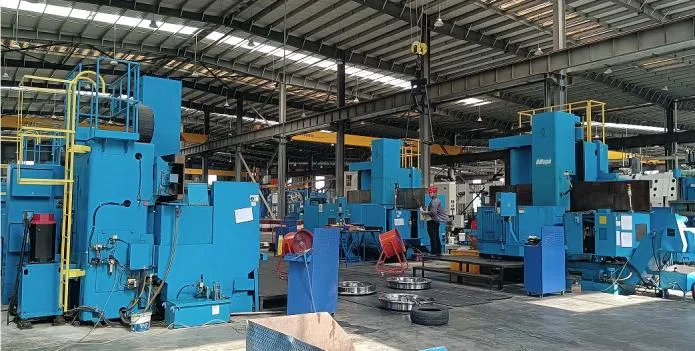
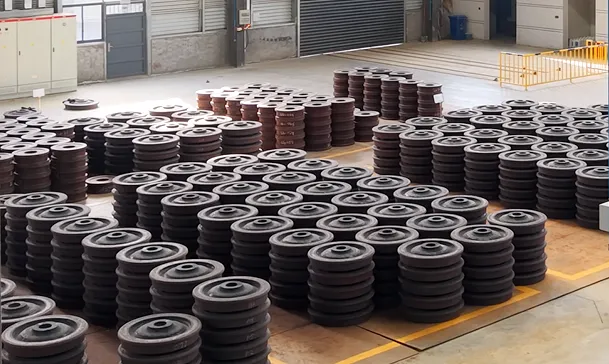
Producing a reliable railway wheel requires not only good design but also consistent manufacturing expertise.
A Luoyang Fonyo Heavy Industries Co., Ltd. we have extensive experience in manufacturing railway and industrial wheels for demanding applications. Our production process focuses on achieving the correct balance between hardness, forza, e tenacità.
Through careful control of material composition, heat treatment parameters, e procedure di ispezione, we ensure that each railway wheel meets strict performance requirements. We also customized railway parts according to your drawings and samples. I nostri prodotti sono progettati per garantire affidabilità a lungo termine, efficienza superiore, e costi di manutenzione ridotti. Puoi esplorare la nostra gamma completa di soluzioni sul nostro sito web www.railwaypart.com Se hai qualche esigenza, per favore contattaci.
Why can excessive hardness be dangerous for a railway wheel?
A railway wheel that is too hard may lose toughness, making the material more brittle. While high hardness improves wear resistance, it can also increase the risk of crack initiation and crack propagation under repeated rail contact stresses.
What is the ideal hardness for a railway wheel?
The ideal hardness depends on the wheel design, applicazione, and railway standards. Engineers typically aim for a balanced hardness level that provides good wear resistance while maintaining sufficient toughness to resist cracking.
Why do railway wheels need both hardness and toughness?
Hardness helps the wheel resist wear and surface fatigue, while toughness allows the material to absorb impact loads and prevent crack growth. A reliable railway wheel must maintain a balance between these two properties.
Is the hardness the same across the entire railway wheel?
NO. A railway wheel usually has a hardness gradient. The rim area often has higher hardness to resist wear, while the web and hub maintain greater toughness to absorb mechanical stresses.
What manufacturing factors affect railway wheel hardness?
Several factors influence railway wheel hardness, including chemical composition, processi di trattamento termico, cooling rates, and microstructure control. Consistent manufacturing processes are essential to maintain stable mechanical properties.