Escanea el código WeChat para contactarnos
Escanea el código WeChat para contactarnos
No dudes en enviarnos un correo electrónico y te responderemos lo antes posible.
Creando el futuro con corazón y alma


1.Preparación de patrones
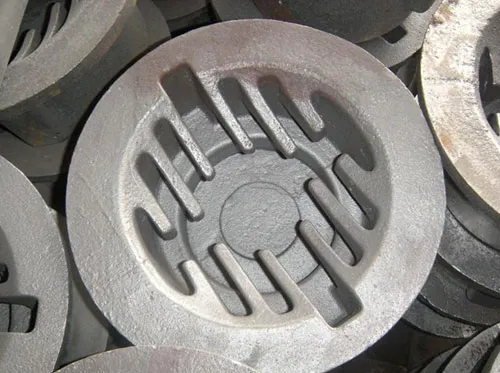
moldes de madera, Se pueden utilizar moldes de metal y moldes de plástico de resina epoxi.. Para piezas fundidas con bajos requisitos para piezas individuales, También se pueden utilizar moldes desechables hechos de espuma plástica.. El uso de moldes de metal o moldes de metal en invierno afectará el endurecimiento., por lo que se deben utilizar moldes de madera tanto como sea posible.. El ángulo de salida del molde debe aumentarse adecuadamente., y la caja central debe convertirse en un tipo de cubo de arroz desconectado o en la medida de lo posible. Para moldes con ángulo de salida limitado, se pueden convertir en un tipo de extracción de núcleos. El sistema de vertido y filetes se debe realizar sobre el molde en la medida de lo posible., y los pernos del molde deben instalarse y apretarse. Antes de moldear, comprobar si el molde está intacto y completo. La superficie del molde de madera debe ser plana y lisa., sin grietas ni rayones, y un agente desmoldante antes del moldeo y fabricación de machos.. Antes de colocar arena, compruebe cuidadosamente si los bloques activos están completos y en su lugar.
2.Preparación de huesos centrales y ganchos colgantes.
Prepare los huesos centrales necesarios y los ganchos colgantes antes de hacer el núcleo.. Debido a la alta resistencia de la arena resinosa., el núcleo óseo se puede simplificar enormemente. Generalmente, no es necesario hacer un núcleo óseo integral de hierro fundido. Se puede hacer insertando varillas de hierro sin apretar.. Sin embargo, También es necesario considerar los requisitos de rigidez y resistencia del núcleo de lodo durante el desmolde., transporte, descenso del núcleo y cierre de la caja, y la flotabilidad del hierro fundido durante el vertido.. Se deben colocar suficientes huesos centrales. Para núcleos de lodo grandes, Se pueden colocar quillas de hierro fundido.. Preste atención a insertar barras de hierro transversales en el gancho inferior del trepador colgante..
3.Ajuste del modelo.
La arena de resina tiene buena fluidez y buen rendimiento autocompactante.. Sin embargo, durante el modelado, todavía es necesario prestar mucha atención a la operación de compactación de las partes cóncavas, esquinas, y debajo del jefe del bloque móvil, que no son fáciles de llenar. El ajuste se puede realizar golpeando con un palo de madera o taponando con las manos., y la superficie de relleno de arena se puede compactar pisándola o con un martillo de madera.. La estabilidad superficial del molde o superficie local que no está bien compactada es pobre., Lo cual es fácil de causar que la arena se pegue mecánicamente. (filtración de hierro), lavado de arena y agujeros de arena, y la holgura del molde después del moldeado es difícil de reparar. During the sand placement and compaction, attention should be paid to the movement and looseness of the mold movable block, the gate rod, the venting and riser rod, the gate ceramic tube, etc.. The sprue rod and the vent and riser rods should be pulled out within a few minutes after molding. The head sand of the continuous sand mixer should be placed in the bucket as back sand because of the abnormal amount of resin and curing agent. De lo contrario, if there is a part of the inner surface of the mold that is not hardened or the strength is insufficient, the whole box will often be knocked off. The strength of the molding sand at the sprue should be taken seriously. The sand flushing caused by the insufficient surface stability of the sprue is often an important cause of sand eye defects in castings. Similarmente, for the sand filling surface of the core box in contact with the molten iron, it should be scraped flat with a trowel in time to enhance the surface stability. When molding with a large sandbox, the sand placement time may exceed the usable time of the resin sand. Por lo tanto, attention should be paid to the advancement route of the sand placement, and the part that has begun to react should not be dug as much as possible. Por lo tanto, all preparations must be made before sand placement, including full mental preparation, especially the placement direction and location of the hanging climbers should be carefully planned. The hanging climbers on the sand-filling surface should be dug out immediately after molding. For multi-box molding of non-pattern patterns, a layer of parting agent (usually talcum powder) should be brushed on the split surface.
4.Demolding and repairing
The demolding time of resin sand should be properly controlled. It is easy to deform if it is too early, and it isn’t easy to demold if it is too large. Por lo tanto, generally, about half an hour after molding, use nails (3″ to 4″) to pierce the mold. If it cannot be pierced, it can generally be de-molded. Since the demolding of resin sand molds is carried out in a semi-hardened state, a large impact force is required. En este momento, attention should be paid to the balance of the demolding. Do not use an iron hammer to hit the wooden mold directly. A wooden block should be placed on it, or a rubber, plastic, or wooden hammer should be used. When dismantling the core box, pay attention to the demolding order and direction of each active part, and dig out the hanging head. For the parts that are accidentally damaged during demolding or transportation, the blocks can be coated with a special core repair adhesive and returned to their original place. If necessary, nails can be used to reinforce. Other damaged parts can be filled with newly mixed resin sand and scraped flat with a trowel. The strength and surface stability of the repaired part is poor, so the most important thing is to carefully do the demolding, manejo, turning and other interactions to minimize the repair operation. Pay special attention to the release of air during modeling and core making.
5.Revestimiento
It is not easy to paint the mold and core that have just been de-molded immediately because the hardening reaction of the resin is still in the primary stage at this time, and the moisture (solvent) in the paint will affect the normal hardening. If alcohol quick-drying paint is used, it needs to be ignited and burned immediately, which will cause the unreacted resin to overburn, which will reduce the surface stability of the mold (centro). Generalmente, the coating operation should be carried out 4-8 hours after modeling. In order to prevent excessive solvent and moisture from penetrating the core and affecting the drying degree of the coating and to ensure the thickness of the coating to improve the resistance to metal penetration, the coating must have a certain concentration. When the brushing performance (such as leveling, easy coating, etc.) is acceptable, the coating concentration should be above 30 “Be. Stir evenly before coating. The coating should be applied from top to bottom, and the coating should not be allowed to drip and accumulate. The coating should be applied evenly to reduce brush marks. También, care should be taken not to miss any coating. The entire pouring system must be coated, and the pouring port ceramic tube should be prevented when it is inconvenient to apply the coating. In order to prevent sand particles from falling into the cavity when closing the box, the pouring riser and the air outlet on the top of the cover box should also be painted. Sin embargo, do not apply the coating on the core head to avoid affecting the mold matching accuracy and hindering the exhaust. This should be paid special attention to during dipping. After the alcohol-based coating is applied, it should be ignited and dried in time. In order to improve the combustion performance of the coating, alcohol above 95% should be used as the diluting solvent. After the water-based coating is applied, it should be dried in a drying room at 150-180 ° C for 1-2 horas. The full drying of the coating is crucial to prevent pores. In the case of poor combustion, a spray gun should be used to supplement the drying, but be careful not to use too much firepower to cause the resin to burn.
6.Lower core box:
Generally the same as clay sand. Resin sand has high strength and is easy to operate when matching molds, but the following points should be noted:
Proveedor
Industrias pesadas Co. de Luoyang Fonyo., Limitado, Fundada en 1998, es un fabricante de piezas fundidas para ferrocarriles. Nuestra fábrica cubre un área de 72,600㎡, con más de 300 empleados, 32 tecnicos, incluido 5 ingenieros superiores, 11 ingenieros asistentes, y 16 Técnicos. Nuestra capacidad de producción es 30,000 toneladas por año. Actualmente, Producimos principalmente fundición., mecanizado, y montaje para locomotora,automotor,trenes de alta velocidad, equipo de minería,energía eólica,etc. Nuestros productos han sido exportados a Rusia, los estados unidos, Alemania, Argentina, Japón, Francia, Sudáfrica,Italia y otros países..
Contacto:cathy
Correo electrónico:[email protected]
Móvil:008615515321683