Отсканируйте код WeChat, чтобы связаться с нами.
Отсканируйте код WeChat, чтобы связаться с нами.
Не стесняйтесь, отправьте нам электронное письмо, и мы ответим вам как можно скорее.
Создаем будущее сердцем и душой


Selecting the correct рыбный болт is far more important than many people realize. Хотя рельсам и шпалам зачастую уделяется наибольшее внимание, a rail joint is only as reliable as the bolts that hold the fish plates firmly against the rail. A poorly selected or incorrectly installed fish bolt can lead to joint movement, accelerated rail wear, higher maintenance costs, и, in severe cases, compromise track safety.
As a manufacturer of railway fastening components, we’ve worked with customers on metro systems, freight railways, горнодобывающие железные дороги, and heavy-haul projects around the world. One thing we’ve learned is that many procurement issues don’t come from poor-quality bolts—they come from choosing the wrong specification.
The questions we hear most often include:
Данное руководство отвечает на эти вопросы и объясняет, как правильно выбрать рыбный болт на основе железнодорожных стандартов, условия эксплуатации, и инженерные требования.
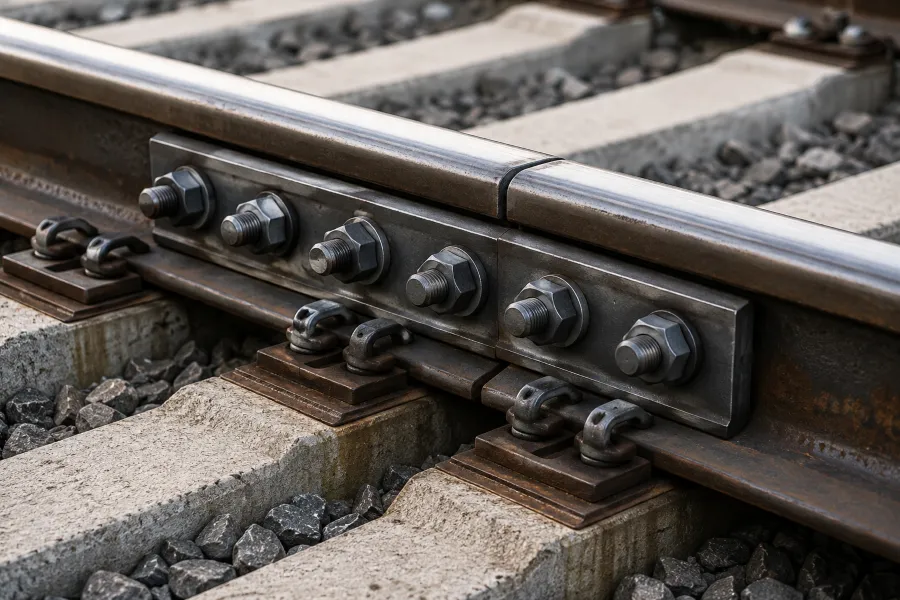
А рыбный болт, также известный как железнодорожный рыбный болт, рельсовый болт, или гусеничный болт, высокопрочный крепеж, используемый для соединения двух рыбных пластин (суставные стержни) через железнодорожный стык.
В отличие от обычных конструкционных болтов, рыболовные болты специально разработаны для применения на железнодорожном транспорте, где они должны выдерживать:
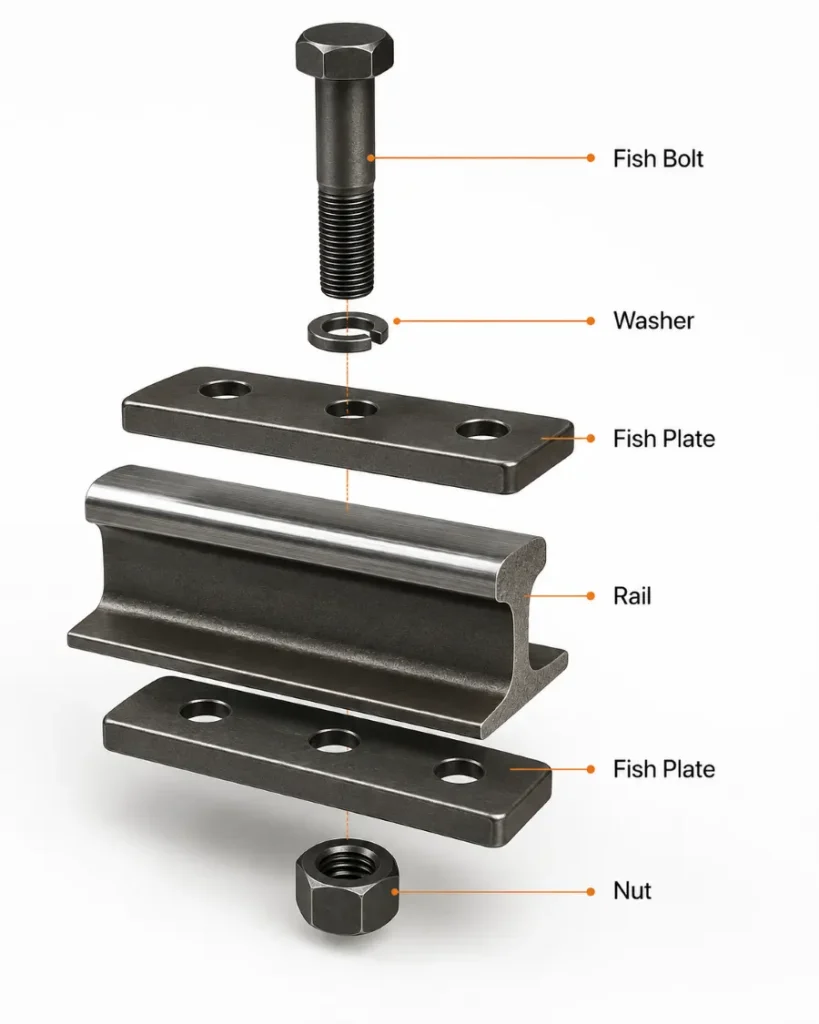
Типичное болтовое соединение рельсов состоит из:
Each component works together to maintain proper clamping force throughout the service life of the track.
Learn how fish plates work in a rail joint in our Rail Fish Plate Guide.
С инженерной точки зрения, a fish bolt is much more than a simple fastener. Its primary function is to generate sufficient clamping force so that the fish plates and rail act as a single structural assembly under repeated train loads.
When the wrong bolt is selected—or when the correct bolt is improperly installed—the consequences can extend far beyond the fastener itself.
Болт меньшего размера или низкой прочности может постепенно терять предварительную нагрузку при циклическом нагружении.. По мере уменьшения силы зажима, рыбные пластины начинают слегка двигаться, когда каждое колесо проходит через сустав.
Это движение ускоряет износ как накладных пластин, так и рельса., со временем увеличивая частоту технического обслуживания.
Железнодорожные стыки в течение всего срока службы подвергаются миллионам циклов нагружения.. Если материал болта, качество резьбы, или термическая обработка неадекватна, усталостные трещины часто возникают в основании резьбы.
По этой причине, железнодорожные рыболовные болты почти всегда изготавливаются из накатанные нити, которые обеспечивают значительно лучшую усталостную прочность, чем нарезанная резьба..
Замена рыбного болта стоит недорого..
Замена изношенных рыбных пластин, поврежденные рельсы, или ремонт вышедшего из строя соединения не является.
По нашему опыту, selecting the correct bolt specification during procurement is one of the simplest ways to reduce long-term maintenance costs.
One of the first questions customers ask is:
The answer depends on the railway application rather than simply choosing the highest strength available.
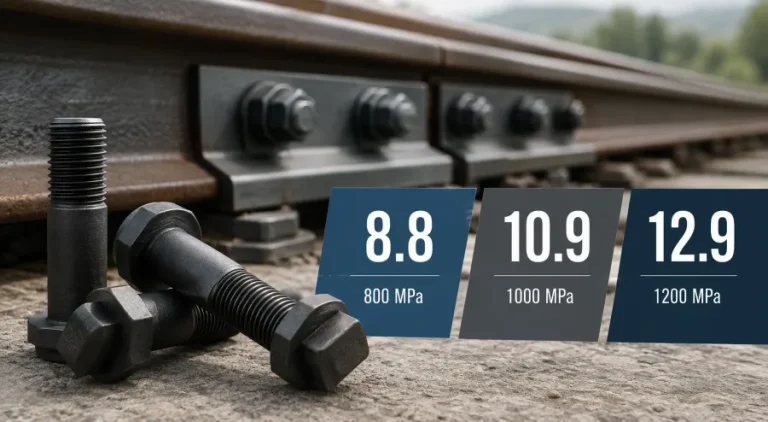
Оценка 8.8 is the most widely used strength class for conventional railway applications.
Типичные области применения включают в себя:
Преимущества включают в себя:
For many urban rail systems, Оценка 8.8 provides sufficient clamping force when properly installed and maintained.
Оценка 10.9 is commonly specified for more demanding railway environments.
Типичные области применения включают в себя:
Compared with Grade 8.8, Оценка 10.9 offers:
From our engineering experience, Оценка 10.9 is the preferred choice for most heavy-duty railway projects because it provides an excellent balance between strength, сопротивление усталости, and ductility.
Although Grade 12.9 offers even higher tensile strength, it is not automatically the best option.
Higher-strength bolts are generally less ductile and more susceptible to hydrogen embrittlement if improper surface treatments are used.
Unless specifically required by the project specification, Оценка 12.9 is rarely necessary for conventional railway joints.
Many customers initially assume that “stronger is always better.” На практике, selecting the appropriate strength grade based on the operating environment usually delivers better long-term reliability.
| Железнодорожное применение | Recommended Grade |
| Метро & Скоростной трамвай | Оценка 8.8 |
| Conventional Passenger Railway | Оценка 8.8 или 10.9 |
| Тяжеловесные грузоперевозки | Оценка 10.9 |
| Горная железная дорога | Оценка 10.9 |
| Высокоскоростная железная дорога | Оценка 10.9 |
| Special Heavy-Duty Applications | Оценка 12.9 (если указано) |
Selecting the correct fish bolt size is just as important as choosing the appropriate strength grade. Even a high-strength bolt cannot perform properly if its diameter or length does not match the fish plate and rail profile.
Unlike general-purpose fasteners, railway fish bolts are designed to fit specific rail standards. The bolt diameter, thread type, head dimensions, and overall length are determined by the rail section and the corresponding fish plate.
Before ordering fish bolts, always confirm:
This information ensures the bolt provides the required preload without excessive clearance or installation issues.
Most railway projects in Europe, Азия, Ближний Восток, and Africa follow МСЖД или В стандарты, where metric fasteners are used.
| Размер болта | Typical Rail Profile | Common Application |
| М22 | S49, МСЖД 50 | Light rail and metro systems |
| М24 | МСЖД 54, МСЖД 60 | Обычные пассажирские и грузовые железные дороги |
| М27 | МСЖД 60 Тяжелые перевозки | Heavy-haul railways and mining lines |
| М30 | Special rail sections | Heavy industrial applications |
Among these sizes, М24 is by far the most commonly specified railway fish bolt for UIC-standard railways.
For many UIC 54 и МСЖД 60 installations, M24 provides sufficient clamping force while remaining compatible with standard fish plate designs.
Однако, some heavy-haul railways adopt М27 bolts to achieve a higher preload and improved resistance to joint movement under extreme axle loads.
Railways in North America generally follow АРЕМА стандарты, which use imperial dimensions rather than metric sizes.
| Размер болта | Typical Rail Section | Common Application |
| 7/8 в | 100 РЭ | Light-duty railway lines |
| 1 в | 115 РЭ, 136 РЭ | Standard freight and passenger railways |
| 1-1/8 в | Тяжелый 136 РЭ | Heavy-haul freight corridors |
Although the functions are the same, AREMA fish bolts are not interchangeable with UIC fish bolts because their thread systems and dimensions are completely different.
Diameter is only one part of the specification.
Bolt length depends on the total thickness of the assembled joint, включая:
A bolt that is too short may not allow full thread engagement.
A bolt that is too long can reduce installation efficiency and increase the exposed thread length, making corrosion more likely over time.
По этой причине, инженеры железнодорожного транспорта обычно указывают оба диаметр болта и длина болта вместе, а не выбирать их по отдельности.
Одна из наиболее распространенных ошибок, с которыми мы сталкиваемся, — это выбор рыболовного болта до подтверждения рыбная тарелка.
На самом деле, Рыбья пластина определяет почти каждый критический размер болта.
Каждая рыбная пластина имеет определенный диаметр отверстий и расстояние между ними.. После подтверждения стандарта рыбной тарелки, подбор подходящей спецификации болтов становится простым.
Типичный процесс отбора выглядит так:
| Рельсовый профиль | Рыбная тарелка | Рекомендуемый рыболовный болт |
| МСЖД 54 | МСЖД 54 Рыбная тарелка | М24 |
| МСЖД 60 | МСЖД 60 Рыбная тарелка | М24 или М27 |
| 115 РЭ | AREMA Объединенная коллегия адвокатов | 1 в |
| 136 РЭ | AREMA Объединенная коллегия адвокатов | 1 в или 1-1/8 в |
Вместо того, чтобы спрашивать, “Какой рыбный болт купить?”, лучший инженерный вопрос:
Такой подход сводит к минимуму проблемы при установке и обеспечивает достижение требуемой силы зажима соединения..
Ищем подходящие стыки? Прочтите наш Руководство по покупке рельсовой рыбной пластины понять, как работает железнодорожный профиль, схема расположения отверстий под болты, и совместная проектная работа вместе.
Распространенным заблуждением является то, что болты одинакового диаметра взаимозаменяемы..
Например, два болта М24 могут иметь разные:
Эти различия могут повлиять на установку, предварительная загрузка, и долговременная надежность.
Всякий раз, когда это возможно, предоставьте вашему поставщику чертеж рыбной тарелки, железнодорожный стандарт, or existing bolt specification instead of specifying only the diameter.
This allows the manufacturer to verify compatibility before production.
Короткий ответ: no.
Although both systems serve the same purpose, they are designed according to different engineering standards.
The main differences include:
| Элемент | МСЖД / В | АРЕМА |
| Thread System | Metric | UNC |
| Размеры | Metric | Imperial |
| Head Type | Hexagonal | Heavy Hex or Square |
| Rail Standards | UIC Rail Profiles | RE Rail Sections |
Attempting to install a UIC fish bolt into an AREMA fish plate—or vice versa—can result in improper thread engagement, incorrect preload, and installation failure.
If your railway project follows UIC standards, all fastening components—including fish plates, болты, орехи, and washers—should follow the same standard.
The same principle applies to AREMA systems.
As a rule of thumb:
Never mix fastening systems within the same rail joint.
Maintaining compatibility across all components is the safest and most reliable approach.
The service life of a рыбный болт depends not only on its strength grade but also on its resistance to corrosion.
Railway fasteners are exposed to rain, снег, coastal salt spray, industrial pollution, and repeated wet-dry cycles throughout their service life. Without appropriate corrosion protection, rust can reduce thread performance, make future maintenance difficult, and eventually affect the integrity of the rail joint.
The most suitable coating depends on the operating environment rather than simply selecting the thickest protective layer.
Black oxide is one of the simplest surface treatments used for steel fasteners.
It provides a uniform appearance and offers light corrosion protection when combined with protective oil.
Типичные области применения включают в себя:
Because the coating is extremely thin, black oxide should not be considered a long-term corrosion solution for outdoor railway projects.
Electroplated zinc is widely used because it offers a good balance between corrosion resistance and cost.
It is commonly specified for:
Однако, engineers should pay particular attention when using electroplated coatings on high-strength bolts.
During the electroplating process, hydrogen may be introduced into the steel. If it is not properly removed through post-plating baking, Оценка 10.9 and Grade 12.9 рыбные болты can become susceptible to hydrogen embrittlement, which may lead to delayed brittle failure under service loads.
Hot-dip galvanizing provides a much thicker zinc coating than electroplating.
It is often selected for:
The thicker coating significantly improves corrosion resistance and extends service life in aggressive environments.
Однако, because the coating adds considerable thickness, both the bolt and nut threads must be manufactured specifically for hot-dip galvanizing to ensure proper assembly.
Modern non-electrolytic coatings such as Geomet и Дакромет have become increasingly popular for high-strength railway fasteners.
These coatings offer several advantages:
Для многих проектов тяжеловесных и высокоскоростных железных дорог., эти системы покрытия стали предпочтительным решением для Оценка 10.9 рыбные болты.
По нашему опыту, они обеспечивают превосходное сочетание долговечности и надежности установки., особенно там, где требуются длительные интервалы технического обслуживания.
Шерардизация — это термодиффузионный процесс цинкования, который создает однородный слой сплава цинка и железа на поверхности болта..
По сравнению с обычным цинкованием, он предлагает:
Хотя менее распространено, чем горячее цинкование., практичный вариант для железнодорожных скреплений, работающих в агрессивных средах.
| Обработка поверхности | Коррозионная стойкость | Лучшее приложение |
| Черный оксид | Низкий | Крытое хранение, временная защита |
| Zinc Electroplating | Середина | Традиционные железнодорожные проекты |
| Hot-Dip Galvanizing | Высокий | Coastal and tropical railways |
| Geomet / Дакромет | Very High | Heavy-haul and high-strength bolts |
| Шерардизация | Высокий | Corrosive environments requiring uniform coating |
There is no single coating suitable for every railway project.
Вместо, we recommend selecting the coating based on the operating environment and bolt strength.
As a general guideline:
Selecting the appropriate coating at the procurement stage can significantly reduce future maintenance costs and extend the service life of the entire rail joint.
After supplying railway fastening components for customers in different countries, we’ve noticed that most purchasing problems are not caused by manufacturing defects. Вместо, they usually result from incorrect specifications during the procurement stage.
Here are some of the most common mistakes—and how to avoid them.
Many buyers assume that a Grade 12.9 fish bolt is always better than Grade 10.9.
На самом деле, higher strength does not necessarily mean better performance.
Оценка 12.9 bolts are less ductile and require stricter control of heat treatment and surface coating. For most heavy-haul, груз, and passenger railway applications, Оценка 10.9 provides a more balanced combination of strength, сопротивление усталости, и долговременная надежность.
A request such as “We need M24 fish bolts” does not provide enough information for manufacturing.
Different railway systems may use the same diameter but require different:
Всякий раз, когда это возможно, provide the rail profile, fish plate drawing, or project standard instead of only the bolt diameter.
Although UIC and AREMA fish bolts perform the same function, they are designed according to different standards.
Mixing metric and imperial components can lead to installation difficulties, improper preload, and unnecessary replacement costs.
Always use fish bolts, орехи, washers, and fish plates that comply with the same railway standard.
Some buyers focus only on the bolt material and overlook the surface coating.
Однако, corrosion is one of the leading causes of maintenance issues in rail joints, especially in coastal regions, порты, горнодобывающие железные дороги, and humid climates.
Choosing the correct coating at the beginning of a project is far less expensive than replacing corroded fasteners later.
Снаружи, rolled threads and cut threads may appear similar.
Their fatigue performance, однако, is very different.
Rolled threads preserve the grain flow of the steel and introduce beneficial compressive stresses at the thread root, making them far more resistant to fatigue cracking.
For safety-critical railway applications, thread rolling should always be preferred over thread cutting.
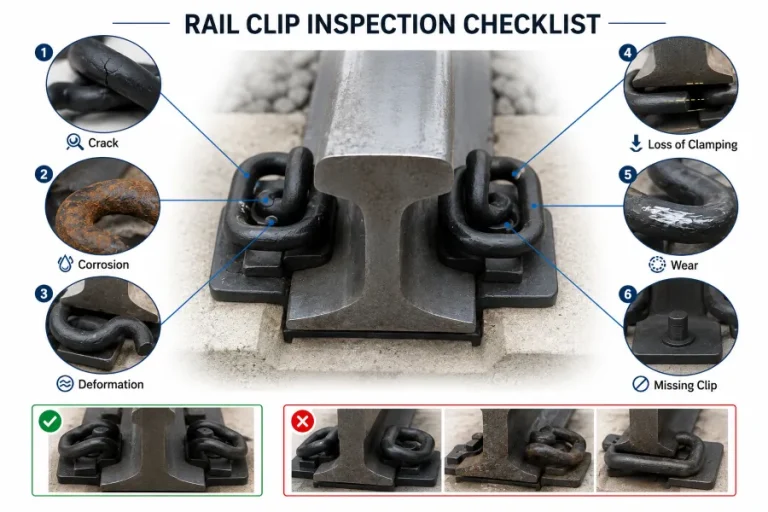
Fish bolts are only one part of a complete fastening system. Learn how Рельсовые зажимы maintain rail clamping force and work together with рыбные болты and fish plates in modern railway track systems.
A railway рыбный болт is expected to remain secure under millions of load cycles during its service life. Achieving that level of reliability depends not only on the material grade but also on consistent manufacturing and rigorous quality control.
В Лоянская компания Fonyo Heavy Industries Co., ООО., every production stage is designed to ensure that fish bolts meet the mechanical performance and dimensional accuracy required by railway standards such as EN, МСЖД, and AREMA.
Rather than relying on final inspection alone, we control quality throughout the entire manufacturing process.
The manufacturing process begins with certified steel from qualified suppliers.
До начала производства, the chemical composition of each batch is verified using a spectrometer to confirm that the material meets the required specification.
This step helps ensure consistent mechanical properties after heat treatment and reduces the risk of material variation between production batches.
The bolt head is formed through hot forging rather than machining.
Hot forging improves grain flow inside the steel, resulting in higher strength and better impact resistance compared with bolts produced from machined bar stock.
The forging process also produces a more accurate bolt head and minimizes material waste.
Heat treatment is one of the most critical steps in manufacturing railway fish bolts.
Температура, время выдержки, and cooling rate are carefully controlled to achieve the required mechanical properties for each strength grade.
Proper heat treatment provides the balance of:
that railway applications demand.
One feature that distinguishes railway-grade fish bolts from ordinary industrial fasteners is the use of накатанные нити.
Unlike cut threads, thread rolling forms the thread profile by cold working the steel.
This process preserves the natural grain flow and introduces compressive residual stress around the thread root, significantly improving fatigue performance under repeated railway loading.
For components subjected to millions of load cycles, rolled threads have become the industry standard.
Every production batch undergoes routine inspection before shipment.
В зависимости от требований заказчика, testing may include:
Material certificates and inspection reports can also be provided to support project documentation and quality assurance requirements.
После проверки, fish bolts receive the specified surface treatment, such as zinc plating, hot-dip galvanizing, or Geomet coating.
Finished bolts are then packaged together with matching nuts and washers to simplify installation on site and reduce the possibility of component mismatch.
Raw Material → Hot Forging → Heat Treatment → Thread Rolling → Inspection → Packaging
Use real factory photos where possible instead of icons. Original manufacturing images strengthen EEAT and help differentiate the article from generic industry content.
Even the highest-quality fish bolt cannot perform as intended if it is installed incorrectly.
Proper installation ensures that the fish plates remain firmly clamped and that the rail joint maintains sufficient preload throughout its service life.
The following practices are recommended for most railway projects.
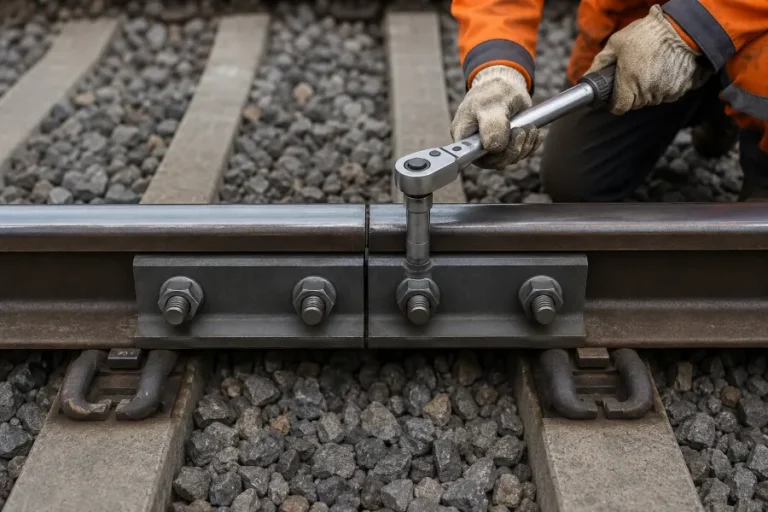
Each bolt size and strength grade has a recommended tightening torque.
Applying too little torque may allow the joint to loosen under vibration, while excessive torque can overstress the bolt or damage the threads.
Always follow the torque values specified by the applicable railway standard or project documentation.
For rail joints using four or six bolts, tightening should be carried out gradually in a balanced sequence rather than fully tightening one bolt at a time.
This helps distribute the clamping force evenly across the fish plates and minimizes uneven stress within the joint.
During the first period of operation, slight settlement may occur as the contact surfaces between the fish plates, рельс, and fasteners stabilize.
Many railway maintenance procedures therefore recommend checking the bolt preload after the line has been placed into service.
Regular inspections also help identify loose fasteners before they develop into larger maintenance issues.
A fish bolt assembly should always consist of compatible components manufactured to the same standard.
Mixing bolts, орехи, or washers from different systems may result in incorrect thread engagement or uneven preload.
When replacing fish bolts during maintenance, it is good practice to replace the complete assembly rather than individual components.
Internal Link: Fish bolts work together with Рельсовые зажимы, Рельсовые колодки, и Рыбные тарелки to form a complete railway fastening system. Understanding how these components interact helps improve joint reliability and reduce maintenance requirements.
A fish bolt is specifically designed for railway rail joints. Compared with general-purpose structural bolts, it is manufactured to railway standards, uses higher-strength materials, и спроектирован так, чтобы выдерживать постоянную вибрацию, ударная нагрузка, и усталостные напряжения. Не рекомендуется заменять железнодорожный болт-рыбку обычным товарным болтом..
Количество рыбных болтов зависит от конструкции рыбной пластины..
Стандарт 4-пластина для рыбы с отверстиями использует четыре болта для рыбы, в то время как 6-пластина для рыбы с отверстиями использует шесть болтов для рыб.
Каждый болт проходит через обе накладки и стенку рельса., фиксация всего соединения как единого узла.
В большинстве приложений по техническому обслуживанию железных дорог, повторное использование рыболовных болтов не рекомендуется.
После длительной эксплуатации и повторных нагрузок, как болт, так и гайка могут изнашиваться, что влияет на способность поддерживать требуемый предварительный натяг.
Replacing the complete bolt assembly during maintenance provides greater reliability and helps reduce the risk of future joint loosening.
For most freight, пассажир, метро, and heavy-haul railway projects, Оценка 10.9 provides an excellent balance between strength, прочность, и усталостная стойкость.
Оценка 12.9 is generally reserved for special engineering applications where exceptionally high strength is specified.
Choosing the highest grade is not always the best engineering solution.
Нет.
UIC and AREMA fastening systems use different dimensions, thread standards, and component specifications.
To ensure proper installation and long-term performance, all components within a rail joint should comply with the same railway standard.
There is no universal answer because the best coating depends on the service environment.
Для внутренних железных дорог, гальванического цинкования часто бывает достаточно.
Для прибрежных, добыча полезных ископаемых, or high-humidity environments, hot-dip galvanizing, Шерардизация, или покрытия Geomet обычно обеспечивают лучшую долговременную защиту от коррозии..
Хотя рыбий болт является одним из самых маленьких компонентов в системе железнодорожного крепления., он играет решающую роль в поддержании целостности каждого стыка рельсов..
Выбор правильного болта подразумевает гораздо больше, чем просто выбор диаметра или класса прочности.. Рельсовый профиль, дизайн рыбной тарелки, условия эксплуатации, коррозионная среда, и применимые железнодорожные стандарты влияют на окончательную спецификацию..
Понимание этих факторов на этапе закупок помогает уменьшить проблемы с установкой., увеличить интервалы технического обслуживания, и повысить долгосрочную надежность пути.
В Лоянская компания Fonyo Heavy Industries Co., ООО., производим железнодорожные рыбные болты, рыбные тарелки, рельсовые зажимы, и другие компоненты железнодорожных креплений для проектов по всему миру. Whether you require standard products or customized fasteners for a specific railway system, our engineering team can help you identify the most suitable solution based on your drawings, технические характеристики, or project requirements.
If you’re planning a railway project or sourcing replacement fish bolts, feel free to contact us. We’ll be happy to recommend the appropriate fish bolt size, класс прочности, surface coating, and matching fastening components for your application.
In addition to fish plates, we also supply рыбные болты, рельсовые зажимы, железнодорожные колодки, железнодорожные шпалы, and other railway track components.
Contact us today for technical support, engineering consultation, and quotations.