Escanea el código WeChat para contactarnos
Escanea el código WeChat para contactarnos
No dudes en enviarnos un correo electrónico y te responderemos lo antes posible.
Creando el futuro con corazón y alma


Seleccionando el correcto perno de pescado es mucho más importante de lo que mucha gente cree. Mientras que los rieles y las traviesas suelen recibir la mayor atención, una unión de riel es tan confiable como los pernos que sujetan las eclisas firmemente contra el riel. Un pasador mal seleccionado o instalado incorrectamente puede provocar el movimiento de las articulaciones., desgaste acelerado del carril, mayores costos de mantenimiento, y, en casos severos, comprometer la seguridad de la vía.
Como fabricante de componentes de fijación ferroviaria., Hemos trabajado con clientes en sistemas de metro., ferrocarriles de carga, ferrocarriles mineros, y proyectos de transporte pesado en todo el mundo. Una cosa que hemos aprendido es que muchos problemas de adquisición no se deben a pernos de mala calidad, sino a la elección de la especificación incorrecta..
Las preguntas que escuchamos con más frecuencia incluyen:
Esta guía responde a estas preguntas y explica cómo seleccionar el producto adecuado. perno de pescado basado en estándares ferroviarios, condiciones de funcionamiento, y requisitos de ingeniería.
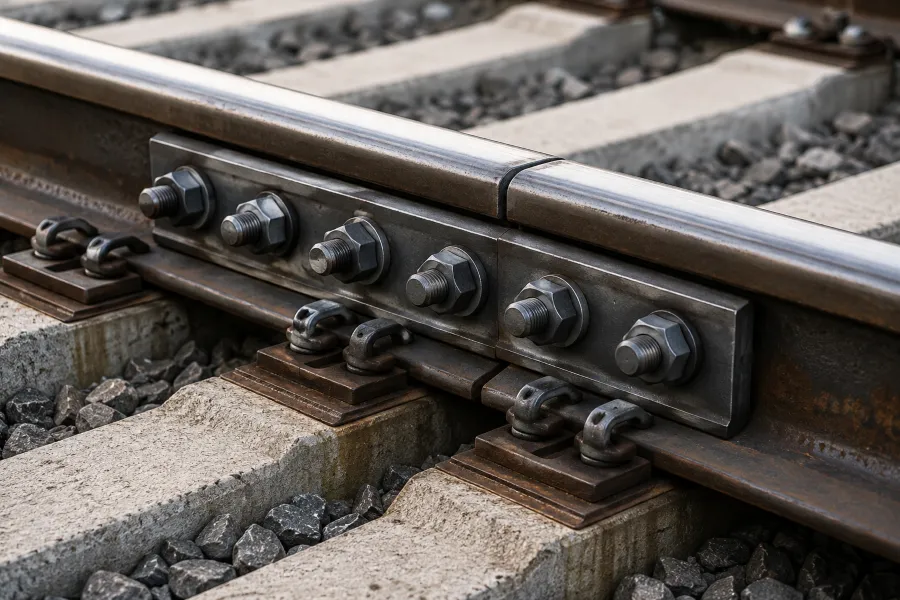
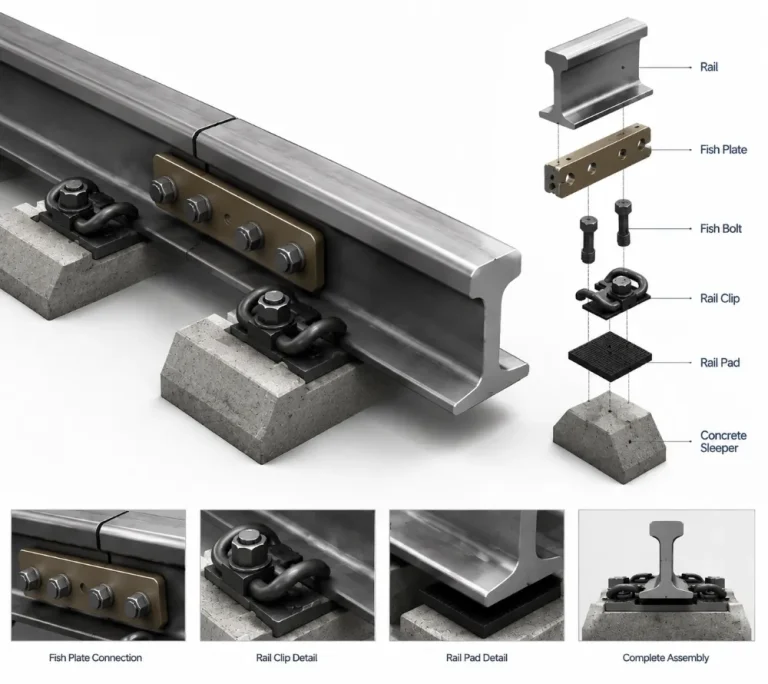
A perno de pescado, también conocido como un perno de pez de ferrocarril, perno de riel, o perno de oruga, es un sujetador de alta resistencia que se utiliza para conectar dos eclisas (barras conjuntas) a través de una unión ferroviaria.
A diferencia de los pernos estructurales ordinarios, Los pernos de pescado están diseñados específicamente para aplicaciones ferroviarias donde deben resistir:
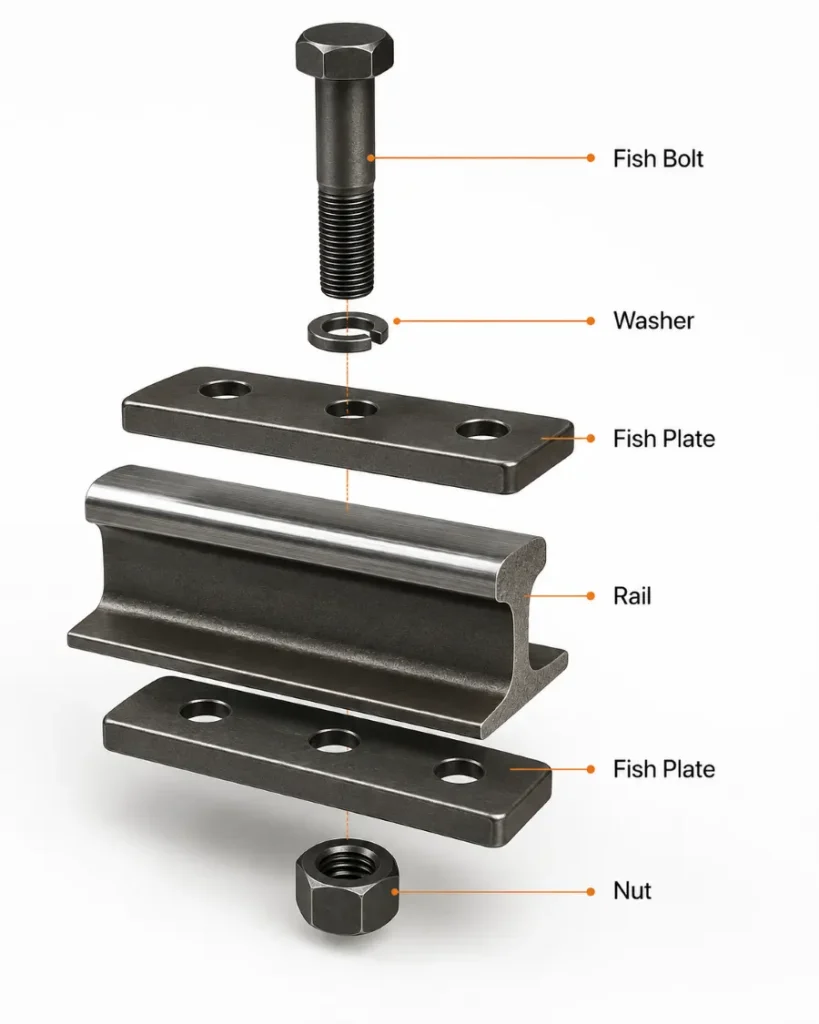
Una junta de carril atornillada típica consta de:
Cada componente trabaja en conjunto para mantener la fuerza de sujeción adecuada durante toda la vida útil de la pista..
Aprenda cómo funcionan las eclisas en una junta de riel en nuestro Guía de eclisa de riel.
Desde una perspectiva de ingeniería, un perno de pescado es mucho más que un simple sujetador. Su función principal es generar suficiente fuerza de sujeción para que las eclisas y el riel actúen como un solo conjunto estructural bajo cargas repetidas del tren..
Cuando se selecciona el perno incorrecto, o cuando se instala incorrectamente el perno correcto, las consecuencias pueden extenderse mucho más allá del propio sujetador..
Un perno de tamaño insuficiente o de baja resistencia puede perder gradualmente la precarga bajo carga cíclica.. A medida que la fuerza de sujeción disminuye, Las eclisas comienzan a moverse ligeramente con cada rueda que pasa sobre la articulación..
Este movimiento acelera el desgaste tanto de las eclisas como del carril., eventualmente aumentando la frecuencia de mantenimiento.
Las juntas ferroviarias experimentan millones de ciclos de carga a lo largo de su vida útil. Si el material del perno, calidad del hilo, o el tratamiento térmico es inadecuado, Las grietas por fatiga a menudo se inician en la raíz de la rosca..
Por esta razón, Los pernos de pescado ferroviarios casi siempre se fabrican con hilos enrollados, que proporcionan una resistencia a la fatiga significativamente mejor que los hilos cortados.
Reemplazar un perno de pesca es económico.
Reemplazo de platos de pescado desgastados, rieles dañados, o reparar una junta defectuosa no es.
En nuestra experiencia, Seleccionar la especificación correcta de pernos durante la adquisición es una de las formas más sencillas de reducir los costos de mantenimiento a largo plazo..
Una de las primeras preguntas que hacen los clientes es:
La respuesta depende de la aplicación ferroviaria en lugar de simplemente elegir la mayor resistencia disponible..
Calificación 8.8 Es la clase de resistencia más utilizada para aplicaciones ferroviarias convencionales..
Las aplicaciones típicas incluyen:
Las ventajas incluyen:
Para muchos sistemas ferroviarios urbanos, Calificación 8.8 Proporciona suficiente fuerza de sujeción cuando se instala y mantiene correctamente..
Calificación 10.9 Se especifica comúnmente para entornos ferroviarios más exigentes..
Las aplicaciones típicas incluyen:
Comparado con el grado 8.8, Calificación 10.9 ofertas:
De nuestra experiencia en ingeniería, Calificación 10.9 es la opción preferida para la mayoría de los proyectos ferroviarios de servicio pesado porque proporciona un excelente equilibrio entre resistencia, resistencia a la fatiga, y ductilidad.
aunque grado 12.9 ofrece una resistencia a la tracción aún mayor, es no es automáticamente la mejor opción.
Los pernos de mayor resistencia generalmente son menos dúctiles y más susceptibles a la fragilización por hidrógeno si se utilizan tratamientos superficiales inadecuados..
A menos que lo requiera específicamente la especificación del proyecto., Calificación 12.9 Rara vez es necesario para juntas ferroviarias convencionales..
Muchos clientes inicialmente suponen que “más fuerte siempre es mejor.” En la práctica, La selección del grado de resistencia adecuado según el entorno operativo generalmente ofrece una mayor confiabilidad a largo plazo..
| Aplicación ferroviaria | Grado recomendado |
| Metro & Tren Ligero | Calificación 8.8 |
| Ferrocarril de pasajeros convencional | Calificación 8.8 o 10.9 |
| Transporte pesado | Calificación 10.9 |
| Ferrocarril Minero | Calificación 10.9 |
| Ferrocarril de alta velocidad | Calificación 10.9 |
| Aplicaciones especiales de servicio pesado | Calificación 12.9 (si se especifica) |
Seleccionando el correcto tamaño del perno de pescado es tan importante como elegir el grado de resistencia adecuado. Incluso un perno de alta resistencia no puede funcionar correctamente si su diámetro o longitud no coinciden con la eclisa y el perfil del riel..
A diferencia de los sujetadores de uso general, Los pernos de pescado para ferrocarril están diseñados para adaptarse a estándares ferroviarios específicos.. El diámetro del perno, tipo de hilo, dimensiones de la cabeza, y la longitud total están determinadas por la sección del carril y la eclisa correspondiente.
Antes de pedir pernos de pescado, siempre confirma:
Esta información garantiza que el perno proporcione la precarga requerida sin espacio excesivo ni problemas de instalación..
La mayoría de los proyectos ferroviarios en Europa, Asia, el Medio Oriente, y África sigue UIC o EN estándares, donde se utilizan sujetadores métricos.
| Tamaño del perno | Perfil de riel típico | Aplicación común |
| M22 | S49, UIC 50 | Sistemas de metro y tren ligero |
| M24 | UIC 54, UIC 60 | Ferrocarriles convencionales de pasajeros y mercancías. |
| M27 | UIC 60 Transporte pesado | Ferrocarriles de transporte pesado y líneas mineras |
| M30 | Secciones ferroviarias especiales | Aplicaciones industriales pesadas |
Entre estos tamaños, M24 Es, con diferencia, el pasador ferroviario más comúnmente especificado para vías férreas estándar UIC..
Para muchas UIC 54 y la UIC 60 instalaciones, M24 proporciona suficiente fuerza de sujeción y al mismo tiempo es compatible con diseños de eclisas estándar.
Sin embargo, algunos ferrocarriles de transporte pesado adoptan M27 Pernos para lograr una mayor precarga y una mejor resistencia al movimiento de las articulaciones bajo cargas extremas del eje..
Los ferrocarriles en América del Norte generalmente siguen AREMA estándares, que utilizan dimensiones imperiales en lugar de tamaños métricos.
| Tamaño del perno | Sección de carril típica | Aplicación común |
| 7/8 en | 100 RE | Líneas ferroviarias ligeras |
| 1 en | 115 RE, 136 RE | Ferrocarriles estándar de mercancías y pasajeros |
| 1-1/8 en | Pesado 136 RE | Corredores de mercancías de transporte pesado |
Aunque las funciones son las mismas., Los pernos de pescado AREMA no son intercambiables con los pernos de pescado UIC porque sus sistemas de rosca y dimensiones son completamente diferentes.
El diámetro es sólo una parte de la especificación..
La longitud del perno depende del espesor total de la junta ensamblada., incluido:
Es posible que un perno demasiado corto no permita un enganche completo de la rosca..
Un perno demasiado largo puede reducir la eficiencia de la instalación y aumentar la longitud de la rosca expuesta., haciendo que la corrosión sea más probable con el tiempo.
Por esta razón, Los ingenieros ferroviarios normalmente especifican ambos diámetro del perno y longitud del perno juntos en lugar de seleccionarlos de forma independiente.
Uno de los errores más comunes que vemos es seleccionar un pez antes de confirmar el plato de pescado.
En realidad, La eclisa determina casi todas las dimensiones críticas del perno..
Cada eclisa está diseñada con un diámetro y espacio de orificio específicos. Una vez confirmado el estándar del plato de pescado., la especificación correspondiente del perno de pescado se vuelve sencilla.
Un proceso de selección típico se ve así:
| Perfil de carril | Plato de pescado | Perno de pescado recomendado |
| UIC 54 | UIC 54 Plato de pescado | M24 |
| UIC 60 | UIC 60 Plato de pescado | M24 o M27 |
| 115 RE | Barra conjunta AREMA | 1 en |
| 136 RE | Barra conjunta AREMA | 1 en o 1-1/8 en |
en lugar de preguntar, “¿Qué pez debo comprar??”, una mejor pregunta de ingeniería es:
This approach minimizes installation problems and ensures the joint achieves the required clamping force.
Looking for matching joint bars? Read our Rail Fish Plate Buying Guide to understand how rail profile, bolt hole pattern, and joint design work together.
It is a common misconception that bolts with the same diameter are interchangeable.
Por ejemplo, two M24 fish bolts may have different:
These differences can affect installation, precarga, y confiabilidad a largo plazo.
Whenever possible, provide your supplier with the fish plate drawing, rail standard, or existing bolt specification instead of specifying only the diameter.
This allows the manufacturer to verify compatibility before production.
La respuesta corta es no.
Although both systems serve the same purpose, they are designed according to different engineering standards.
The main differences include:
| Artículo | UIC / EN | AREMA |
| Thread System | Metric | UNC |
| Dimensiones | Metric | Imperial |
| Head Type | Hexagonal | Heavy Hex or Square |
| Rail Standards | UIC Rail Profiles | RE Rail Sections |
Attempting to install a UIC fish bolt into an AREMA fish plate—or vice versa—can result in improper thread engagement, incorrect preload, and installation failure.
If your railway project follows UIC standards, all fastening components—including fish plates, pernos, nueces, and washers—should follow the same standard.
The same principle applies to AREMA systems.
As a rule of thumb:
Never mix fastening systems within the same rail joint.
Maintaining compatibility across all components is the safest and most reliable approach.
The service life of a perno de pescado depends not only on its strength grade but also on its resistance to corrosion.
Railway fasteners are exposed to rain, nieve, coastal salt spray, industrial pollution, and repeated wet-dry cycles throughout their service life. Without appropriate corrosion protection, rust can reduce thread performance, make future maintenance difficult, and eventually affect the integrity of the rail joint.
The most suitable coating depends on the operating environment rather than simply selecting the thickest protective layer.
Black oxide is one of the simplest surface treatments used for steel fasteners.
It provides a uniform appearance and offers light corrosion protection when combined with protective oil.
Las aplicaciones típicas incluyen:
Because the coating is extremely thin, black oxide should not be considered a long-term corrosion solution for outdoor railway projects.
Electroplated zinc is widely used because it offers a good balance between corrosion resistance and cost.
It is commonly specified for:
Sin embargo, engineers should pay particular attention when using electroplated coatings on high-strength bolts.
During the electroplating process, hydrogen may be introduced into the steel. If it is not properly removed through post-plating baking, Calificación 10.9 and Grade 12.9 pernos de pescado can become susceptible to hydrogen embrittlement, which may lead to delayed brittle failure under service loads.
Hot-dip galvanizing provides a much thicker zinc coating than electroplating.
It is often selected for:
The thicker coating significantly improves corrosion resistance and extends service life in aggressive environments.
Sin embargo, because the coating adds considerable thickness, both the bolt and nut threads must be manufactured specifically for hot-dip galvanizing to ensure proper assembly.
Modern non-electrolytic coatings such as Geomet y Dacromet have become increasingly popular for high-strength railway fasteners.
These coatings offer several advantages:
For many heavy-haul and high-speed railway projects, these coating systems have become the preferred solution for Calificación 10.9 pernos de pescado.
En nuestra experiencia, they provide an excellent combination of durability and installation reliability, particularly where long maintenance intervals are required.
Sherardizing is a thermal diffusion zinc process that creates a uniform zinc-iron alloy layer on the bolt surface.
Compared with conventional galvanizing, it offers:
Although less common than hot-dip galvanizing, it is a practical option for railway fasteners operating in corrosive environments.
| Tratamiento superficial | Resistencia a la corrosión | Best Application |
| Óxido negro | Bajo | Indoor storage, temporary protection |
| Zinc Electroplating | Medio | Conventional railway projects |
| Hot-Dip Galvanizing | Alto | Coastal and tropical railways |
| Geomet / Dacromet | Very High | Heavy-haul and high-strength bolts |
| sherardizando | Alto | Corrosive environments requiring uniform coating |
There is no single coating suitable for every railway project.
En cambio, we recommend selecting the coating based on the operating environment and bolt strength.
As a general guideline:
Selecting the appropriate coating at the procurement stage can significantly reduce future maintenance costs and extend the service life of the entire rail joint.
After supplying railway fastening components for customers in different countries, we’ve noticed that most purchasing problems are not caused by manufacturing defects. En cambio, they usually result from incorrect specifications during the procurement stage.
Here are some of the most common mistakes—and how to avoid them.
Many buyers assume that a Grade 12.9 fish bolt is always better than Grade 10.9.
En realidad, higher strength does not necessarily mean better performance.
Calificación 12.9 bolts are less ductile and require stricter control of heat treatment and surface coating. For most heavy-haul, transporte, and passenger railway applications, Calificación 10.9 provides a more balanced combination of strength, resistencia a la fatiga, y confiabilidad a largo plazo.
A request such as “We need M24 fish bolts” does not provide enough information for manufacturing.
Different railway systems may use the same diameter but require different:
Whenever possible, provide the rail profile, fish plate drawing, or project standard instead of only the bolt diameter.
Although UIC and AREMA fish bolts perform the same function, they are designed according to different standards.
Mixing metric and imperial components can lead to installation difficulties, improper preload, and unnecessary replacement costs.
Always use fish bolts, nueces, washers, and fish plates that comply with the same railway standard.
Some buyers focus only on the bolt material and overlook the surface coating.
Sin embargo, corrosion is one of the leading causes of maintenance issues in rail joints, especially in coastal regions, puertos, ferrocarriles mineros, and humid climates.
Choosing the correct coating at the beginning of a project is far less expensive than replacing corroded fasteners later.
Desde el exterior, rolled threads and cut threads may appear similar.
Their fatigue performance, sin embargo, is very different.
Rolled threads preserve the grain flow of the steel and introduce beneficial compressive stresses at the thread root, making them far more resistant to fatigue cracking.
For safety-critical railway applications, thread rolling should always be preferred over thread cutting.
Fish bolts are only one part of a complete fastening system. Learn how Clips de riel maintain rail clamping force and work together with pernos de pescado and fish plates in modern railway track systems.
un ferrocarril perno de pescado is expected to remain secure under millions of load cycles during its service life. Achieving that level of reliability depends not only on the material grade but also on consistent manufacturing and rigorous quality control.
En Industrias pesadas Co. de Luoyang Fonyo., Limitado., every production stage is designed to ensure that fish bolts meet the mechanical performance and dimensional accuracy required by railway standards such as EN, UIC, and AREMA.
Rather than relying on final inspection alone, we control quality throughout the entire manufacturing process.
The manufacturing process begins with certified steel from qualified suppliers.
Before production starts, the chemical composition of each batch is verified using a spectrometer to confirm that the material meets the required specification.
This step helps ensure consistent mechanical properties after heat treatment and reduces the risk of material variation between production batches.
The bolt head is formed through hot forging rather than machining.
Hot forging improves grain flow inside the steel, resulting in higher strength and better impact resistance compared with bolts produced from machined bar stock.
The forging process also produces a more accurate bolt head and minimizes material waste.
Heat treatment is one of the most critical steps in manufacturing railway fish bolts.
Temperatura, tiempo de espera, and cooling rate are carefully controlled to achieve the required mechanical properties for each strength grade.
Proper heat treatment provides the balance of:
that railway applications demand.
One feature that distinguishes railway-grade fish bolts from ordinary industrial fasteners is the use of hilos enrollados.
Unlike cut threads, thread rolling forms the thread profile by cold working the steel.
This process preserves the natural grain flow and introduces compressive residual stress around the thread root, significantly improving fatigue performance under repeated railway loading.
For components subjected to millions of load cycles, rolled threads have become the industry standard.
Every production batch undergoes routine inspection before shipment.
Dependiendo de los requisitos del cliente, testing may include:
Material certificates and inspection reports can also be provided to support project documentation and quality assurance requirements.
Después de la inspección, fish bolts receive the specified surface treatment, such as zinc plating, hot-dip galvanizing, or Geomet coating.
Finished bolts are then packaged together with matching nuts and washers to simplify installation on site and reduce the possibility of component mismatch.
Raw Material → Hot Forging → Heat Treatment → Thread Rolling → Inspection → Packaging
Use real factory photos where possible instead of icons. Original manufacturing images strengthen EEAT and help differentiate the article from generic industry content.
Even the highest-quality fish bolt cannot perform as intended if it is installed incorrectly.
Proper installation ensures that the fish plates remain firmly clamped and that the rail joint maintains sufficient preload throughout its service life.
The following practices are recommended for most railway projects.
Each bolt size and strength grade has a recommended tightening torque.
Applying too little torque may allow the joint to loosen under vibration, while excessive torque can overstress the bolt or damage the threads.
Always follow the torque values specified by the applicable railway standard or project documentation.
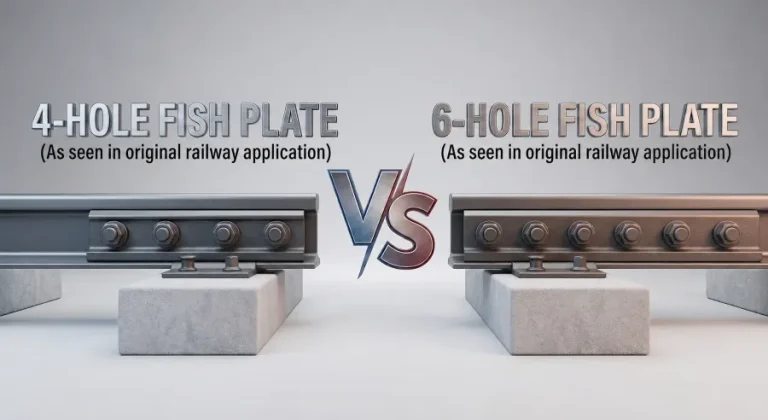
For rail joints using four or six bolts, tightening should be carried out gradually in a balanced sequence rather than fully tightening one bolt at a time.
This helps distribute the clamping force evenly across the fish plates and minimizes uneven stress within the joint.
During the first period of operation, slight settlement may occur as the contact surfaces between the fish plates, carril, and fasteners stabilize.
Many railway maintenance procedures therefore recommend checking the bolt preload after the line has been placed into service.
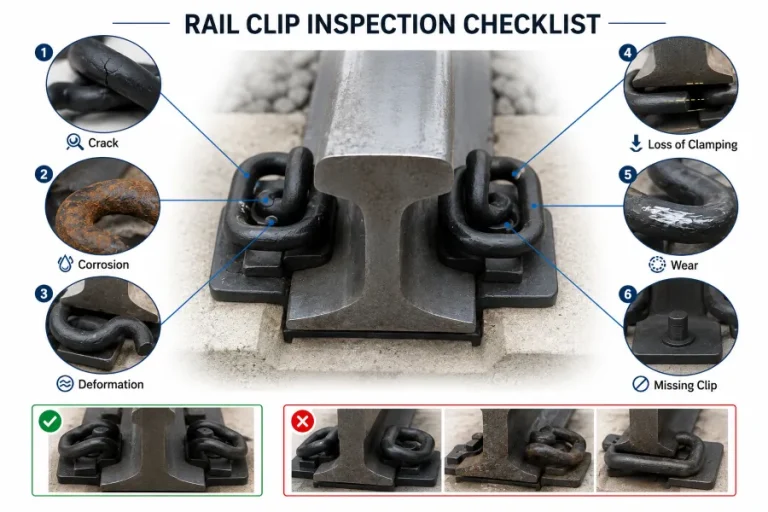
Regular inspections also help identify loose fasteners before they develop into larger maintenance issues.
A fish bolt assembly should always consist of compatible components manufactured to the same standard.
Mixing bolts, nueces, or washers from different systems may result in incorrect thread engagement or uneven preload.
When replacing fish bolts during maintenance, it is good practice to replace the complete assembly rather than individual components.
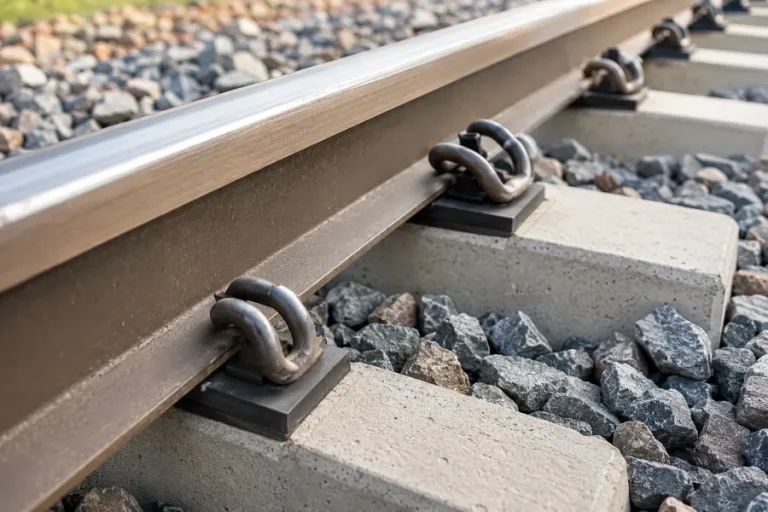
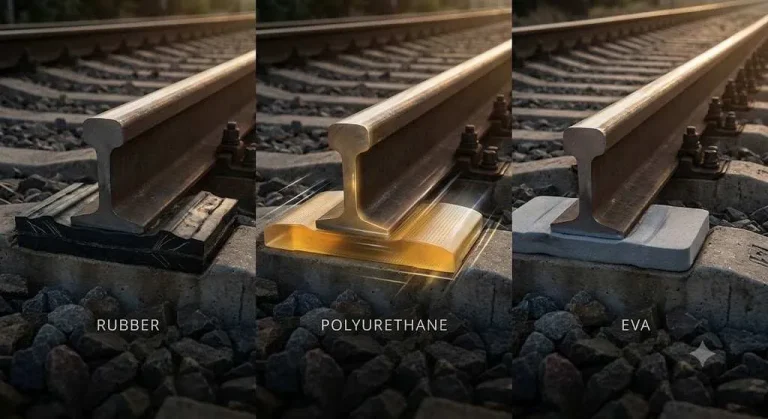
Internal Link: Fish bolts work together with Clips de riel, Almohadillas de riel, y Platos De Pescado to form a complete railway fastening system. Understanding how these components interact helps improve joint reliability and reduce maintenance requirements.
A fish bolt is specifically designed for railway rail joints. Compared with general-purpose structural bolts, it is manufactured to railway standards, uses higher-strength materials, and is designed to withstand continuous vibration, carga de impacto, and fatigue stresses. It is not recommended to replace a railway fish bolt with an ordinary commercial bolt.
The number of fish bolts depends on the fish plate design.
A standard 4-hole fish plate uses four fish bolts, while a 6-hole fish plate uses six fish bolts.
Each bolt passes through both fish plates and the rail web, securing the complete joint as a single assembly.
In most railway maintenance applications, reusing fish bolts is not recommended.
After long-term service and repeated loading, both the bolt and nut may experience wear that affects the ability to maintain the required preload.
Replacing the complete bolt assembly during maintenance provides greater reliability and helps reduce the risk of future joint loosening.
For most freight, pasajero, metro, and heavy-haul railway projects, Calificación 10.9 provides an excellent balance between strength, tenacidad, y resistencia a la fatiga.
Calificación 12.9 is generally reserved for special engineering applications where exceptionally high strength is specified.
Choosing the highest grade is not always the best engineering solution.
No.
UIC and AREMA fastening systems use different dimensions, thread standards, and component specifications.
To ensure proper installation and long-term performance, all components within a rail joint should comply with the same railway standard.
There is no universal answer because the best coating depends on the service environment.
For inland railways, zinc electroplating is often sufficient.
For coastal, minería, or high-humidity environments, hot-dip galvanizing, sherardizando, or Geomet coatings generally provide better long-term corrosion protection.
Although a fish bolt is one of the smallest components in a railway fastening system, it plays a critical role in maintaining the integrity of every rail joint.
Selecting the correct bolt involves much more than choosing a diameter or strength grade. Perfil de carril, diseño de plato de pescado, condiciones de funcionamiento, corrosion environment, and applicable railway standards all influence the final specification.
Understanding these factors at the procurement stage helps reduce installation problems, extend maintenance intervals, and improve the long-term reliability of the track.
En Industrias pesadas Co. de Luoyang Fonyo., Limitado., we manufacture railway fish bolts, platos de pescado, clips de riel, and other railway fastening components for projects worldwide. Whether you require standard products or customized fasteners for a specific railway system, our engineering team can help you identify the most suitable solution based on your drawings, especificaciones técnicas, or project requirements.
If you’re planning a railway project or sourcing replacement fish bolts, no dude en contactarnos. We’ll be happy to recommend the appropriate tamaño del perno de pescado, grado de resistencia, surface coating, and matching fastening components for your application.
Además de platos de pescado, también suministramos pernos de pescado, clips de riel, almohadillas de riel, traviesas de ferrocarril, y otros componentes de vías férreas.
Contáctenos hoy para soporte técnico, consulta de ingenieria, y citas.