Escanea el código WeChat para contactarnos
Escanea el código WeChat para contactarnos
No dudes en enviarnos un correo electrónico y te responderemos lo antes posible.
Creando el futuro con corazón y alma


A primera vista, most clip de riel elástico look remarkably similar. Si están instalados en un ferrocarril de mercancías, una línea de metro, o un tren de alta velocidad, su propósito básico es el mismo: to hold the rail securely against the sleeper while allowing enough elasticity for the track to perform safely under dynamic loads.
Because of this similarity, many buyers assume that choosing a rail clip is simply a matter of selecting the correct model from a catalogue. En realidad, the selection process is much more involved. A rail clip that performs reliably on one railway may not be suitable for another, even if the rail sections appear identical.
A lo largo de los años, we have worked with customers involved in freight railways, ferrocarriles de pasajeros, sistemas de metro, ferrocarriles mineros, and industrial rail projects. One thing these projects have in common is that the discussion rarely begins with the rail clip itself.
En cambio, experienced engineers usually start by asking a different question:
What kind of railway are you building?
La respuesta determina casi todas las decisiones que siguen.. Velocidad del tren, carga por eje, tipo de cama, perfil de carril, condiciones ambientales, y las normas ferroviarias aplicables influyen en qué sistema de fijación proporcionará el mejor rendimiento a largo plazo..
En esta guía, Explicaremos cómo los ingenieros abordan la selección de clips de riel elásticos y qué factores se deben considerar antes de tomar una decisión de compra..
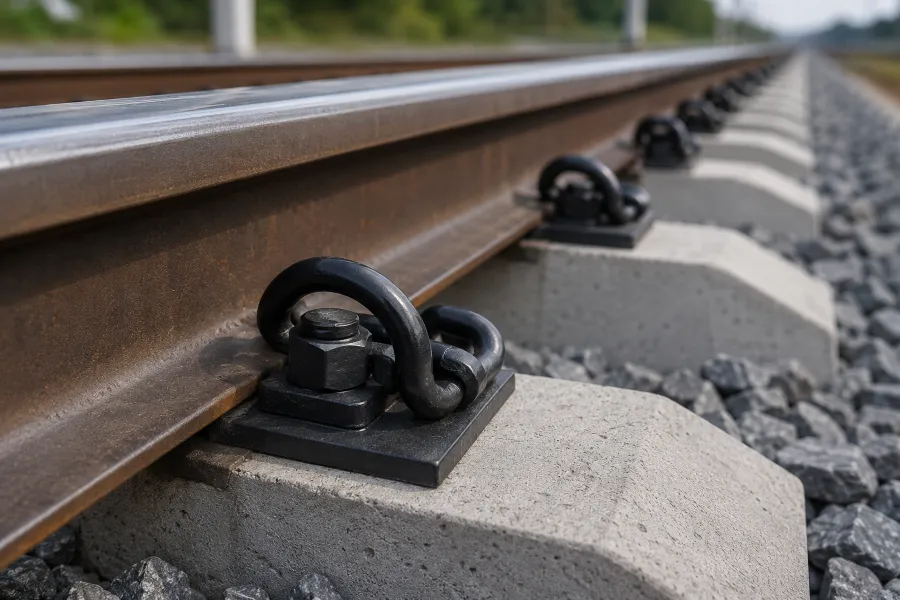
Aunque el clip de riel elástico es sólo un componente dentro del sistema de fijación ferroviaria, Tiene una influencia significativa en la estabilidad de toda la pista..
Cada vez que pasa un tren, el sistema de fijación experimenta una combinación de cargas verticales de las ruedas, fuerzas laterales, vibración, impacto, y movimiento térmico. En lugar de resistir completamente a estas fuerzas, el sistema de fijación está diseñado para gestionarlos. The rail clip provides the clamping force needed to keep the rail securely positioned while allowing controlled elastic movement that protects both the rail and the supporting structure.
When the fastening system is properly designed, these loads are distributed more evenly throughout the rail pad, durmiente, hombro, and fastening components. Como resultado, rail movement is reduced, vibration is controlled, and maintenance intervals become longer.
En comparación, an unsuitable rail clip may initially appear to perform normally, yet over time it can contribute to excessive rail creep, uneven component wear, reduced fastening force, or premature fatigue failure. These problems often develop gradually and become noticeable only after years of service, making proper selection at the design stage far more important than many people realize.
Por esta razón, engineers rarely choose a rail clip based solely on its appearance or price. En cambio, they evaluate how the clip will perform as part of the complete fastening system throughout the railway’s expected service life.
When discussing a new railway project with a customer, one of the first technical questions is surprisingly simple:
Which rail section are you using?
The reason is straightforward. Different rail profiles have different foot widths, dimensiones, and contact surfaces, all of which influence how the fastening system applies clamping force.
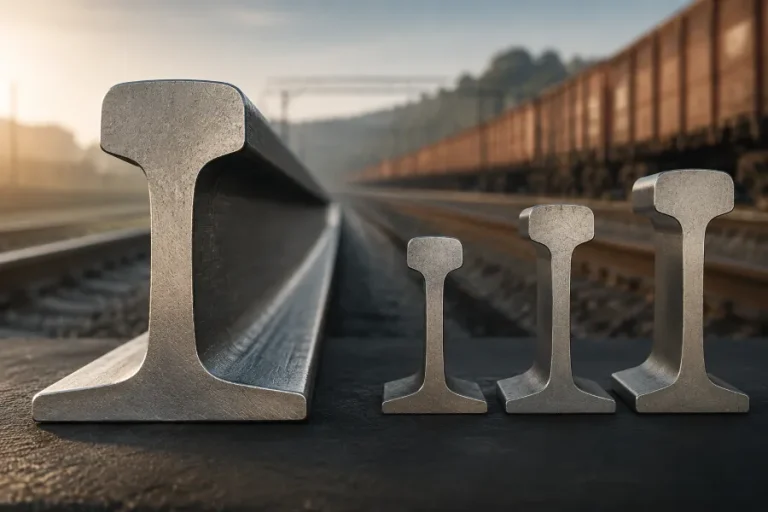
Whether the project uses UIC54, UIC60, 60E1, 136RE, 115RE, or another rail section, the elastic rail clip must be compatible with the entire fastening assembly rather than considered as an independent component.
Many people assume that if two clips look similar, they can simply be exchanged. En la práctica, even small dimensional differences may affect installation accuracy, fuerza de sujeción, y rendimiento a largo plazo. A fastening system is designed as a complete assembly, with the rail clip, aislante, almohadilla de riel, hombro, and sleeper working together.
This is why experienced engineers usually identify the rail profile first and then select the fastening components that have been designed specifically for that rail section.
Another important factor is the type of durmiente used in the project.
A primera vista, the sleeper appears to have little relationship with the rail clip. En realidad, the sleeper forms the foundation of the fastening system, directly influencing how loads are transferred from the rail into the track structure.
Concrete sleepers are now the most common choice for modern mainline railways because they provide excellent stability, durabilidad, y consistencia dimensional. Timber sleepers remain widely used on certain conventional railways, bridge approaches, and turnout sections, while steel sleepers continue to serve heavy-duty industrial and mining railways where different operating conditions apply. Slab track systems introduce another fastening arrangement altogether, particularly on high-speed passenger lines.
Because each type of sleeper behaves differently under load, the fastening system must be designed accordingly. The rail clip is therefore selected together with the rail pad, hombro, anchor, and insulator rather than treated as a universal component.
When engineers discuss fastening systems, Por lo general, evalúan la compatibilidad del conjunto completo en lugar de preguntar si un clip de riel individual puede adaptarse a otro proyecto..
La velocidad del ferrocarril es otro factor que influye significativamente en el diseño del sistema de fijación..
Consideremos dos proyectos ferroviarios completamente diferentes.. Uno es un ferrocarril industrial que transporta vehículos de mantenimiento a velocidades relativamente bajas.. El otro es un ferrocarril de pasajeros que opera a más de 300 kilómetros por hora. Aunque ambos requieren clips de riel elásticos, las expectativas de rendimiento son completamente diferentes.
En ferrocarriles más lentos, durabilidad, facilidad de instalación, y un mantenimiento rentable son a menudo las principales preocupaciones. Los ferrocarriles de mercancías de transporte pesado ponen mayor énfasis en resistir cargas elevadas y repetidas por eje durante millones de ciclos de carga.. Passenger railways require a balance between strength and ride comfort, while high-speed railways demand exceptionally stable rail support to minimize vibration and maintain accurate track geometry.
This explains why rail clips that appear almost identical may be manufactured with different mechanical properties, tolerancias, and fatigue performance depending on their intended application.
Higher operating speeds generally require more consistent clamping force and tighter manufacturing control because even small variations in fastening performance can influence long-term track stability.

If train speed influences stability, axle load largely determines how much work the rail clip must perform throughout its service life.
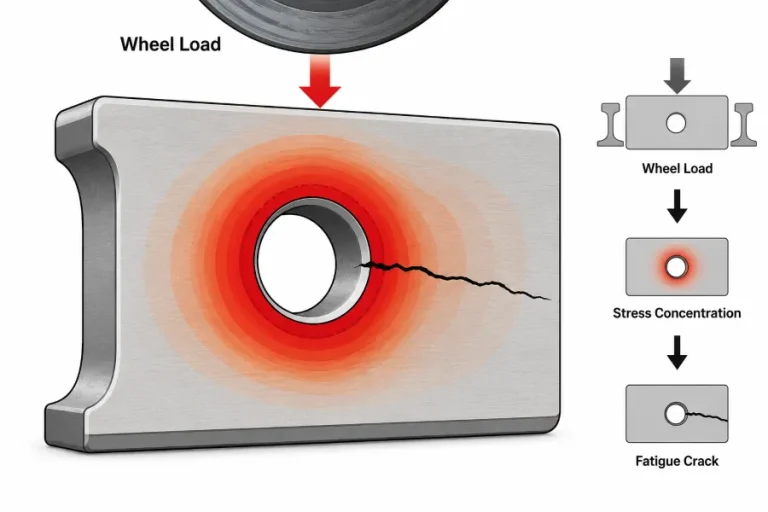
Unlike many structural components that experience occasional loading, a rail clip is subjected to repeated stress every time a wheel passes over the track. Durante la operación, the clip deflects slightly, returns to its original position, and repeats this process millions of times without interruption.
This repeated elastic movement is exactly what the clip is designed to do. Sin embargo, it also means that fatigue resistance becomes one of the most important performance indicators.
For heavy-haul freight railways, ferrocarriles mineros, and industrial transport systems, maintaining consistent elasticity over many years is often more important than achieving the highest initial clamping force. A clip that gradually loses its spring properties or develops fatigue cracks will eventually affect the stability of the entire fastening system.
Por esta razón, engineers pay close attention not only to the design of the rail clip but also to the quality of the spring steel, proceso de tratamiento térmico, manufacturing accuracy, and fatigue testing carried out before delivery.
En muchos proyectos ferroviarios, the service life of an elastic rail clip is determined less by its appearance than by the quality of its manufacturing process.
Once the operating conditions have been defined, engineers usually turn their attention to another question that is sometimes underestimated: Where will the railway operate?
Environmental conditions can have a significant influence on the long-term performance of an elastic rail clip. A fastening system designed for a dry inland railway may perform very differently when exposed to coastal salt spray, heavy rainfall, desert sand, or freezing winter temperatures.
Corrosion is one of the most common concerns. In coastal regions, airborne salt continuously attacks exposed steel components. Without adequate surface protection, corrosion can gradually reduce the service life of rail clips and other fastening parts. For these projects, engineers often specify protective finishes such as hot-dip galvanizing, Dacromet, or Geomet coatings, depending on the project’s technical requirements.
Cold climates present a different challenge. As temperatures drop, materials become less ductile, making the quality of the spring steel and heat treatment even more important. A properly manufactured elastic rail clip should maintain its mechanical properties throughout seasonal temperature changes without becoming brittle.
Mining railways and industrial lines introduce another set of operating conditions. Polvo, humedad, abrasive particles, and heavy traffic increase wear throughout the fastening system. En estos ambientes, durability and long-term reliability usually take priority over appearance.
Por esta razón, experienced engineers rarely specify a rail clip without first understanding the environment in which it will operate.
Another question we often receive from customers is whether a rail clip complies with a particular railway standard.
This is an important discussion because railway standards are intended to ensure that every component within the fastening system works together correctly.
Depending on the project, customers may require compliance with European, American, Chino, Australian, or other national railway standards. In addition to these published specifications, many railway authorities also provide project-specific drawings and technical requirements that must be followed during manufacturing.
Rather than viewing standards as a purchasing requirement alone, engineers treat them as the foundation of system compatibility. A fastening assembly that performs well in one railway network may require different dimensions, materiales, or testing procedures before it can be used in another.
Confirmar el estándar aplicable al comienzo del proyecto ayuda a evitar cambios de diseño innecesarios más adelante y garantiza que cada componente de fijación funcione según lo previsto después de la instalación..
Una de las preguntas más comunes de los nuevos compradores es:
“¿Qué clip de riel es el mejor??”
En realidad, No hay una respuesta única porque cada clip de riel ha sido desarrollado para resolver un problema de ingeniería particular..
Por ejemplo, Los clips E se utilizan ampliamente en líneas ferroviarias convencionales debido a su estructura simple., fuerza de sujeción confiable, e historial de servicio comprobado. Los clips SKL se seleccionan comúnmente para ferrocarriles modernos de pasajeros y de alta velocidad donde el rendimiento de sujeción estable y el control de vibraciones son especialmente importantes.. PR Clips and Nabla Clips are also widely used in different railway systems, each offering characteristics that suit particular track designs and maintenance practices.
Instead of comparing these products as competitors, engineers evaluate how well each design matches the operating conditions of the railway.
The goal is never to choose the most complicated clip or the strongest clip. It is to select the fastening system that provides the right balance of safety, durabilidad, mantenibilidad, and cost throughout the life of the railway.
Two elastic rail clips can look almost identical when placed side by side, yet their performance after years of service may be completely different.
The difference usually lies inside the material rather than on the surface.
Los clips de riel de alta calidad generalmente se fabrican con aceros para resortes como 60Si2MnA o SUP9 porque estos materiales brindan la resistencia y elasticidad necesarias para soportar cargas repetidas.. Sin embargo, Seleccionar el acero correcto es sólo el comienzo..
Después de formar, Los clips deben someterse a un tratamiento térmico cuidadosamente controlado para lograr la combinación de dureza requerida., tenacidad, y recuperación elástica. Si el proceso de tratamiento térmico no se controla adecuadamente, el clip puede volverse demasiado quebradizo o no mantener suficiente fuerza de sujeción con el tiempo.
Los procesos de fabricación adicionales, como el granallado y el recubrimiento de superficies, mejoran aún más el rendimiento ante la fatiga y la resistencia a la corrosión.. Aunque estos pasos no son visibles inmediatamente después de la instalación, they have a major influence on how the rail clip performs throughout millions of loading cycles.
Para ingenieros, the appearance of the finished product is important, but the manufacturing process behind it is even more critical.
Before an elastic rail clip leaves the factory, it should undergo a series of inspections designed to verify that every batch meets the specified technical requirements.
Dimensional accuracy is checked to ensure proper fit within the fastening assembly. Mechanical properties are verified to confirm that the spring steel has achieved the required performance after heat treatment. Manufacturers also carry out hardness testing, prueba de fatiga, and coating inspection where applicable.
These inspections are not simply part of a quality control procedure. They provide confidence that every rail clip delivered to the project will perform consistently under real operating conditions.
For railway owners, replacing a defective rail clip after installation is far more expensive than identifying a manufacturing problem before shipment. This is why comprehensive inspection remains an essential part of modern railway manufacturing.

After supporting railway projects in different countries, we have noticed that a few selection mistakes appear repeatedly.
One of the most common is choosing a rail clip based only on its appearance. Two clips may have almost the same shape while differing significantly in material quality, tratamiento térmico, vida de fatiga, and long-term clamping performance.
Another mistake is considering the rail clip as an independent product rather than part of the complete fastening system. The clip must work together with the rail section, almohadilla de riel, aislante, hombro, and sleeper. Ignoring the compatibility of these components can reduce the overall performance of the track.
Environmental conditions are also sometimes overlooked. A fastening system that performs well in a dry inland environment may require additional corrosion protection when installed in coastal regions or heavy industrial areas.
Finalmente, some buyers focus primarily on the purchase price without considering maintenance costs over the railway’s service life. Selecting a higher-quality fastening system at the beginning of a project often reduces inspection frequency, costos de reemplazo, and track maintenance in the years that follow.
Selecting the right elastic rail clip is not simply a matter of choosing a product from a catalogue. It is an engineering decision that affects the safety, fiabilidad, and maintenance requirements of the entire railway.
Experienced engineers evaluate the complete operating environment before recommending a fastening system. They consider the rail section, tipo de cama, velocidad del tren, carga por eje, condiciones ambientales, normas ferroviarias, calidad de los materiales, and manufacturing process as parts of the same engineering solution rather than separate decisions.
Although elastic rail clips represent only one component within the railway fastening system, they play a vital role in maintaining stable rail support over millions of loading cycles. Choosing the right fastening solution at the beginning of a project helps improve long-term track performance while reducing maintenance costs throughout the railway’s operating life.
If you are planning a new railway project or upgrading an existing track, taking the time to evaluate these factors will help you select a fastening system that delivers reliable performance for many years to come.
En Industrias pesadas Co. de Luoyang Fonyo., Limitado., we manufacture a wide range of railway fastening components, including elastic rail clips, almohadillas de riel, platos de pescado, pernos de pescado, and other railway track parts. Whether you are developing a new railway line or replacing an existing fastening system, our engineering team can help you select fastening solutions that match your rail section, condiciones de funcionamiento, y requisitos del proyecto.
The best way to choose an elastic rail clip is to evaluate the entire fastening system rather than the clip alone. Engineers normally begin by confirming the rail section, tipo de cama, velocidad de funcionamiento, carga por eje, condiciones ambientales, and applicable railway standard. These factors determine the required clamping force, rendimiento de fatiga, protección contra la corrosión, and compatibility with other fastening components. Selecting a rail clip without considering these conditions may result in premature wear or increased maintenance costs.
Both E Clips and SKL Clips are widely used elastic fastening systems, but they are designed for different railway applications. E Clips are commonly used on conventional railways because of their simple structure and reliable performance. SKL Clips are frequently selected for passenger and high-speed railways where stable clamping force and vibration control are particularly important. The most suitable option depends on the project requirements rather than one design being universally better than the other.
No siempre. Rail clips are designed to work with specific rail profiles and fastening assemblies. Even if two rail sections appear similar, differences in the rail foot dimensions can affect installation accuracy and clamping performance. Engineers usually select the rail section first and then choose a compatible fastening system designed for that profile.
High-quality elastic rail clips are generally manufactured from spring steels such as 60Si2MnA or SUP9. These materials provide excellent strength, elasticidad, and fatigue resistance after proper heat treatment. The manufacturing process is just as important as the material itself, since incorrect heat treatment can reduce the service life of the clip.
Service life depends on many factors, incluyendo carga por eje, train frequency, condiciones ambientales, practicas de mantenimiento, and manufacturing quality. En condiciones normales de funcionamiento, a properly manufactured rail clip can remain in service for many years while maintaining its clamping force. Regular inspection as part of routine track maintenance helps maximize its operating life.
Unlike many structural components, elastic rail clips experience repeated loading every time a train passes. Over their service life, they may undergo millions of loading cycles. Fatigue testing verifies that the clip can maintain its elasticity and mechanical performance without developing cracks or losing clamping force under repeated stress.
Galvanized rail clips offer improved corrosion resistance, making them suitable for coastal regions, humid climates, and industrial environments. Sin embargo, galvanizing is not always the only solution. Depending on the operating conditions, protective coatings such as Dacromet or Geomet may also provide excellent long-term corrosion protection. The appropriate coating should be selected according to the project environment.
Sí. Many manufacturers can produce customized rail clips to suit different rail sections, sistemas de fijación, normas ferroviarias, and surface protection requirements. Before manufacturing begins, engineers usually review the project drawings and technical specifications to ensure the clip is fully compatible with the complete fastening assembly.