Escanea el código WeChat para contactarnos
Escanea el código WeChat para contactarnos
No dudes en enviarnos un correo electrónico y te responderemos lo antes posible.
Creando el futuro con corazón y alma


Los clips E y SKL son de acero para resortes. clips de sujeción de rieles Se utiliza para sujetar el riel contra el durmiente., pero pertenecen a diferentes familias de sistemas de fijación. Los clips E utilizan una forma de C asimétrica compacta con un hombro o placa base de yeso, mientras que los clips SKL utilizan una abrazadera de tensión en forma de W con placas guía aislantes y bloques patrón.. Ninguno de los dos es universalmente mejor: la elección correcta depende del perfil del carril, tipo de cama, carga por eje, velocidad de línea, Filosofía de mantenimiento y el estándar que aplica su proyecto..
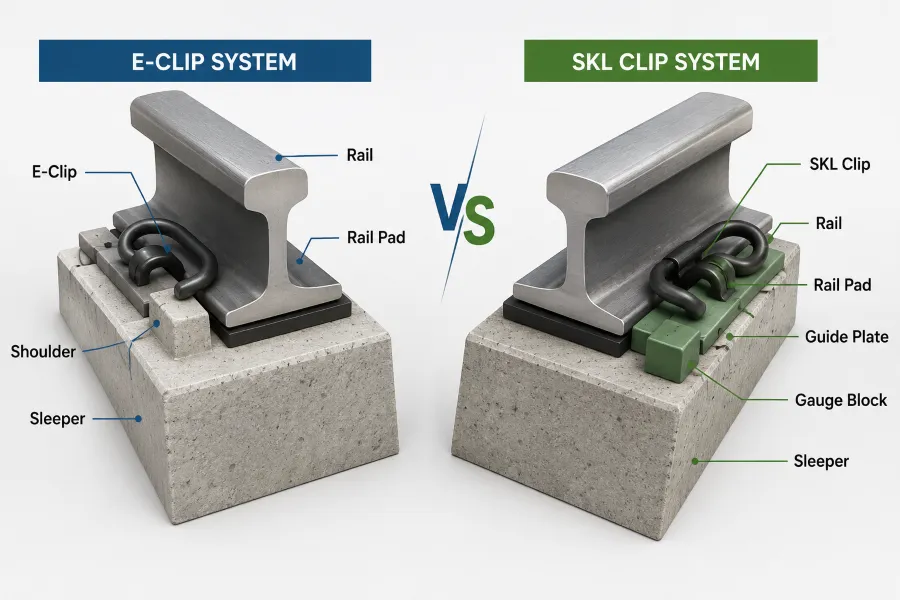
Si alguna vez has comparado dos sistemas de fijación para un proyecto ferroviario y has visto “clip electrónico” en un dibujo y “Clip SKL” por el otro, Los nombres se parecen lo suficiente como para ser confusos.. Ambos son clips de resorte.. Ambos sujetan el riel hacia abajo. Ambos están hechos de acero para muelles.. Y ambos aparecen en el debate entre E-clip y SKL clip que cada equipo de adquisiciones eventualmente tiene.. Entonces, ¿cuál es mejor para tu ferrocarril??
A primera vista, la elección parece simple: Elige el que tenga más fuerza de sujeción..
En la práctica, La selección de clips de riel no es tan sencilla..
Un clip E y un clip SKL hacen el mismo trabajo en la misma familia de sistemas de fijación, pero no son componentes intercambiables. Pertenecen a diferentes diseños de sistemas., con diferentes componentes a su alrededor, lógica de instalación diferente y comportamiento de mantenimiento diferente. Comparación de los sistemas de clips E-clip y SKL por un solo número, como fuerza de sujeción o vida de fatiga, se pierde la mayor parte de lo que importa.
Entonces, ¿cómo deberías comparar los clips E y SKL para tu proyecto?? Esa es la pregunta que responde esta guía., porque la decisión entre E-clip y SKL afecta el sistema de sujeción con el que vivirá durante décadas.
El E-clip es un clip de acero elástico con un diseño compacto., forma asimétrica. Se instala introduciéndolo en un hombro moldeado en la traviesa o montado sobre una placa base., y presiona el pie del riel a través de un aislante..
El nombre proviene de la forma., que se parece a la letra E cuando se ve de lado. Designaciones comunes como E1609, E1809 y E2009 se refieren a diferentes tamaños y geometrías para diferentes secciones de riel.
El E-clip se caracteriza por ser compacto y sencillo. El sistema tiene pocas partes.: el clip, el hombro, un aislante y una almohadilla de riel. La instalación es rápida, y el clip se puede introducir con una sencilla herramienta desde el lateral del carril. La eliminación es igualmente sencilla, which matters on lines where rail replacement happens frequently.
Because the shoulder is cast into the sleeper, the E-clip system is a system you commit to when you cast the sleeper. Changing to a different clip type later means changing the sleeper, not just the clip.
The E-clip is widely used in systems derived from British and international designs, and it appears in projects across Europe, África, the Middle East and Asia under various national standards. It is one of the most common elastic rail clips in the world, which means spares and tooling are usually easy to source. On the E-clip vs SKL clip question, this availability is one of the E-clip’s quiet advantages.
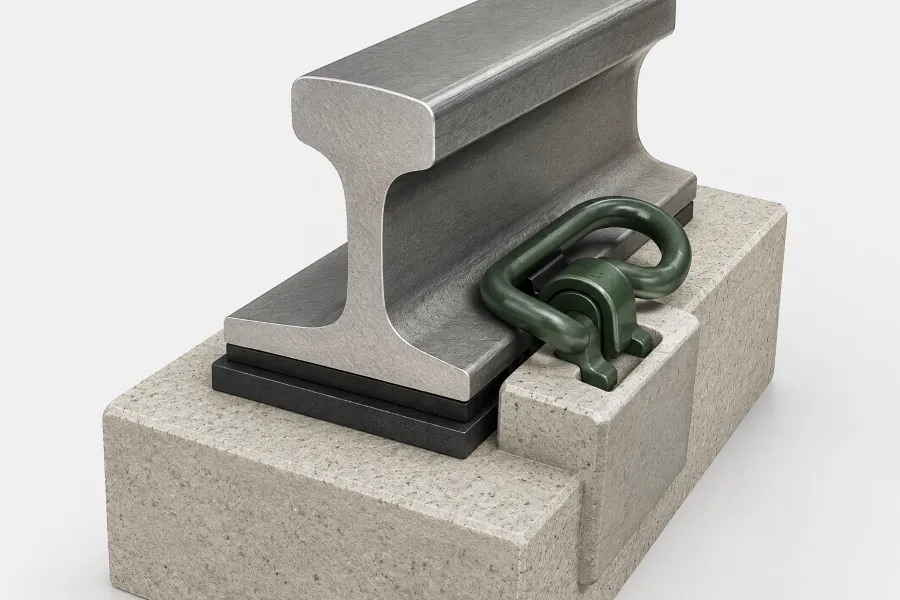
The SKL clip is a spring steel tension clamp with a W-shape when viewed from the side. It works inside a fastening system that includes insulating guide plates, gauge blocks, a rail pad and, on many designs, a baseplate or sleeper anchor.
The name SKL comes from the German “Schwellenklemmplatte” tradition, and the system is associated with Central European fastening practice. Common designations such as SKL1, SKL12, SKL14 and SKL21 refer to different clip sizes for different rail sections and load levels.
The SKL system is modular. The clip, guide plates and gauge blocks are separate components that can be replaced individually, and the gauge blocks allow lateral adjustment of the rail position within limits. That modularity is one of the reasons the system is popular on networks where precise gauge adjustment and component-level maintenance matter.
Installation of an SKL clip requires more steps than an E-clip: the guide plates and gauge blocks go in first, then the clip is driven into position over the rail foot. Removal follows the reverse order. The extra components mean the system costs more per fastening, and installation takes longer.
The SKL system is strongly associated with high-speed and heavy-haul practice in Europe and beyond, and it is often specified on modern lines where the fastening system is designed as part of the whole track structure. That is why the E-clip vs SKL clip choice often follows the project’s design philosophy as much as its load conditions.
The difference between E-clips and SKL clips is not one number. It is a set of engineering trade-offs. And the E-clip vs SKL clip comparison usually comes down to these five.
Clamping force and elasticity. Spring clips work by elastic deflection: they are pressed into position, and the spring stores the deflection as clamping force. The clamping force and the range of deflection differ between clip designs, and both depend on the specific model, the wire diameter and the material. A general statement such as “E-clips have X kN and SKL clips have Y kN” can be misleading, because the values vary across models and standards. What is fair to say is that SKL-system clips generally use a larger spring geometry and are often specified where higher clamping force and greater deflection range are required, while E-clips are chosen for compactness and simplicity.
System components. An E-clip system is minimal: acortar, shoulder, aislante, almohadilla. An SKL system adds guide plates and gauge blocks. More components means more parts to manage in the warehouse, but it also means individual components can be replaced instead of the whole fastening.
Gauge adjustment. Because the SKL system includes gauge blocks, lateral rail position can be adjusted within the design range by swapping blocks. The E-clip system has less adjustment capability, because the shoulder position is fixed by the sleeper.
Installation and removal. E-clips are faster to install and remove, which is an advantage on lines with frequent rail replacement. SKL clips take longer per fastening but the modular system means worn components can be replaced individually. Esta diferencia de mantenimiento es a menudo el factor decisivo en la discusión entre E-clip y SKL para líneas existentes..
Compromiso del sistema. El hombro del E-clip se coloca en el durmiente., por lo que la elección está bloqueada en el momento del lanzamiento del durmiente.. El sistema SKL se puede montar con inserciones de anclaje o placas base que ofrecen más flexibilidad en la etapa de diseño., aunque la combinación de clip y placa aún debe coincidir.
Cada clip de resorte es un componente de fatiga.. Se desvía durante la instalación y luego circula por cada rueda que pasa., durante millones de ciclos a lo largo de su vida útil. Por lo tanto, la vida a fatiga es una consideración real., y los proveedores a menudo citan números para ello..
Aquí es donde yo sería cauteloso., y se aplica a la comparación de clips E-clip vs SKL tanto como a cualquier otra opción de clip.
Las cifras de vida por fatiga de los clips de riel dependen en gran medida del modelo específico., el diámetro del alambre, la materia, el tratamiento térmico, El método de prueba y los criterios de aceptación.. Dos proveedores pueden cotizar números diferentes para clips de apariencia similar porque probaron diferentes modelos o utilizaron diferentes condiciones de prueba.. Un número citado sin el estándar de prueba detrás dice poco.
En lo que puede confiar es en el estándar. Rendimiento del clip, incluyendo pruebas de fatiga, está cubierto por normas como EN 13481 para el rendimiento del sistema de fijación y UIC 864 para dimensiones de eclisa y perno. La norma aplicable define el método de prueba., y el método de prueba define lo que significa el número.
Al comparar clips, Solicitaría el informe de la prueba de fatiga y el estándar con el que fue probado., en lugar de comparar números de titulares de hojas de datos.
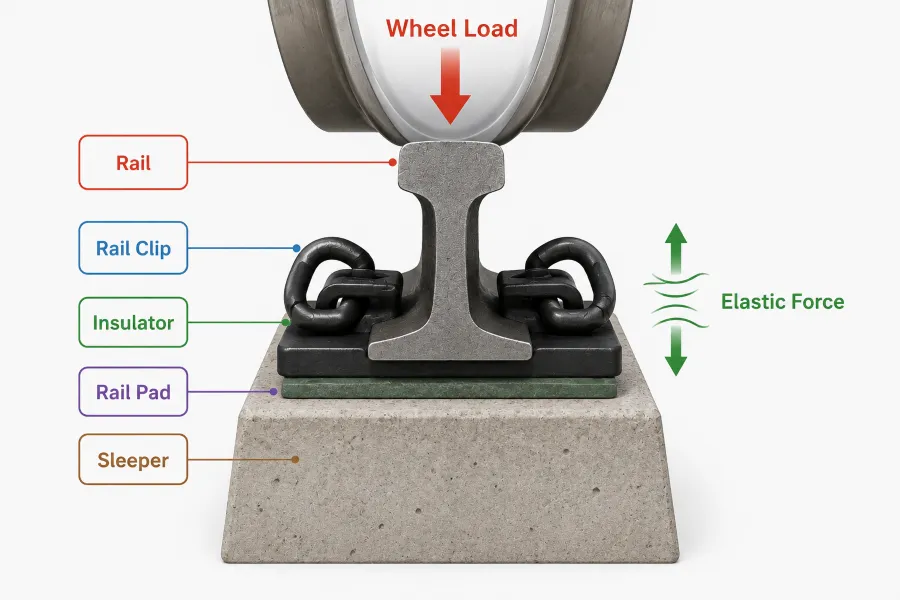
There is no universal answer, and any supplier who gives you one without asking about your track is selling you their catalogue. The E-clip vs SKL clip decision falls into place once you work through the system questions.
Un proceso de selección práctico se parece más a esto:
| Pregunta | Por qué es importante |
| Which rail profile are you fastening? | Clip geometry must match the rail foot and the sleeper |
| Which sleeper type do you have? | Shoulder cast into sleeper locks in the E-clip choice |
| What axle load and line speed apply? | Higher loads and speeds tend toward larger, stiffer systems |
| What is the maintenance philosophy? | Component-level replacement favours modular systems |
| How often is rail replaced? | Fast clip removal favours the simpler system |
| Which standard applies to the project? | EN 13481, UIC, national or project specification |
| Is gauge adjustment needed? | Gauge blocks in the SKL system allow lateral adjustment |
Estos son puntos de partida, not a universal specification. The final choice should be checked against the actual track design and the applicable standard.
Por ejemplo, a light-rail or branch line with concrete sleepers already cast with E-clip shoulders may reasonably stay with the E-clip system, because changing would mean replacing sleepers. A new high-speed or heavy-haul line designed from scratch may reasonably specify an SKL-type system where the design team wants modular components and gauge adjustability.
Neither choice is wrong on its own. What is wrong is choosing without checking the system, the standard and the sleeper. If you are already working through the wider fastening picture, nuestro guide to railway track maintenance shows where clip inspection sits inside the full maintenance cycle.
When comparing rail clip suppliers, No me detendría en preguntar qué tipos de clips hacen.. Pregunta qué hay detrás del clip..
Un proveedor confiable debería poder proporcionar:
Para proyectos más grandes, la trazabilidad importa. Si un clip falla en servicio, la capacidad de rastrearlo hasta el calor y el lote es lo que permite a la investigación evaluar la exposición a lo largo de la línea.
Si está trabajando en el sistema de sujeción más amplio, nuestro Eclisas de riel explicadas: Tipos, Estándares, Guía de dimensiones y selección Explica cómo se relacionan los componentes de un sistema de vía articulada con los requisitos UIC y EN..
E-clips and SKL clips are both proven spring steel designs with decades of service behind them. The question is not which one is better in the abstract, but which one fits your rail profile, your sleeper, your loads, your maintenance practice and your standard.
That is why I would not recommend choosing a rail clip based on a single datasheet number. Start with the system. Check the sleeper and the rail profile. Confirm the standard. Then compare clips within the same system family, using test reports from the same test method. The E-clip vs SKL clip decision, done properly, is a system decision, not a component decision.
En Industrias pesadas Co. de Luoyang Fonyo., Limitado., nosotros fabricamos clips de riel elásticos, including E-clip and SKL-type designs, together with pernos de pescado, platos de pescado and rail pads, según dibujos del cliente, Normas aplicables y requisitos del proyecto.. For rail fastening systems, we can review the required clip type, material, tratamiento térmico, coating and testing requirements before production.
si tienes un dibujo, specification or an existing clip sample, envíanos los detalles. Our engineering team can help check the required clip type, requisitos estándar y de producción aplicables antes de la cotización. For the wider wheel-rail picture, our guide to ruedas de ferrocarril covers the other half of the interface.
E-clips and SKL clips are both spring steel rail clips, pero pertenecen a diferentes familias de sistemas de fijación. The E-clip is a compact asymmetric clip driven into a shoulder cast into the sleeper, with few components. The SKL clip is a W-shape tension clamp used with insulating guide plates and gauge blocks, offering modular components and lateral gauge adjustment.
Ninguno de los dos es universalmente mejor. The E-clip system is compact, simple and fast to install, and suits lines where the sleeper is already cast with the shoulder. The SKL system offers modular components and gauge adjustability, and is often specified for high-speed and heavy-haul lines. The applicable standard and track design should determine the choice.
No. The clip geometry must match the rail profile, el durmiente, the shoulder or baseplate, and the rest of the fastening system. An E-clip will not fit an SKL guide plate assembly, and an SKL clip will not drive into an E-clip shoulder. Changing systems means changing the sleeper or baseplate design.
No automáticamente. Clamping force depends on the specific model, wire diameter, material and standard. General statements about clamping force ranges can be misleading because values vary across models. Compare test reports from the same test standard instead of headline numbers.
Fastening system performance, including rail clips, está cubierto por normas como EN 13481, UIC leaflets and national or project specifications. The applicable standard defines the test method for clamping force, fatigue and deflection, which is what makes different clips comparable.
Not without checking the whole fastening system. If the shoulder is cast into the sleeper, changing to an SKL system requires changing the sleeper or adding a compatible baseplate. El perfil del carril, sleeper type and standard must all be compatible.
Ask for the clip designation and matching rail profile, la norma aplicable, material and heat treatment details, clamping force and fatigue test reports with the test method, coating details, and compatibility with shoulders, placas guía, bloques patrón y almohadillas para rieles.