Digitalize o código WeChat para entrar em contato conosco
Digitalize o código WeChat para entrar em contato conosco
Sinta-se à vontade para nos enviar um e-mail e responderemos o mais breve possível.
Criando o futuro com coração e alma


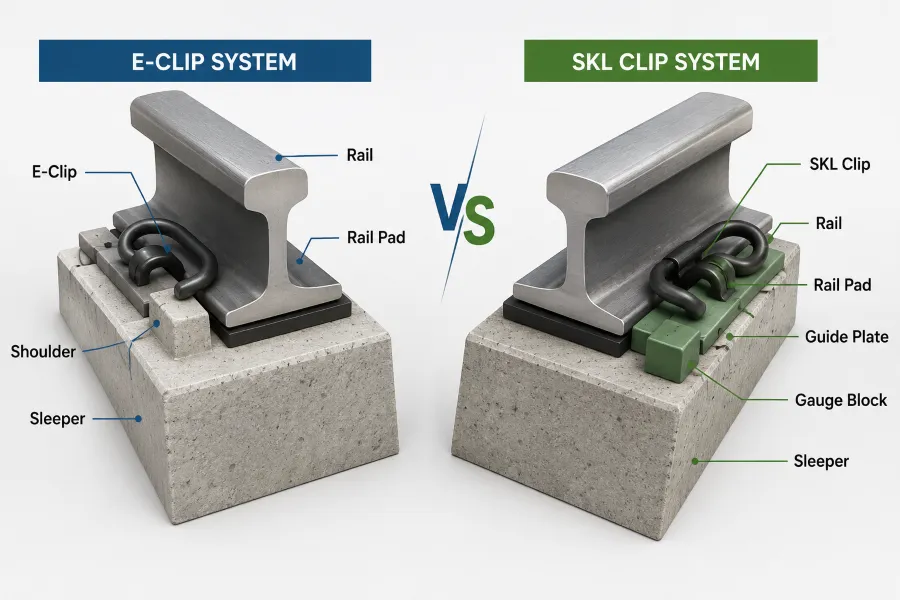
Os clipes E e os clipes SKL são ambos de aço para molas clipes de fixação de trilho usado para segurar o trilho contra o dormente, mas pertencem a diferentes famílias de sistemas de fixação. Os clipes E usam um formato C assimétrico compacto com um ombro fundido ou placa de base, enquanto os clipes SKL usam um grampo de tensão em forma de W com placas guia isolantes e blocos padrão. Nenhum dos dois é universalmente melhor: a escolha certa depende do perfil do trilho, tipo dorminhoco, carga por eixo, velocidade da linha, filosofia de manutenção e o padrão que seu projeto aplica.
Se você já comparou dois sistemas de fixação para um projeto ferroviário e viu “Clipe eletrônico” em um desenho e “Clipe SKL” por outro, os nomes parecem semelhantes o suficiente para serem confusos. Ambos são clipes de mola. Ambos seguram o trilho para baixo. Ambos são feitos de aço mola. And both appear in the E-clip vs SKL clip debate that every procurement team eventually has. So which one is better for your railway?
À primeira vista, a escolha parece simples: pick the one with more clamping force.
Na prática, rail clip selection is not quite that straightforward.
An E-clip and an SKL clip do the same job in the same family of fastening systems, but they are not interchangeable components. They belong to different system designs, with different components around them, different installation logic and different maintenance behavior. Comparing E-clip vs SKL clip systems by a single number, like clamping force or fatigue life, misses most of what matters.
So how should you compare E-clips and SKL clips for your project? That is the question this guide answers, because the E-clip vs SKL clip decision affects the fastening system you will live with for decades.
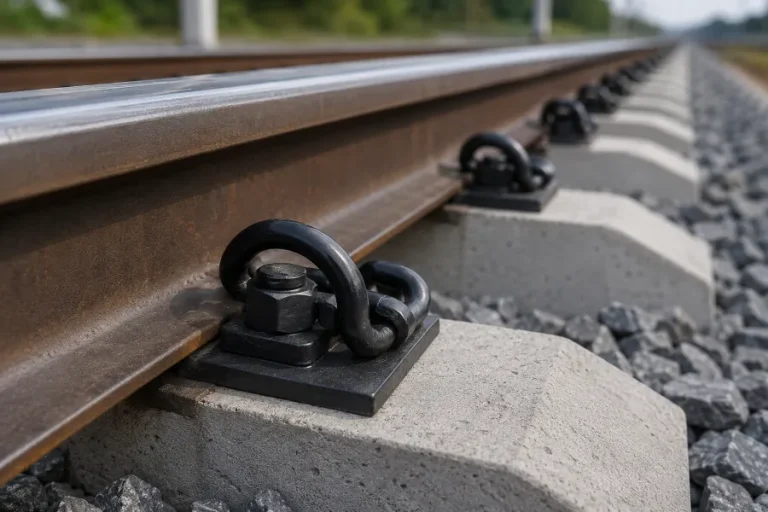
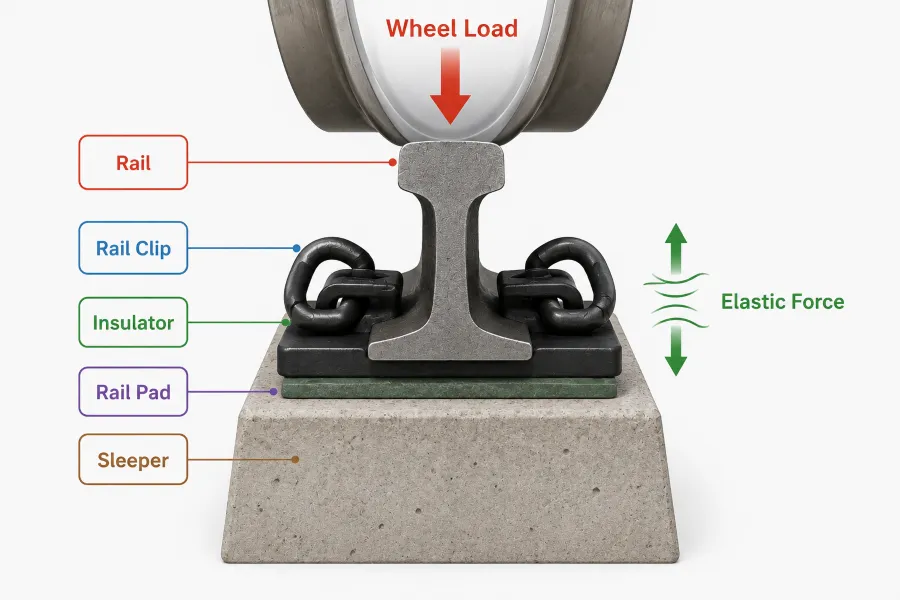
The E-clip is a spring steel clip with a compact, asymmetrical shape. It is installed by driving it into a shoulder that is cast into the sleeper or mounted on a baseplate, and it presses down on the rail foot through an insulator.
The name comes from the shape, which resembles the letter E when viewed from the side. Common designations such as E1609, E1809 and E2009 refer to different sizes and geometries for different rail sections.
The E-clip is known for being compact and simple. The system has few parts: the clip, the shoulder, an insulator and a rail pad. Installation is quick, and the clip can be driven in with a simple tool from the side of the rail. Removal is equally straightforward, o que é importante em linhas onde a substituição de trilhos acontece com frequência.
Porque o ombro é lançado no dorminhoco, o sistema E-clip é um sistema com o qual você se compromete ao lançar o dorminhoco. Mudar para um tipo de clipe diferente posteriormente significa mudar o sleeper, não apenas o clipe.
O E-clip é amplamente utilizado em sistemas derivados de designs britânicos e internacionais, e aparece em projetos em toda a Europa, África, o Oriente Médio e a Ásia sob vários padrões nacionais. É um dos clipes ferroviários elásticos mais comuns do mundo, o que significa que peças sobressalentes e ferramentas geralmente são fáceis de obter. Na questão do clipe E-clip vs SKL, esta disponibilidade é uma das vantagens silenciosas do E-clip.
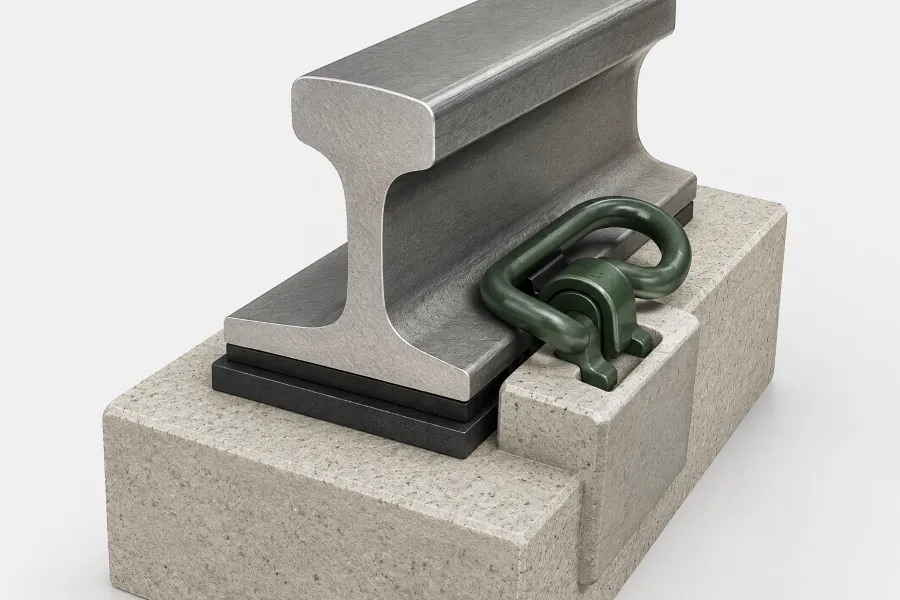
The SKL clip is a spring steel tension clamp with a W-shape when viewed from the side. It works inside a fastening system that includes insulating guide plates, gauge blocks, a rail pad and, on many designs, a baseplate or sleeper anchor.
The name SKL comes from the German “Schwellenklemmplatte” tradition, and the system is associated with Central European fastening practice. Common designations such as SKL1, SKL12, SKL14 and SKL21 refer to different clip sizes for different rail sections and load levels.
The SKL system is modular. The clip, guide plates and gauge blocks are separate components that can be replaced individually, and the gauge blocks allow lateral adjustment of the rail position within limits. That modularity is one of the reasons the system is popular on networks where precise gauge adjustment and component-level maintenance matter.
Installation of an SKL clip requires more steps than an E-clip: the guide plates and gauge blocks go in first, then the clip is driven into position over the rail foot. Removal follows the reverse order. The extra components mean the system costs more per fastening, and installation takes longer.
The SKL system is strongly associated with high-speed and heavy-haul practice in Europe and beyond, and it is often specified on modern lines where the fastening system is designed as part of the whole track structure. That is why the E-clip vs SKL clip choice often follows the project’s design philosophy as much as its load conditions.
The difference between E-clips and SKL clips is not one number. It is a set of engineering trade-offs. And the E-clip vs SKL clip comparison usually comes down to these five.
Clamping force and elasticity. Spring clips work by elastic deflection: they are pressed into position, and the spring stores the deflection as clamping force. The clamping force and the range of deflection differ between clip designs, and both depend on the specific model, the wire diameter and the material. A general statement such as “E-clips have X kN and SKL clips have Y kN” can be misleading, because the values vary across models and standards. What is fair to say is that SKL-system clips generally use a larger spring geometry and are often specified where higher clamping force and greater deflection range are required, while E-clips are chosen for compactness and simplicity.
System components. An E-clip system is minimal: grampo, ombro, isolador, pad. An SKL system adds guide plates and gauge blocks. More components means more parts to manage in the warehouse, but it also means individual components can be replaced instead of the whole fastening.
Gauge adjustment. Because the SKL system includes gauge blocks, lateral rail position can be adjusted within the design range by swapping blocks. The E-clip system has less adjustment capability, because the shoulder position is fixed by the sleeper.
Installation and removal. E-clips are faster to install and remove, which is an advantage on lines with frequent rail replacement. SKL clips take longer per fastening but the modular system means worn components can be replaced individually. This maintenance difference is often the deciding factor in the E-clip vs SKL clip discussion for existing lines.
System commitment. The E-clip shoulder is cast into the sleeper, so the choice is locked in at sleeper casting time. The SKL system can be mounted with anchor inserts or baseplates that offer more flexibility at the design stage, though the clip and plate combination must still be matched.
Every spring clip is a fatigue component. It is deflected on installation and then cycled by every passing wheel, for millions of cycles over its service life. Fatigue life is therefore a real consideration, and suppliers often quote numbers for it.
This is where I would be cautious, and it applies to the E-clip vs SKL clip comparison as much as to any other clip choice.
Fatigue life figures for rail clips are highly dependent on the specific model, the wire diameter, the material, o tratamento térmico, the test method and the acceptance criteria. Two suppliers can quote different numbers for similar-looking clips because they tested different models or used different test conditions. A number quoted without the test standard behind it tells you little.
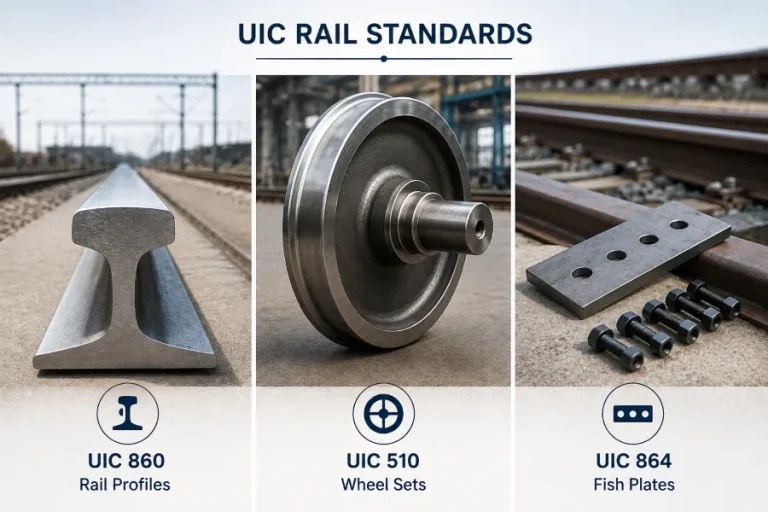
What you can rely on is the standard. Clip performance, including fatigue testing, is covered by standards such as EN 13481 for fastening system performance and UIC 864 for fish plate and bolt dimensions. The applicable standard defines the test method, and the test method defines what the number means.
When comparing clips, I would ask for the fatigue test report and the standard it was tested to, rather than comparing headline numbers from datasheets.
There is no universal answer, and any supplier who gives you one without asking about your track is selling you their catalogue. The E-clip vs SKL clip decision falls into place once you work through the system questions.
Um processo de seleção prático é mais parecido com isto:
| Pergunta | Por que é importante |
| Which rail profile are you fastening? | Clip geometry must match the rail foot and the sleeper |
| Which sleeper type do you have? | Shoulder cast into sleeper locks in the E-clip choice |
| What axle load and line speed apply? | Higher loads and speeds tend toward larger, stiffer systems |
| What is the maintenance philosophy? | Component-level replacement favours modular systems |
| How often is rail replaced? | Fast clip removal favours the simpler system |
| Which standard applies to the project? | EM 13481, UIC, national or project specification |
| Is gauge adjustment needed? | Gauge blocks in the SKL system allow lateral adjustment |
Estes são pontos de partida, não é uma especificação universal. A escolha final deve ser verificada em relação ao projeto real da via e à norma aplicável.
Por exemplo, um trilho leve ou ramal com travessas de concreto já moldadas com ombros de clipe E pode razoavelmente permanecer com o sistema de clipe E, porque mudar significaria substituir travessas. Uma nova linha de alta velocidade ou transporte pesado projetada do zero pode especificar razoavelmente um sistema do tipo SKL onde a equipe de projeto deseja componentes modulares e ajuste de bitola.
Nenhuma das escolhas é errada por si só. O que há de errado é escolher sem verificar o sistema, o padrão e o dorminhoco. Se você já está trabalhando na imagem de fixação mais ampla, nosso guia para manutenção de trilhos ferroviários mostra onde fica a inspeção do clipe dentro do ciclo completo de manutenção.
Ao comparar fornecedores de clipes ferroviários, Eu não pararia de perguntar quais tipos de clipes eles fazem. Pergunte o que está por trás do clipe.
Um fornecedor confiável deve ser capaz de fornecer:
Para projetos maiores, a rastreabilidade é importante. Se um clipe falhar em serviço, a capacidade de rastreá-lo até o calor e o lote é o que permite que a investigação avalie a exposição ao longo da linha.
Se você estiver trabalhando em um sistema de fixação mais amplo, nosso Pratos de peixe ferroviário: Tipos, Padrões, Dimensões e Guia de Seleção explica como os componentes de um sistema de vias articuladas se relacionam com os requisitos UIC e EN.
E-clips and SKL clips are both proven spring steel designs with decades of service behind them. The question is not which one is better in the abstract, but which one fits your rail profile, your sleeper, your loads, your maintenance practice and your standard.
That is why I would not recommend choosing a rail clip based on a single datasheet number. Start with the system. Check the sleeper and the rail profile. Confirm the standard. Then compare clips within the same system family, using test reports from the same test method. The E-clip vs SKL clip decision, done properly, is a system decision, not a component decision.
No Luoyang Fonyo Indústrias Pesadas Co., Ltda., nós fabricamos clipes de trilho elástico, including E-clip and SKL-type designs, together with parafusos de peixe, pratos de peixe and rail pads, de acordo com desenhos do cliente, padrões aplicáveis e requisitos do projeto. For rail fastening systems, we can review the required clip type, material, tratamento térmico, coating and testing requirements before production.
Se você tem um desenho, especificação ou uma amostra de clipe existente, envie-nos os detalhes. Nossa equipe de engenharia pode ajudar a verificar o tipo de clipe necessário, padrão aplicável e requisitos de produção antes da cotação. Para uma imagem mais ampla do trilho da roda, nosso guia para rodas ferroviárias cobre a outra metade da interface.
Os clipes E e os clipes SKL são clipes de trilho de aço com mola, mas pertencem a diferentes famílias de sistemas de fixação. O E-clip é um clipe assimétrico compacto inserido em um ombro moldado no dormente, com poucos componentes. O clipe SKL é um grampo de tensão em forma de W usado com placas guia isolantes e blocos padrão, oferecendo componentes modulares e ajuste de bitola lateral.
Nenhum dos dois é universalmente melhor. O sistema E-clip é compacto, simples e rápido de instalar, e combina com linhas onde o dormente já está moldado com o ombro. O sistema SKL oferece componentes modulares e ajuste de medidor, e é frequentemente especificado para linhas de alta velocidade e transporte pesado. The applicable standard and track design should determine the choice.
Não. The clip geometry must match the rail profile, o dorminhoco, the shoulder or baseplate, and the rest of the fastening system. An E-clip will not fit an SKL guide plate assembly, and an SKL clip will not drive into an E-clip shoulder. Changing systems means changing the sleeper or baseplate design.
Não automaticamente. Clamping force depends on the specific model, wire diameter, material and standard. General statements about clamping force ranges can be misleading because values vary across models. Compare test reports from the same test standard instead of headline numbers.
Fastening system performance, including rail clips, is covered by standards such as EN 13481, UIC leaflets and national or project specifications. The applicable standard defines the test method for clamping force, fatigue and deflection, which is what makes different clips comparable.
Not without checking the whole fastening system. If the shoulder is cast into the sleeper, changing to an SKL system requires changing the sleeper or adding a compatible baseplate. O perfil do trilho, sleeper type and standard must all be compatible.
Ask for the clip designation and matching rail profile, a norma aplicável, material and heat treatment details, clamping force and fatigue test reports with the test method, coating details, and compatibility with shoulders, placas guia, blocos padrão e trilhos.