Scannez le code WeChat pour nous contacter
Scannez le code WeChat pour nous contacter
N'hésitez pas à nous envoyer un email et nous vous répondrons dans les plus brefs délais.
Créer l'avenir avec cœur et âme


Les clips E et les clips SKL sont tous deux en acier à ressort clips de fixation des rails sert à maintenir le rail contre la traverse, mais ils appartiennent à des familles de systèmes de fixation différentes. Les clips E utilisent une forme en C asymétrique compacte avec une épaule ou une plaque de base moulée, tandis que les clips SKL utilisent une pince de tension en forme de W avec des plaques de guidage isolantes et des cales étalons. Ni l’un ni l’autre n’est universellement meilleur: le bon choix dépend du profil du rail, type de dormeur, charge par essieu, vitesse de ligne, la philosophie de maintenance et la norme appliquée par votre projet.
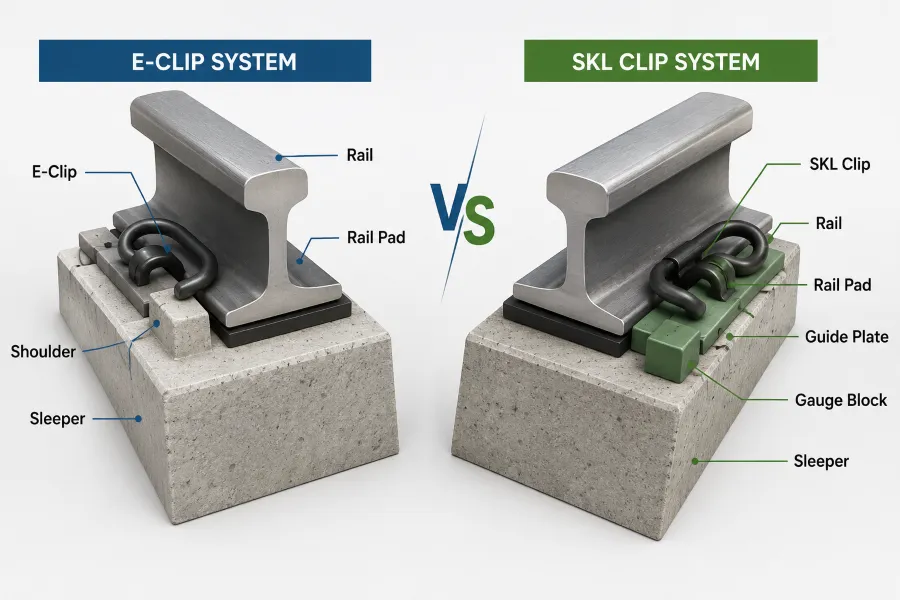
Si vous avez déjà comparé deux systèmes de fixation pour un projet ferroviaire et vu “Clip électronique” sur un dessin et “Pince SKL” de l'autre, les noms se ressemblent suffisamment pour prêter à confusion. Les deux sont des clips à ressort. Les deux maintiennent le rail vers le bas. Les deux sont en acier à ressort. And both appear in the E-clip vs SKL clip debate that every procurement team eventually has. So which one is better for your railway?
À première vue, le choix semble simple: pick the one with more clamping force.
En pratique, rail clip selection is not quite that straightforward.
An E-clip and an SKL clip do the same job in the same family of fastening systems, but they are not interchangeable components. They belong to different system designs, with different components around them, different installation logic and different maintenance behavior. Comparing E-clip vs SKL clip systems by a single number, like clamping force or fatigue life, misses most of what matters.
So how should you compare E-clips and SKL clips for your project? That is the question this guide answers, because the E-clip vs SKL clip decision affects the fastening system you will live with for decades.
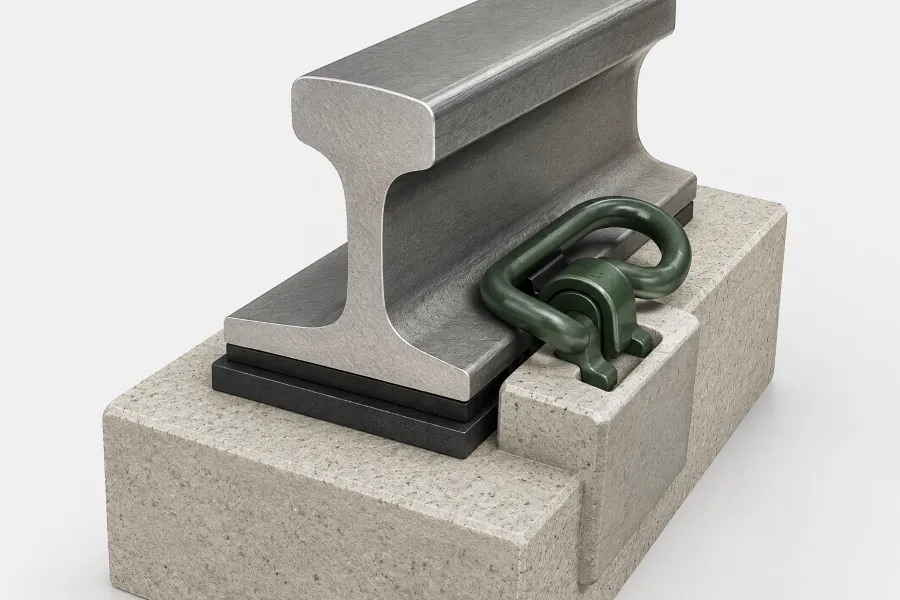
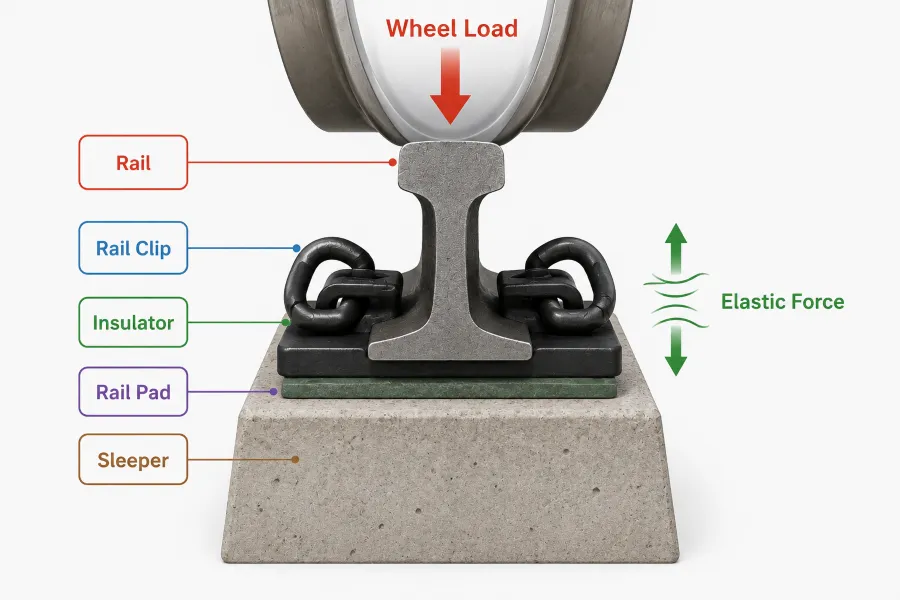
The E-clip is a spring steel clip with a compact, asymmetrical shape. It is installed by driving it into a shoulder that is cast into the sleeper or mounted on a baseplate, and it presses down on the rail foot through an insulator.
The name comes from the shape, which resembles the letter E when viewed from the side. Common designations such as E1609, E1809 and E2009 refer to different sizes and geometries for different rail sections.
The E-clip is known for being compact and simple. The system has few parts: le clip, the shoulder, an insulator and a rail pad. Installation is quick, and the clip can be driven in with a simple tool from the side of the rail. Removal is equally straightforward, which matters on lines where rail replacement happens frequently.
Because the shoulder is cast into the sleeper, the E-clip system is a system you commit to when you cast the sleeper. Changing to a different clip type later means changing the sleeper, not just the clip.
The E-clip is widely used in systems derived from British and international designs, and it appears in projects across Europe, Afrique, the Middle East and Asia under various national standards. It is one of the most common elastic rail clips in the world, which means spares and tooling are usually easy to source. On the E-clip vs SKL clip question, this availability is one of the E-clip’s quiet advantages.
The SKL clip is a spring steel tension clamp with a W-shape when viewed from the side. It works inside a fastening system that includes insulating guide plates, gauge blocks, a rail pad and, on many designs, a baseplate or sleeper anchor.
The name SKL comes from the German “Schwellenklemmplatte” tradition, and the system is associated with Central European fastening practice. Common designations such as SKL1, SKL12, SKL14 and SKL21 refer to different clip sizes for different rail sections and load levels.
The SKL system is modular. The clip, guide plates and gauge blocks are separate components that can be replaced individually, and the gauge blocks allow lateral adjustment of the rail position within limits. That modularity is one of the reasons the system is popular on networks where precise gauge adjustment and component-level maintenance matter.
Installation of an SKL clip requires more steps than an E-clip: the guide plates and gauge blocks go in first, then the clip is driven into position over the rail foot. Removal follows the reverse order. The extra components mean the system costs more per fastening, and installation takes longer.
The SKL system is strongly associated with high-speed and heavy-haul practice in Europe and beyond, and it is often specified on modern lines where the fastening system is designed as part of the whole track structure. That is why the E-clip vs SKL clip choice often follows the project’s design philosophy as much as its load conditions.
The difference between E-clips and SKL clips is not one number. It is a set of engineering trade-offs. And the E-clip vs SKL clip comparison usually comes down to these five.
Clamping force and elasticity. Spring clips work by elastic deflection: they are pressed into position, and the spring stores the deflection as clamping force. The clamping force and the range of deflection differ between clip designs, and both depend on the specific model, the wire diameter and the material. A general statement such as “E-clips have X kN and SKL clips have Y kN” can be misleading, because the values vary across models and standards. What is fair to say is that SKL-system clips generally use a larger spring geometry and are often specified where higher clamping force and greater deflection range are required, while E-clips are chosen for compactness and simplicity.
System components. An E-clip system is minimal: agrafe, shoulder, isolant, tampon. An SKL system adds guide plates and gauge blocks. More components means more parts to manage in the warehouse, but it also means individual components can be replaced instead of the whole fastening.
Gauge adjustment. Because the SKL system includes gauge blocks, lateral rail position can be adjusted within the design range by swapping blocks. The E-clip system has less adjustment capability, because the shoulder position is fixed by the sleeper.
Installation and removal. E-clips are faster to install and remove, which is an advantage on lines with frequent rail replacement. SKL clips take longer per fastening but the modular system means worn components can be replaced individually. This maintenance difference is often the deciding factor in the E-clip vs SKL clip discussion for existing lines.
System commitment. The E-clip shoulder is cast into the sleeper, so the choice is locked in at sleeper casting time. The SKL system can be mounted with anchor inserts or baseplates that offer more flexibility at the design stage, though the clip and plate combination must still be matched.
Every spring clip is a fatigue component. It is deflected on installation and then cycled by every passing wheel, for millions of cycles over its service life. Fatigue life is therefore a real consideration, and suppliers often quote numbers for it.
This is where I would be cautious, and it applies to the E-clip vs SKL clip comparison as much as to any other clip choice.
Fatigue life figures for rail clips are highly dependent on the specific model, the wire diameter, the material, the heat treatment, the test method and the acceptance criteria. Two suppliers can quote different numbers for similar-looking clips because they tested different models or used different test conditions. A number quoted without the test standard behind it tells you little.
What you can rely on is the standard. Clip performance, including fatigue testing, is covered by standards such as EN 13481 for fastening system performance and UIC 864 for fish plate and bolt dimensions. The applicable standard defines the test method, and the test method defines what the number means.
When comparing clips, I would ask for the fatigue test report and the standard it was tested to, rather than comparing headline numbers from datasheets.
There is no universal answer, and any supplier who gives you one without asking about your track is selling you their catalogue. The E-clip vs SKL clip decision falls into place once you work through the system questions.
Un processus de sélection pratique ressemble plus à ceci:
| Question | Pourquoi c'est important |
| Which rail profile are you fastening? | Clip geometry must match the rail foot and the sleeper |
| Which sleeper type do you have? | Shoulder cast into sleeper locks in the E-clip choice |
| What axle load and line speed apply? | Higher loads and speeds tend toward larger, stiffer systems |
| What is the maintenance philosophy? | Component-level replacement favours modular systems |
| How often is rail replaced? | Fast clip removal favours the simpler system |
| Which standard applies to the project? | DANS 13481, CUI, national or project specification |
| Is gauge adjustment needed? | Gauge blocks in the SKL system allow lateral adjustment |
These are starting points, not a universal specification. The final choice should be checked against the actual track design and the applicable standard.
Par exemple, a light-rail or branch line with concrete sleepers already cast with E-clip shoulders may reasonably stay with the E-clip system, because changing would mean replacing sleepers. A new high-speed or heavy-haul line designed from scratch may reasonably specify an SKL-type system where the design team wants modular components and gauge adjustability.
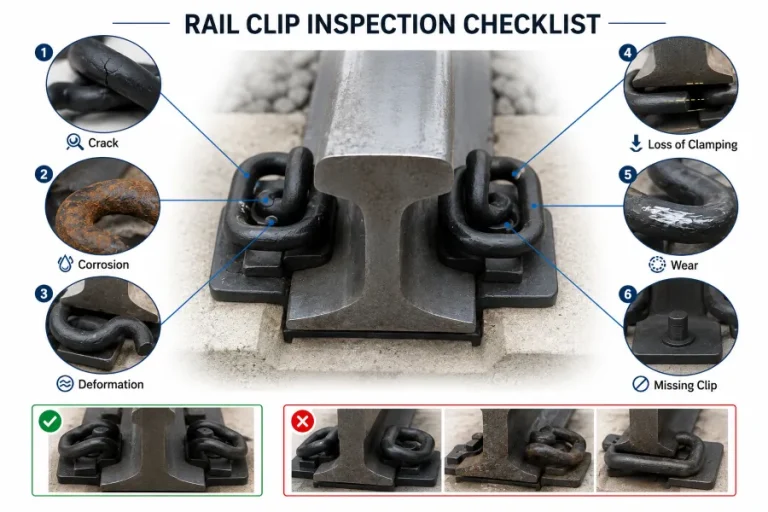
Neither choice is wrong on its own. What is wrong is choosing without checking the system, the standard and the sleeper. If you are already working through the wider fastening picture, notre guide to railway track maintenance shows where clip inspection sits inside the full maintenance cycle.
When comparing rail clip suppliers, I would not stop at asking which clip types they make. Ask what sits behind the clip.
A reliable supplier should be able to provide:
For larger projects, traceability matters. If a clip fails in service, the ability to trace it back to the heat and batch is what allows the investigation to scope the exposure across the line.
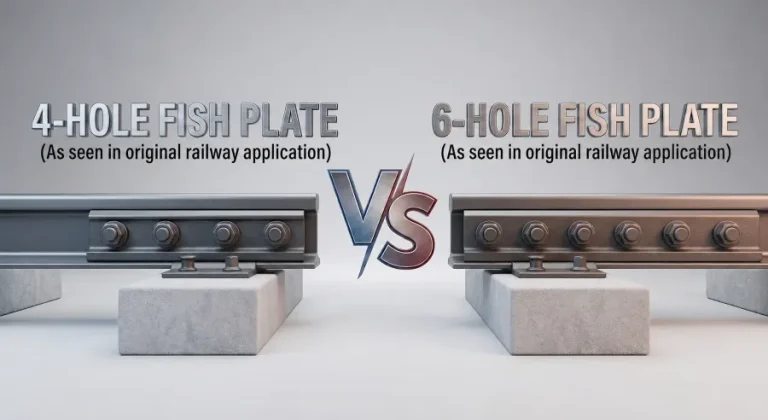
If you are working on the wider fastening system, notre Éclisses de rail expliquées: Espèces, Normes, Dimensions et guide de sélection explains how the components of a jointed track system relate to UIC and EN requirements.
E-clips and SKL clips are both proven spring steel designs with decades of service behind them. The question is not which one is better in the abstract, but which one fits your rail profile, your sleeper, your loads, your maintenance practice and your standard.
That is why I would not recommend choosing a rail clip based on a single datasheet number. Start with the system. Check the sleeper and the rail profile. Confirm the standard. Then compare clips within the same system family, using test reports from the same test method. The E-clip vs SKL clip decision, done properly, is a system decision, not a component decision.
À Luoyang Fonyo Heavy Industries Co., Ltée., nous fabriquons clips de rail élastiques, including E-clip and SKL-type designs, together with boulons de poisson, assiettes à poisson and rail pads, selon les dessins du client, normes applicables et exigences du projet. For rail fastening systems, we can review the required clip type, matériel, traitement thermique, coating and testing requirements before production.
Si tu as un dessin, specification or an existing clip sample, envoyez-nous les détails. Our engineering team can help check the required clip type, Norme applicable et exigences de production avant le devis. For the wider wheel-rail picture, our guide to roues de chemin de fer covers the other half of the interface.
E-clips and SKL clips are both spring steel rail clips, mais ils appartiennent à des familles de systèmes de fixation différentes. The E-clip is a compact asymmetric clip driven into a shoulder cast into the sleeper, with few components. The SKL clip is a W-shape tension clamp used with insulating guide plates and gauge blocks, offering modular components and lateral gauge adjustment.
Ni l’un ni l’autre n’est universellement meilleur. The E-clip system is compact, simple and fast to install, and suits lines where the sleeper is already cast with the shoulder. The SKL system offers modular components and gauge adjustability, and is often specified for high-speed and heavy-haul lines. The applicable standard and track design should determine the choice.
Non. The clip geometry must match the rail profile, le dormeur, the shoulder or baseplate, and the rest of the fastening system. An E-clip will not fit an SKL guide plate assembly, and an SKL clip will not drive into an E-clip shoulder. Changing systems means changing the sleeper or baseplate design.
Pas automatiquement. Clamping force depends on the specific model, wire diameter, material and standard. General statements about clamping force ranges can be misleading because values vary across models. Compare test reports from the same test standard instead of headline numbers.
Fastening system performance, including rail clips, is covered by standards such as EN 13481, UIC leaflets and national or project specifications. The applicable standard defines the test method for clamping force, fatigue and deflection, which is what makes different clips comparable.
Not without checking the whole fastening system. If the shoulder is cast into the sleeper, changing to an SKL system requires changing the sleeper or adding a compatible baseplate. Le profil ferroviaire, sleeper type and standard must all be compatible.
Ask for the clip designation and matching rail profile, la norme applicable, material and heat treatment details, clamping force and fatigue test reports with the test method, coating details, and compatibility with shoulders, guide plates, gauge blocks and rail pads.