Scannen Sie den WeChat-Code, um mit uns Kontakt aufzunehmen
Scannen Sie den WeChat-Code, um mit uns Kontakt aufzunehmen
Schicken Sie uns gerne eine E-Mail und wir werden Ihnen so schnell wie möglich antworten.
Mit Herz und Seele die Zukunft gestalten


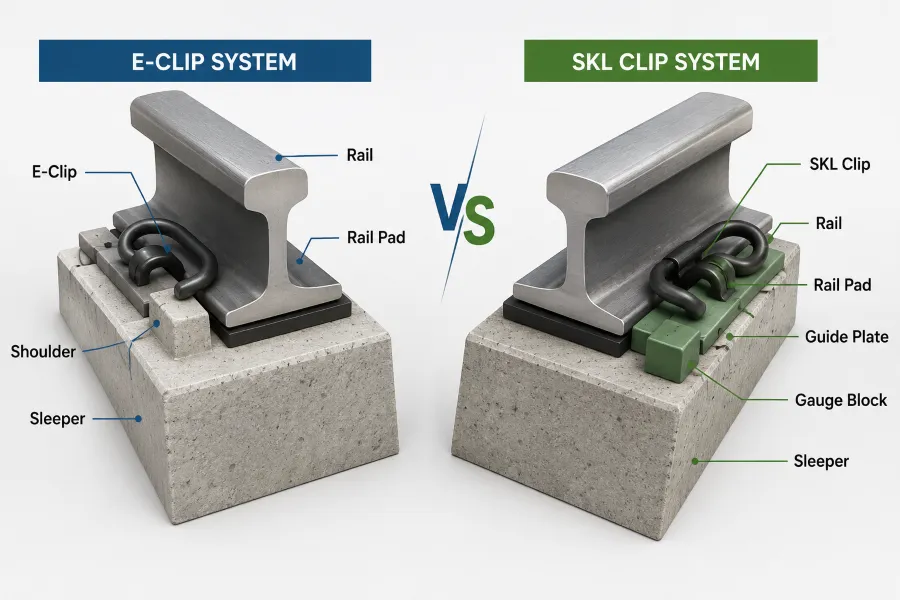
E-Clips und SKL-Clips bestehen beide aus Federstahl Schienenbefestigungsclips dient dazu, die Schiene gegen die Schwelle zu halten, Sie gehören jedoch zu unterschiedlichen Befestigungssystemfamilien. E-Clips verwenden eine kompakte asymmetrische C-Form mit einer gegossenen Schulter oder Grundplatte, während SKL-Clips eine W-förmige Spannklemme mit isolierenden Führungsplatten und Endmaßen verwenden. Keines von beiden ist allgemein besser: Die richtige Wahl hängt vom Schienenprofil ab, Schlaftyp, Achslast, Liniengeschwindigkeit, Wartungsphilosophie und den für Ihr Projekt geltenden Standard.
Wenn Sie schon einmal zwei Befestigungssysteme für ein Eisenbahnprojekt verglichen und gesehen haben “E-Clip” auf einer Zeichnung und “SKL-Clip” auf der anderen Seite, Die Namen sehen ähnlich genug aus, um verwirrend zu sein. Bei beiden handelt es sich um Federklemmen. Beide halten die Schiene fest. Beide sind aus Federstahl gefertigt. Und beide tauchen in der Debatte zwischen E-Clip und SKL-Clip auf, die irgendwann jedes Beschaffungsteam führt. Welches ist also besser für Ihre Eisenbahn??
Auf den ersten Blick, Die Wahl scheint einfach: Wählen Sie diejenige mit der größeren Klemmkraft.
In der Praxis, Die Auswahl der Schienenklemmen ist nicht ganz so einfach.
Ein E-Clip und ein SKL-Clip erfüllen in derselben Familie von Befestigungssystemen die gleiche Aufgabe, aber sie sind keine austauschbaren Komponenten. Sie gehören zu unterschiedlichen Systemdesigns, mit verschiedenen Komponenten um sie herum, unterschiedliche Installationslogik und unterschiedliches Wartungsverhalten. Vergleich von E-Clip- und SKL-Clip-Systemen anhand einer einzelnen Zahl, wie Spannkraft oder Ermüdungslebensdauer, vermisst das meiste, was wichtig ist.
Wie sollten Sie also E-Clips und SKL-Clips für Ihr Projekt vergleichen?? Das ist die Frage, die dieser Leitfaden beantwortet, Denn die Entscheidung zwischen E-Clip und SKL-Clip beeinflusst das Befestigungssystem, mit dem Sie jahrzehntelang leben werden.
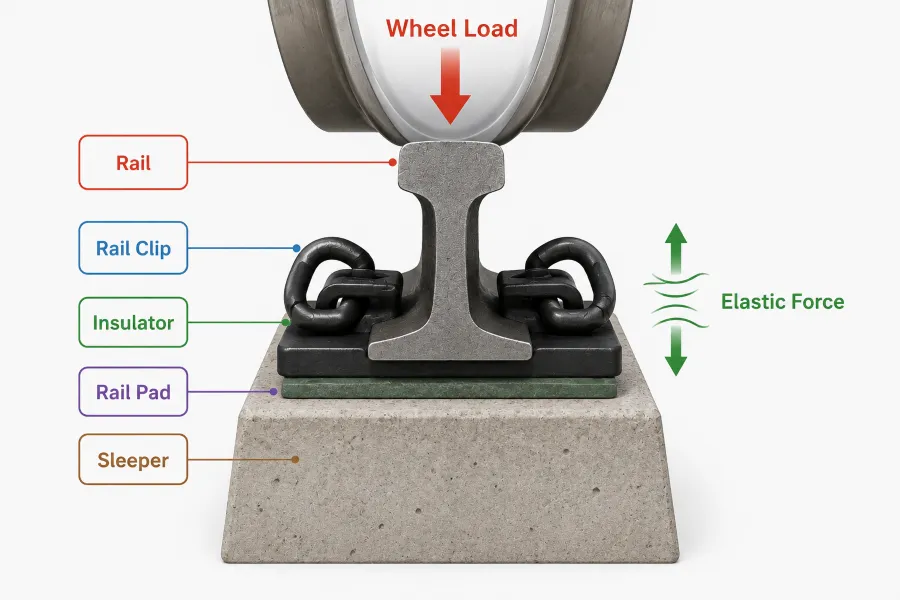
Der E-Clip ist ein Federstahlclip mit kompakter Form, asymmetrische Form. Der Einbau erfolgt durch Eintreiben in eine Schulter, die in die Schwelle eingegossen oder auf einer Grundplatte montiert ist, und drückt über einen Isolator auf den Schienenfuß.
Der Name kommt von der Form, der von der Seite betrachtet dem Buchstaben E ähnelt. Gängige Bezeichnungen wie E1609, E1809 und E2009 beziehen sich auf unterschiedliche Größen und Geometrien für verschiedene Schienenabschnitte.
Der E-Clip ist für seine Kompaktheit und Einfachheit bekannt. Das System besteht aus wenigen Teilen: der Clip, die Schulter, ein Isolator und ein Schienenpolster. Die Installation geht schnell, und der Clip kann mit einem einfachen Werkzeug von der Seite der Schiene her eingetrieben werden. Die Entfernung ist ebenso unkompliziert, which matters on lines where rail replacement happens frequently.
Because the shoulder is cast into the sleeper, the E-clip system is a system you commit to when you cast the sleeper. Changing to a different clip type later means changing the sleeper, not just the clip.
The E-clip is widely used in systems derived from British and international designs, and it appears in projects across Europe, Afrika, the Middle East and Asia under various national standards. It is one of the most common elastic rail clips in the world, which means spares and tooling are usually easy to source. On the E-clip vs SKL clip question, this availability is one of the E-clip’s quiet advantages.
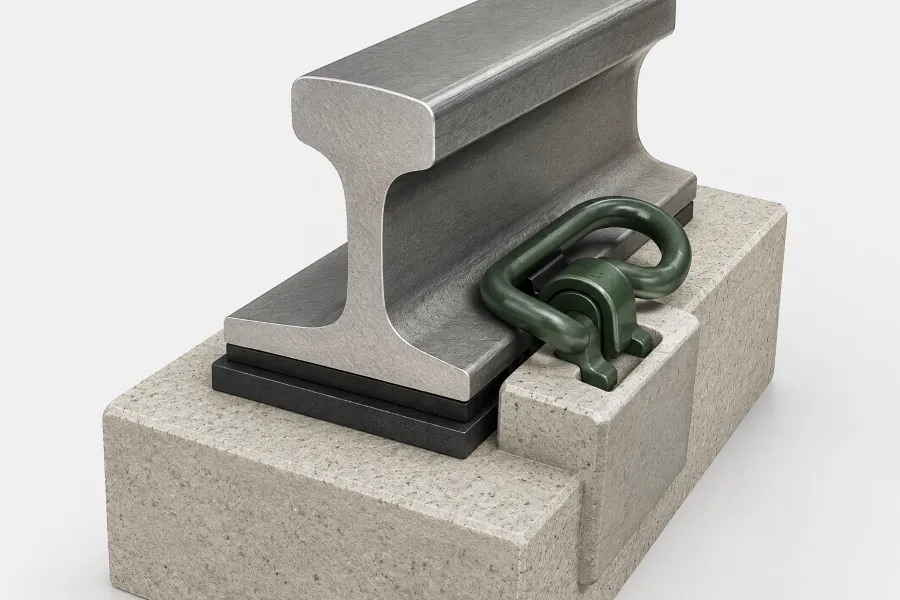
The SKL clip is a spring steel tension clamp with a W-shape when viewed from the side. It works inside a fastening system that includes insulating guide plates, gauge blocks, a rail pad and, on many designs, a baseplate or sleeper anchor.
The name SKL comes from the German “Schwellenklemmplatte” tradition, and the system is associated with Central European fastening practice. Common designations such as SKL1, SKL12, SKL14 and SKL21 refer to different clip sizes for different rail sections and load levels.
The SKL system is modular. The clip, guide plates and gauge blocks are separate components that can be replaced individually, and the gauge blocks allow lateral adjustment of the rail position within limits. That modularity is one of the reasons the system is popular on networks where precise gauge adjustment and component-level maintenance matter.
Installation of an SKL clip requires more steps than an E-clip: the guide plates and gauge blocks go in first, then the clip is driven into position over the rail foot. Removal follows the reverse order. The extra components mean the system costs more per fastening, and installation takes longer.
The SKL system is strongly associated with high-speed and heavy-haul practice in Europe and beyond, and it is often specified on modern lines where the fastening system is designed as part of the whole track structure. That is why the E-clip vs SKL clip choice often follows the project’s design philosophy as much as its load conditions.
The difference between E-clips and SKL clips is not one number. It is a set of engineering trade-offs. And the E-clip vs SKL clip comparison usually comes down to these five.
Clamping force and elasticity. Spring clips work by elastic deflection: they are pressed into position, and the spring stores the deflection as clamping force. The clamping force and the range of deflection differ between clip designs, and both depend on the specific model, the wire diameter and the material. A general statement such as “E-clips have X kN and SKL clips have Y kN” can be misleading, because the values vary across models and standards. What is fair to say is that SKL-system clips generally use a larger spring geometry and are often specified where higher clamping force and greater deflection range are required, while E-clips are chosen for compactness and simplicity.
System components. An E-clip system is minimal: Clip, Schulter, Isolator, Unterlage. An SKL system adds guide plates and gauge blocks. More components means more parts to manage in the warehouse, but it also means individual components can be replaced instead of the whole fastening.
Gauge adjustment. Because the SKL system includes gauge blocks, lateral rail position can be adjusted within the design range by swapping blocks. The E-clip system has less adjustment capability, because the shoulder position is fixed by the sleeper.
Installation and removal. E-clips are faster to install and remove, which is an advantage on lines with frequent rail replacement. SKL clips take longer per fastening but the modular system means worn components can be replaced individually. This maintenance difference is often the deciding factor in the E-clip vs SKL clip discussion for existing lines.
System commitment. The E-clip shoulder is cast into the sleeper, so the choice is locked in at sleeper casting time. The SKL system can be mounted with anchor inserts or baseplates that offer more flexibility at the design stage, though the clip and plate combination must still be matched.
Every spring clip is a fatigue component. It is deflected on installation and then cycled by every passing wheel, for millions of cycles over its service life. Fatigue life is therefore a real consideration, and suppliers often quote numbers for it.
This is where I would be cautious, and it applies to the E-clip vs SKL clip comparison as much as to any other clip choice.
Die Angaben zur Ermüdungslebensdauer von Schienenklemmen hängen stark vom jeweiligen Modell ab, der Drahtdurchmesser, das Material, die Wärmebehandlung, die Prüfmethode und die Akzeptanzkriterien. Zwei Lieferanten können unterschiedliche Zahlen für ähnlich aussehende Clips angeben, weil sie unterschiedliche Modelle getestet oder unterschiedliche Testbedingungen verwendet haben. Eine Zahl ohne Angabe des Teststandards sagt wenig aus.
Auf den Standard können Sie sich verlassen. Clip-Leistung, einschließlich Ermüdungstests, wird durch Normen wie EN abgedeckt 13481 für die Leistung von Befestigungssystemen und UIC 864 für Laschen- und Bolzenabmessungen. Die jeweils gültige Norm legt die Prüfmethode fest, und die Testmethode definiert, was die Zahl bedeutet.
Beim Vergleich von Clips, Ich würde nach dem Ermüdungstestbericht und der Norm fragen, nach der es getestet wurde, anstatt Schlagzeilen aus Datenblättern zu vergleichen.
Eine allgemeingültige Antwort gibt es nicht, Und jeder Lieferant, der Ihnen eins gibt, ohne nach Ihrem Titel zu fragen, verkauft Ihnen seinen Katalog. Die Entscheidung zwischen E-Clip und SKL-Clip fällt erst, wenn Sie die Systemfragen durchgearbeitet haben.
Ein praktischer Auswahlprozess sieht eher so aus:
| Frage | Warum es wichtig ist |
| Welches Schienenprofil befestigen Sie?? | Die Clipgeometrie muss zum Schienenfuß und zur Schwelle passen |
| Welchen Schlaftyp haben Sie?? | Schulterbeton in Schwellenschlössern in der E-Clip-Auswahl |
| Welche Achslast und Streckengeschwindigkeit gelten?? | Höhere Lasten und Geschwindigkeiten tendieren zu größeren, steifere Systeme |
| Was ist die Wartungsphilosophie?? | Der Austausch auf Komponentenebene begünstigt modulare Systeme |
| Wie oft wird die Schiene ausgetauscht?? | Eine schnelle Clipentfernung begünstigt das einfachere System |
| Welcher Standard gilt für das Projekt?? | IN 13481, UIC, nationale oder Projektspezifikation |
| Ist eine Einstellung des Messgeräts erforderlich?? | Gauge blocks in the SKL system allow lateral adjustment |
These are starting points, not a universal specification. The final choice should be checked against the actual track design and the applicable standard.
Zum Beispiel, a light-rail or branch line with concrete sleepers already cast with E-clip shoulders may reasonably stay with the E-clip system, because changing would mean replacing sleepers. A new high-speed or heavy-haul line designed from scratch may reasonably specify an SKL-type system where the design team wants modular components and gauge adjustability.
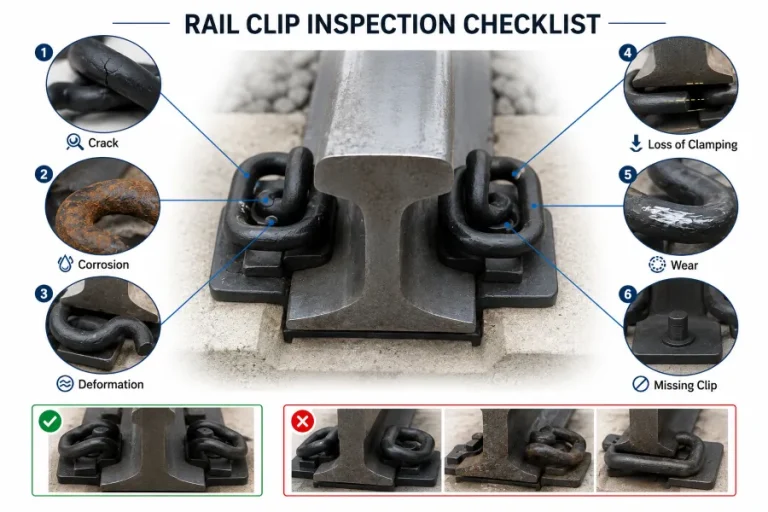
Neither choice is wrong on its own. What is wrong is choosing without checking the system, the standard and the sleeper. If you are already working through the wider fastening picture, unser guide to railway track maintenance shows where clip inspection sits inside the full maintenance cycle.
When comparing rail clip suppliers, I would not stop at asking which clip types they make. Ask what sits behind the clip.
A reliable supplier should be able to provide:
For larger projects, traceability matters. If a clip fails in service, the ability to trace it back to the heat and batch is what allows the investigation to scope the exposure across the line.
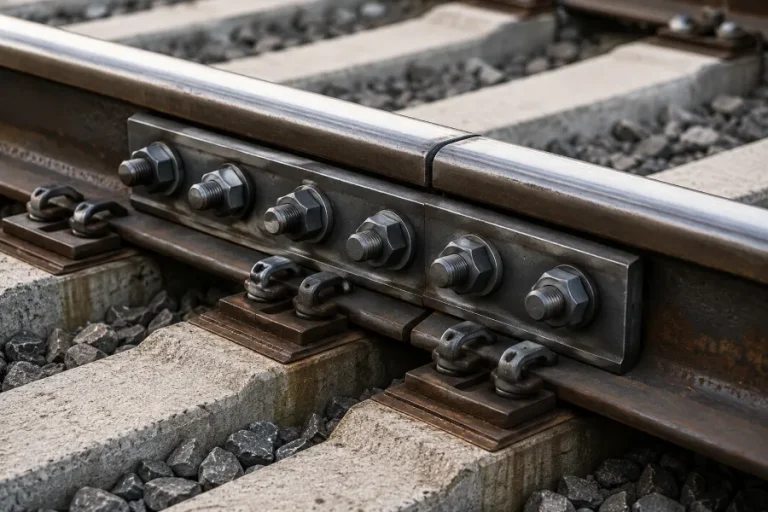
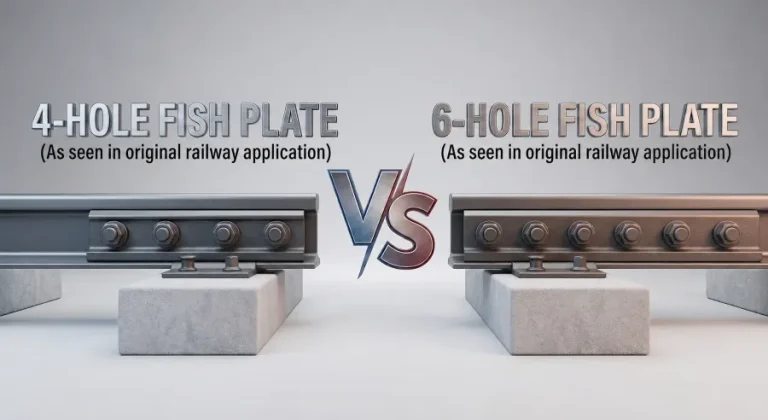
If you are working on the wider fastening system, unser Schienenlaschen erklärt: Typen, Standards, Abmessungen und Auswahlhilfe explains how the components of a jointed track system relate to UIC and EN requirements.
E-clips and SKL clips are both proven spring steel designs with decades of service behind them. The question is not which one is better in the abstract, but which one fits your rail profile, your sleeper, your loads, your maintenance practice and your standard.
That is why I would not recommend choosing a rail clip based on a single datasheet number. Start with the system. Check the sleeper and the rail profile. Confirm the standard. Then compare clips within the same system family, using test reports from the same test method. The E-clip vs SKL clip decision, done properly, is a system decision, not a component decision.
Bei Luoyang Fonyo Heavy Industries Co., Ltd., wir fertigen elastische Schienenklemmen, including E-clip and SKL-type designs, together with Fischbolzen, Fischteller and rail pads, nach Kundenzeichnungen, geltende Normen und Projektanforderungen. For rail fastening systems, we can review the required clip type, Material, Wärmebehandlung, coating and testing requirements before production.
Wenn Sie eine Zeichnung haben, specification or an existing clip sample, Schicken Sie uns die Details. Our engineering team can help check the required clip type, Bitte informieren Sie sich vor der Angebotserstellung über die geltenden Normen und Produktionsanforderungen. For the wider wheel-rail picture, our guide to Eisenbahnräder covers the other half of the interface.
E-clips and SKL clips are both spring steel rail clips, Sie gehören jedoch zu unterschiedlichen Befestigungssystemfamilien. The E-clip is a compact asymmetric clip driven into a shoulder cast into the sleeper, mit wenigen Komponenten. The SKL clip is a W-shape tension clamp used with insulating guide plates and gauge blocks, offering modular components and lateral gauge adjustment.
Keines von beiden ist allgemein besser. The E-clip system is compact, simple and fast to install, and suits lines where the sleeper is already cast with the shoulder. The SKL system offers modular components and gauge adjustability, and is often specified for high-speed and heavy-haul lines. The applicable standard and track design should determine the choice.
NEIN. The clip geometry must match the rail profile, der Schläfer, the shoulder or baseplate, and the rest of the fastening system. An E-clip will not fit an SKL guide plate assembly, and an SKL clip will not drive into an E-clip shoulder. Changing systems means changing the sleeper or baseplate design.
Nicht automatisch. Clamping force depends on the specific model, wire diameter, material and standard. General statements about clamping force ranges can be misleading because values vary across models. Compare test reports from the same test standard instead of headline numbers.
Fastening system performance, including rail clips, wird durch Normen wie EN abgedeckt 13481, UIC leaflets and national or project specifications. The applicable standard defines the test method for clamping force, fatigue and deflection, which is what makes different clips comparable.
Not without checking the whole fastening system. If the shoulder is cast into the sleeper, changing to an SKL system requires changing the sleeper or adding a compatible baseplate. Das Schienenprofil, sleeper type and standard must all be compatible.
Ask for the clip designation and matching rail profile, the applicable standard, material and heat treatment details, clamping force and fatigue test reports with the test method, coating details, and compatibility with shoulders, guide plates, gauge blocks and rail pads.