Scannen Sie den WeChat-Code, um mit uns Kontakt aufzunehmen
Scannen Sie den WeChat-Code, um mit uns Kontakt aufzunehmen
Schicken Sie uns gerne eine E-Mail und wir werden Ihnen so schnell wie möglich antworten.
Mit Herz und Seele die Zukunft gestalten


Eisenbahnrad prices vary because a wheel is not one product but a family of engineering specifications. The price difference comes from the manufacturing process (forged or cast), the steel grade and heat treatment, the applicable standard (AAR, IN, UIC or national), the testing and inspection required, and the order volume. Two wheels that look similar can carry very different engineering requirements, and the price reflects that.
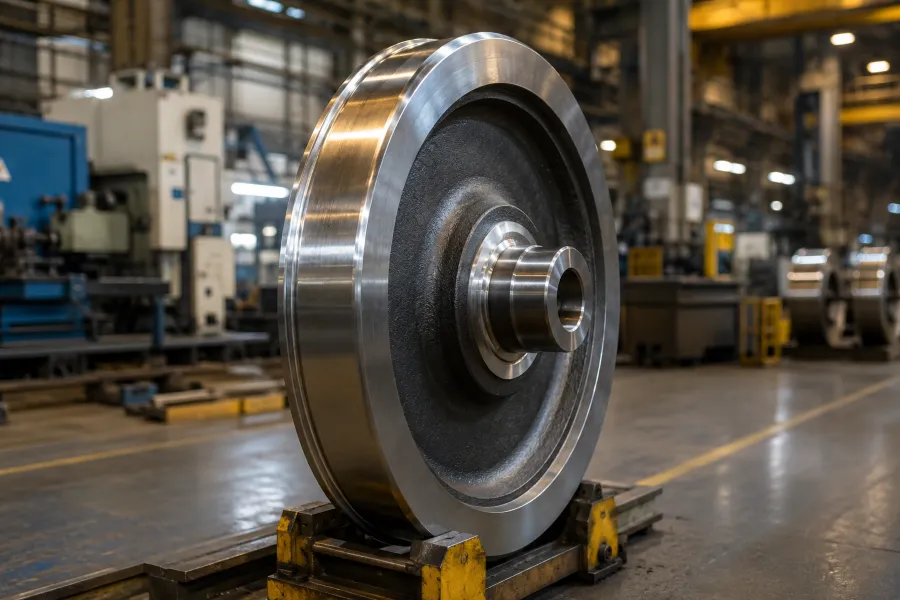
If you have ever received quotations for railway wheels from two suppliers and wondered why the numbers are so different, you are not alone. The wheels may look similar in a drawing. The same diameter. The same tread profile. Even the same axle load rating.
Auf den ersten Blick, Die Wahl scheint einfach: buy from the lower-priced supplier.
In der Praxis, railway wheel prices are not quite that straightforward.
Ein Eisenbahnrad ist ein sicherheitskritisches Bauteil. Es trägt das Fahrzeug, guides it through curves, absorbs track irregularities and takes a fatigue beating measured in millions of cycles. Its price reflects not just the steel, but how the steel was processed, how the wheel was manufactured, and how thoroughly it was verified before delivery. That is why railway wheel prices can vary so much for components that look alike on a drawing.
So how should you compare railway wheel prices?
The single biggest driver of railway wheel price differences is the manufacturing process.
Forged wheels are produced by heating a steel billet and shaping it under a large forging press, then rolling and heat-treating the wheel. The process produces a dense, consistent grain structure and is generally considered to offer better resistance to fatigue and impact. It is also a more expensive route: large presses, precise temperature control, multiple processing steps and more energy.
Cast wheels are made by pouring molten steel into a mold. The process is simpler, uses less energy and requires less capital equipment, which makes it less expensive per wheel. Casting also offers more flexibility in shape. The trade-off is that the internal structure is generally less consistent than forged steel, and casting defects such as porosity or inclusions need to be carefully controlled and inspected.
Does that mean forged wheels are always better? Nicht automatisch. There are applications where a cast wheel, made to its standard and properly inspected, is the appropriate engineering choice. And there are applications where the higher fatigue resistance of a forged wheel justifies its higher price. The applicable standard, the operating conditions and the project specification should drive the decision, not a general preference for one process. Understanding this trade-off is the first step in making sense of railway wheel prices.
For a deeper look at how the two processes compare, our earlier article on forged and cast railway wheel manufacturing covers the technical differences in detail.
The steel in a railway wheel is not a commodity. Wheel steels are specified by standards such as AAR M-107/M-208 (Klasse B, C and D for North American practice), IN 13262 und UIC 812-3, each defining chemical composition limits, mechanical properties and acceptance criteria.
Higher-strength classes generally use more alloying elements, more controlled melting and stricter testing. That costs more. A wheel made to a higher steel class is not automatically the right choice for every line, but where the project specification requires it, the material cost is part of the price.
Heat treatment adds another layer. Die Felge, the plate and the hub may be heat-treated differently to balance wear resistance against toughness. Controlled rim quenching, Zum Beispiel, is a precise process with real cost attached. When a quotation for a “similar” wheel is noticeably lower, it is worth asking what heat treatment the price actually includes.
This is one of the reasons I would be cautious about comparing railway wheel prices by weight alone. Two wheels with the same mass can have very different steel grades, heat treatment and verification behind them.

A railway wheel price is not just for the metal and the machining. A large part of the cost sits in the verification.
Depending on the standard, the wheel may need ultrasonic testing of the rim and web, hardness mapping, tensile and impact testing on test pieces from the same heat, residual stress measurement, dimensional inspection and surface quality checks. Each of these tests has a cost, and a specification that requires full traceability from heat number to final inspection report adds more.
Imagine two wheels that look identical on a drawing. One comes with a full set of inspection records: material certificate, heat treatment records, ultrasonic test reports, dimensional reports and traceability to the production batch. The other arrives with a single-page certificate of conformity.
The first wheel costs more. It also gives the maintenance team the information they need if something goes wrong years later.
The question is not whether the documentation is “nice to have”. On many railways, the inspection documentation is a contractual requirement, and the difference in railway wheel prices between a fully documented wheel and a lightly documented one can be significant.
This connects to a broader point about railway procurement: the standard that applies to the component is often more important than the number on the drawing. Our guide to railway standards for wheels explains how UIC, EN and AAR specifications relate to each other.
Railway wheels are manufactured on production lines that are set up for specific sizes and designs. The tooling, the process qualification and the setup time all have to be absorbed into the price.
A one-off order for a special wheel design carries a different share of setup and tooling cost than a series order of the same wheel. This is not a supplier trying to charge more for the same product. It is the real cost of changing the production line, and it is why volume is one of the most direct levers on railway wheel prices.
The reverse is also worth knowing: a very low price can signal that a supplier is not carrying the process qualification, testing or documentation that the specification requires. The cheapest quote is not automatically the best value, and the most expensive quote is not automatically the most justified. Railway wheel prices need to be understood against what they include.
There is no single price that is correct for every railway wheel. But there is a reliable way to compare quotations.
| Frage | Warum es wichtig ist |
| Which manufacturing process is quoted? | Forged and cast wheels carry different costs and different performance |
| Which steel grade and standard apply? | AAR, EN or UIC classes define the material and its cost |
| What heat treatment is included? | Rand, plate and hub treatment affects price and service life |
| What testing and inspection is specified? | UT, Härte, tensile, impact and dimensional checks add cost |
| What documentation is required? | Certificates and traceability affect the price and the acceptance |
| What is the order volume and delivery? | Volume and lead time change the unit price |
| What is the wheel actually for? | Line speed, axle load and application drive the specification |
These are starting points, not a universal pricing rule. The final comparison should be made between quotations that include the same scope: same process, same standard, same testing and same documentation. When you lay two railway wheel prices side by side, always check that you are comparing the same engineering package.
When comparing railway wheel prices, I would not stop at asking for the price per wheel. Ask what the price includes.
A reliable supplier should be able to provide:
For larger projects, Besonders wichtig ist die Rückverfolgbarkeit. If a wheel later shows abnormal wear or a defect, the ability to trace it back to the heat, the production batch and the inspection records is what makes the investigation possible. The same logic applies on the track side, where a railway track maintenance program depends on knowing exactly which components are in service.
If you are new to the wheel side of the system, our guide to train wheel design covers the geometry and how a wheel is engineered before any price is quoted.
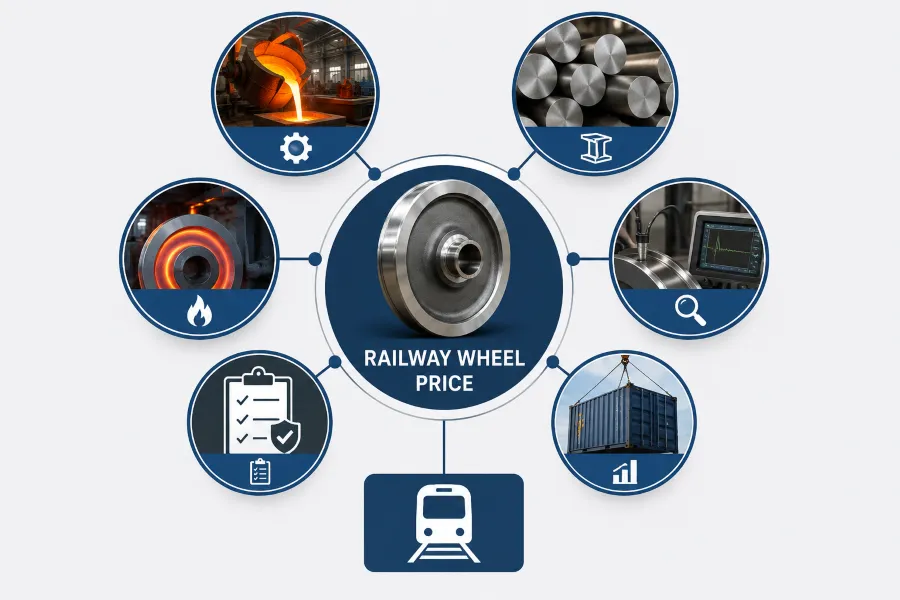
The numbers on a quotation for railway wheels are useful because they give you a starting point. But railway wheel prices are more than a price per tonne.
A reliable wheel depends on the complete package: the steel, the process, the heat treatment, the standard, the testing and the documentation. The difference in price between two quotations is often the difference in what is actually being delivered.
That is why I would not recommend choosing the cheapest railway wheel simply because the price is lower, or the most expensive simply because the process sounds more advanced. Start with the application. Check the applicable standard. Compare quotations with the same scope. Then decide how railway wheel prices should be judged for your project.
Bei FONYO, wir fertigen Eisenbahnräder Und Eisenbahnguss products according to customer drawings, geltende Normen und Projektanforderungen. Für Räder, we can review the required steel grade, Herstellungsprozess, Wärmebehandlung, testing and inspection requirements before production.
Wenn Sie eine Zeichnung haben, specification or an existing wheel sample, Schicken Sie uns die Details. Our engineering team can help check the required railway wheel specification, Bitte informieren Sie sich vor der Angebotserstellung über die geltenden Normen und Produktionsanforderungen.
The main drivers are the manufacturing process (forged or cast), the steel grade and heat treatment, the applicable standard, the testing and inspection required, and the order volume. Forged wheels generally cost more than cast wheels, higher steel classes cost more than lower classes, and full inspection documentation adds to the price.
Nicht automatisch. Forged wheels generally offer better fatigue and impact resistance because of their denser grain structure, which is why they are specified for demanding applications. Cast wheels are less expensive and can be the appropriate engineering choice where the standard and operating conditions allow. The applicable standard should drive the decision.
The quotations may not cover the same scope. One may include a different manufacturing process, Stahlsorte, Wärmebehandlung, testing program or documentation. Compare quotations line by line for process, Standard, testing and traceability before judging them by price alone.
Nicht unbedingt. A higher price usually reflects more process, testing or documentation, but the right price is the one that matches your applicable standard and operating conditions. Over-specifying a wheel for a light application can cost more without adding value.
Es gibt keine einheitliche Antwort, and a specific number without the specification behind it can be misleading. Wheel price depends on the process, Stahlsorte, Standard, testing, volume and documentation. The useful comparison is between quotations that include the same scope.
Ask for the steel grade and standard, the manufacturing process, heat treatment records, mechanical test results, ultrasonic and inspection reports, dimensional reports, traceability to the production batch, and marking and packaging requirements.
Because a wheel is a safety-critical component that may be in service for decades. If abnormal wear or a defect appears later, traceability from the heat number to the inspection records is what allows the investigation to identify the cause and scope of the problem.