WeChat 코드를 스캔하여 문의하세요
WeChat 코드를 스캔하여 문의하세요
이메일을 보내주시면 최대한 빨리 답변해 드리겠습니다..
마음과 영혼을 다해 미래를 창조하다

레일은 침목에 직접 고정되지 않고 침목판을 통해 침목에 고정됩니다.. 목재 침목은 일반적으로 강철 철도 연결판을 사용합니다., while concrete sleepers typically use composite material railway tie plates.
This component, which is usually precisely forged from special spring steel or composite materials, has its core function to conduct and buffer the power intelligently. When tens or even hundreds of tons of wheel loads crash onto the rail, the pad, thanks to its meticulously designed elasticity, instantly transforms into an efficient “force disperser”, softening and spreading the massive concentrated impact force, and evenly transmitting it to the wider surface of 자는 사람 below. This significantly alleviates the stress concentration on the sleeper, effectively preventing fatal damages such as cracking and subsidence. 동시에, it is like a precise “shock absorber”, absorbing the high-frequency vibrations and impact energy between the wheel and the rail, significantly reducing noise and greatly improving the smoothness of train operation and passenger comfort. 없어서는 안될 필수품입니다 “quiet guardian” 철도 시스템에서.
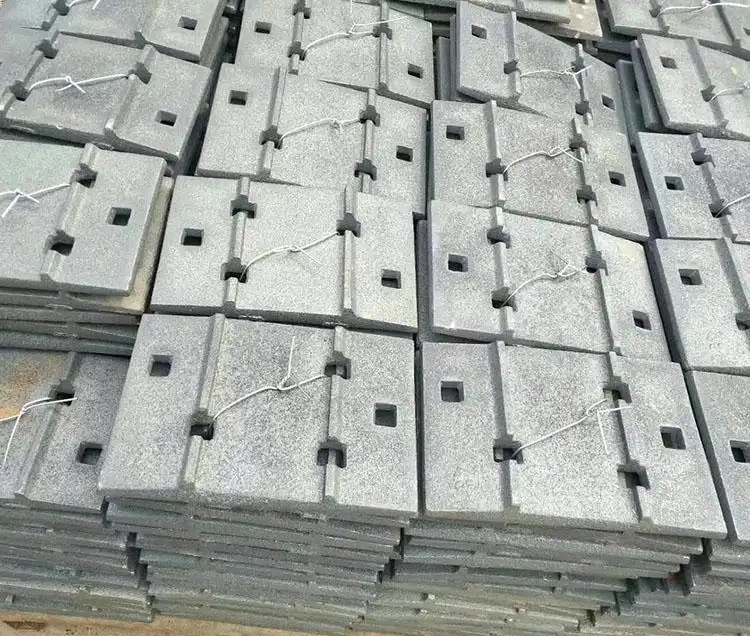
Their surfaces are closely attached to the bottom of the rails, often featuring anti-slip patterns or raised slots to ensure that the rails do not shift under huge lateral forces (such as when a train turns) and firmly “잠그다” onto the rails. The bottom is shaped according to different types of sleepers (the flat surface of concrete sleepers or the grooves of wooden sleepers) to achieve stable support. Many base plates also integrate or are paired with high-performance elastic pads, like embedding a layer of “rubber spring” between steel and concrete/wood, further enhancing the buffering and insulation performance. In terms of material selection, special spring steel is treated through cold hardening, possessing excellent fatigue resistance and wear resistance characteristics that “get stronger under pressure”; while composite base plates (such as glass fiber reinforced polyamide) are increasingly widely used on high-speed and heavy-load railways due to their advantages of light weight, 내식성, good insulation, and maintenance-free.
· 2.1Protecting the sleepers from wear;
·2.2Providing a flat contact surface for the rail base;
·2.3 Preventing rail creep.
2.4 For wooden sleepers, the steel rail tie plate also serves another function, which is to provide the inclination angle (cant) of the rail.
2.4.1 첫째로, it protects the rail from wear. Since the contact pressure between the rail and the sleeper is very high, in order to protect the sleeper, it is necessary to reduce the pressure. For wooden sleepers, since wood can withstand less stress, it is necessary to increase the contact area to distribute the stress. In the picture of the metal pad, the red box outlines the projection of the rail base, and the yellow box outlines the projection of the rail pad. The area of the yellow box is larger than that of the red box. When the area increases, the stress distributed on the sleeper naturally decreases. For concrete sleepers, since concrete can withstand more stress than wood, the demand for stress dispersion is relatively smaller. 하지만, during train operation, due to the unevenness of the rail, the roundness of the wheels, and changes in the strength of the track, the dynamic impact can reach up to twice the weight of the train. Such a strong impact may still damage concrete sleepers. 그러므로, composite material railway tie plates are often used on concrete sleepers, which are relatively soft and can alleviate the dynamic impact to a certain extent.
2.4.2 둘째, it provides a flat contact surface for the rail base. The upper surface of the sleeper is not an absolute plane. Originally, the projection area of the rail base on the sleeper is not large. If the contact surface is not flat, the contact area will be even smaller. 그러므로, using the rail pad can provide a flat contact surface, thereby increasing the contact area and reducing the stress.
2.4.3 Thirdly, it prevents rail creep. On the side of the rail base in contact with the sleeper on the metal pad, there are two “steps” (coinciding with the edges of the red box in the picture), so this rail pad is called a Double Shoulder Tie Plate. These two “steps” can prevent the rail from lateral movement. When the metal pad is used in combination with spikes, it cannot provide sufficient longitudinal restraint for the rail, so anti-slip equipment needs to be used in conjunction, which will be explained later. The friction coefficient between the composite material rail tie plate and the rail is greater than that between the concrete sleeper and the rail. Combined with the use of elastic fasteners, it can provide sufficient lateral and longitudinal restraint.
2.4.4 마지막으로, the metal rail pad also has the function of providing the rail inclination angle. As shown in the picture, the rail is not arranged perpendicular to the sleeper but inclined inward (gauge side) by a certain angle, which can provide a better wheel-rail contact surface. The inclination angle of the rails in North American railways is 1:40. For concrete sleepers, the inclination angle of the rail is integrated into the sleeper; 즉, the rail contact surface of the sleeper (Rail Seat) is itself inclined.
뤄양포뇨중공업(Luoyang Fonyo Heavy Industries), 주식회사,1998년에 설립된 철도 주조 부품 제조업체입니다. 저희 공장 부지는 72,600㎡입니다., 이상으로 300 직원, 32 기술자, 포함 5 수석 엔지니어, 11 보조 엔지니어, 그리고 16 기술자. 우리의 생산 능력은 30,000 연간 톤. 현재, 우리는 주로 주조물을 생산하고 있습니다, 가공, 기관차 조립 및 조립,철도 차량,고속 열차, 광산 장비,풍력,등.
우리는 CRRC에 철도 부품을 공급하고 있습니다.(이상 포함 20 CRRC의 지사 및 자회사),Gemac 엔지니어링 기계,삼니그룹, 중공업,등. 우리의 제품은 러시아로 수출되었습니다, 미국, 독일, 아르헨티나, 일본, 프랑스, 남아프리카,이탈리아와 전 세계의 다른 나라들.
연락처 정보:
이메일:[email protected]
이동하는:008615515321683