WeChat コードをスキャンしてご連絡ください
WeChat コードをスキャンしてご連絡ください
お気軽にメールをお送りください。できるだけ早くご返信させていただきます.
心と魂で未来を創る


Each railway carriages is connected by a pair of hooks, but the connection doesn’t look very tight and they wobble a bit. Why don’t they come apart? Why not just connect them directly instead of using these seemingly flimsy hooks?
Train couplers, also known as car couplers, are used to connect trains or locomotive sets together. したがって, train couplers can connect multiple locomotive sets, transmit the traction force of locomotives, and also play a role in buffering by keeping locomotives at a certain distance. したがって, train couplers play a very important role.
1.1 The coupling is an important locomotive component, so it is manufactured using a forging process. This makes the material more precise and thus improves the strength of the train coupling.
We often see that, whether it is a regular train or a high-speed train, eight carriages are grouped together, and each group is connected to the others like holding hands.
Sometimes multiple sets are connected together, mainly to increase the locomotive’s transport capacity.
As long as the train sets are of the same type, the number of train sets can be increased or decreased at any time according to the size of the transport capacity, so as to maintain the flexibility of train transport capacity. This can also save energy and improve the utilization efficiency of the train.
1.2 Who invented the James Hook?
The earliest method of connecting locomotives was to use ordinary iron chains to tie the carriages together at the joint. This method was time-consuming, laborious, and not very sturdy. When going uphill, the excessive force could cause the trains to come apart, and when going downhill, rear-end collisions were likely to occur, resulting in frequent safety accidents.
後で, an American railway engineer named Jenner discovered many shortcomings in train coupling and decided to invent a convenient and practical train coupler.
After countless failures, the automatic train coupling hook that is still in use today was finally invented. 後で, in order to commemorate Jannet’s great invention, people named this train coupling “Jannet coupling”.
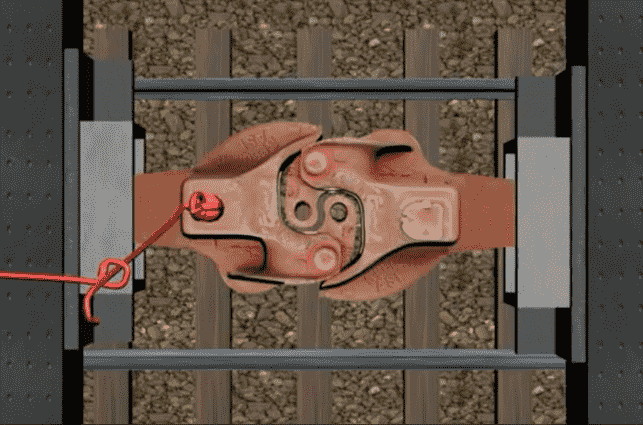
2.1 The Jan-type locomotive coupler is like two iron hands, installed at the front of the carriage. There is a “mechanism” in the palm of the iron hand, so as long as the two iron hands touch, の “mechanism” will be triggered and they will hold each other tightly.
2.2 The locomotive hook is mainly composed of three parts: the hook head, the hook body, and the hook tail. Inside the hook head are the hook tongue, hook tongue pin, lock lifting pin, lock tongue push iron, and hook lock iron.
It also utilizes a simple yet ingenious mechanical principle to achieve the opening, closing, and locking functions of the hook. Although it looks rough, this hook is actually simple, practical, and very safe.
2.3 When the locomotives need to be connected, the two hooks come close together, and the hooks exert pressure from the inclined plane to open the spring hook tongues, forming a hook handshake. 現時点では, after the hooks enter, the spring will rebound, and the locking pin will also fall, so the hooks will not disengage.
To disengage, simply lift the lock pin, and the hook tongue will be opened simultaneously. At this point, as long as the lock tongue is pulled, it can be turned outward to disengage from the hook, and the two iron handles can be easily separated.
3. EMU couplers
Because high-speed trains are faster and more automated, their components are more precise, so the couplers of high-speed trains are somewhat different from ordinary James couplings.
3.1 The couplers of high-speed trains all adopt automatic electrical connection. In order to make the train run more smoothly and reduce friction and noise between parts, there is no gap at the coupler connection, achieving seamless connection, just like two magnets attracting each other. したがって, this type of coupler is also called close-fitting coupler.
This type of close-fitting coupler features a truly close fit, truly automatic connection and uncoupling, and is mainly composed of mechanical coupler head , air connection pipe , power connection device and buffer device.
3.2 When the coupler is in the ready-to-engage state, the coupler tongue positioning rod is in the ready-to-engage position, the coupler tongue spring is in the maximum tension state, and the coupler tongue connecting rod also retracts into the coupler head.
3.3 When the train couplers are in the coupled state, the hook tongues of both hooks extend into the other hook head, pushing the positioning rod top block away from the ready-to-couple state. The hook tongue spring force will also push the hook tongue to rotate counterclockwise, finally allowing the hook tongue to fully enter the other hook mouth, thus completing the connection.
3.4 When the train is uncoupled, the uncoupling cylinder is inflated by the solenoid valve, which pushes the coupler tongue to rotate clockwise, so that the coupler tongue is completely disengaged from the multiple coupler mouths, completing the uncoupling. The positioning rod will then reset, and the coupler will be ready to be coupled again.
Couplers are one of the most basic and important components of all locomotives. It is precisely because of components such as couplers in high-speed trains that modern trains are safer, more comfortable, and more intelligent.
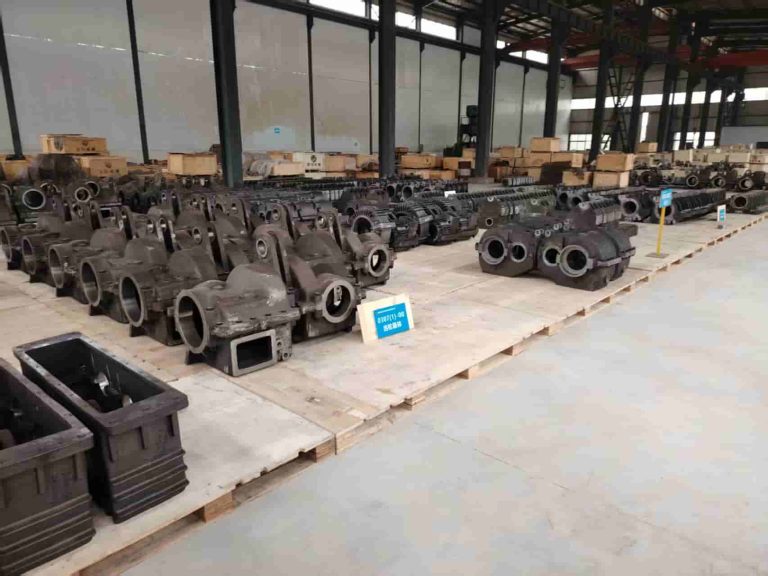
洛陽豊洋重工業株式会社, 株式会社,に設立された 1998, 鉄道鋳物部品のメーカーです. 当社の工場面積は72,600㎡です。, 以上の 300 従業員, 32 技術者, 含む 5 シニアエンジニア, 11 アシスタントエンジニア, そして 16 当社の生産能力は 30,000 年間トン. 現在, 私たちは主に鋳物を生産しています, 機械加工, 機関車の組立て, 鉄道車両, 高速鉄道, 鉱山機械,風力,等.
当社はCRRCに鉄道部品を供給しています。(以上を含む 20 CRRCの支店および子会社),Gemacエンジニアリングマシナリー,サニーグループ, 中信重工業,等. 当社の製品はロシアに輸出されています, 米国, ドイツ, アルゼンチン, 日本, フランス, 南アフリカ,イタリアをはじめとする世界中の国.