WeChat コードをスキャンしてご連絡ください
WeChat コードをスキャンしてご連絡ください
お気軽にメールをお送りください。できるだけ早くご返信させていただきます.
心と魂で未来を創る


技術者が鉄道台車の信頼性を評価する場合, の サイドフレーム 通常、最も注目されるコンポーネントの 1 つです. 比較的単純な鉄骨構造に見えますが、, 鉄道台車のサイドフレームは、実際に台車システム内でいくつかの重要な機能を実行します。. ホイールセットの荷重をサポートします, アクスルアセンブリの正しい位置を維持します, 列車の運行中に発生する力を伝達します.
多くの一般的な機械部品とは異なります, サイドフレーム 継続的に変化する負荷の下で動作する. 不完全な軌道上を走行する貨車は、車両と貨物の静的重量だけでなく、振動によって生じる動的力にもさらされます。, 影響, 制動, 加速度, そしてカーブ交渉. 数百万回を超える動作サイクル, これらの繰り返し荷重により、構造内部に疲労応力が発生する可能性があります.
このため, the design of a railway bogie side frame is not simply about achieving sufficient strength. Engineers must also consider fatigue life, casting quality, 寸法精度, material performance, and long-term maintenance requirements.
In practical railway applications, a well-designed and properly manufactured side frame can significantly improve bogie stability, reduce wheel wear, and extend the service life of the entire rail vehicle.
This article explains the function, 構造設計, 材料の選択, and manufacturing process of railway bogie side frames from an engineering perspective.
あ 鉄道台車側枠 is a major structural component installed on both sides of a railway bogie. It connects the wheelset assemblies with the suspension system and works together with the bolster to form the main load-bearing structure of the bogie.
In a conventional three-piece freight wagon bogie, the structure mainly consists of:
しかし, the side frame is not simply a supporting bracket between wheels. エンジニアリングの観点から, it is the structural link that controls how forces move through the bogie.
The typical load path during operation is:
Vehicle body → Bolster → Suspension system → Side frame → Bearing adapter → Wheelset → Rail
Every component in this path must work together correctly. If the side frame has insufficient strength, poor dimensional accuracy, or manufacturing defects, the entire bogie performance can be affected.
For freight wagons, especially heavy-haul applications, サイドフレームは、高い軸荷重や繰り返しの衝撃条件下でも信頼性の高い性能を維持する必要があります。.
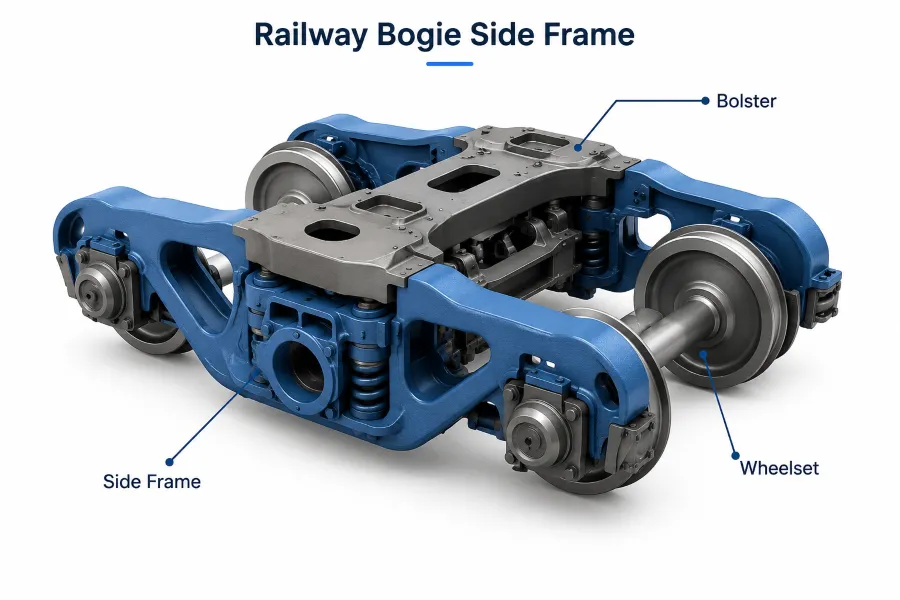
サイドフレームの主な機能は、垂直荷重と動的荷重を台車構造から車輪セットに伝達することです。.
鉄道運行中, 車両と荷物の重量はサスペンション システムを介して伝達されます。. サイドフレームはこれらの力を受け取り、ベアリングアダプターとホイールセットに伝達します。.
デザインの観点から, 課題は最大負荷を処理することだけではありません. 鉄道コンポーネントは、その耐用期間中に数百万回の荷重サイクルを経験する可能性があります。, 疲労性能も同様に重要になります.
このため, エンジニアは通常、次のことに重点を置きます:
サイドフレームが柔らかすぎると車両の安定性に影響を与える可能性があります, 一方、重量が過剰になると製造コストが増加し、バネ下質量が増加する可能性があります。. 最終的な設計は常に強度と効率のバランスを考慮して行われます。.
鉄道台車サイドフレームのもう 1 つの重要な機能は、車輪セットの位置を制御することです。.
サイドフレームの台座部分はベアリングアダプターをサポートし、車軸と台車構造間の正しい関係を維持するのに役立ちます。.
動作中, ホイールセットは制御された範囲内で移動する必要があります. 過度の動きは次のような結果を引き起こす可能性があります:
このため、台座開口部の加工精度が製造上の重要な要件となります。.
実際の鉄道保守では, ここの磨耗や変形は台車の性能問題の初期の兆候となる可能性があるため、エンジニアはこの領域を注意深く検査することがよくあります。.
鉄道車両は、純粋に垂直ではない多くの力を受けます。.
電車がカーブを通過するとき, 速度を変える, または不規則な路面状況を走行する場合, 台車は横方向と縦方向の力を受けます.
サイドフレームは、構造的な完全性を維持しながら、これらの力を吸収する必要があります。.
これは特に重要になります:
A side frame designed only for static strength may fail prematurely because railway operation involves continuous dynamic loading.
したがって, fatigue analysis and practical operating conditions must be considered during the design stage.
Designing a railway bogie side frame is a process of balancing several engineering requirements. The component must be strong enough to withstand heavy loading, flexible enough to work with the suspension system, and practical enough to be manufactured consistently.
鉄道用途で, a side frame is expected to operate safely for many years under changing environmental and loading conditions. したがって, engineers do not only consider the maximum load that the component can carry. They also pay close attention to how stress is distributed throughout the structure and how the component will behave after millions of operating cycles.
A well-designed side frame should achieve three main objectives:
The pedestal area is one of the most important regions in a railway bogie side frame.
This area directly supports the bearing adapter and connects the side frame with the wheelset assembly. 動作中, it is continuously exposed to vertical loads, 振動, and impact forces generated from wheel-rail interaction.
エンジニアリングの観点から, the challenge is maintaining accurate positioning while allowing the necessary movement between components.
If the pedestal geometry is not properly controlled, several problems may occur:
このため, manufacturers pay particular attention to the machining accuracy and surface condition of the pedestal area after casting.
の casting process itself is also important because defects in this region can significantly reduce fatigue performance. Any internal shrinkage, 内包物, or micro-cracks may become potential failure points under repeated railway loading.
The spring seat is another important area in side frame design.
In many freight bogie designs, the suspension springs are positioned between the side frame and bolster. The spring seat must provide stable support and ensure that the suspension forces are evenly distributed.
A poorly designed spring seat may lead to:
During the design stage, engineers consider factors such as contact area, local wall thickness, and stress concentration.
The goal is not simply to make the spring seat stronger. Excessive reinforcement can increase casting difficulty and add unnecessary weight. その代わり, the structure should be optimized so that the material is placed where it contributes most to strength.
This is one of the reasons why experienced railway casting manufacturers rely heavily on engineering analysis before producing the first casting.
Although a railway bogie side frame is manufactured as a single structural casting, different areas experience different stress levels.
Sharp changes in geometry can create stress concentration points. Under repeated loading conditions, these areas may become locations where fatigue cracks initiate.
During design optimization, エンジニアは通常、次のことに重点を置きます:
鉄道部品用, fatigue performance is often more important than short-term strength. A component may easily pass a static load test but still experience problems after years of repeated service if fatigue behavior is not considered.
したがって, side frame design normally involves both static analysis and fatigue evaluation.
Reducing weight is an important consideration in modern railway vehicle design, but it must be achieved without compromising safety.
A heavier side frame may provide additional strength, but it also increases:
一方で, excessive weight reduction can reduce fatigue life and structural reliability.
The ideal design uses optimized geometry to achieve the best balance between:
Modern engineering methods such as 3D modeling and casting simulation help designers evaluate different structural solutions before production.

Material selection is one of the most important decisions in railway bogie side frame manufacturing.
Unlike ordinary steel structures, railway side frames must withstand repeated impact loads, 振動, and fatigue cycles throughout their service life. したがって, the material must provide not only high strength but also good toughness and resistance to fatigue damage.
このため, most railway bogie side frames are manufactured from high-strength cast steel.
Cast steel has become the preferred material for many railway bogie side frames because it offers several advantages.
初め, casting allows manufacturers to produce complex structural shapes that would be difficult or expensive to manufacture through welding or machining from solid steel.
A side frame contains many functional areas, 含む:
Casting makes it possible to integrate these features into one continuous structure.
2番, cast steel provides good mechanical performance. With proper alloy design and heat treatment, it can achieve the required combination of:
These characteristics make it suitable for demanding railway applications.
For international freight railway applications, AAR M-201 cast steel specifications are widely recognized, especially in North American railway systems.
Different grades are selected depending on operating requirements.
例えば:
Higher-strength grades may be selected for:
Standard grades may be suitable for:
The final material choice depends on several factors, 含む:
When evaluating cast steel for railway side frames, engineers usually focus on more than tensile strength.
Important considerations include:
Railway components may experience sudden impact loads, especially when vehicles operate on uneven track conditions. Good toughness helps prevent brittle failure.
A side frame may experience millions of load cycles during service. The ability to resist fatigue crack initiation is essential.
Even a high-strength material can fail if internal casting defects exist. したがって, material performance is closely related to the quality control of the foundry process.
Proper heat treatment improves the internal structure of cast steel and ensures consistent mechanical properties throughout the component.
For a railway component manufacturer, selecting the right material is not only a matter of choosing a steel grade.
The complete manufacturing system must be considered:
A reliable side frame requires cooperation between material engineering, casting technology, 機械加工, and quality control.
This is why railway casting production requires much more experience than ordinary industrial steel castings.
の manufacturing process of a railway bogie side frame is much more demanding than producing a general steel casting. Because the side frame is a safety-critical railway component, every stage from casting design to final inspection must be carefully controlled.
A small defect that may be acceptable in ordinary industrial castings can become a serious risk in railway applications. このため, experienced manufacturers focus not only on producing a casting that meets the drawing requirements, but also on ensuring long-term reliability under actual operating conditions.
The typical manufacturing process includes casting design, steel melting, 熱処理, 機械加工, そして検査.
The production of a railway bogie side frame starts before the first piece of steel is poured.
Engineers first analyze the component drawing and develop the casting process. Unlike simple castings, サイドフレームは壁の厚さが異なる複雑な形状をしており、構造的完全性に対する高い要件があります。.
この段階では, メーカーは検討します:
適切に設計された鋳造プロセスは、ひけ巣などの一般的な鋳造の問題を軽減します。, 気孔率, 不均一な微細構造.
今日, 多くの経験豊富な鋳造工場は 3D モデリングと鋳造シミュレーション技術を使用して、生産前に潜在的な欠陥を予測しています. これにより、エンジニアは金型設計を最適化し、初回生産品質を向上させることができます。.
ものづくりの視点から, 良好な鋳造品質は、実際の注湯プロセスが開始される前にほぼ決定されます。.
鋳造工程確認後, 鋼の溶解は次の重要な段階になる.
The chemical composition of the steel directly affects the final mechanical properties of the railway side frame. したがって, manufacturers must strictly control alloy elements during melting.
Typical controlled elements include:
生産中, samples are taken for chemical analysis to verify that the molten steel meets the specified requirements.
鉄道部品用, consistency is especially important. A single casting with abnormal chemical composition may have different mechanical performance compared with other production batches.
したがって, professional railway foundries normally maintain strict process records for each heat of steel.
Railway bogie side frames are usually produced using sand casting because this process provides the flexibility required for large and complex structural components.
During pouring, several factors influence casting quality:
The temperature must be controlled carefully. If it is too low, incomplete filling may occur. If it is too high, excessive oxidation or grain growth may affect the material properties.
The cooling process determines the internal structure of the casting.
Uneven cooling may create:
The quality of the sand mold also affects surface finish and dimensional accuracy.
For large railway castings, process stability is essential because even small variations can influence final performance.
キャスト後, the railway side frame usually requires 熱処理 to achieve the required mechanical properties.
The casting process naturally creates internal stresses due to uneven cooling. Heat treatment helps improve the internal structure and provides more stable performance.
Common heat treatment methods include:
Normalizing is used to refine the grain structure and improve material consistency.
It helps:
For higher-strength requirements, quenching and tempering may be applied.
This process improves:
The exact heat treatment process depends on the selected material grade and customer requirements.
鉄道用途向け, heat treatment control is extremely important because mechanical properties must remain consistent throughout the entire casting.
熱処理後, the side frame enters the 機械加工 stage.
Although the component is produced by casting, several areas require precision machining to achieve the necessary dimensional accuracy.
The most important machining areas include:
The pedestal opening directly affects the relationship between the side frame and wheelset assembly.
Incorrect dimensions may influence:
The spring seat must provide accurate support for the suspension components.
Machining accuracy helps ensure proper load distribution.
These areas require controlled dimensions to guarantee correct assembly with other bogie components.
鉄道用途向け, 機械加工 is not simply about achieving dimensional accuracy. 台車全体が運転中にどのように動作するかに直接影響します。.
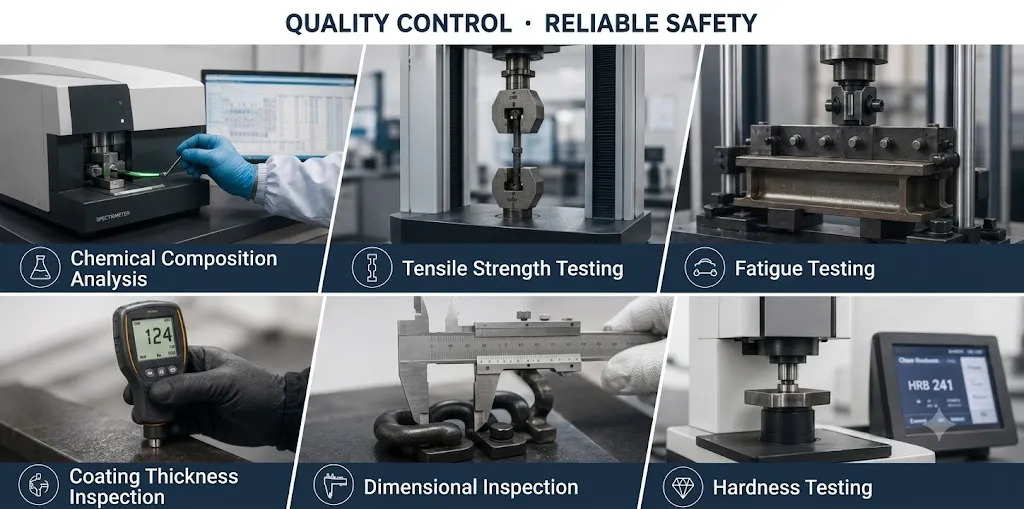
鉄道台車側枠は安全関連部品のため, 検査要件は通常の鋳鋼品よりもはるかに厳しいです.
通常、資格のあるメーカーが次のことを行います。 検査 最終製品のチェックだけではなく、製造プロセス全体を通して.
化学分析により、鋼グレードが要求仕様を満たしていることが確認されます。.
これにより、熱処理後に材料が期待される機械的性能を確実に発揮できるようになります。.
材料の強度と靭性を確認するために機械試験が実行されます。.
典型的なテストには次のものがあります。:
これらの結果により、完成したサイドフレームが必要な動作条件に耐えられることが確認されます。.
内部欠陥は必ずしも視覚的に特定できるわけではないため、, non-destructive testing is an important part of railway casting inspection.
Common methods include:
Used to detect surface and near-surface defects such as cracks.
Used to identify internal defects that may exist inside the casting.
These inspection methods help ensure that potential problems are discovered before the component enters service.
Final dimensional inspection verifies that the machined side frame meets the engineering drawing requirements.
Important measurements include:
Accurate dimensions ensure smooth assembly with other bogie components.
Although railway side frames are designed for long service life, understanding possible failure mechanisms is important for both manufacturers and operators.
Most failures are related to fatigue, 着る, or manufacturing defects.
Fatigue cracking is one of the main concerns for railway structural components.
Because a side frame experiences repeated loading during every journey, small areas of stress concentration may gradually develop into cracks.
一般的な原因には次のようなものがあります。:
Good structural design, high-quality casting, and proper inspection are essential for preventing fatigue-related failures.
The pedestal area experiences continuous interaction with the bearing adapter.
時間とともに, wear may affect:
Regular inspection and correct maintenance practices help identify wear before it becomes a serious problem.
Casting defects are another important consideration.
Potential defects include:
This is why process control during melting, 注ぐ, and solidification is critical.
A high-quality railway side frame is not only the result of good material selection but also the result of a controlled manufacturing process.
Railway bogie side frames are safety-critical structural components, so their design and manufacturing are usually controlled by railway standards and customer-specific specifications.
一般的な工業用鋳物とは異なります。, railway components often require strict requirements for:
国際鉄道プロジェクト向け, manufacturers normally need to understand not only the component drawing but also the applicable railway standards and operating conditions.
For North American freight railway applications, AAR (アメリカ鉄道協会) specifications are among the most widely referenced standards.
The AAR M-201 specification for cast steel is commonly associated with railway cast components such as:
These requirements focus on ensuring that cast steel components have sufficient:
For freight wagons operating under heavy loads, compliance with AAR requirements provides confidence that the component can withstand demanding service conditions.
しかし, in practical manufacturing, meeting a material standard alone is not enough. The complete production process, including casting control, 熱処理, 機械加工, and inspection capability, also determines the final quality of the side frame.
Railway bogie side frames are mainly used in freight and heavy-duty railway vehicles, especially where high load capacity and long service life are required.
代表的なアプリケーションには次のものがあります。:
Freight wagons are one of the most common applications.
例としては次のものが挙げられます。:
These vehicles often operate under high axle loads, requiring side frames with excellent fatigue resistance.
Heavy-haul railways place some of the highest demands on bogie components.
In mining and bulk transportation systems, trains may operate continuously with extremely heavy loads.
このような状況下では, the side frame must provide:
Industrial railways used in ports, 鉄鋼工場, 鉱山, and large manufacturing facilities also rely on robust bogie structures.
Although operating speeds may be lower than mainline railways, the loading conditions can be severe due to heavy cargo and frequent operation.
The same side frame design cannot always be applied to every railway project.
Engineers usually consider several operating conditions before selecting the appropriate design and material.
Axle load is one of the most important factors.
Higher axle loads create greater stress on:
Heavy-load applications generally require stronger structures and stricter quality control.
Environmental conditions also influence material and manufacturing requirements.
例えば:
ある環境向けに設計されたコンポーネントは、変更を加えなければ別の環境に適さない可能性があります.
鉄道事業者は通常、長い運行間隔を想定しています.
台車コンポーネントの交換には費用と時間がかかる場合があるため, メーカーは初期強度だけではなく長期疲労性能を考慮する必要がある.
鉄道台車側枠のサプライヤー選びは、通常の鋳鋼品の購入とは異なります。.
資格のあるメーカーは、鋳造能力だけでなく、鉄道用途についての深い理解も持っている必要があります.
購入者の視点から見ると, いくつかの側面は評価する価値があります.
Experience is one of the most important factors.
Railway castings have unique requirements compared with general mechanical castings.
An experienced manufacturer understands:
A supplier that has produced railway components before can usually identify potential problems earlier during the engineering stage.
A reliable side frame manufacturer should have complete control over the production process.
これには以下が含まれます:
Having all these capabilities under controlled management helps ensure stable quality.
For international customers, engineering communication is also important. The supplier should be able to understand technical drawings, 標準, および顧客固有の要件.
Railway customers normally pay close attention to quality documentation and traceability.
A professional manufacturer should be able to provide production records covering:
Traceability is especially important for safety-critical railway components because every component must be linked back to its production history.
Producing one qualified prototype is not enough.
Railway customers usually require stable quality during long-term supply.
A reliable manufacturer should demonstrate:
For railway projects, production consistency is often more important than a single low-cost quotation.
鉄道 bogie side frame may appear to be a simple steel casting, but its engineering requirements are anything but simple. From structural design and material selection to casting, 熱処理, 機械加工, そして検査, every stage plays a role in determining the safety, 耐久性, and long-term performance of the bogie.
For railway manufacturers and operators, choosing a high-quality side frame is not simply about meeting drawing dimensions. It is about ensuring consistent material properties, reliable manufacturing quality, and proven performance throughout the component’s service life.
で 洛陽豊洋重工業, we manufacture a wide range of railway components for freight, 乗客, 地下鉄, and heavy-haul railway applications. Our product portfolio includes railway bogie side frames そして ボルスター, 鉄道の車輪, and complete 鉄道線路のコンポーネント manufactured to international standards.
If you are looking for a trusted partner for railway components or custom railway castings, 私たちの エンジニアリングチーム is ready to support your project from design consultation to mass production.