Scan the WeChat code to contact us
Scan the WeChat code to contact us
Feel free to send us a email and we will reply to you as soon as possible.
Creating the future with heart and soul


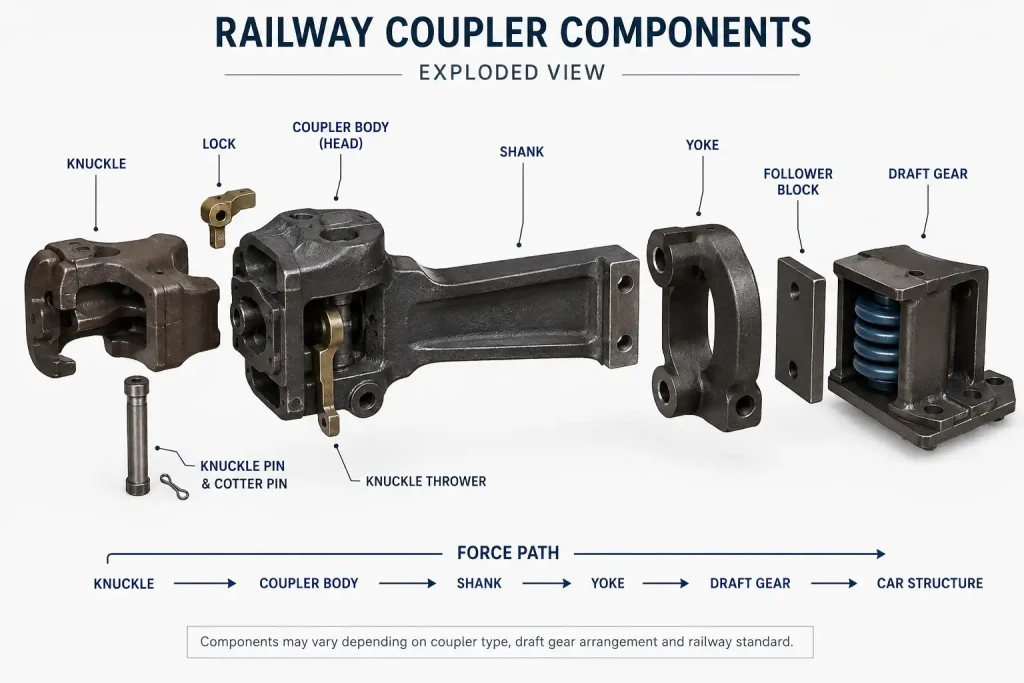
A railway coupler is not one part. It is a chain of cast steel components, each with one job, that together carry every tonne of force between two railcars. The main railway coupler components are the knuckle, the coupler body and shank, the yoke, the draft gear, the follower block, and the pins and locks that hold them all in the right place.
This guide walks through each component, what it does, what it is made of, and what to look for when you are buying or inspecting railway coupler components.
Start with the knuckle, because it is the only component you can see doing its job from the trackside.
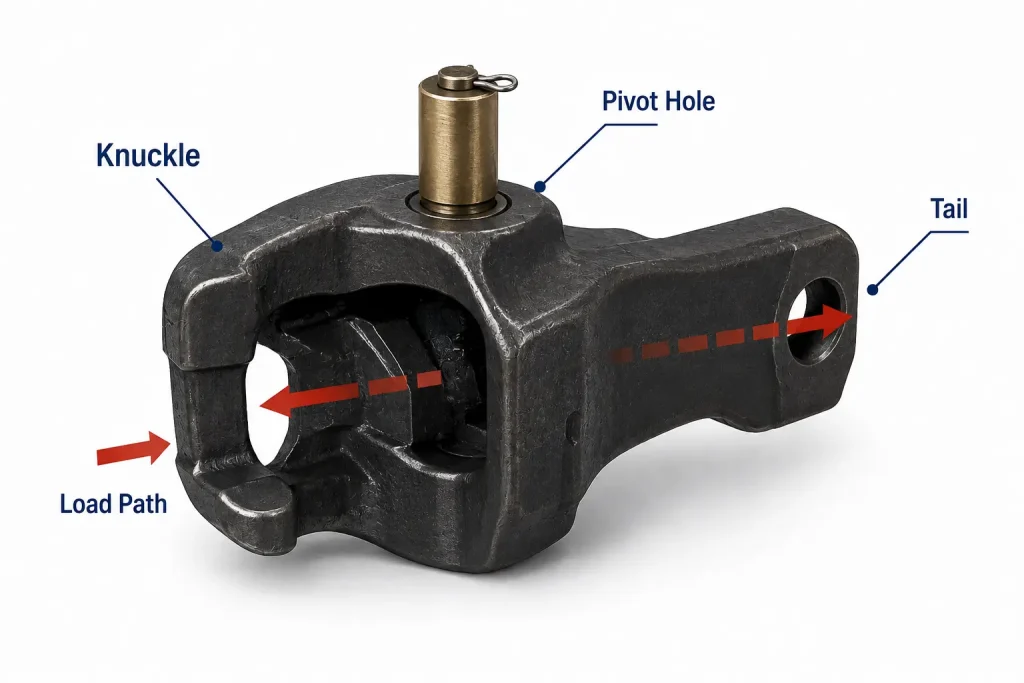
The knuckle is a pivoting, claw-shaped casting inside the coupler head. When two cars come together, the knuckle of one coupler swings open, engages the knuckle of the other, and swings shut again. The two interlock the way two hooked fingers do. Everything else in the system exists to support this one motion.
A knuckle is cast, not machined from bar. The hook profile has to be right, because that profile is what makes one railroad’s cars couple with another’s. In North America that profile is set by AAR standards, and a knuckle that does not match it will not couple reliably with the rest of the fleet.
Knuckles carry both draft and buff load, so the steel has to be tough as well as strong. AAR Grade E steel is the common material, chosen because it balances yield strength against fracture toughness. A knuckle that is too hard will crack; one that is too soft will deform. I have seen knuckles rejected at inspection because they were cast from the wrong grade to save cost, and the failure mode is never obvious until the part is loaded.
Across the whole set of railway coupler components, the knuckle is the one where material grade matters most, because it sits directly in the load path and takes every impact the train produces.
The knuckle pivots on a vertical pin. On its own that pin does not carry the longitudinal load, which passes through the knuckle tail into the body. But if the pin shears, the knuckle stops behaving, so pins are heat-treated for a hard surface over a ductile core.
The knuckle only works because it sits inside a coupler body that holds it and lets it pivot.
The coupler body is the heavy head at the end of the car. It carries the knuckle, the lock, and the operating mechanism. Behind the head, the shank runs back toward the car, and this is the beam that actually transmits the pulling and pushing forces from the connection into the vehicle.
Most people who are not familiar with couplers think the head does all the work. It does not. The head makes the connection; the shank carries the load. A shank is engineered as a beam because it sees millions of tension and compression cycles over its life, and fatigue is what kills it, not a single overload.
The shank ends in a butt, and the design of that butt matters more than it looks. Different butt designs load the connecting pin differently. A quad-shear butt, for example, puts the vertical pin in shear at four points rather than two, which is why it turns up on heavier service. This is the kind of detail that separates a coupler built for a switching yard from one built for a heavy-haul coal line.
Behind the coupler is where the components stop being visible from the trackside, and where most of the misunderstanding lives.
The yoke is a U-shaped steel casting that wraps around the draft gear and connects the coupler to the car’s center sill. When the locomotive pulls, the force passes from the knuckle through the body, down the shank, and into the yoke. The yoke then transfers it to the draft gear, which sits in a pocket in the car’s underframe.
Sitting between the coupler butt and the draft gear is the follower block, a rectangular steel plate. Its job is simple and easy to underrate: it distributes the compressive force evenly onto the draft gear instead of letting it concentrate at one point. If the follower is not flat, the load peens one spot and the draft gear wears unevenly. It is one of the cheapest components in the assembly and one of the first to be ignored.
In a cushioned car, the design changes. Some cushioned draft arrangements do away with the separate yoke and follower block entirely, because the cushioning unit handles the force path differently. So the presence of a yoke is not universal; it depends on the draft arrangement the car is built with.
If the knuckle is the component you can watch, the draft gear is the one you only ever feel the effect of.
The draft gear sits behind the follower, inside the center sill, and its entire purpose is to absorb the kinetic energy of cars starting, stopping, and being coupled. Without it, every coupler impact would transmit rigidly into the car body and, worse, into whatever the car is carrying.
Draft gears absorb energy in different ways depending on the design. Friction draft gears use steel friction plates that rub together and convert kinetic energy into heat. Spring and hydraulic designs use coil springs or fluid chambers to do the same job. Which one a car gets depends on the service: a heavy-haul car sees forces that a light switching car never will.
This is the component most buyers under-specify. The draft gear capacity has to match the train forces the car will actually see, and a draft gear that is too light for the service will bottom out and beat the car structure to death over time. Of all the railway coupler components, it is the easiest to overlook because it is the one you never see working.
The four main castings get the attention, but the small parts decide whether the system works day to day.
The lock is a steel block that drops into place behind the knuckle once it is closed. Gravity does the work, and that is the whole safety story of the automatic coupler: the lock falls, and the connection holds without anyone standing between the cars. The knuckle thrower is the internal lever that pushes the knuckle open during uncoupling, and the lock lift is the linkage that lifts the lock so the knuckle can release.
None of these are optional. A coupler with a good body, a good knuckle, and a worn lock will open in service, and the result is a parted train. When I review a coupler, the small parts are what I check first, because they are cheap and they are where a saving turns into a failure.
If you are buying these components rather than making them, a few checks separate a real supplier from a trading desk. Railway coupler components are safety parts, and the way you buy them should reflect that.
First, the material and the standard. North American coupler components are made to AAR standards, and AAR M-201 and M-211 cover the castings and the purchase and acceptance requirements. Ask for the grade, not just “cast steel.” Grade E is common for knuckles and bodies, but the specification has to match the service.
Second, the traceability. A coupler is a safety part, and a mill certificate with a heat number that you can tie back to the casting matters more than a good price. If the heat number on the certificate does not match the marking on the part, walk away.
Third, the inspection. Good suppliers magnetic-particle or ultrasonic-test the critical load paths on knuckles, yokes and bodies. A supplier who cannot show you an inspection record for a load-bearing casting is telling you something about how seriously it takes the part.
What are the main components of a railway coupler?
The main railway coupler components are the knuckle, the coupler body and shank, the yoke, and the draft gear. Around them sit the follower block, the knuckle pin, the lock, the knuckle thrower, and the lock lift linkage. Each has one job, and the force passes through them in sequence.
What does the knuckle do?
The knuckle is the pivoting, claw-shaped part that interlocks with the knuckle on the next car. It is the component that actually makes the connection, and everything else in the coupler supports that one motion.
What is the difference between the coupler and the draft gear?
The coupler makes the connection and transmits force. The draft gear sits behind the coupler, inside the car’s center sill, and absorbs the shock of starting, stopping and coupling so the force is cushioned before it reaches the car body.
What is a coupler yoke?
The yoke is a U-shaped steel casting that wraps around the draft gear and connects the coupler to the car. It is the link that transfers the pulling and pushing forces from the coupler shank into the draft gear and the car’s underframe.
What material are coupler components made from?
The load-bearing castings, like the knuckle and the body, are typically cast from AAR Grade E steel, chosen for a balance of strength and fracture toughness. The exact grade and heat treatment depend on the service the coupler will see.
What is the follower block for?
The follower block is a steel plate between the coupler butt and the draft gear that spreads the compressive load evenly onto the draft gear. If it is not flat, the load concentrates and the draft gear wears unevenly.
Do all couplers have a yoke?
Not always. Cushioned draft arrangements can do away with the separate yoke and follower block because the cushioning unit handles the force path differently. So whether a yoke is present depends on the draft arrangement the car was built with.
A railway coupler looks like one heavy casting from the trackside, but it is a chain: the knuckle interlocks, the body and shank carry, the yoke transfers, the draft gear absorbs, and the small parts hold it all shut. Remove any link and the train parts or the car structure gets beaten to death. Get the railway coupler components right, and the whole system works for decades without anyone noticing it is there.
Whether you are speccing coupler components for a new build or replacing worn parts in a maintenance cycle, the material grade and the traceability matter as much as the geometry. Both have to be right before the car goes back into service.
At FONYO, we manufacture railway casting products including coupler bodies, knuckles and yokes. If you are matching components to a coupler you are not certain about, send us the drawing or an existing sample before you request a quotation, and we will confirm the grade, the standard and the inspection record against it first.