Scan the WeChat code to contact us
Scan the WeChat code to contact us
Feel free to send us a email and we will reply to you as soon as possible.
Creating the future with heart and soul


If you’ve spent time on a railway track, you’ve probably noticed that the rail doesn’t just sit on the sleeper. Something holds it down, keeps it aligned, and stops it from creeping under the weight of passing trains. That “something” is the railway track fastening system—and after years of working with railway components, I’ve come to think of it as the most underrated part of track design.
I’ve seen tracks where the rails, sleepers, and ballast were all specified correctly, but the fastening system was treated as an afterthought. Clips loosened within months. Pads deformed and lost their stiffness. Fish bolts backed off under vibration. The track looked fine from a distance, but the maintenance records told a different story.
So if you’re looking for a quick answer: a railway track fastening system is the assembly of components—rail clips, rail pads, fish plate bolts, fish plates, and insulators—that secures the rail to the sleeper, maintains gauge, absorbs dynamic loads, and preserves track circuit insulation. Getting it right means matching every component to the axle load, traffic type, climate, and maintenance capability of the railway. Getting it wrong means premature wear, loose rails, and a maintenance bill that grows every year.
What follows is a practical guide of railway track based on what we’ve seen work—and fail—across freight, heavy-haul, metro, and industrial railways.
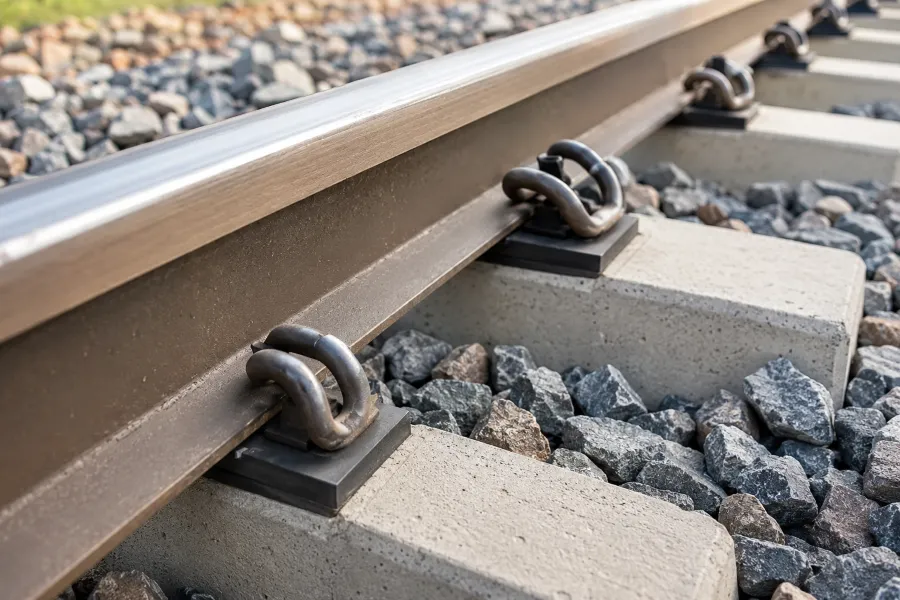
Most people think of a fastening system as “the thing that holds the rail down.” That’s true, but it’s only part of the story.
A well-designed fastening system does four jobs simultaneously. It holds the rail firmly against lateral and longitudinal movement, so the rail doesn’t shift under train forces or creep along the track. It transmits vertical loads from the rail into the sleeper, distributing pressure so the sleeper doesn’t crack under concentrated stress. It provides a controlled amount of resilience, absorbing dynamic impact and protecting both the sleeper and the ballast below. And on lines with track circuits, it maintains electrical insulation between the rail and the sleeper, so the signalling system works reliably.
When we review a railway track fastening system for a customer, the first question isn’t “which clip?”—it’s “what’s the axle load and what sleeper are you using?” The system has to work as a whole. A clip that performs well on a concrete sleeper with an elastic pad may behave completely differently on a timber sleeper with a steel baseplate.
None of these jobs can be compromised without consequences. I’ve visited industrial railways where the operator couldn’t understand why sleepers were cracking under the rail seat after only three years. The rails were fine. The sleepers were fine. The rail pads had gone flat, and the clips had lost their toe load. The fastening system had quietly stopped doing its job.
A railway track fastening system isn’t one product. It’s several components working together, and each one can become the weakest link.
Rail clips are the primary holding force. Elastic clips—such as E-clips, SKL clamps, or Pandrol-type V fasteners—use spring steel to maintain a consistent downward force on the rail foot. They’re designed to flex under dynamic load and return to position, which is why they’re preferred over rigid bolts for modern track. The key parameter isn’t just the clip type; it’s the toe load it maintains over time. A clip that loses its preload after a few years of traffic isn’t holding anything.
Rail pads sit between the rail and the sleeper, spreading load and absorbing impact. The pad has to match the axle load, the sleeper type, and the climate. A pad that’s too soft bottoms out and stops protecting the sleeper. A pad that’s too stiff transmits impact straight through, which accelerates sleeper damage and can even affect railway wheel contact dynamics.
Fish plates (joint bars) connect rail sections at joints. On continuously welded rail they’re less common, but they’re still essential at insulation joints, expansion joints, and maintenance cuts. The way fish plates are installed and maintained has a direct effect on joint failure rates, if you want to know more about the installation of fish plate, you can read this article Fish Plates for Crane Rails: Selection & Installation Guide
Bolts and washers hold the system together. Fish bolts, clip bolts, anchor bolts—they all look simple, but their torque, material grade, and anti-loosening design matter more than most people expect. We’ve seen fish bolts back out within months because the wrong washer was used or the torque wasn’t re-checked after the first few weeks of traffic.
Insulators keep the rail electrically separate from the sleeper where track circuits are used. They’re small, inexpensive, and easy to overlook—until a cracked insulator causes a track circuit failure and a signal goes red for no apparent reason.
One of the most common questions we hear from buyers is:”Which standard should our railway track fastening system meet?”
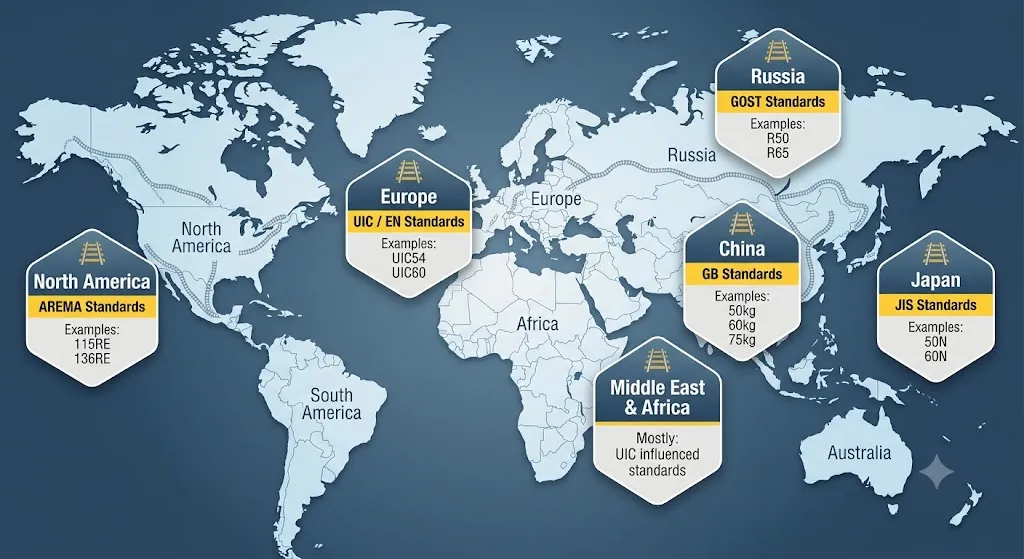
The answer depends on where the railway is and what type of traffic it carries. There isn’t a single universal standard, but several are widely recognised.
European railways commonly reference EN 13146 and EN 13481, which define test methods and performance requirements for fastening systems. These standards cover clip stiffness, fatigue resistance, attenuation of impact, and long-term performance under repeated loading. They’re detailed, and for good reason—a fastening system that passes these tests has been pushed hard in the lab before it ever sees a train.
North American railways typically follow AREMA specifications, which take a different approach. AREMA chapters cover track structure design, including fastening requirements for timber and concrete sleepers, with a strong emphasis on field experience and operating practice.
UIC standards are used by many international railways, particularly for interoperability across borders. Chinese standards (TB/T) define fastening requirements for domestic networks and some export projects.
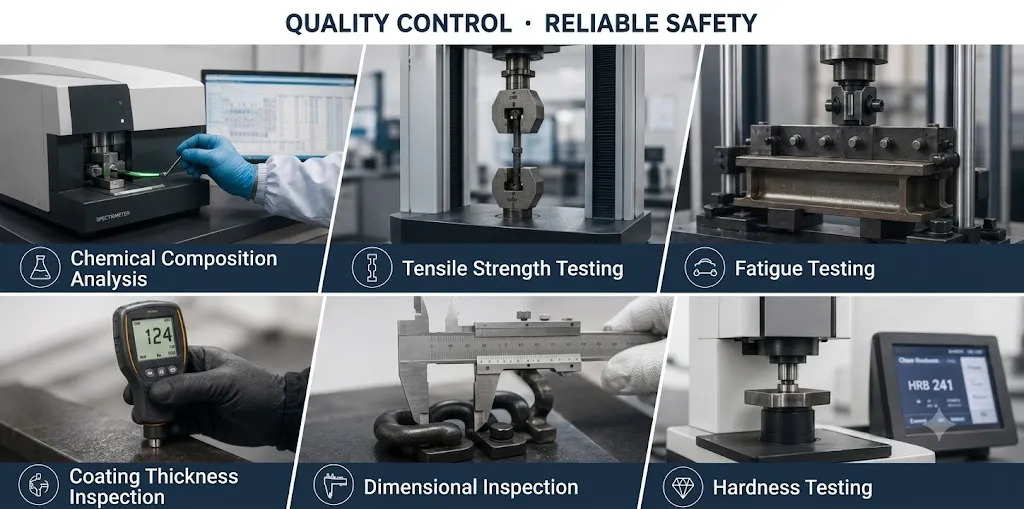
In practice, the worldwide standard matters less than whether the supplier can actually prove compliance. We’ve reviewed quotations where the fastening system was listed as “EN compliant” but no test reports were attached. A standard on paper without test data is a promise, not a guarantee. When sourcing fastening components, ask for the actual reports—fatigue test results, stiffness measurements, dimensional inspection records—not just a certificate number on a quotation sheet.
This is where many projects go wrong, because selection often starts with the wrong question.
The wrong question is: “Which clip type should we use?”
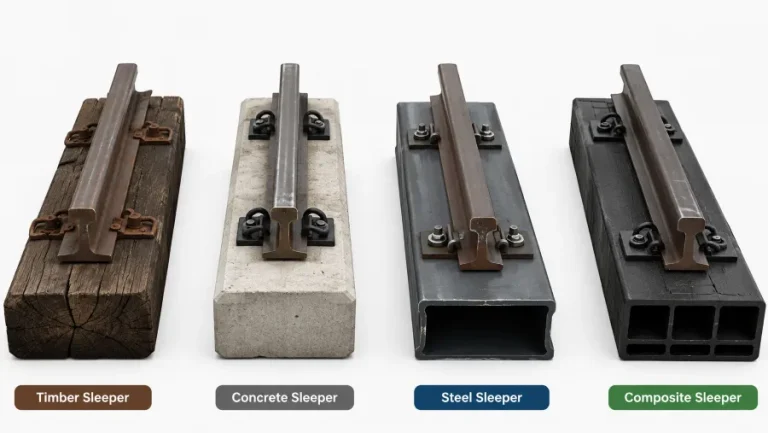
The right starting point is the operating environment. What axle load will the track carry? Is it heavy-haul freight, mixed traffic, high-speed passenger, or industrial shunting? What sleeper type—concrete, timber, or steel? What climate—does the track see extreme cold, desert heat, or coastal humidity? Is there a track circuit, and what insulation resistance is required?
In heavy-haul projects, customers often ask us if they can save money by using a standard clip instead of a heavy-haul rated one. Sometimes the answer is yes, if the traffic volume is moderate and the curves are gentle. But on a 35-tonne axle load line with tight curves, the saving per clip disappears quickly when you’re re-tightening or replacing loosened clips every six months.
The selection process should flow from the track to the system, not the other way around. Start with the axle load and sleeper type, determine the required toe load and pad stiffness, then select components that meet those requirements. The railway track fasteniing system is only as reliable as its weakest component—and the weakest component is usually the one that was chosen based on price.
For buyers, the practical checklist is straightforward. Confirm the clip type and toe load rating. Check the pad material, stiffness grade, and temperature range. Verify the bolt grade and anti-loosening design. Ensure insulators meet the track circuit’s insulation resistance requirement. And request test reports for every component—not just a blanket “compliant” statement that could mean almost anything.
After years of inspecting track, I’ve noticed that fastening failures tend to follow predictable patterns.
Clip loosening is the most common. Elastic clips lose toe load over time due to vibration, plastic deformation of the pad, or wear at the clip-sleeper interface. The rail starts to move slightly under traffic, which accelerates wear on everything around it. On curves, loosened clips can lead to gauge widening—a serious safety concern that’s far cheaper to prevent than to fix.
Pad failure takes several forms. Pads can crack, deform permanently, or lose stiffness through ageing and temperature cycling. When a pad fails, the load distribution changes, and the sleeper takes more punishment than it was designed for. We’ve seen concrete sleepers crack prematurely because the pads had gone flat and nobody noticed until the next inspection cycle.
Bolt loosening at fish joints and fastening bases is insidious because it’s hard to detect visually. A bolt that has lost a significant portion of its torque looks the same as one that’s properly tightened. Torque audits and ultrasonic testing catch it; a walk-by inspection usually doesn’t.
Insulator cracking causes track circuit failures and, if left unaddressed, can lead to corrosion of steel components where the insulation has failed.
The pattern I keep seeing is that failures don’t happen in isolation. A pad that goes flat leads to clip loosening. A loosened clip leads to rail movement. Rail movement leads to bolt loosening and gauge drift. The fastening system is a chain, and one weak link accelerates the wear of every other component around it.
A good fastening system isn’t maintenance-free. But good maintenance can make a mediocre system last years longer than a neglected premium one.
The most effective practices are simple but consistent. Regular visual inspection catches obvious problems: missing clips, cracked insulators, displaced pads. Torque audits on fish bolts and anchor bolts catch loosening before it becomes critical. Ultrasonic testing of bolts detects internal cracks that visual inspection will never find. And periodic measurement of track gauge and rail cant reveals whether the fastening system is still holding the rail in the correct position—or whether it has gradually drifted.
We’ve visited railways where maintenance teams extended railway track fastening system life by years without changing a single component type—just by tightening, cleaning, and replacing individual parts before they failed. The difference wasn’t the product. It was the discipline.
One thing I’ve learned is that fastening maintenance should be planned, not reactive. Waiting for a clip to fall out before replacing it means the adjacent clips have already been overloaded. A planned maintenance cycle—where clips, pads, and insulators are inspected and replaced on a schedule based on traffic volume—costs less in the long run than emergency repairs and unplanned track closures.
After years around track projects, one thing has become clear: the fastening system is rarely the most expensive part of the track, but it’s often the part that determines whether the track performs or fails.
Rails and sleepers get specified carefully because they’re expensive and visible. The fastening system sits between them, doing the hardest work—holding everything together under millions of loading cycles—and too often it’s selected by default rather than by design.
The questions that matter are the ones that define your track. What axle load? What sleeper type? What traffic volume? What climate? What insulation requirement? Answer those, and the component choices become clear.
At FONYO, we manufacture elastic rail clips, rail pads, fish plates, fish bolts, and complete fastening system components for freight, heavy-haul, passenger, metro, and industrial railways. We help customers specify the system that fits the track—not just the components that fit a catalogue.
Because in railway engineering, the right fastening system is the one that’s still holding the rail in the correct position when the rest of the track is ready for its next maintenance cycle.
The main components are rail clips (or elastic fasteners), rail pads, fish plates (joint bars), bolts and washers, insulators, and in some systems, baseplates. Each component has a specific function—holding force, load distribution, insulation, or joint connection—and all must work together for the system to perform reliably under traffic.
Inspection frequency depends on traffic volume and axle load. Heavy-haul and high-speed lines usually require more frequent inspections than light industrial tracks. Most operators combine regular visual inspections with periodic torque audits, gauge measurements, and ultrasonic testing of critical bolts to detect loosening and wear before they become safety risks.
Elastic fastening systems use spring-steel clips that flex under dynamic load and return to position, maintaining consistent toe load on the rail. Rigid systems use bolts or clamps that hold firmly but don’t absorb dynamic impact. Elastic systems are generally preferred for modern track because they reduce impact transmission and maintain holding force over a wider range of operating conditions.
Common standards include EN 13146 and EN 13481 (European), AREMA (North American), UIC (international), and TB/T (Chinese). These standards define requirements for clip stiffness, fatigue resistance, insulation, dimensional tolerances, and testing methods. The applicable standard depends on the railway’s location, operator requirements, and traffic type.
Rail clips can loosen due to vibration, plastic deformation of the rail pad, wear at the clip-sleeper contact point, or fatigue of the spring steel. High axle loads, tight curves, and inadequate maintenance all accelerate the process. Once a clip loses its toe load, the rail begins to move, which accelerates wear on adjacent components and can lead to gauge widening on curves.
Yes. In most elastic fastening systems, individual clips, pads, and insulators can be replaced without dismantling the entire assembly. This is one of the advantages of elastic systems over rigid bolted designs. However, replacement parts should match the original system specification—mixing clip types or pad stiffnesses within the same track section can create uneven performance.
Each clip type has strengths depending on the application. SKL clamps offer high toe load and are common on heavy-haul and high-speed lines. E-clips provide reliable holding force with relatively simple installation. Pandrol-type V fasteners are widely used for their ease of installation and maintenance. The choice should be based on axle load, sleeper type, maintenance capability, and compatibility with existing track—rather than on brand preference alone.