Отсканируйте код WeChat, чтобы связаться с нами.
Отсканируйте код WeChat, чтобы связаться с нами.
Не стесняйтесь, отправьте нам электронное письмо, и мы ответим вам как можно скорее.
Создаем будущее сердцем и душой


При содержании и ремонте тяжеловесных железных дорог, шлифовка рельсов – очень важная задача. Зачем нужна шлифовка рельсов? This is because the service life of rails is directly related to rolling contact fatigue cracks and rail wear. Fatigue cracks affect the running state of wheels and rails, increase maintenance costs, shorten the service life of rails, and even cause rail breaks. Rail wear, especially the side wear of the upper rail on curves, can lead to rapid rail damage.
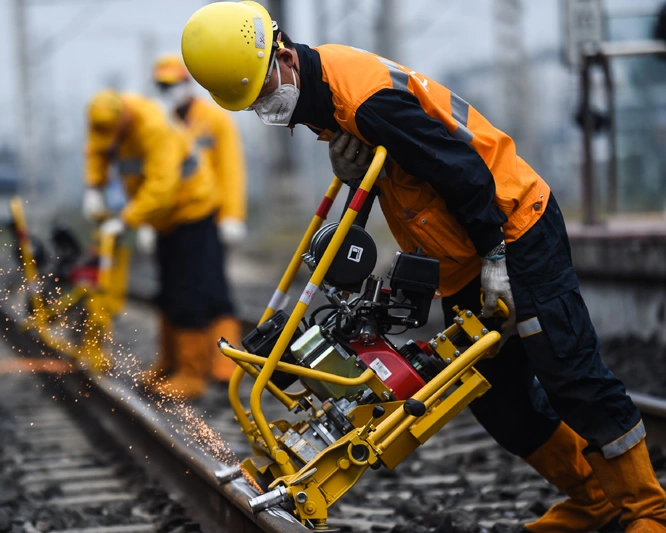
To slow down the development of rolling contact fatigue and wear damage between rails and wheels and extend the service life of rails, modern rail maintenance and repair technologies must be adopted. В настоящее время, rail grinding (фрезерование) technology is widely used by heavy-haul railways around the world as the main means to alleviate rolling contact fatigue and wear damage of rails.
Проще говоря, after a period of use, rails will develop problems such as side wear, wave wear, hidden rail defects, rail cracks, rail flanges, and scratches, losing their standard “я” форма. All these are signs of rail “illness”, which disrupts the optimal rail profile, alters the wheel-rail contact state, increases wheel-rail noise, accelerates the deterioration of vehicle and track components, and exacerbates the further spread of rail damage.
After the rail wears down, it can no longer maintain its optimal profile. The cure for this is to perform a kind of “surgical operation” on the rail-rail grinding. Rail grinding essentially involves cutting the surface of the rail to remove defects and restore it to its optimal profile.
The more severe the rail damage, the greater the amount of cutting required, the larger the workload, the greater the difficulty, and the shorter the rail’s lifespan. Поэтому, corrective grinding and restorative grinding are like “treating diseases”, while the best approach is to prevent the rail from “falling ill”, то есть, to carry out regular preventive grinding to eliminate damage in its nascent stage. The reason why preventive grinding is good is that it does not require a large amount of rail cutting, generally controlled within 0.1 to 0.2mm. Сюда, it can extend the rail’s lifespan without a large amount of cutting, making it the most economical and effective method.
(1) Corrective grinding, also known as restorative grinding, with each grinding amount ranging from 0.5 to 4.6mm;
(2) Transitional grinding, which aims to transform the corrective grinding system into a preventive or periodic grinding system;
(3) Preventive grinding or periodic grinding, which only requires the removal of a small amount of metal, 0.2 to 0.3mm, and is the most economical and effective;
(4) Special grinding to achieve a specific rail cross-section shape and a smooth rail contact surface. To achieve the best quality of rail grinding, the grinding method is usually determined based on multiple factors such as the line grade of the operation section, transportation capacity, target rail cross-section, pre-grinding rail condition, grinding cycle, and block time.
According to the maintenance and repair practices of heavy-haul railway lines in various countries around the world, among the four types of grinding operations, preventive grinding has the highest cost-effectiveness. Настоящее время, preventive rail grinding technology has become an indispensable part of heavy-haul railway line maintenance and repair. According to statistical data, in Canada, the use of rail grinding technology can extend the lifespan of rails in curved sections by 2.2 times and in straight sections by 3 к 4 раз; in the United States, experiments have shown that preventive grinding technology reduces the annual rail damage rate by 65% compared to corrective grinding; in Australia, the use of preventive grinding technology can extend the rail lifespan by 50% к 58%.
Regular preventive grinding of rails can extend their lifespan by 5 к 8 годы, improve train operation, maintain passenger comfort, reduce hunting motion, lower noise, reduce energy consumption, and decrease the maintenance costs of locomotive components and tracks, resulting in both economic and social benefits. Research shows that when the micro-cracks on the rail do not exceed 0.2mm, preventive grinding is the best time to stop the accelerated deterioration trend of the rail.
Sliding shoe grinding involves pressing a grinding stone against the rail and moving it back and forth to remove the surface layer of the rail. This grinding method can only grind the rail head longitudinally, cannot adjust the rail profile, and cannot grind turnouts. Более того, it is relatively slow and is gradually being phased out. Grinding wheel grinding typically uses a high-speed rotating grinding wheel driven by an electric motor or hydraulic motor to grind the rail. This is an active grinding method and is currently the main grinding method. Milling grinding is a new type of rail profile restoration operation mode. The milling cutters are installed on the radial surface of the milling wheel, and each milling section has several milling cutters. There are several milling sections in one rotation of the milling wheel, and all the milling cutters together form the required rail head profile.
On railways, the rail head rolling surface is usually ground by grinding machines or grinding cars to eliminate surface irregularities and surface defects of the rail, thereby restoring the rail head profile to its original design shape, slowing down the further development of surface defects, improving the smoothness of the rail surface, and achieving the goals of enhancing passenger comfort, reducing wheel-rail noise, and extending the rail’s lifespan. In addition to small-scale rail grinding tools, the major large-scale rail grinding equipment currently available in China mainly includes the GMC-96x rail grinding train, the CMC-20 rail grinding car (switch grinding car), the GMC-96b rail grinding train, and the PGM-48 rail grinding train etc. Each type of equipment has its unique capabilities and advantages.
Лоянская компания Fonyo Heavy Industries Co., ООО, основана в 1998 году, является производителем деталей для железнодорожного литья.. Наша фабрика занимает площадь 72 600 кв.м., с более чем 300 сотрудники, 32 техники, включая 5 старшие инженеры, 11 помощники инженера, и 16 техники. Наша производственная мощность составляет 30,000 тонн в год. В настоящее время, в основном мы производим литье, механическая обработка, и сборка для локомотива, вагон, высокоскоростные поезда, горное оборудование, энергия ветра, и т. д..
Мы поставляем железнодорожные детали для CRRC(в том числе более 20 филиалы и дочерние компании CRRC), Гемак инженерное оборудование, Санигрупп, Ситик Хэви Индастриз, и т. д.. Наша продукция экспортируется в Россию., Соединенные Штаты, Германия, Аргентина, Япония, Франция, ЮАР, Италия и другие страны мира.
Контактная информация:
Электронная почта:[email protected]
мобильный:008615515321683