Scan the WeChat code to contact us
Scan the WeChat code to contact us
Feel free to send us a email and we will reply to you as soon as possible.
Creating the future with heart and soul


When you first look at a railway wheels, it seems almost too simple to be important. Just a steel wheel rolling on a steel rail.
But there is one small feature that makes the entire railway system safe and stable — the wheel flange.
So why do railway wheels have flanges? And why is this detail so critical in rail engineering?
Let’s walk through it in a simple, practical way.
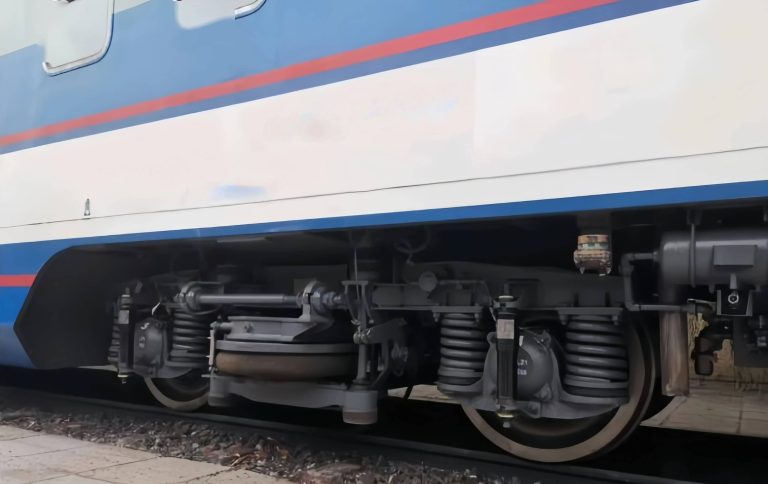
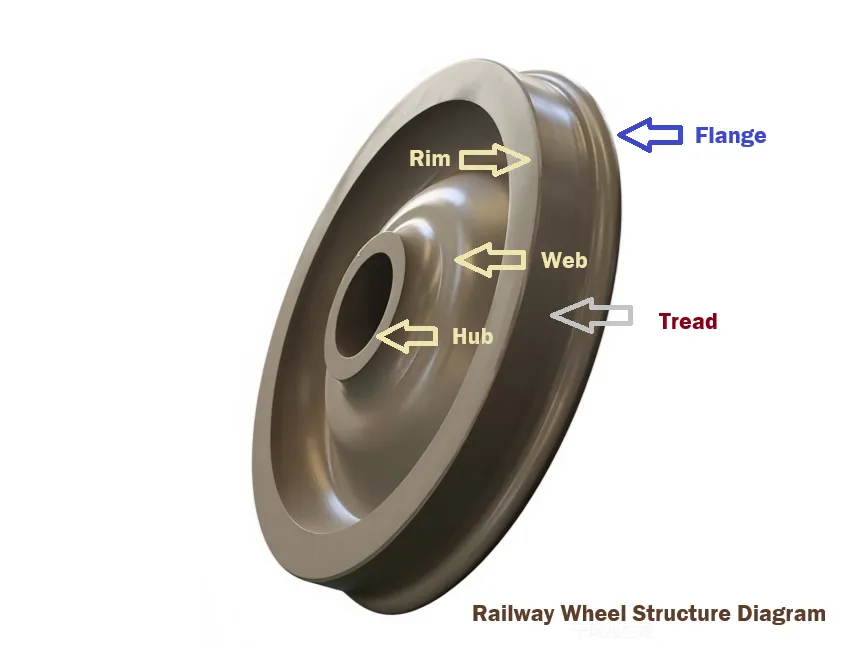
The railway wheel flange is the inner raised edge of a wheel.
If you look at a wheel from the inside, you’ll see a slightly thickened rim that stands higher than the running surface. That is the flange.
A standard railway wheel usually has three main parts:
In most railway systems, including freight wagons and passenger trains, the flange is always located on the inside of the track.
It looks simple, but its role is extremely important.
The short answer is:
👉 to keep the wheel safely guided on the rail track
But in real railway engineering, the reason is more detailed than just “preventing derailment.”
Let’s break it down.
Rail transport involves extremely heavy loads and continuous vibration.
Even a small lateral movement can become a safety risk.
This is where the train wheel flange plays its most important role.
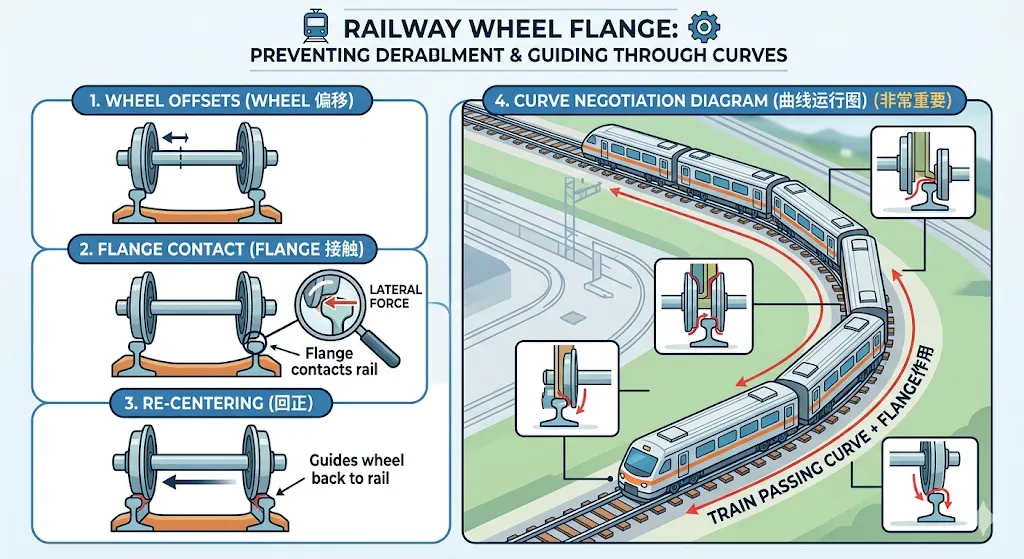
If the wheel starts moving sideways, the flange will:
So instead of the wheel “falling off” the track, the flange acts like a physical safety boundary.
This is the main reason why railway wheels have flanges in almost all rail systems in the world.
Railways are not straight lines. They include many curves, switches, and junctions.
When a train enters a curve, the wheelset experiences strong lateral forces.
In this situation, the flange helps by:
However, the flange is not constantly pushing against the rail. It only becomes active when needed.
This is why railway engineers describe it as a “guidance safety feature” rather than a driving contact surface.
To understand the flange properly, we need to look at how a wheel actually runs on a rail.
In normal conditions:
These conditions include:
So in reality, a railway wheel is designed for rolling contact on the tread, not continuous flange contact.
This is a key point many people misunderstand.
Railway tracks are not perfect. Over time, even well-maintained rail systems may have:
The rail wheel flange design provides a built-in safety margin.
Even when conditions are not ideal, the flange ensures:
This is especially important in heavy freight and industrial rail systems.
A common question is:
👉 “If one flange is good, wouldn’t two be safer?”
The answer is no — not for railway systems.
If both sides had flanges:
That’s why standard railways use a single flange design.
However, double flange wheels do exist — but mainly in industrial systems (we’ll explain this later).
Railway wheel design is actually a balance between:
The flange is carefully designed so that:
This balance is what makes modern railway systems efficient and reliable.
Without a flange, the wheel would lose its lateral guidance system.
This could lead to:
In short, rail transport would become unreliable and unsafe.
That’s why the wheel flange is considered an essential safety component, not an optional feature.
Most railway systems use single flange wheels, but industrial applications sometimes use double flange wheels.
We explain this in detail in another article:
But here is the simple difference:
In industrial environments, double flanges help provide extra lateral stability because:
The railway wheel flange design is widely used in many industries, such as:
No matter the application, the purpose is always the same:
👉 safe, stable, guided movement on rails
In real operation, the flange can gradually wear out due to occasional contact with rails.
Common causes include:
That’s why railway operators regularly inspect:
Proper maintenance ensures long service life and safe operation.
For industrial users, choosing the right material (cast or forged steel) also affects flange durability significantly.
So, why do railway wheels have flanges?
Because they provide a simple but powerful safety mechanism that keeps trains guided on the track under all real-world conditions.
The flange is not always working, but when it is needed, it plays a critical role in:
Without it, modern rail transport would not be as reliable, efficient, or safe as it is today.
Because the rail itself already provides lateral guidance on the outer side. The inner flange is enough to keep the wheel aligned and prevent derailment while still allowing smooth movement on curves.
No, they don’t. In normal operation, only the wheel tread is in contact with the rail. The flange only touches the rail during tight curves, lateral movement, or abnormal track conditions.
The main purpose is to guide the wheel along the rail, improve stability during operation, and prevent derailment when lateral forces occur.
Because they act as a mechanical safety barrier. Even if the wheel starts to move sideways due to load or track conditions, the flange helps keep the wheelset within the rail gauge.
Without a flange, the wheel would have no lateral guidance. This increases the risk of derailment, especially in curves or under heavy load conditions.
In industrial applications like cranes or material handling systems, double flange wheels are used to provide extra stability because tracks may not be perfectly aligned and loads are often heavier.
The tread is the main surface that carries the load and rolls on the rail. The flange is the inner guiding edge that only engages when lateral movement occurs.
Yes. Flanges can wear over time due to curve negotiation, heavy loads, and track conditions. That’s why regular inspection and maintenance are important in railway operations.
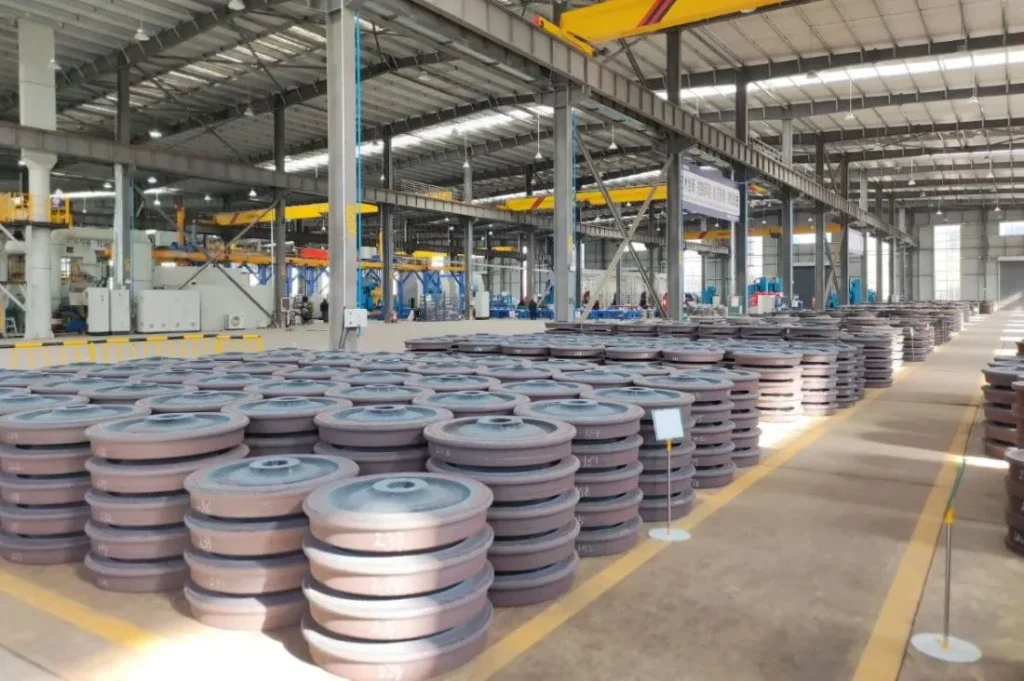
At Luoyang Fonyo Heavy Industries Co., Ltd., we specialize in manufacturing high-quality railway wheels for industrial and heavy-duty applications.
Our products include:
Our wheels are widely used in railway systems, mining equipment, steel plants, and industrial material handling systems.
If you are looking for a reliable supplier of railway wheels, we are ready to support your project.
👉 Website: www.railwaypart.com
We look forward to working with you.