Scan the WeChat code to contact us
Scan the WeChat code to contact us
Feel free to send us a email and we will reply to you as soon as possible.
Creating the future with heart and soul


Railway bogies are among the most important structural systems in modern rail vehicles. Whether used in freight wagons, passenger coaches, metro trains, or heavy-haul locomotives, bogies support vehicle loads, guide wheelsets, absorb track irregularities, and ensure safe operation under demanding service conditions.
A railway bogie is more than just a wheel-supporting structure. It is an integrated system consisting of side frames, bolsters, axle box housings, suspension components, braking elements, and various structural parts that work together to maintain stability, ride quality, and operational safety.
Because these components operate under continuous dynamic loading, impact forces, and long-term fatigue cycles, their design, material selection, manufacturing processes, and inspection procedures must meet strict engineering requirements.
This guide explains the key railway bogie and running gear components, the materials commonly used in their production, the casting manufacturing, machining, and heat treatment processes behind their performance, and the quality inspection control measures required to ensure reliability throughout their service life.
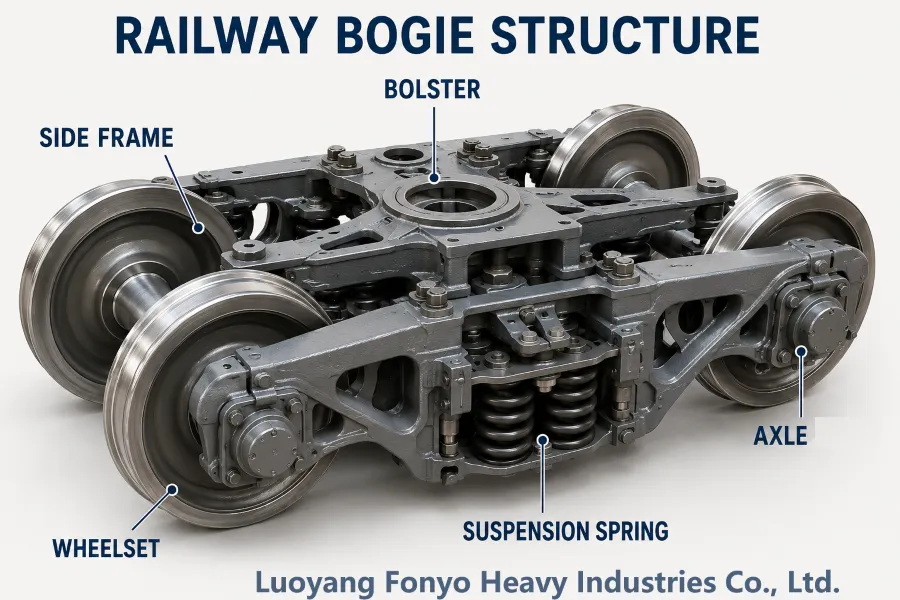
The bogie is the wheel-mounted chassis located beneath a rail vehicle. Its primary functions include supporting vehicle weight, transmitting traction and braking forces, guiding wheelsets along the track, and reducing vibration generated during operation.
Depending on the vehicle type, a bogie may include:
Suspension systems
Brake beams
Structural brackets and supports
Together, these components form the running gear system responsible for maintaining safety, stability, and ride comfort.
For a detailed overview of how these components interact, see How Railway Parts in Running Gears Ensure Safety, Stability, and Smoothness.
Why Railway Bogie Structures Must Withstand Extreme Loads
Railway bogie components operate under some of the most demanding loading conditions in the rail industry. Unlike static structural components, bogie structures experience: Continuous cyclic loading, Dynamic impact forces, Braking and traction loads, Curving forces Wheel-rail interaction stresses, and Long-term fatigue loading
In heavy-haul freight operations, a single bogie may support axle loads exceeding dozens of tonnes while remaining reliable over millions of kilometers of service.
This is why structural integrity, fatigue resistance, and material toughness are critical engineering considerations.
Learn more in Why Railway Bogie Structures Can Carry Extreme Loads Without Collapsing.
Material selection directly affects the strength, toughness, fatigue life, wear resistance, and service reliability of railway bogie components.
For critical load-bearing parts such as side frames, bolsters, and axle box housings, medium-carbon cast steel remains one of the most widely used materials because it offers an excellent balance between strength and toughness.
Read more:
Where Is Medium Carbon Cast Steel Used in Railway Industry?
Manganese in Railway Cast Steel: Properties and Role
In some applications, ductile iron may also be used for selected railway and industrial components where good castability, vibration damping, and cost efficiency are required.
Further reading:
Ductile Iron Castings in Heavy Industry: Advantages and Applications
Steel vs. Ductile Iron: Choosing the Right Materials for Reliable Railway Parts
Material performance is also strongly influenced by microstructure, grain size, alloy composition, and heat treatment processes, all of which play an important role in long-term fatigue resistance.
Large railway bogie castings require precise control throughout the manufacturing process.
Production typically involves:
Among these stages, casting quality is particularly important because internal defects can significantly affect structural performance and service life.
Related resources:
Railway Bogie Side Frame Casting: Process, Challenges and Defect Control
How to Produce Excellent Bogie Side Frames and Bolsters
The Complete Guide to Railway Castings
Modern foundries may utilize different molding technologies depending on casting size, complexity, and quality requirements.
Additional resources:
V Process Casting: Process, Advantages and Applications
What Is Lost Foam Casting and Its Applications in Railway and Heavy Equipment Parts
Sand Casting for Railway: Water Glass vs. Furan Resin – What Actually Works
High-quality castings alone cannot guarantee long-term railway performance.
Heat treatment is essential for achieving the mechanical properties required by railway standards and customer specifications.
Proper heat treatment helps improve: strength, toughness ductility, fatigue resistance and structural stability of casting bogie parts.
The final microstructure of the material plays a decisive role in crack resistance and long-term reliability.
Recommended reading:
1. Why Heat Treatment Is Essential for Reliable Railway Castings
2. Heat Treatment of Railway Castings: Process, Purpose and Quality Control
3. Inside Industrial Castings: Why Austenite and Heat Treatment Matter in Railway Cast Steel
4. Why Grain Size Matters in Steel Castings for Railway Parts
5. Understanding Ferrite–Pearlite Balance in Ductile Iron for Railway and Wind Power
After casting and heat treatment, railway bogie components must undergo precision machining to achieve the dimensional accuracy required for assembly and long-term operation.
Railway bogie components require tight tolerances to ensure proper fit and reliable load transfer. Because even small dimensional deviations will affect bearing performance, wheelset alignment, suspension behavior, as well as the fatigue life and maintenance intervals of railway parts.
For large structural components, machining quality is often as important as casting quality itself.
Further reading:
1. High-Precision Machining for Railway Components: Engineering Approach to Quality and Efficiency
2. Why Precision Machining Matters for Railway Parts
3. Machining Tolerances: What Runout, Surface Finish and Specs Really Mean
Railway bogie components are classified as safety-critical parts because their failure can directly affect vehicle stability and operational safety.
As a result, manufacturers implement comprehensive inspection procedures throughout production, from raw material verification to final dimensional inspection.
Non-destructive testing helps identify internal and surface defects without damaging the component.
Common inspection methods include Ultrasonic Testing (UT), Magnetic Particle Testing (MT) and Visual Testing (VT)
Each method is designed to detect different types of discontinuities and plays an important role in ensuring structural integrity.
Recommended reading:
1. UT vs MT: What’s the Difference in Railway Component Inspection?
2. Exploring the Three Major Non-Destructive Testing Techniques for Railway Casting Parts
Mechanical properties are closely linked to microstructure.
Manufacturers often perform metallographic analysis to verify grain structure, phase distribution, and heat treatment effectiveness.
Further reading:
Modern railway components require strict dimensional control.
Coordinate measuring machines (CMM), precision gauges, and advanced machining inspection systems are commonly used to verify critical dimensions and geometric tolerances before shipment.
Producing high-quality railway bogie components requires controlling numerous variables throughout casting, heat treatment, machining, and inspection.
Several manufacturing challenges can directly affect structural reliability.
Large steel castings are particularly susceptible to shrinkage defects during solidification.
Proper feeding design and process control are necessary to achieve sound internal structures.
Related article:
Shrinkage and Feeding in Railway Castings: How Molten Metal Behaves During Solidification
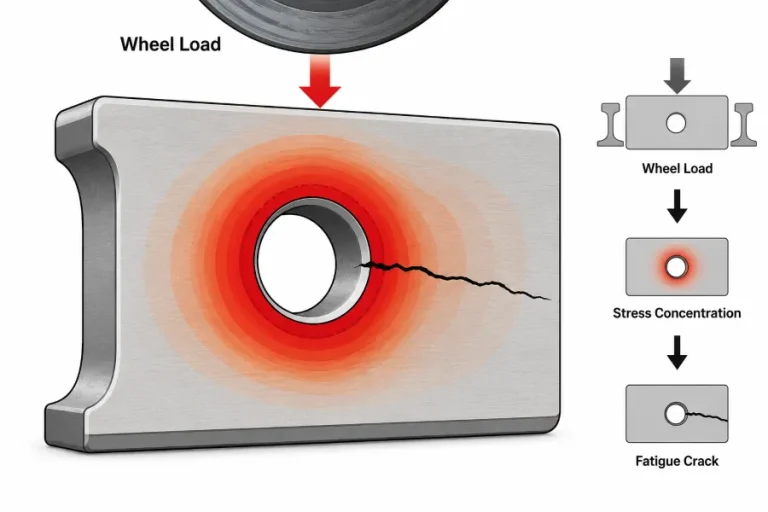
Rapid cooling, uneven section thickness, and improper heat treatment can generate residual stresses that increase cracking risk.
Related article:
Surface defects may affect inspection results, machining efficiency, and fatigue performance.
Related article:
What Affects the Surface Quality of Steel Castings? A Practical Guide
Successful bogie manufacturing depends on preventing defects rather than correcting them after production.
Related article:
A Practical Guide to Solve Defects in Railway Castings
Railway bogie components must comply with strict technical standards that define material properties, dimensional tolerances, testing requirements, and acceptance criteria.
Depending on the target market and application, manufacturers may need to meet requirements from AAR standards, EN standards, AREMA standards, TB/T standards, or some customer specific specifications.
These standards ensure that components can withstand demanding railway service conditions while maintaining safety and interchangeability.
Recommended reading:
1. Standards and Engineering Practice for Railway Side Frames and Bolsters
2. Interpreting EN, AREMA and GB Compliance Requirements for Railway Accessories Under Global Standards
A bogie is not just a supporting structure beneath a rail vehicle. It is a core system that directly affects safety, stability, ride comfort, and long-term operating cost. From the frame and suspension to the braking interface and wheelset interaction, every component must work together under continuous dynamic loads and harsh service conditions.
At FONYO, we focus on the manufacturing quality of key bogie components, including bogie frames, side frames, bolsters, and other structural castings. With controlled materials, precise machining, and strict inspection processes, we aim to ensure consistent performance under real railway operating environments.
If you are sourcing reliable bogie components or looking for a manufacturing partner for custom railway castings, feel free to contact our engineering team for technical discussion and quotation support.