Scannez le code WeChat pour nous contacter
Scannez le code WeChat pour nous contacter
N'hésitez pas à nous envoyer un email et nous vous répondrons dans les plus brefs délais.
Créer l'avenir avec cœur et âme


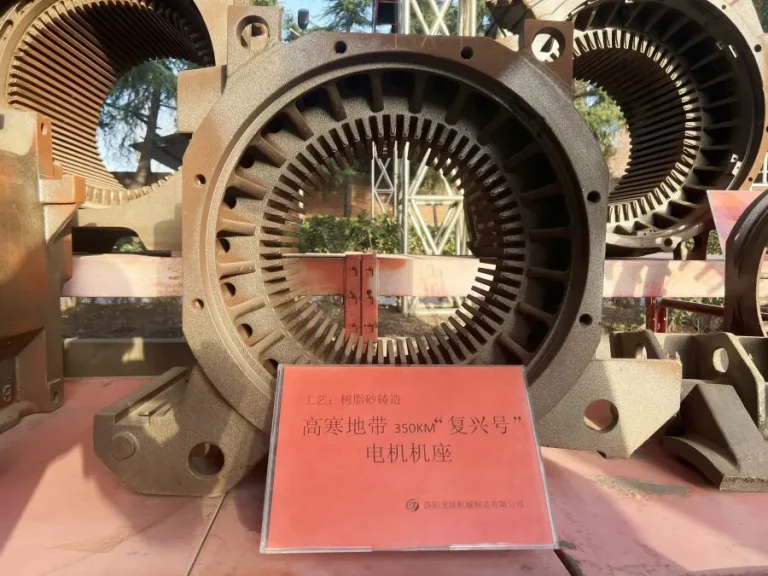
Le moulage au sable enduit a une longue histoire dans le domaine de la fonderie et produit un grand nombre de pièces moulées; cependant, when producing precision pièces en acier moulé using castable sand casting, many problems arise: sticking (scabbing), cold separation, and air holes. How to solve these problems remains to be further explored.
1.1 Characteristics of castable sand: It has suitable strength performance; good fluidity, resulting in clear contours of the sand mold and core, dense structure, capable of manufacturing complex cores; the surface quality of the sand mold (cœur) is good, with surface roughness reaching Ra = 6.3 – 12.5 µm, dimensional accuracy reaching CT7 – CT9 grade; good collapsibility, and the castings are easy to clean.
1.2 Application scope: Castable sand can be used to make both molds and cores; the mold or core made of castable sand can be used either in combination or in conjunction with other molds (cores); it can be used not only for gravity casting or low-pressure casting of metals, but also for iron mold castable sand casting, and for hot centrifugal casting; it can be used not only for the production of cast iron and non-ferrous alloy castings, but also for the production of cast steel parts.
2.1. Castable sand is generally composed of refractory materials, binders, curing agents, lubricants, and special additives.
(1) Refractory materials are the main component of castable sand. The requirements for refractory materials are: high refractoriness, low volatiles, relatively round particles, and solid. En général, natural washed silica sand is selected. The requirements for silica sand are: high SiO2 content (for cast iron and non-ferrous alloy castings, it should be greater than 90%, for cast steel parts, it should be greater than 97%); the clay content should not exceed 0.3% (it is washed sand); [the clay content of water-washed sand is stipulated to be less than; the particle size 1: is distributed among 3 – 5 sieve sizes; the particle shape is round, the angular factor should not be greater than 1.3; the acid consumption value is not less than 5 ml.] (2) Binders are generally phenolic resin.
(3) Curing agents are usually urotropine; lubricants are generally calcium stearate, which functions to prevent the castable sand from caking and increase fluidity. The main role of additives is to improve the performance of castable sand.
(4) Basic composition and ratio of castable sand: Component Ratio (mass fraction, %) Explanation: Raw sand 100 Washed sand, phenolic resin 1.0 – 3.0 accounting for the weight of raw sand, urotropine (2% aqueous solution) 10 – 15 accounting for the weight of resin, calcium stearate 5 – 7 accounting for the weight of resin, additifs 0.1 – 0.5 accounting for the weight of raw sand. 1: 2) 10 – 15 accounting for the weight of resin, calcium stearate 5 – 7 accounting for the weight of resin, additifs 0.1 – 0.5 accounting for the weight of raw sand.
2.2. Production process of castable sand
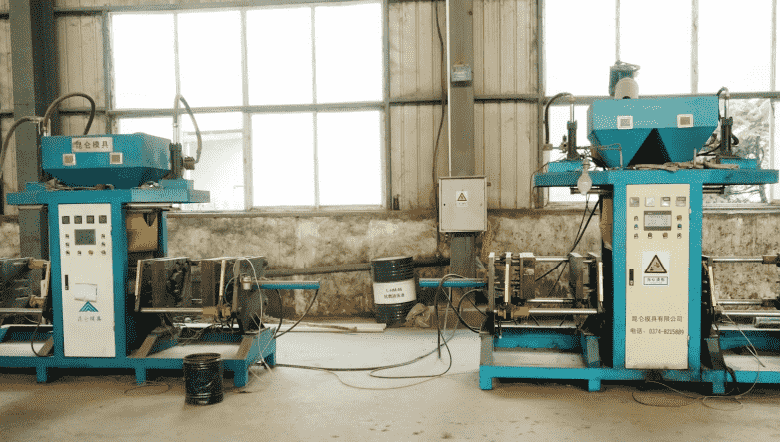
The production process of castable sand mainly includes cold casting, warm casting, and hot casting. Actuellement, the production of castable sand almost all adopts the hot casting method. The hot casting process is to heat the raw sand to a certain temperature, then mix and stir with resin, urotropine aqueous solution, and calcium stearate, respectivement, and then cool, crush, and sieve. Due to differences in the formula, the mixing process is also different. Actuellement, there are many types of castable sand production lines in China, with about 2000 – 2300 semi-automatic lines using manual feeding and about 50 fully automatic lines using computer control, which have effectively improved production efficiency and product stability. Par exemple, the automated visual production line of the casting company, its feeding time is controlled precisely to 0.1 secondes, the heating temperature is controlled precisely à 1/10 °C, and it can observe the mixing state of the sand at any time through video, with a production efficiency of 6 tons per hour.
3.1 Ordinary castable sand Common coated sand, also known as traditional coated sand, is usually composed of quartz sand, thermoplastic phenolic resin, urotropine, and calcium stearate. It does not contain any additives. The resin content is usually relatively high under certain strength requirements, and it does not possess the characteristics of high temperature resistance, low expansion, and low gas generation. It is suitable for the production of castings with low requirements.
3.2 High-strength Low-gas Release Coated Sand
Caractéristiques: Haute résistance, low expansion, low gas generation, slow gas generation, oxidation resistance. Introduction: High-strength low-gas release coated sand is an updated product of common coated sand. By adding relevant characteristics, “additifs,” and adopting new formulation techniques, the resin dosage is significantly reduced. Its strength is more than 30% higher than that of common coated sand; the gas generation is significantly reduced, and the gas generation speed can be slowed down, which can better meet the needs of casting production. This type of coated sand is mainly suitable for the production of cast iron parts, medium and small-sized cast steel, and alloy cast steel parts. Actuellement, this type of coated sand has three series: GD-1 high-strength low-gas release coated sand; GD-2 high-strength low-expansion and low-gas release coated sand; GD-3 high-strength low-expansion and low-gas release oxidation-resistant coated sand.
3.3 High-temperature-resistant (Class) Sable enduit (ND Type)
Caractéristiques: High temperature resistance, haute résistance, low expansion, low gas generation, slow gas generation, easy disintegration, oxidation resistance. Introduction: High-temperature-resistant coated sand is a new type of coated sand with excellent high-temperature performance (high strength at high temperatures, long heat resistance time, small thermal expansion, low gas generation) and comprehensive casting performance. This type of coated sand is particularly suitable for the production of complex thin-walled precision cast iron parts (such as automotive engine blocks, cylinder heads, etc.) and high-quality cast steel parts (such as container corners, train brake buffers, middle shell parts, etc.), which can effectively eliminate casting defects such as sticking, déformation, fissuration thermique, and gas pores. Actuellement, this coated sand has four series: VND-1 high-temperature-resistant coated sand; ND-2 high-temperature-resistant low-expansion and low-gas release coated sand; ND-3 high-temperature-resistant low-expansion and low-gas release oxidation-resistant coated sand; ND-4 high-temperature-resistant high-strength low-expansion and low-gas release coated sand.
3.4 Easily Disintegrating Coated Sand
It has good strength and excellent low-temperature disintegration performance, suitable for the production of castings.
3.5 Other Special Requirements Coated Sand
To meet the needs of different products, a series of special coated sands have been developed, such as centrifugal casting coated sand, rapid cooling coated sand,wet-coated sand, anti-sticking sand,anti-pulse lines,anti-peeling coated sand, etc.
Luoyang Fonyo Heavy Industries Co., Ltée,fondée en 1998, est un fabricant de pièces moulées ferroviaires. Notre usine couvre une superficie de 72 600㎡, avec plus de 300 employés, 32 techniciens, y compris 5 ingénieurs supérieurs, 11 ingénieurs adjoints, et 16 techniciens. Notre capacité de production est 30,000 tonnes par an. Actuellement, nous produisons principalement du moulage, usinage, et montage pour locomotive, wagon, trains à grande vitesse, équipement minier,énergie éolienne,etc..
Nous sommes la fourniture de pièces ferroviaires au CRRC(dont plus de 20 succursales et filiales de CRRC),Machines d'ingénierie Gemac,Groupe Sany, Industries lourdes Citic,etc.. Nos produits ont été exportés vers la Russie, les États-Unis, Allemagne, Argentine, Japon, France, Afrique du Sud,Italie et autres pays du monde.