Scannez le code WeChat pour nous contacter
Scannez le code WeChat pour nous contacter
N'hésitez pas à nous envoyer un email et nous vous répondrons dans les plus brefs délais.
Créer l'avenir avec cœur et âme


Railway rails are manufactured through a multi-stage process: high-carbon steel is smelted in a BOF or EAF, vacuum-degassed to remove hydrogen, continuously cast into blooms, reheated to around 1250°C, hot-rolled through universal mills into the standard rail profile, heat-treated for head hardness, straightened, finished, and ultrasonically inspected. Each stage affects the rail’s strength, résistance à l'usure, and fatigue life in service.
To most people, un chemin de fer looks like a simple piece of steel. En réalité, producing a reliable rail requires strict control over metallurgy, rolling temperature, traitement thermique, and inspection at every stage. Get one of those stages wrong, and you’ve created a rail that might fail in five years instead of thirty.
En ingénierie ferroviaire, factors such as steel cleanliness, grain structure, and residual stress determine fatigue performance and service life. These properties cannot be judged by appearance alone and require proper testing and documentation.
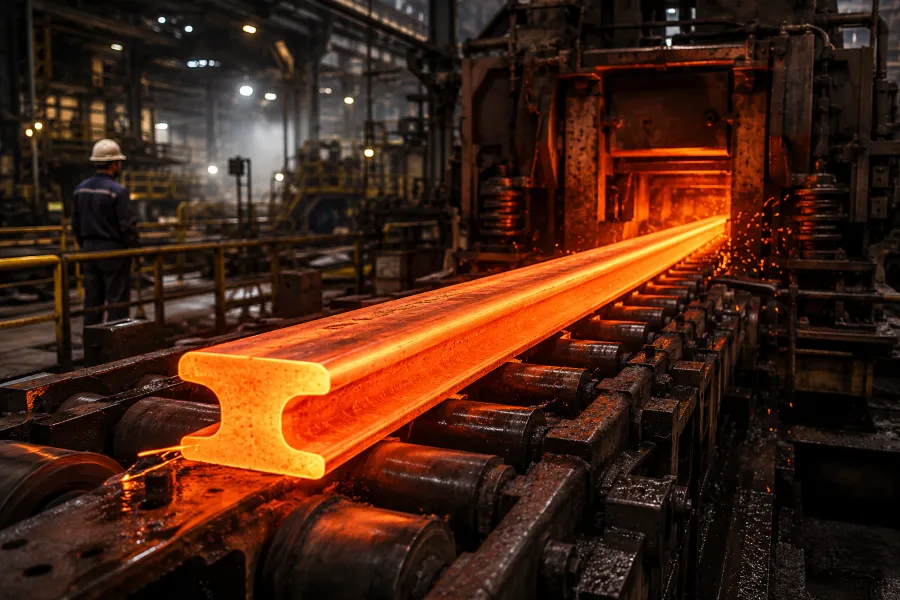
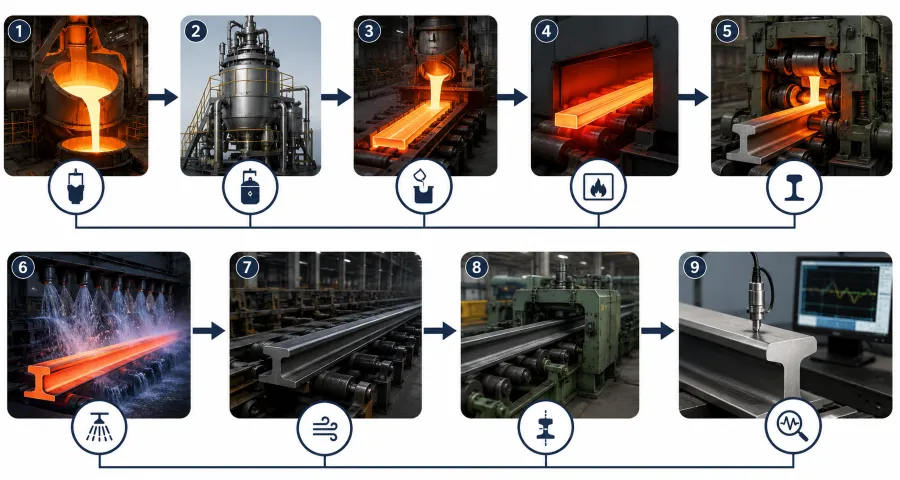
This railway rail manufacturing process covers every stage from steel production and bloom casting through rolling, traitement thermique, finition, to final inspection.
Steel Making (BOF / EAF) →Vacuum Degassing (Hydrogen Removal) →Continuous Casting (Bloom Formation) →Bloom Reheating (~1250°C) →Universal Rolling (Head / Web / Foot Forming) →Traitement thermique (Head Hardening) →Controlled Cooling & Straightening →Finishing & Marking →NDT Inspection (Utah + Eddy Current)
Choosing a reliable railway rail manufacturer is about more than checking final product dimensions. Understanding this complete rail manufacturing process helps procurement teams evaluate whether a supplier truly controls rail quality from steelmaking through to final inspection—not just at the shipping dock.
Rail steel isn’t like structural steel. It’s high-carbon, typiquement 0.45 à 0.60% carbon with 0.70 à 1.20% manganèse. That chemistry gives the rail its hardness and wear resistance—the properties that let it survive millions of wheel passes from railway wheels without grinding away.
The common grades you’ll encounter depend on which market you’re sourcing from. In Chinese manufacturing, U71Mn and U75V are widely used. European standards define grades like R260, R320, and R350HT. North American railways reference AREMA specifications. These grading systems follow different classification logic—European R-grades indicate minimum tensile strength levels defined by EN standards, while Chinese U-grades follow their own alloy-based naming convention. What matters for procurement isn’t memorizing every grade name, but understanding that higher strength generally means harder rail—and harder rail involves trade-offs in brittleness and weldability.
People sometimes ask whether harder is always better. It depends on the application. Fret lourd? You want maximum wear resistance. Metro curves? Sometimes a slightly softer rail wears more evenly and actually lasts longer because it doesn’t develop surface spalling under the combination of high axle load and tight radius.
The steelmaking stage is where most quality problems either get prevented or created.
Depending on the steelmaking route, rail steel may be produced through a Basic Oxygen Furnace (BOF) using hot metal from blast furnaces, or an Electric Arc Furnace (EAF) using recycled steel scrap and direct reduced iron. Both routes can produce quality rail steel—the key is what happens after the initial melt.
What separates rail steel from ordinary construction steel is what comes next. The molten steel goes through vacuum degassing (or an equivalent secondary metallurgy process). This step removes dissolved hydrogen and oxygen from the steel. Hydrogen is the dangerous one—if it stays in the solidified steel, it causes internal defects known as hydrogen flakes (also called hydrogen-induced cracking), which can lead to sudden rail failure months or even years after installation.
In modern rail production, hydrogen content is typically controlled to very low levels—often below a few ppm depending on the applicable rail standard (DANS 13674, AREMA, GB/T 2585, or JIS E 1101) and the specific steel grade. Oxygen content is similarly controlled during secondary metallurgy. These aren’t values you can verify by looking at the finished rail. You need the mill test certificate, and you need to know which standard that certificate references.
The degassed steel is then continuously cast into blooms—large rectangular sections, typically around 280×380 mm. These blooms become the raw material for the rolling stage.
This is the core of the manufacturing process.
The bloom goes into a reheating furnace and comes out at around 1250°C. Then it passes through a series of rolling mills—roughing, intermediate, and finishing—that progressively shape it into the familiar rail profile consisting of the head, la toile, et le pied.
Rail rolling is genuinely complex. Unlike rolling a simple flat bar, the rail has three distinct sections that each need different amounts of mechanical work. The head needs to be dense and hard—it’s the running surface where wheel-rail contact happens millions of times. The web needs to be thin but strong—it connects head to foot and resists bending under vertical and lateral loads. The foot needs to be wide and stable—it distributes load onto the sleepers or baseplates. Getting all three right in a single pass sequence requires carefully designed grooved rolls and precise temperature control throughout.
Most modern rail mills use a universal mill for the final passes, which controls the head, la toile, and foot dimensions simultaneously. Dimensional accuracy after rolling is typically within ±0.5 mm. That precision matters because the rail has to match fish plates, clips de rail élastiques, baseplates, and other track components exactly—any deviation creates fitting problems downstream and can accelerate wear at the joint interface.
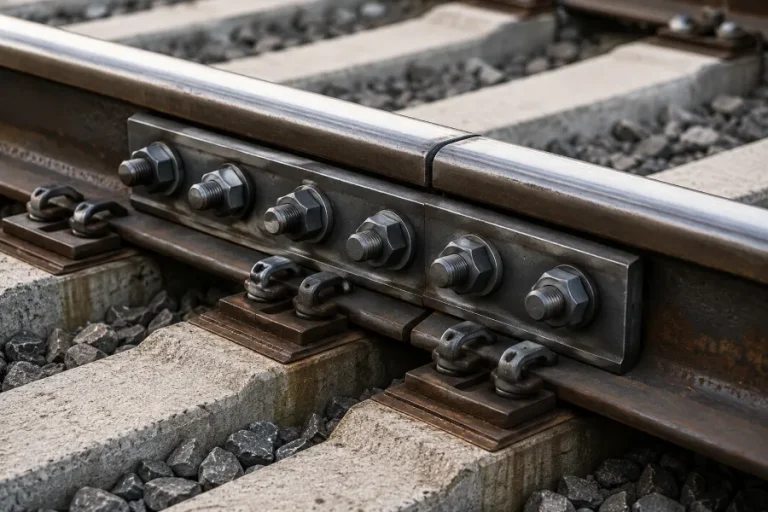
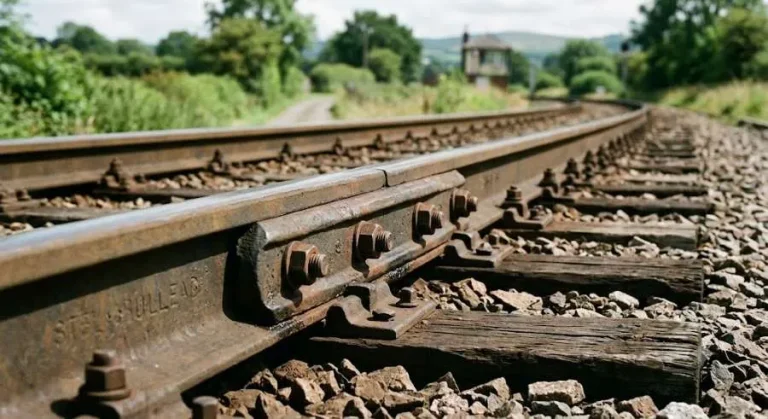
One thing that’s easy to overlook: the rolling process also refines the internal grain structure of the steel. Properly rolled rail has a fine, uniform grain that gives it toughness and fatigue resistance. Poorly rolled rail—too few passes, wrong temperature, worn rolls—has coarse or mixed grain that makes it brittle under repeated loading. You can’t see the difference from the outside. But it shows up in service, usually as premature fatigue cracking on the rail surface or at joint locations where rails connect with fish plates and other fastening components.
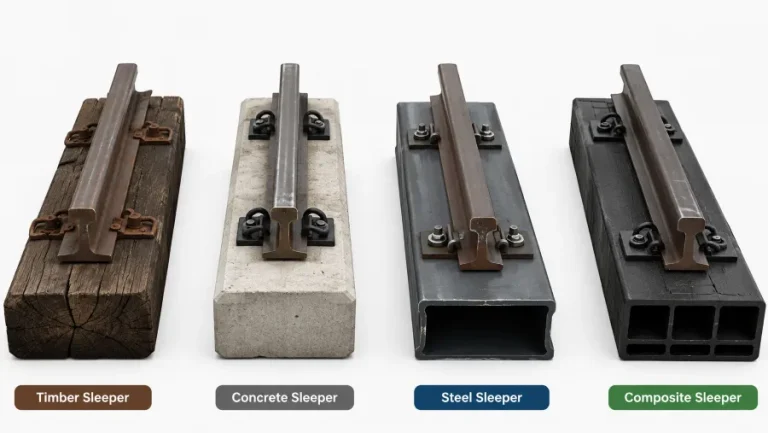
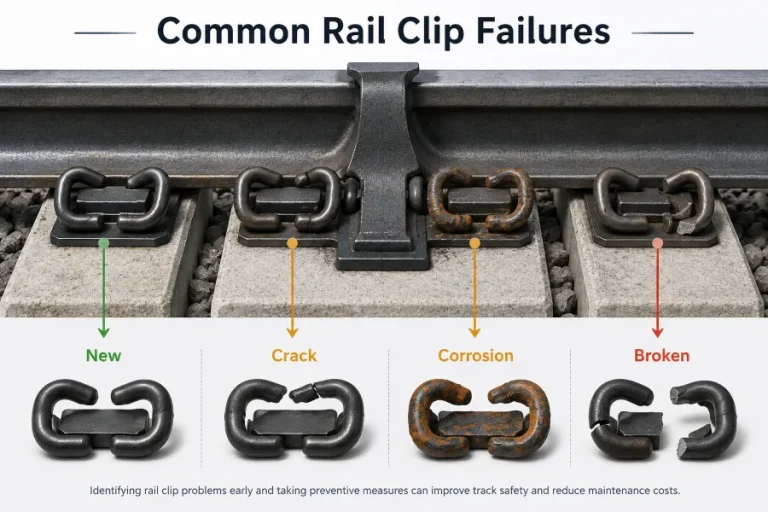
For railway component manufacturers and suppliers, this interdependency between rail quality and fastening components is worth noting. Rails don’t operate in isolation—they work together with railway wheels, assiettes à poisson, clips de rail élastiques, patins de rail, and other rail fastening components as a complete track system. A rail with dimensional deviation doesn’t just affect itself; it affects how well the entire system performs.
After rolling, the rail head—the running surface that contacts the wheels—gets hardened. This is the step that determines how long the rail will resist wear under traffic.
There are a few ways to do this. Online residual heat quenching uses the rail’s own retained heat from rolling, supplemented by induction heating, followed by controlled spray quenching. It’s efficient and increasingly common in modern mills. The traditional method is offline heat treatment—quenching and tempering in a dedicated facility after the rail has cooled to ambient temperature.
Head-hardened rails reach surface hardness of HB300 or higher. Rail grades such as R260 typically have a hardness level around HB260. For heavy haul applications with high axle loads, the difference in service life between the two can be substantial—head hardened rail can significantly extend service life depending on traffic conditions, charges par essieu, curve radius, and maintenance practices including grinding frequency.
The term “head hardened” is used loosely enough in the industry that procurement teams should pay attention. Suppliers should specify whether they use online quench-and-temper, offline quenching and tempering, or another dedicated heat treatment method—and provide actual hardness survey data across the rail cross-section, not just a single checkbox on a datasheet. When procuring head-hardened rail, request the heat treatment records and verify the guaranteed hardness values against whichever applicable standard governs your project.
Après traitement thermique, the rail goes onto a cooling bed. Controlled cooling is critical—if the rail cools too quickly or unevenly, internal stresses build up and can cause warping, camber, or delayed cracking. Many mills cool the rail upside down to counteract the natural tendency of the thicker head and thinner foot to cool at different rates and create differential contraction.
Once cooled, the rail goes through a roller straightener. This machine works the rail from both horizontal and vertical directions to achieve the straightness tolerance required by standard. For long rails—25 meters or more—maintaining straightness within spec across the full length is no small feat.
This is also where patience matters. When mills rush the cooling process to meet delivery deadlines, the result is rails with locked-in residual stress that causes progressive warping after installation. Not immediately. Weeks or months later. When the rail is already in the track, under load, and far more expensive to replace than it would have been at the mill.
Before a rail leaves the mill, it goes through several finishing operations that don’t always get discussed but matter for both installation and traceability.
The rail is cut to the ordered length—common lengths include 12m, 25m, and 100m for welded long-rail strings. End surfaces may be faced or drilled for bolt holes if the rail will be used in jointed track rather than continuous welded rail (CWR). Each rail then receives identification marking: grade designation (R260, U75V, etc.), melt number, manufacturer logo, and often year of production. These markings are typically rolled into the rail web or stamped on the end face—they stay visible throughout the rail’s service life and are essential for any future quality investigation.
Some special specifications may require additional surface conditioning or finishing operations before shipment to meet particular project requirements. For export orders, anti-corrosion coating and protective packaging are applied based on the destination climate and transit duration.
These finishing steps are worth mentioning in procurement discussions. A supplier who can’t tell you how their rails are marked, or who uses generic packaging for overseas shipments, may be cutting corners in areas that affect product traceability and site acceptance.
Every rail should go through ultrasonic testing and eddy current inspection before shipment. Ultrasonic testing catches internal defects—inclusions, vides, internal cracks. Eddy current testing catches surface defects and near-surface discontinuities that might not be visible to the naked eye.
The inspection stage is also where dimensional verification happens—rail height, head width, largeur du pied, épaisseur de l'âme, straightness, and twist. Rails that fall outside the tolerances defined in the applicable standard get rejected or downgraded to lower-spec applications.
But here’s something inspection records don’t always tell you: inspection only catches what it’s designed to catch. If the inspection parameters aren’t properly set for a specific defect type, or if the equipment isn’t calibrated correctly, certain defects can go undetected. That’s why leading rail mills invest heavily in both inspection technology and process control—they know that catching defects at the end is more expensive than preventing them during manufacturing.
For critical applications—high-speed lines, heavy haul mainlines, cold-region railways—some project specifications also require additional testing such as residual stress measurement, fracture toughness testing, or drop-weight tests. These go beyond routine NDT but provide extra confidence for demanding service conditions.
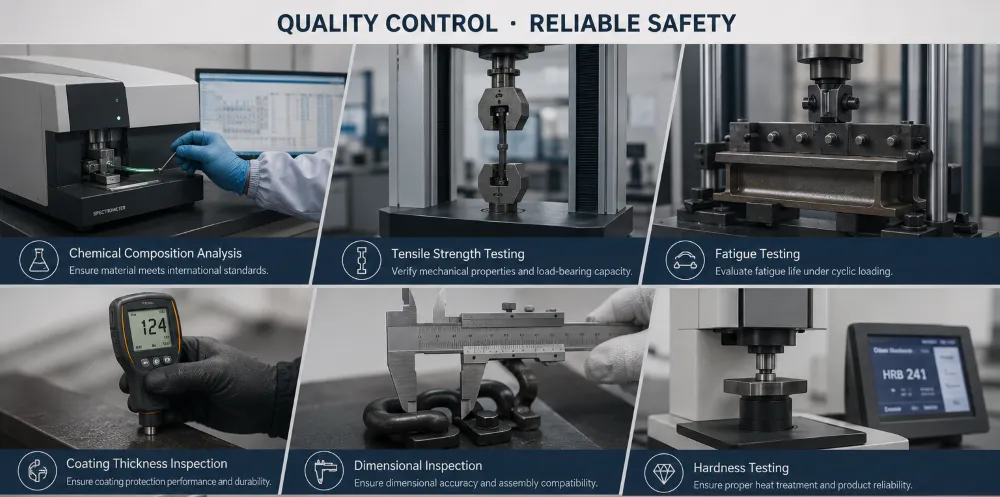
When evaluating a rail supplier, experienced procurement teams usually focus on more than just the unit price per ton. They want to understand how the steel was produced, how the rail was formed and treated, and what documentation backs up the quality claims.
Steelmaking and casting. Whether the route is BOF with blast furnace hot metal or EAF using scrap and DRI, what matters most is whether vacuum degassing (or equivalent secondary metallurgy) was performed. Request the mill test report showing chemical composition against the specified standard, and confirm that hydrogen and oxygen control was part of the process—not an optional add-on.
Rolling and heat treatment. Ask whether the mill uses a universal rolling mill for final passes, what heat treatment method is applied (online residual heat vs. offline quench-and-temper), and what hardness range is guaranteed. A supplier who can discuss these details confidently is usually one who actually controls the process.
Inspection and traceability. Full ultrasonic and eddy current inspection should be standard. Beyond that, request a sample inspection certificate to verify what parameters are recorded and what acceptance criteria are applied. Third-party inspection by an independent laboratory adds meaningful credibility—especially for projects where rail failure consequences are severe.
OIN 9001 certification is important and indicates a structured quality management system. But for railway procurement, it should be viewed alongside product-specific standards compliance—EN 13674, AREMA, GB/T 2585, or JIS E 1101—which tell you whether the actual rail meets recognized technical requirements for chemical composition, propriétés mécaniques, and inspection acceptance criteria.
A railway rail may look like a simple steel bar, but it is one of the most precisely engineered products in the steel industry. Every stage—from steelmaking and vacuum degassing through continuous casting, roulement, traitement thermique, refroidissement contrôlé, finition, and inspection—determines whether the rail will perform reliably for decades or fail prematurely in service.
Whether you’re specifying rails for a new line, sourcing replacements for maintenance, or evaluating suppliers for a long-term supply contract, understanding the complete manufacturing process is the foundation of informed procurement decisions. And when rails, roues de chemin de fer, and track fastening components work together as a complete railway system, the quality of each component affects the performance of the whole.
À Luoyang Fonyo Heavy Industries Co., Ltée., as a railway component manufacturer integrating casting, usinage, forger, and inspection capabilities, we supply roues de chemin de fer, track components—including rails, assiettes à poisson, clips de rail élastiques, patins de rail—and railway castings to freight railways, systèmes de métro, and industrial tracks worldwide. Our engineering team supports customers with material selection based on applicable standards (DANS, AREMA, GB/T, IL, CUI), manufacturing requirement specification, inspection documentation review, and customized railway solutions. If you’re unsure which rail grade matches your axle load, volume de trafic, and operating environment, we can help identify the correct specification.
Railway rails are made from high-carbon steel, typically containing 0.45–0.60% carbon and 0.70–1.20% manganese. Common grades include U71Mn and U75V (Chinese GB/T 2585), R260, R320, and R350HT (European EN 13674), and various AREMA grades for North America. High carbon content provides the hardness needed to withstand repeated wheel loading over millions of cycles.
Vacuum degassing removes dissolved hydrogen from molten steel during secondary metallurgy. Residual hydrogen causes internal defects known as hydrogen flakes (hydrogen-induced cracking), which can lead to sudden rail failure months or years later. Acceptable limits vary by standard and grade, but modern production consistently targets very low ppm levels verified on mill test certificates.
Standard rail (such as R260 at approximately HB260) receives basic rolling and normalizing. Head hardened rail undergoes additional thermal processing—online residual heat quenching or offline quenching and tempering—to produce a hardened surface layer (HB300+) on the rail head while maintaining a tougher core. This significantly improves wear resistance, making HH rail preferred for heavy haul, sharp curves, and high-traffic sections.
Rails undergo ultrasonic testing (Utah) for internal defects and eddy current testing (ET) for surface discontinuities. Dimensional checks cover height, head width, largeur du pied, épaisseur de l'âme, straightness, and twist. Critical applications may additionally require residual stress measurement, fracture toughness testing, or drop-weight tests per project specification.
Service life depends on accumulated MGT, charge par essieu, curve radius, and maintenance quality. On straight heavy haul track with proper maintenance: 20–30 years or 500–1000 MGT. In sharp curves with high axle loads: 5–10 years or 150–300 MGT. Head hardened rail and preventive grinding programs can considerably extend service life.
Railway rails are made from specialized high-carbon rail steel designed for repeated wheel loads, résistance à l'usure, fatigue strength, and strict dimensional tolerances. Ordinary structural steel—such as Q235 or A36—lacks the hardness, dureté, and cleanliness required to survive millions of wheel passes under heavy axle loads. Using structural steel as a substitute for rail steel creates a serious safety risk.
The main international standards areDANS 13674 (Europe — R260/R320/R350HT), AREMA (Amérique du Nord), GB/T 2585 (China — U71Mn/U75V), JUSTE E 1101 (Japon), etCUI 860-1 (international interchange). Each defines requirements for chemistry, propriétés mécaniques, dimensions, dureté, and inspection acceptance criteria. Always confirm which standard governs your project and request compliance documentation from the supplier.