Scan the WeChat code to contact us
Scan the WeChat code to contact us
Feel free to send us a email and we will reply to you as soon as possible.
Creating the future with heart and soul


In a typical production route, rolling takes place after forging and piercing, when the wheel blank still lacks its final geometry. At this stage, the railway wheel rolling process is responsible for transforming a rough preform into a near-finished component.
During rolling, the rim is gradually expanded to its target diameter while the tread and flange profiles are formed under controlled deformation. More importantly, the material is forced to flow along the circumferential direction. This directional flow is not just a geometric adjustment—it is fundamental to improving fatigue resistance and ensuring uniform mechanical properties throughout the wheel.
When the rolling process is properly controlled, it reduces machining allowance and enhances structural consistency. When it is not, the resulting issues often remain hidden until later stages.
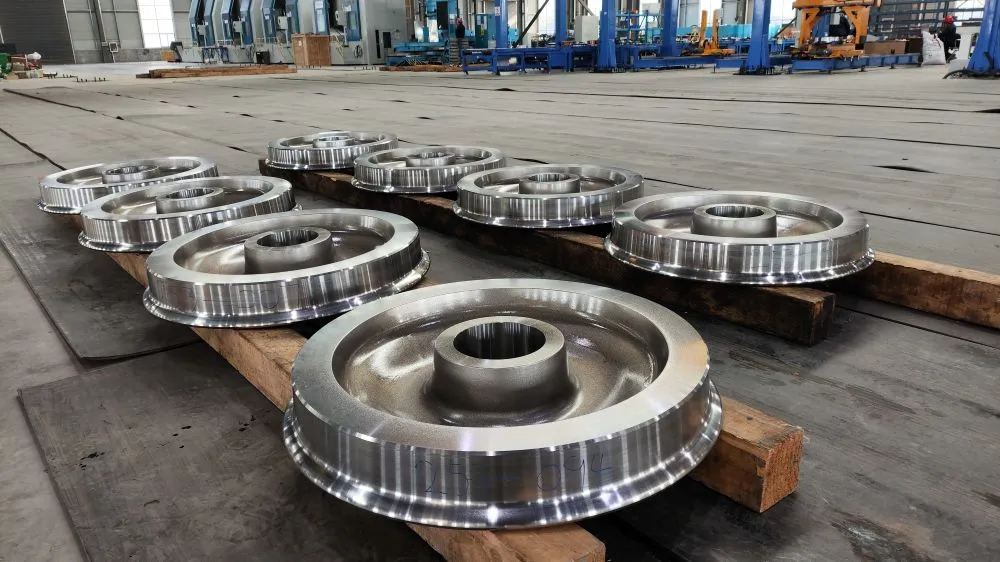
The forces involved in the railway wheel rolling process are substantial. If the rolling mill does not provide sufficient rigidity, part of the deformation will be absorbed by the machine itself rather than the workpiece. This leads to subtle but critical deviations in diameter, roundness, and flange geometry.
A rigid system ensures that deformation occurs exactly where it is intended. In practice, this is one of the most fundamental conditions for achieving stable and repeatable dimensional accuracy.
In earlier or less advanced setups, some rollers operate passively, relying on friction to rotate. However, in modern railway wheel rolling process systems, fully driven rollers are increasingly adopted.
This shift allows much tighter control over how the material flows during deformation. Instead of relying on indirect force transfer, the system actively manages rolling speed and contact conditions. As a result, slippage is reduced, and the material deforms more uniformly across the rim.
This is particularly important for maintaining consistency in both geometry and internal structure.
Rolling is performed at elevated temperatures, which places the rollers under constant thermal stress. If cooling is interrupted, even briefly, the roller surface may begin to degrade.
Over time, this can lead to thermal cracking or a reduction in surface hardness, both of which introduce instability into the process. For this reason, continuous cooling is not just a protective measure—it is an essential part of maintaining consistent rolling conditions.
By keeping temperature fluctuations under control, manufacturers can ensure that each wheel is formed under nearly identical conditions.
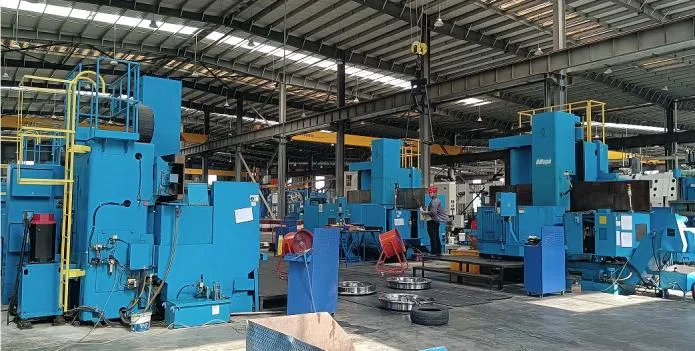
Surface quality is often assumed to be determined during machining, but in reality, many defects originate earlier, during rolling.
When load distribution is uneven or internal torque is not properly controlled, the material may experience localized stress concentrations. This can result in surface scoring or micro-tearing, which are difficult to eliminate later.
A well-balanced rolling system minimizes unnecessary friction and ensures that forces are applied smoothly across the contact area. This leads to cleaner surfaces and reduces the likelihood of crack initiation during service.
Mechanical clearances within the rolling system are rarely visible in final products, but their impact is significant over time.
If clearances are too large or inconsistent, the system may begin to vibrate under load. This affects not only the stability of the process but also the distribution of forces acting on the wheel.
Proper clearance design ensures smooth operation and helps maintain dimensional accuracy across long production runs. It also reduces wear on critical components, contributing to overall process reliability.
Even in well-controlled environments, defects can occur when process parameters are not properly managed.
Surface scoring, for example, is typically linked to excessive friction or poor load distribution. Although it may appear minor, it often increases machining requirements and can become a starting point for cracks under cyclic loading.
Out-of-roundness is another common issue, usually associated with insufficient machine rigidity or unstable rolling conditions. This type of deviation directly affects wheel balance and can influence performance in service.
Uneven material flow is more subtle but equally important. When deformation is not uniform, different areas of the rim may exhibit varying mechanical properties, which reduces overall fatigue resistance.
There are also indirect issues, such as thermal cracking of rollers. While this does not immediately appear on the wheel, it introduces variability into the process and eventually affects product consistency.
Finally, dimensional deviations often result from inadequate control of rolling parameters. These deviations increase machining time and reduce overall production efficiency.
It is common to see the railway wheel rolling process discussed alongside forging, but the two processes serve fundamentally different roles.
Forging is responsible for creating the initial shape of the wheel. It improves material density and establishes the basic geometry. However, it does not fully define the final dimensions or material flow characteristics.
Rolling, on the other hand, refines the geometry and aligns the internal structure. It is during the railway wheel rolling process that the rim reaches its final dimensions and the material flow becomes optimized for service conditions.
From an engineering standpoint, forging creates the foundation, while rolling determines performance.

In practice, achieving consistent quality in the railway wheel rolling process is not determined by a single parameter or piece of equipment. It is the result of how rigidity, load control, thermal stability, and material flow are managed together as a system.
From an engineering perspective, what matters is not only whether a manufacturer has rolling capability, but how stable and repeatable that process is over time.
At Luoyang Fonyo Heavy Industries Co., Ltd., our railway wheel production is built around this principle. The rolling system is designed with high structural rigidity, fully driven rollers, and continuous cooling control to ensure stable deformation conditions. Combined with controlled load distribution and precise mechanical clearances, this allows us to maintain consistent quality across different wheel specifications and production batches.
More importantly, the railway wheel rolling process in our production line is integrated with forging and heat treatment as a continuous system, rather than isolated steps. This ensures that dimensional accuracy, internal structure, and final mechanical properties are aligned from the beginning.
If you are evaluating railway wheel suppliers or managing long-term procurement projects, understanding how the rolling process is controlled can provide valuable insight into product reliability.
For more information about our company and engineering capabilities, please visit www.railwaypart.com. Our engineering team is available to support your technical requirements.