WeChat 코드를 스캔하여 문의하세요
WeChat 코드를 스캔하여 문의하세요
이메일을 보내주시면 최대한 빨리 답변해 드리겠습니다..
마음과 영혼을 다해 미래를 창조하다


When people evaluate 연성이 있는 철 주물, they usually look at chemical composition or mechanical properties first.
But in real foundry practice, those numbers are not where quality starts — they are the outcome of a stable and controlled ductile iron melting process.
We have seen the same pattern repeatedly in demanding applications like railway components and heavy equipment: two suppliers using similar raw materials, but their castings perform very differently in service.
The difference almost always traces back to what happenedbefore pouring — specifically, desulfurization, nodulizing, and inoculation.
This guide walks you through each step of the ductile iron melting process, explains why it matters, and gives you practical questions to ask suppliers.
Whether you are a buyer, designer, or foundry engineer, you will learn how to judge process quality — not just final test reports.

Every stable ductile iron melting process begins with one thing that is easy to underestimate: 유황 제어.
The theory is simple: sulfur consumes magnesium.
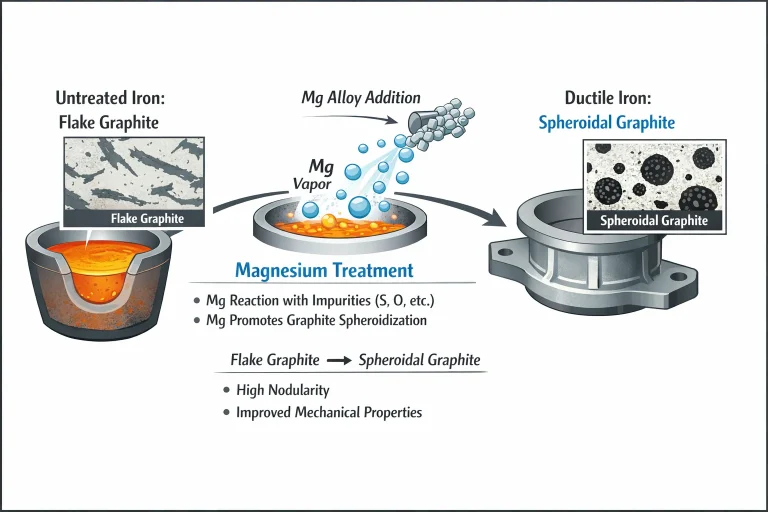
In molten iron, magnesium must first react with sulfur and oxygen before it can convert graphite into a spherical shape. If sulfur is too high, magnesium is wasted — and nodulizing fails.
생산 중, a reliable process requires sulfur below 0.015%, ideally below 0.010% before treatment.
Common desulfurization methods include adding calcium carbide, calcium oxide, or soda ash — followed bythorough slag removal. Leftover slag can release sulfur back into the iron, undoing your work.
👉Key takeaway: Without good desulfurization, nodulizing becomes a gamble.
If desulfurization prepares the battlefield, nodulizing is the decisive battle.
This step addsmagnesium (usually as a magnesium alloy or pure magnesium via a ladle) to the molten iron. Magnesium changes how graphite grows — from flakes to spheroids.
Why is this step the most problematic?
The reaction looks dramatic — flames, smoke — and seems successful. But the real result only appears under a microscope and in mechanical tests. Magnesium fading, base iron variations, or long waiting times can turn a “successful” reaction into a reject.
Rule of thumb: After nodulizing, pouring should be completed within8–10 minutes. Longer than that, nodularity drops significantly.
After nodulizing, the graphite spheroids exist, but they are not yet stable.
접종 adds a “safety net” — it helps graphite precipitate uniformly and finely during solidification, avoiding chunky graphite, localized carbides, or shrinkage defects.
Solution: multiple inoculation steps
This “staged compensation” ensures uniform microstructure from thin sections to heavy sections.
Look at the three steps together, and the logic becomes clear:
| 단계 | Role | Failure consequence |
| Desulfurization | Removes obstacles to magnesium | Failed nodulizing, irregular graphite |
| Nodulizing | Creates spherical graphite | Low nodularity, poor mechanical properties |
| 접종 | Controls graphite distribution | Local hard spots, 수축, uneven structure |
If one step is weak, the next step cannot fully compensate.
That is why experienced foundries focus not on individual test results, but onprocess stability and repeatability across the whole ductile iron melting process.
Even with clear theory, the shop floor is full of surprises:
| 도전 | Consequence | Practical solution |
| Raw material variation (에스, 영형) | Unstable Mg recovery | Pre-treatment fast analysis, adjust desulfurization |
| Temperature drop during transfer | Incomplete nodulizing | Control tap temperature, shorten transfer path |
| Long waiting time | Mg fading + inoculation fading | Set strict time limit (예를 들어, pour within 8 min) |
| Only one inoculation step | Poor structure in large castings | Add stream or mold inoculation |
메모: For small castings, the process window is more forgiving. For large structural parts — railway side frames, heavy equipment components — every deviation risks a complete scrap.

Ductile iron used in railway, 채광, 풍력, or heavy trucks demands more than just a nodularity ≥90%. It requires:
✅Stable nodularity from heat to heat (예를 들어, variation ≤3%)
✅No harmful structures (cementite, irregular graphite)
✅Low internal defects (수축, gas porosity)
These do not come from a material spec sheet. They come from:
다시 말해서: Stability of the melting process = reliability of the casting in service.
In our foundry (replace with your company description), we treat theductile iron melting process as a continuous flow system, not isolated operations:
This approach is essential forlarge or critical components — because passing once is easy; passing 1000 times consistently is the real challenge.
Next time you assess a ductile iron supplier, ask three direct questions:
A supplier who can answer these with clear numbers — and show records on the shop floor — is one that treats theductile iron melting process as a core competence.

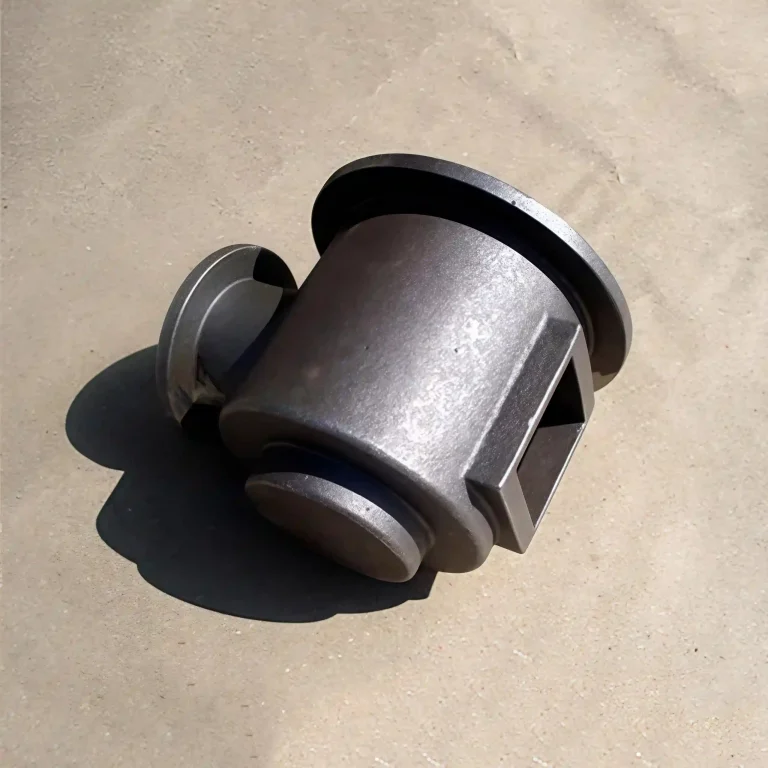
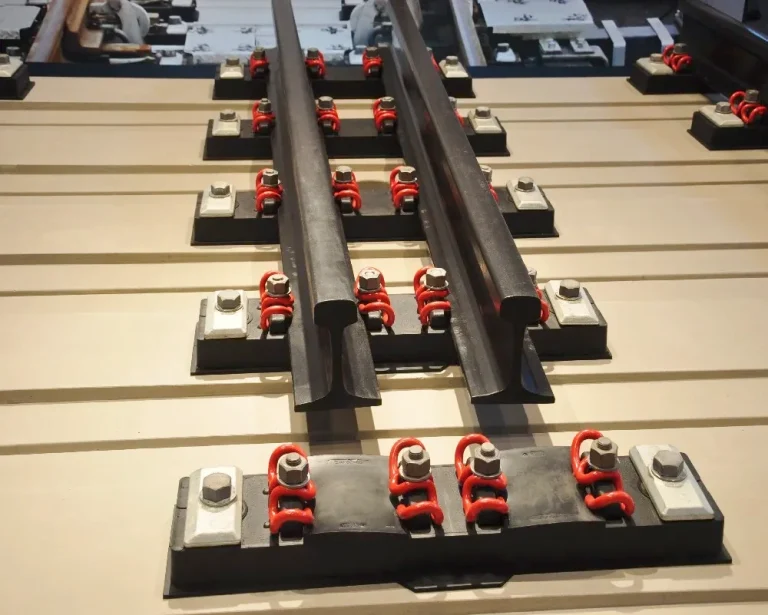
We specialize in high-reliability ductile iron castings for demanding industries including 철도, heavy equipment, 풍력, and off-highway vehicles, ~와 같은 철도 기어박스 하우징, wind power housing, and vehicle yoke part.
Our focus is not on “occasional compliance”, but on a stable and repeatable ductile iron melting process that delivers consistent performance, heat after heat.
👉 Learn more at: 뤄양포뇨중공업(Luoyang Fonyo Heavy Industries), 주식회사.
You can visit our website www.railwaypart.com and get more information about us.