Scan the WeChat code to contact us
Scan the WeChat code to contact us
Feel free to send us a email and we will reply to you as soon as possible.
Creating the future with heart and soul


A railway component is reliable when it keeps performing its job, cycle after cycle, under the loads and conditions it was specified for, without an unplanned failure that takes the vehicle out of service or, worse, creates a safety risk.
That sounds simple. It is not.
Reliability is not something you can measure on a single part with a caliper, and it is not something a supplier can promise with a brochure. It is the result of a chain of decisions that starts before the drawing is finished and does not end until the component is retired.
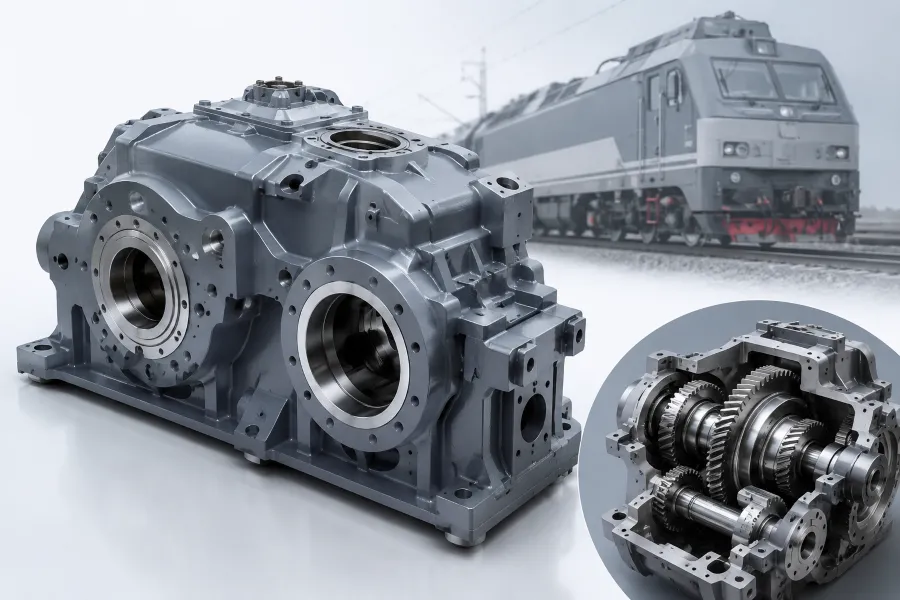
Most people use “reliable” as a vague compliment, the way they might call a supplier “good.” Engineers cannot afford that. In railway engineering, the word is unpacked into four separate things, and a component can be strong on one and weak on another.
That framework has a name, and a standard. EN 50126, the RAMS standard, defines reliability, availability, maintainability and safety as four distinct targets that have to be specified and demonstrated over the whole life of a system.
Reliability is about not failing in the first place. Availability is about being ready when the railway needs it. Maintainability is about how quickly and cheaply a failure is put right. Safety is about what happens when something does go wrong.
A casting that never cracks but takes six hours to swap out has good reliability and terrible maintainability. A clip that is cheap and fast to replace but creeps loose every few months has the opposite problem. The component that a procurement team actually wants scores on all four at once, and the only way to know is to look at the whole picture, not one impressive number.
This is the thing nobody tells you up front. A supplier can hand you a hardness certificate, a tensile result, a beautiful micrograph, and none of it tells you whether the part will still be doing its job in year twelve. The numbers describe the material. Reliability describes the material, the design, the process, and the way the part is treated in service, all at once.
Here is where the abstraction turns concrete.
Take a length of rail. It looks like a solid, inert lump of steel. It is not. Every axle that passes over it flexes it, and it does not get a rest between trains. A mainline rail carries millions of tonnes over its life, and the load is applied, released, and applied again, millions of times.
If a crack starts, it starts small, at a corner the maintenance regime was never designed to look at. That is not a hypothetical. It is roughly what happened at Hatfield in 2000, where gauge corner cracking in a rail had been developing for months and the inspection system did not catch it in time. Four people died and over seventy were injured.
What strikes me about Hatfield is not that a rail failed. Rails fail. It is that the whole system around that rail, the specification, the inspection intervals, the assumptions about how the steel would behave, did not line up with reality. A “reliable” rail is not just a rail with good chemistry. It is a rail whose maintenance regime actually looks for the failure mode that rail is going to develop.
When I review a supplier’s documents, I do not start with the tensile strength. I start by asking whether the certificate tells me which heat the steel came from, and whether that heat number is marked on the rail itself. If those two do not match, the paperwork is a story, not a record.
Reliability is built in stages, and each stage can quietly undo the one before it.
The first stage is the drawing and the specification. A part specified with the wrong grade, the wrong tolerance, or the wrong surface condition is unreliable before a single chip of metal is cut.
This is where over-specification does as much harm as under-specification. I have written before about how tight a railway component tolerance should be, and the short version is that tight is not automatically better. A tolerance tighter than the function needs adds cost and inspection burden without adding reliability.
The second stage is the material. The grade has to match the duty, and the certificate has to match the material. A mill test report to EN 10204 3.1 tells you the chemistry and the mechanical properties of a specific heat, but it is only worth anything if you can trace the finished part back to that heat number.
Choosing a grade is its own discipline, and the same logic I have written about for railway bolt grades applies to almost every component: a grade has to match the application, and stronger is not automatically better.
The third stage is the process. Casting, forging, welding, heat treatment. Each one introduces its own failure modes. A railway casting that passes inspection can still fail in service if the residual stress or a sub-surface defect was never the thing the inspection was looking for.
The fourth stage is verification. This is where most of the money and most of the argument sits. Dimensional inspection, ultrasonic testing, magnetic particle inspection, proof load.
And here is the subtle part: the inspection is only as good as the failure mode it is designed to catch. You can inspect the wrong thing very thoroughly, which is why the logic behind railway wheel inspection is worth understanding even if you do not buy wheels.
The fifth stage is service. A component that is reliable in a test bay can be unreliable on a specific route, with a specific axle load, a specific climate, a specific maintenance interval. Reliability is a property of the component in its environment, not the component in isolation.
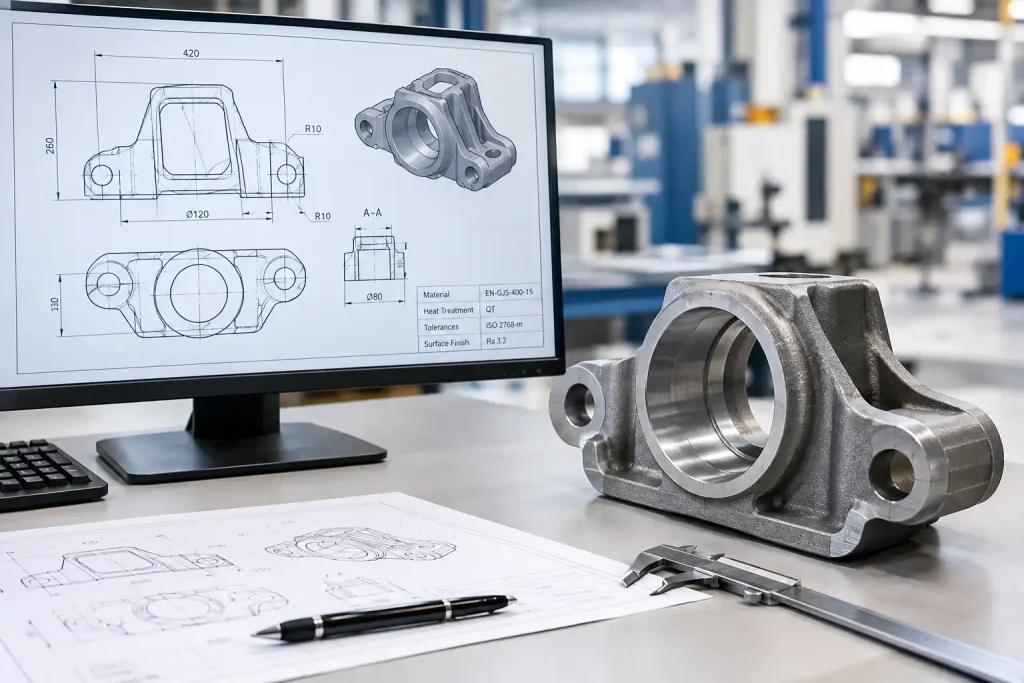
I have lost count of how many times a supplier has sent me a certificate as if it settled the question.
A certificate is a snapshot. It says the part met a standard on the day it was tested. It does not say the part will meet it in year eight, on a route the supplier has never seen, under a maintenance regime the supplier did not write.
That does not make certificates useless. Far from it. The right certificates, the material certificate, the inspection records, the heat number traceability, are the foundation of any reliability claim. What they are not is a substitute for understanding the failure mode.
Imagine two fish bolts from two suppliers, both with a certificate, both the same grade. One supplier can trace the batch back to the heat number and the inspection record. The other cannot. They are not the same component, even if the pieces of paper look identical. The traceability is what turns a certificate from a marketing document into evidence.
If you are buying railway components, there are a handful of questions that separate a supplier who can talk about reliability from one who can only talk about price. None of them require an engineering degree to ask.
First, can the supplier trace every finished part back to the heat of steel it came from? If the answer is vague, everything downstream of it is built on sand. Traceability is not a nice-to-have in this industry. It is the difference between a recall you can scope and a recall you cannot.
Second, does the supplier have a railway-specific quality system, not just a generic one? ISO 22163, formerly ISO/TS 22163 and sometimes still called IRIS, builds on ISO 9001 and adds the safety, risk management and traceability requirements that railway buyers actually need. A supplier with only ISO 9001 may be perfectly competent, but the railway-specific requirements are where the gaps usually hide.
Third, what testing does the supplier do in-house, and what does it outsource? The answer matters less than whether the supplier knows the answer. A wheelset needs ultrasonic and magnetic particle inspection on every axle, not just a sample, and the supplier should be able to tell you which tests it performs and which it commissions, with accreditation for each.
Fourth, does the supplier understand the standard your project is actually using? EN 13262 for wheels, EN 13260 for wheelsets, EN 13232 for track. These are not interchangeable. A supplier who says “yes we comply with railway standards” without asking which one is a supplier who has not read your specification.
Fifth, can the supplier tell you how the part is supposed to fail, and how you will know before it does? This is the question almost nobody asks, and it is the one that tells you the most. A supplier who can describe the expected failure mode and the inspection that catches it understands reliability as a system. A supplier who cannot is selling you a part and hoping.
The interesting thing about reliability is where the failures actually come from. It is almost never the headline number.
It is the heat number that does not match the certificate. It is the tolerance that was “close enough” on a drawing that mattered more than the buyer realised. It is the residual stress in a casting that nobody measured because the standard did not require it. It is the maintenance interval that was written for a different route, a different axle load, a different climate.
Reliability, in other words, is mostly a documentation and process problem wearing the costume of a materials problem. The steel is usually fine. It is the chain around the steel that breaks.
That is why a procurement for railway component decision built only on price, or only on a single impressive test result, is a gamble. The reliable component is the one where the drawing, the material, the process, the inspection and the service assumptions all line up and can all be shown to line up, on paper, to someone who asks the right questions.
Whether you are designing a new vehicle or replacing worn track parts, the discipline is the same. Reliability is not a feature you can buy off a shelf. It is a property you have to ask for, specify, and then verify, stage by stage, from the heat of steel to the day the part comes out of service.
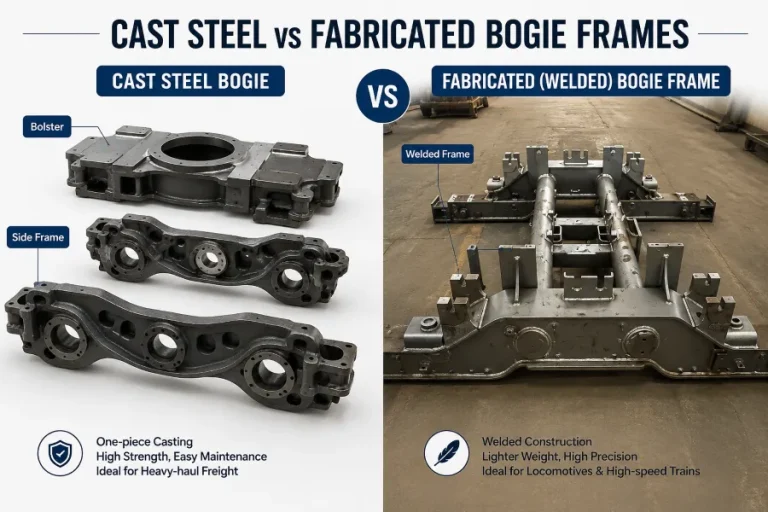
At FONYO, we manufacture railway components including railway wheels, fish plates, fish bolts, elastic rail clips, rail pads, and cast components such as side frames and bolsters. We work to customer drawings and the applicable standards, and we can review the material grade, heat treatment, inspection and testing requirements for your component before production.
If you send us a drawing or a specification, our engineers can tell you which standards apply, what testing the part will need, and where the reliability risk in your particular component is most likely to sit.
No. A certificate shows the part met a standard when it was tested. It does not show how the part will behave in year eight, on your route, under your maintenance regime. The certificate for railway component is necessary but not sufficient. Traceability and a clear understanding of the failure mode matter just as much.
Not automatically. A stronger material can be more prone to cracking, more difficult to weld, or over-specified for a duty that did not need it. Strength has to match the application. In some cases a slightly lower-strength grade with better toughness is the more reliable choice.
They are related but not the same. Reliability is about not failing. Availability is about being ready for service when needed. A component can be reliable but take a long time to replace, which hurts availability. The RAMS framework treats them as separate targets because improving one can cost the other.
Because it lets you connect a finished part back to the exact batch of steel it came from, along with that batch’s chemistry and test results. Without it, a field failure cannot be scoped to the affected parts, and a recall becomes a guess.
It is a start, but on its own it is usually not enough for safety-critical parts. ISO/TS 22163 (IRIS) adds the railway-specific safety, risk management and traceability requirements that ISO 9001 does not cover. If a supplier only has ISO 9001, ask how it handles the railway-specific requirements anyway.
Yes. This is one of the most important things to understand. A component can meet every dimensional and material check on day one and still fail later, because of residual stress, a fatigue crack that the inspection was not designed to find, or a service condition the specification did not anticipate. Inspection catches what it is aimed at, nothing more.
It is hard to pick one, but if I had to, it would be traceability. A supplier who can trace every part to a heat number and an inspection record, and who is willing to show you how, is a supplier whose other claims are built on something solid.