Scan the WeChat code to contact us
Scan the WeChat code to contact us
Feel free to send us a email and we will reply to you as soon as possible.
Creating the future with heart and soul


As a professional railway wheel manufacturer, we implement a comprehensive railway wheel inspection and quality control system throughout the entire production process.
From raw material verification to final inspection, every railway wheel undergoes strict testing to ensure safety, durability, and reliable performance in demanding railway applications.
Our inspection process integrates advanced non-destructive testing technologies, mechanical testing equipment, and laboratory analysis to guarantee consistent product quality.
Ultrasonic testing is one of the most critical inspection methods for railway wheels. Internal defects in the wheel rim may lead to rim cracking or fatigue failure during service.
Our inspection system uses phased-array ultrasonic testing technology, which allows precise detection of internal defects in multiple areas of the wheel, including the rim, wheel plate, and hub.
Inspection sensitivity is calibrated using a Φ1-6 dB flat-bottom hole equivalent reference.
Inspection criteria include:
This process ensures the structural integrity and safety of railway wheels.
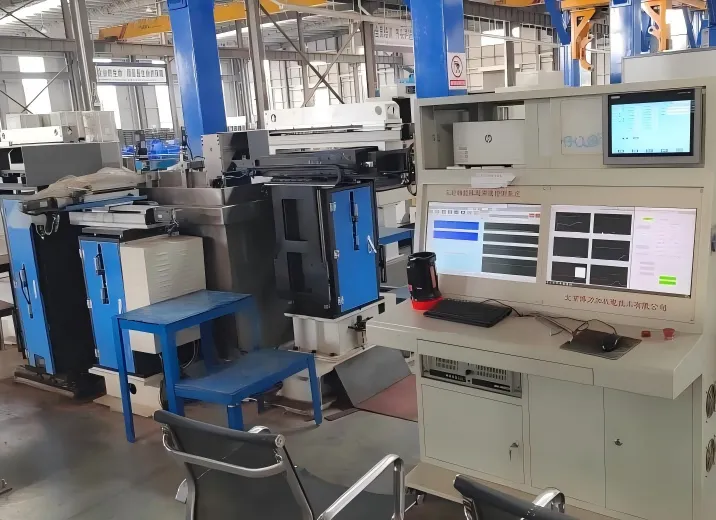
Magnetic particle inspection is used to detect surface cracks and discontinuities that may occur during forging, heat treatment, or machining.
This non-destructive testing method can identify very small surface defects that may not be visible during visual inspection.
Magnetic particle testing ensures that the surface of each railway wheel meets strict safety requirements before delivery.
Hardness control plays an important role in the performance of railway wheels.
Excessive hardness may increase brittleness, while insufficient hardness may reduce wear resistance. Therefore, precise hardness testing is essential.
Our hardness testing system includes:
These tests ensure consistent hardness distribution across the wheel rim.
Mechanical testing verifies that railway wheel materials can withstand heavy loads and repeated stress during railway operation.
Our laboratory performs several key mechanical tests, including:
| Testing Equipment | Test Purpose |
| Pendulum impact testing machine | Impact toughness testing |
| Electro-hydraulic universal testing machine | Tensile strength testing |
| 100 kN electro-hydraulic servo fatigue testing machine | Fatigue life testing |
These tests ensure that the wheels meet required mechanical performance standards.
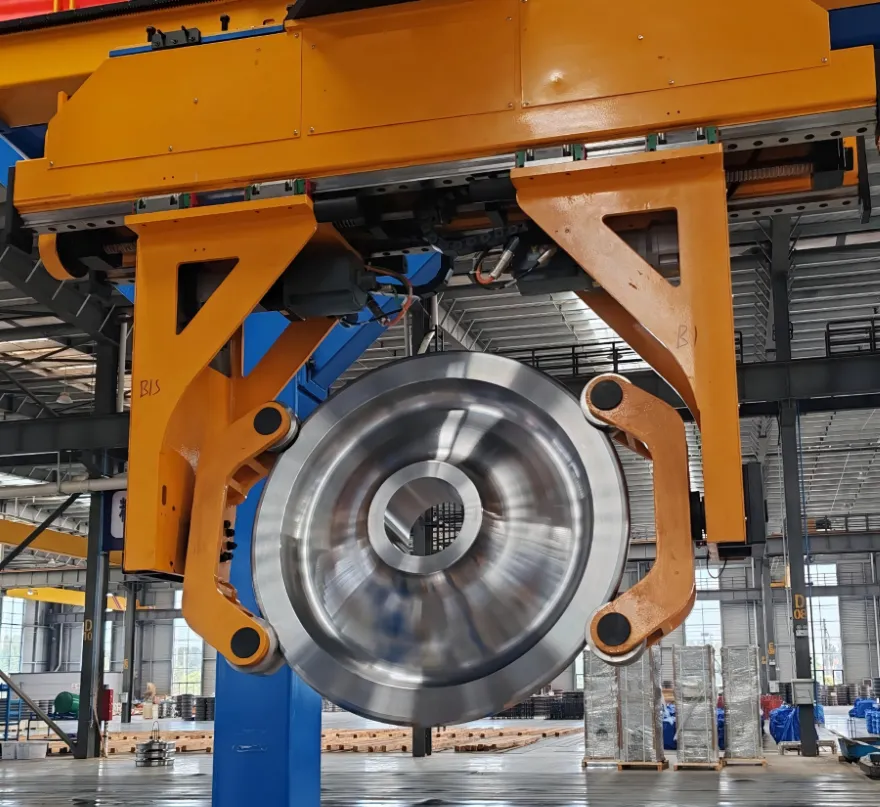
Metallographic analysis is used to examine the microstructure of railway wheel steel and evaluate the effectiveness of the heat treatment process.
Using a metallographic microscope, engineers analyze:
This analysis helps ensure that the material achieves the required strength, toughness, and fatigue resistance.
To ensure reliable railway wheel inspection and quality control, our factory is equipped with a complete range of inspection and laboratory equipment.
| Equipment | Purpose |
| Phased-array ultrasonic testing system | Internal defect detection |
| Magnetic particle testing machine | Surface crack inspection |
| Online Brinell hardness tester | Production line hardness testing |
| Rockwell hardness tester | Laboratory hardness verification |
| Spectrometer | Chemical composition analysis |
| Metallographic microscope | Microstructure analysis |
| Pendulum impact testing machine | Impact toughness testing |
| Universal testing machine | Tensile strength testing |
| Electro-hydraulic fatigue testing machine | Fatigue life testing |
By combining automated inspection lines, advanced NDT technology, and comprehensive laboratory testing, we maintain a strict quality control system for railway wheels.
Our inspection line has an annual capacity of approximately 150,000 railway wheels, ensuring efficient and consistent quality verification.
Through continuous monitoring and advanced testing technology, we provide reliable railway wheels for demanding railway and industrial applications.
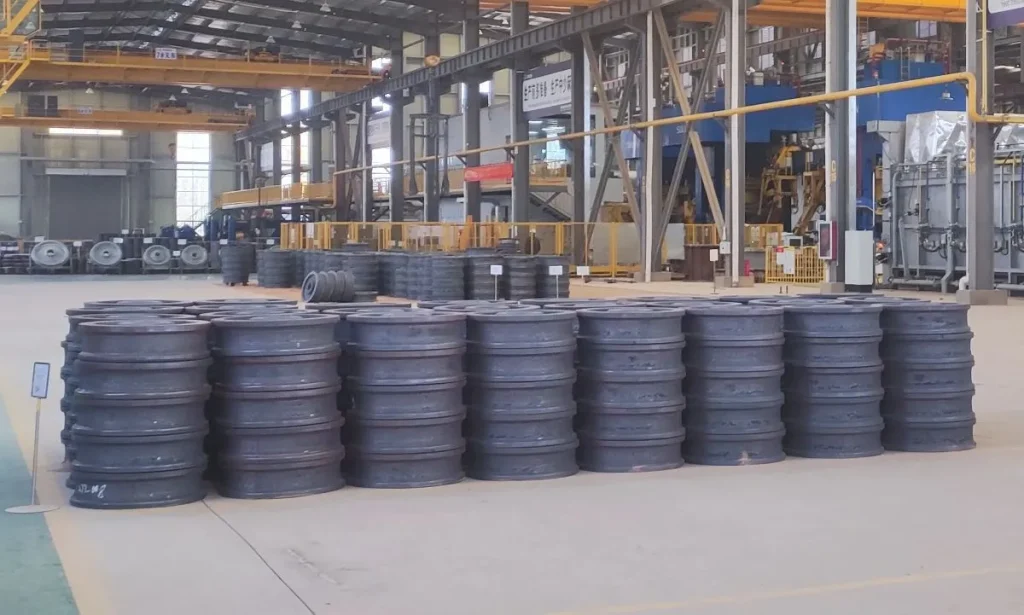
Railway wheel inspection typically includes several testing methods to ensure structural integrity and operational safety.
Common inspection methods include:
These inspection methods help ensure that railway wheels meet strict safety and performance requirements.
Ultrasonic testing is one of the most important methods in railway wheel inspection because it can detect internal defects that are not visible from the surface.
Using phased-array ultrasonic technology, inspectors can identify defects inside the wheel rim, wheel plate, and hub.
This helps prevent potential failures such as rim cracking during railway operation.
For this reason, ultrasonic testing is widely used in railway wheel quality control.
During railway wheel testing, both internal and surface defects can be detected.
Typical defects include:
Advanced non-destructive testing methods such as ultrasonic testing and magnetic particle inspection are used to identify these defects.
A reliable railway wheel manufacturer ensures product quality through a comprehensive inspection system that includes:
By combining automated inspection equipment with laboratory testing, manufacturers can ensure that every railway wheel meets required safety and performance standards.
If you are looking for a reliable railway wheel manufacturer with strict quality inspection and testing capabilities, Luoyang Fonyo Heavy Industries Co., Ltd. can support your project.
Our team provides custom railway wheels and related components based on customer drawings or technical specifications. Every product is manufactured and inspected under a comprehensive quality control system to ensure safety and long service life.
For technical inquiries or quotation requests, please feel free to contact us. You can also visit our website www.railwaypart.com to get more information about us.