WeChat コードをスキャンしてご連絡ください
WeChat コードをスキャンしてご連絡ください
お気軽にメールをお送りください。できるだけ早くご返信させていただきます.
心と魂で未来を創る


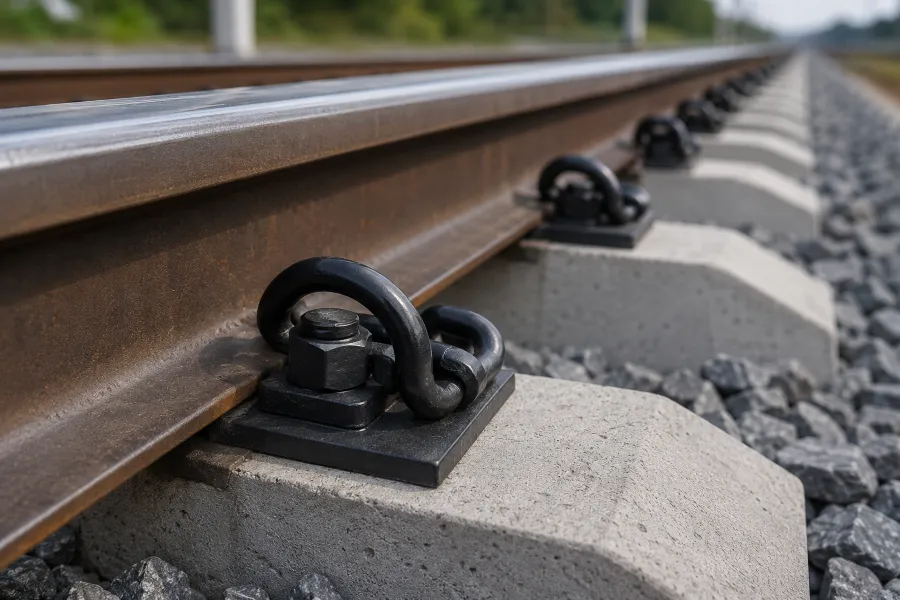
レールクリップ are among the smallest components in a railway track system, but they play one of the biggest roles. Their job is simple in theory: keep the rail securely fastened to the sleeper while allowing just enough elasticity to absorb vibration and dynamic loads. 実際に, however, they work under extremely demanding conditions every day.
Every passing train subjects a rail clip to repeated loading and unloading cycles. Add temperature changes, 水分, 重い軸重, and years of continuous service, and it becomes clear why rail clip failures eventually occur. The good news is that most failures do not happen suddenly. They usually begin with small changes that can be identified long before a clip actually breaks.
From our experience manufacturing railway fastening components for different railway projects, we have found that understanding how rail clips fail is just as important as selecting the right clip in the first place. この記事では, we’ll look at the most common rail clip failures, explain what causes them, and discuss practical ways to prevent them.
Many people assume a failed rail clip is simply the result of poor product quality. While manufacturing defects can occasionally be a factor, they are rarely the primary reason.
あ レールクリップ is designed to withstand millions of loading cycles throughout its service life. During those years, it experiences continuous vibration, impact loads from passing trains, thermal expansion and contraction of the rails, and environmental exposure. Even a well-designed elastic rail clip gradually loses performance if these factors are not properly managed.
多くの場合, the failure actually begins somewhere else in the fastening system. A worn rail pad, loose fish bolts, incorrect installation, or poor track geometry can all increase the stress placed on the clip. 時間とともに, that additional stress accelerates fatigue and shortens its service life.
Understanding these failure mechanisms helps maintenance teams solve the real problem instead of simply replacing broken clips one after another.
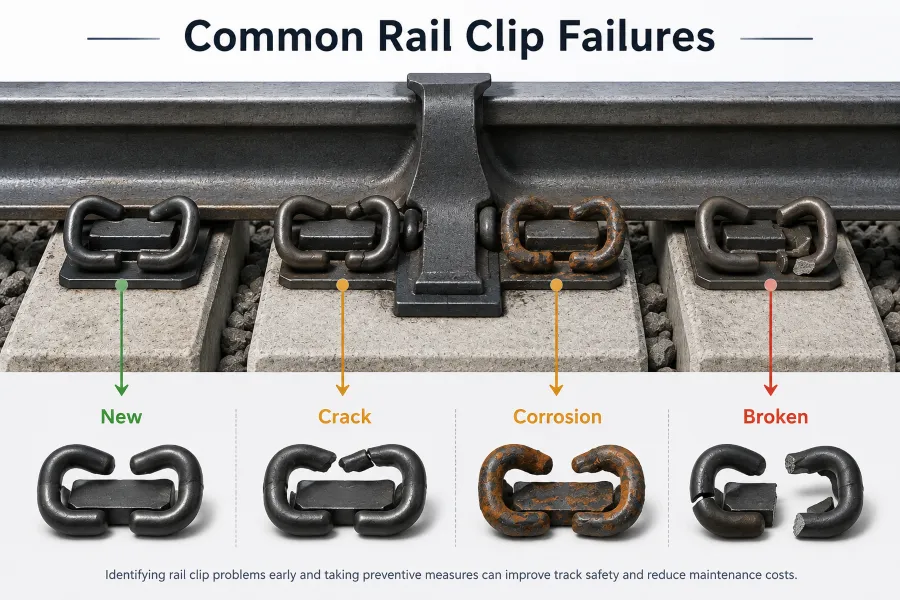
If there is one failure that railway maintenance engineers encounter most often, it is fatigue cracking.
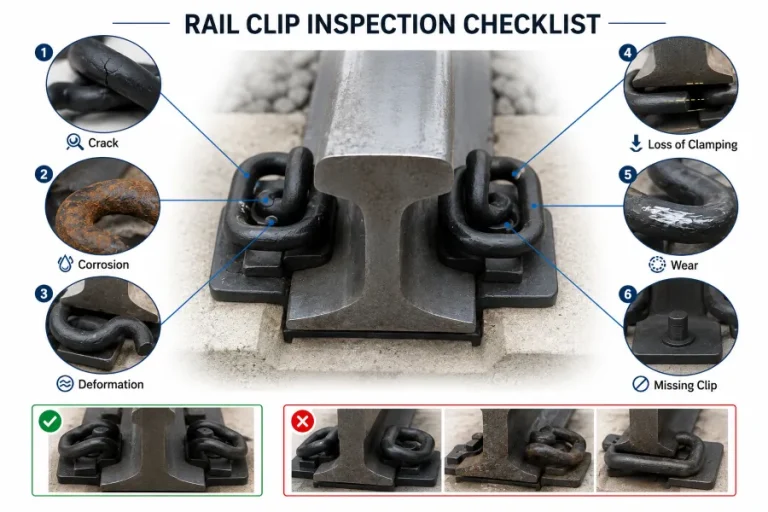
Unlike a sudden overload, fatigue develops slowly. Every train that passes creates a small amount of stress inside the spring steel. Individually these stresses are insignificant, but after millions of loading cycles, tiny microscopic cracks begin to form, usually around the curved sections where stress is naturally concentrated.
初めに, these cracks are almost impossible to notice during a routine visual inspection. The clip may still appear to function normally. As more trains pass over the track, however, the crack gradually grows until the remaining material can no longer support the load. Eventually the clip fractures.
This is why a rail clip can seem perfectly fine one week and be completely broken the next. The failure itself happens quickly, but the damage has often been developing for months.
Regular inspections, especially on heavily trafficked lines, are the most effective way to identify fatigue damage before complete failure occurs.
A rail clip does not have to break before it stops doing its job.
One issue that is often overlooked is the gradual loss of clamping force. As spring steel ages and experiences repeated loading, it may undergo slight permanent deformation. The clip still looks intact, but it no longer applies the designed pressure to the rail.
This reduction in clamping force allows the rail to move slightly under wheel loads. The movement may be almost invisible, yet it increases vibration throughout the fastening system.
時間とともに, that extra movement accelerates wear on rail pads, insulators, 魚皿, and even the sleepers themselves. Maintenance teams sometimes replace these components without realizing that the original problem was a rail clip that had simply lost its elasticity.
このため, evaluating clamping performance should be part of any comprehensive railway track maintenance program, not just checking whether clips are broken.
Environmental conditions can have a significant impact on rail clip service life.
Railway lines located near the coast, in mining operations, or in chemical industrial areas are constantly exposed to moisture, salt, and corrosive substances. These conditions gradually attack the protective surface of the clip.
一見して, corrosion may appear to be only a cosmetic issue. 実際には, small corrosion pits create stress concentration points where fatigue cracks can start much earlier than expected.
This combination of corrosion and cyclic loading is known as corrosion fatigue, and it is responsible for many premature rail clip failures around the world.
Selecting clips with suitable surface protection and regularly cleaning heavily contaminated track sections can significantly reduce this risk.
Not every rail clip failure begins after years of service. Some problems are introduced during installation.
Even a high-quality rail clip cannot perform as designed if it is installed incorrectly. A clip that is not fully seated, positioned in the wrong orientation, or forced into place with excessive impact may already contain residual stress before the railway even enters service.
We’ve also seen cases where maintenance teams mixed different fastening components that were never designed to work together. Using an incompatible rail pad or insulator changes the load distribution across the fastening system, increasing the stress applied to the clip.
Proper installation may not receive as much attention as material selection, but it often has an equally important influence on service life.
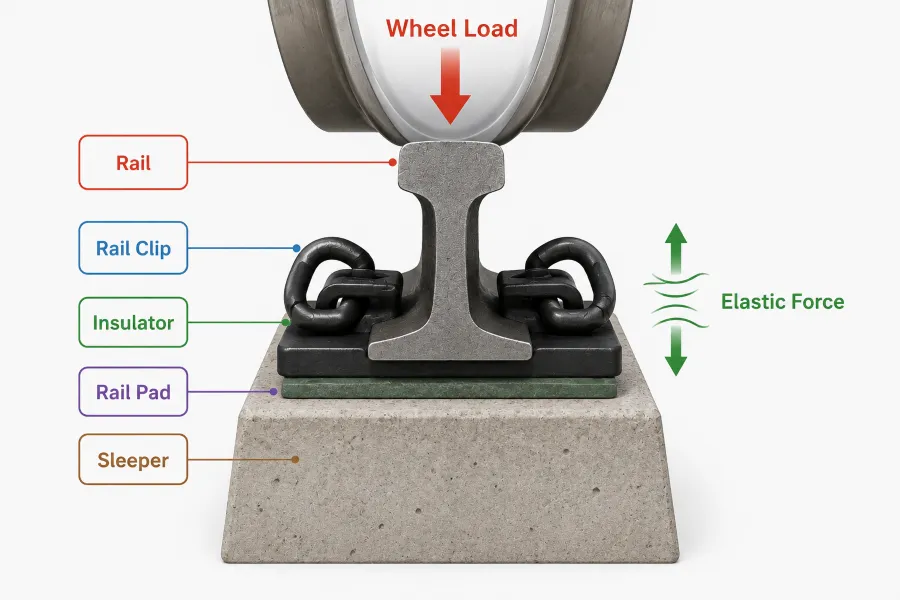
Rail clips work as part of a complete fastening system rather than as individual components.
As trains continue to pass, slight movement occurs between the rail, clip, insulator, and rail pad. Under normal conditions, these movements remain within the designed elastic range. しかし, once one component begins to wear excessively, the entire load distribution changes.
This creates additional vibration and movement, which further accelerates wear throughout the system.
言い換えると, replacing only the visibly damaged clip may not solve the underlying issue if surrounding components have already deteriorated.
Looking at the fastening system as a whole usually leads to longer maintenance intervals and lower overall costs.
A broken rail clip is rarely the beginning of the problem—it is usually the final result of damage that has been developing for a long time.
Once the clip fractures completely, it can no longer provide the required clamping force. Rail movement increases immediately, placing greater loads on adjacent clips and other fastening components.
If the damaged clip is not replaced promptly, nearby clips may begin carrying additional stress, increasing the likelihood of multiple failures within the same section of track.
This is why maintenance engineers generally treat a fractured rail clip as a signal to inspect the surrounding fastening system rather than replacing only a single component.
Experienced maintenance engineers know that prevention is far less expensive than emergency repairs.
Instead of waiting for a clip to break, inspections should focus on identifying early warning signs. Small surface cracks, 腐食, unusual deformation, reduced clamping force, or abnormal rail movement often indicate that the fastening system is beginning to deteriorate.
Track sections carrying heavy freight traffic, operating under high axle loads, or located in harsh environments deserve more frequent inspections because the clips experience significantly greater stress than those on lightly used lines.
When these warning signs are identified early, replacing a small number of components can often prevent much larger maintenance issues later.
In many railway projects, extending the life of a rail clip has less to do with the clip itself and more to do with maintaining the entire fastening system.
Choosing the correct clip for the rail profile and loading conditions is the first step. Proper installation ensures the designed clamping force is achieved from the beginning. Regular inspections help identify fatigue or corrosion before serious damage develops. 同時に, replacing worn rail pads, damaged insulators, or loose fish bolts prevents unnecessary stress from being transferred to the clips.
When all these elements work together, rail clips can provide reliable performance for many years under demanding operating conditions.
Although maintenance practices play a major role, manufacturing quality should never be overlooked.
A well-manufactured elastic rail clip starts with carefully selected spring steel, precise heat treatment, and strict dimensional control. Consistent mechanical properties help maintain stable clamping force throughout the clip’s service life, while comprehensive quality inspections reduce the risk of premature failures.
で Luoyang Fonyo Heavy Industries, we manufacture railway elastic rail clips for various railway fastening systems in accordance with international railway standards. Every clip is produced with a focus on fatigue resistance, dimensional accuracy, and long-term reliability to support demanding railway operations worldwide. We also specialize in鉄道部品, 鉄道の車輪, 鉄道鋳物, and custom-engineered railway parts for customers around the world. Whether you are sourcing standard railway products or developing components based on technical drawings, our engineering and manufacturing teams are committed to delivering reliable, high-quality solutions that meet international industry standards.