Scannez le code WeChat pour nous contacter
Scannez le code WeChat pour nous contacter
N'hésitez pas à nous envoyer un email et nous vous répondrons dans les plus brefs délais.
Créer l'avenir avec cœur et âme


Transit ferroviaire silencieux: mystery decoding railway signal system
In a speeding train steel orbit, comme un compteur horaire de fonctionnement de précision, derrière sa sécurité et son efficacité, hides a set of complex and the nervous system – the railway signal system of wisdom. This system uses electromagnetic waves as its language and mechanical devices as its limbs to build a three-dimensional driving safety barrier. This article will reveal the operational logic of this “invisible commander” from four dimensions: signal transmission, section control, station interlocking and intelligent upgrade.
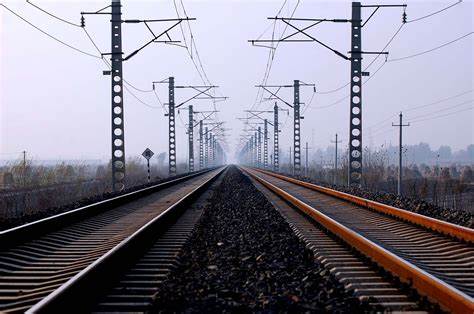
1. Signal transmission
Railway neural network of railway signal transmission depends on the physical carrier of diversification. Traditional cables use copper core conductors and multi-layer protective structures, encoding traffic instructions such as turnout positions and speed limit information through current changes. Par exemple, the MHYVP-type signal cable uses tin-plated copper conductors and polyethylene insulation layers, which can maintain stable signal transmission in an environment ranging from -40℃ to 70℃. Its shielding layer can resist electromagnetic interference of over 50 dB. Modern wireless communication technology realizes two-way communication between the vehicle and the ground through the GSMA-R network. In the CTCS-3 level train control system, the onboard equipment exchanges position data with the ground wireless Block Center (RBC) chaque 6 seconds to ensure real-time control at a speed of 350km/h. In tunnel special scenarios such as the leakage cable technology, this kind of slot conductor forms a continuous radiation field near 2.1 MiGui height, making the train through the tunnel still keep a 4 g / 5 g signal full. Experimental data show that the leakage cable signal attenuation rate is only 0.03 dB/m, a traditional base station coverage efficiency 80% increased.
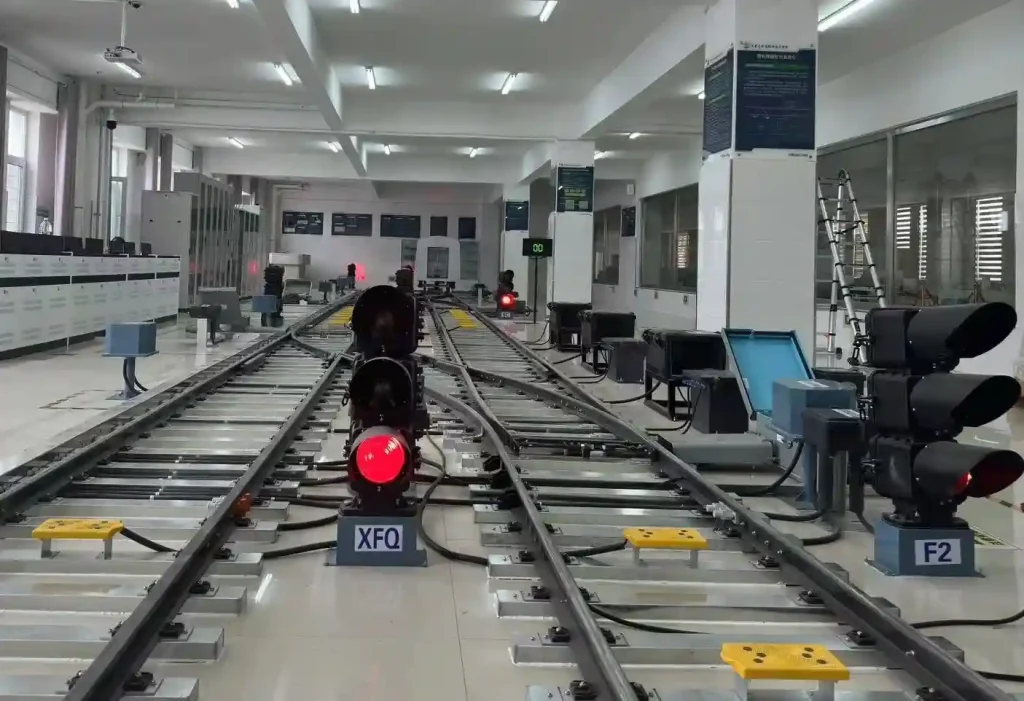
2.Range control
Block system of space and time art block system through virtual security section, to ensure that the train will not “crash”. The traditional fixed block divides the track into multiple fixed sections (usually 1.5-2km) and relies on the track circuit to detect the occupancy status. When a train enters a certain section, the track relay triggers a red light signal, and the trains behind it need to maintain a safe distance of at least three sections of 610. While moving block technology subverts this pattern. Based on the centimeter-level positioning of the Beidou satellite (with a horizontal accuracy of 2.5m and an elevation accuracy of 5m) and 5G communication (with a delay of < 10), the system dynamically calculates the braking curve of the train and forms a virtual zone that moves along with the train. Par exemple, in the application of the Beijing-Shanghai High-Speed Railway, the train tracking interval has been compressed from 3 minutes to 2 minutes, and the line’s transportation capacity has increased by 30%. The realization of this “elastic safety zone” relies on the speed-distance iterative operations of the onboard device 2,000 times per second to ensure that the emergency braking decision is completed within 0.1 secondes.
3.The station interlocking
Precision game station as a road network node, the security control by the interlocking system strictly. The system realizes the logical interlocking of signal machines, turnouts and approaches through triple redundant computers. Take the 97-type 25Hz phase-sensitive track circuit as an example. It adopts frequency modulation technology to increase the detection sensitivity to 0.15Ω·km and can identify vehicle occupation as short as 6 mètres. When approaching the station, the train interlocking system startup “approach walkthrough” mécanisme: switch machine for 3 seconds to complete switch transformation (such as ZD9 type electric switch machine output 4500 n ZhuanHuanLi), signal synchronization switch lamp status. The entire process needs to go through 15 logical checks. Any equipment failure will trigger the “fail-safe” principle and automatically guide to the most conservative driving plan.
4.intelligent evolution
Count from mechanization to the evolutionary history of the signal system, reflected the transition of industrial civilization. Dans les premiers jours, the template signal relied on manual switching, with response delays reaching the minute level. The modern CTCS-4 system has achieved fully automatic unmanned driving. The ID-Space system, which will be put into application in 2024, extends the railway control logic to the low-altitude domain. Through the integrated network of air, space and ground, it coordinates unmanned aerial vehicles and trains to share the transportation corridor. Material innovation is also pushing for change: the new type of optical fiber composite signal cable using g. 657. A2 fiber bending, bending radius reduced to 5 mm, transmission loss < 0.18 dB/km, make signal delay is reduced to nanoseconds. The use of environmentally friendly halogen-free flame-retardant sheath materials reduces the combustion toxicity index of cables by 90% compared with traditional PVC.
Fournisseur
Luoyang Fonyo Heavy Industries Co., Ltée,fondée en 1998, est un fabricant de pièces ferroviaires moulées. Notre usine couvre une superficie de 72 600㎡, avec plus de 300 employés, 32 techniciens, y compris 5 ingénieurs supérieurs, 11 ingénieurs adjoints, et 16 techniciens. Notre capacité de production est 30,000 tonnes par an. Actuellement, nous produisons principalement du moulage, usinage, et montage pour locomotive,wagon,trains à grande vitesse, équipement minier,énergie éolienne,etc. Nos produits ont été exportés vers la Russie, les États-Unis, Allemagne, Argentine, Japon, France, Afrique du Sud,Italie et autres pays.
Contact:Cathy
E-mail:[email protected]
Mobile:008615515321683