Scan WeChat-koden for at kontakte os
Scan WeChat-koden for at kontakte os
Du er velkommen til at sende os en e-mail, og vi vil svare dig hurtigst muligt.
At skabe fremtiden med hjerte og sjæl


Skinne fiskeplade, også kendt som ledstænger, er væsentlige komponenter, der bruges til at forbinde to skinneender og opretholde sporkontinuitet. De er meget udbredt i hovedjernbaner, metrosystemer, industrial rail tracks, kranskinner, minedrift jernbaner, and other rail infrastructure projects.
Although modern railways increasingly use continuously welded rail (CWR), rail joints remain necessary in turnouts, broer, temporary tracks, industrielle sidespor, kranskinnesystemer, and maintenance applications. Selecting the correct fish plate is therefore critical for track safety, load transfer, og langsigtet pålidelighed.
This guide explains rail fish plate types, international standards, materiale specifikationer, dimensioner, manufacturing methods, and practical selection criteria for railway projects.
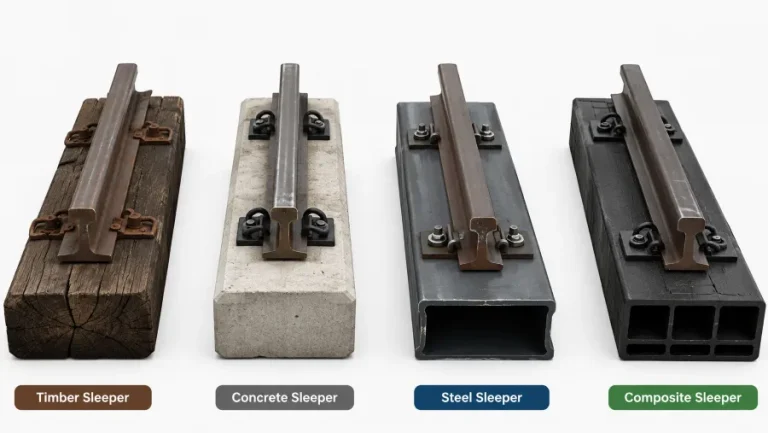
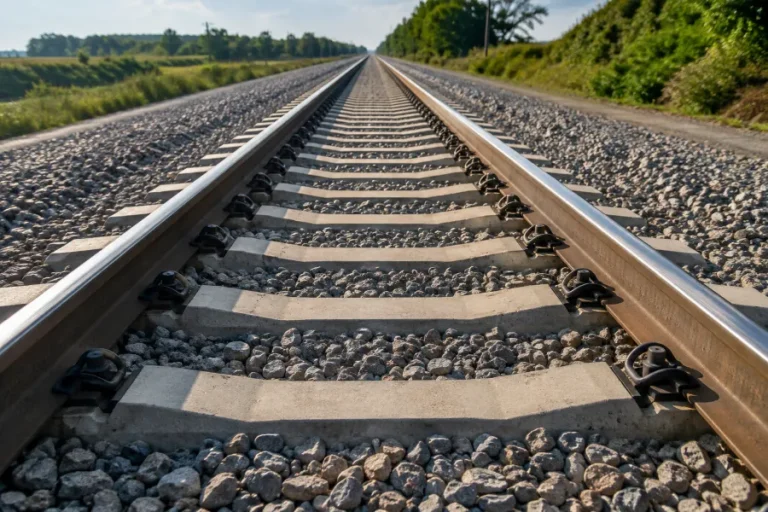
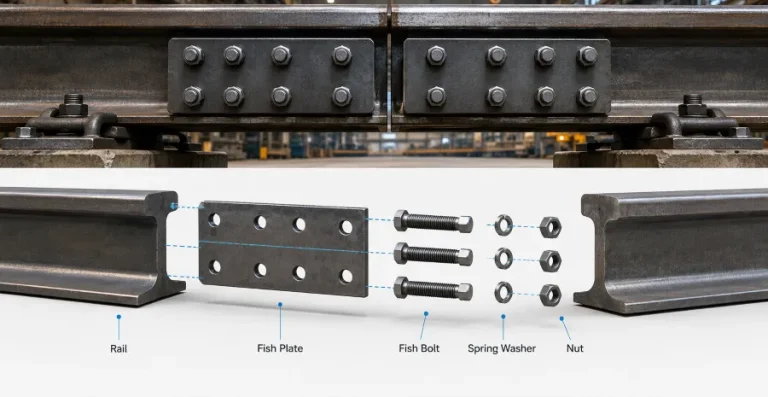
A rail fish plate is only one component within a complete railway fastening assembly. In jointed track systems, fish plates work together with several other track components to maintain rail alignment and transfer wheel loads safely through the track structure.
Typical components used together include:
Each component serves a specific purpose. Rail clips provide clamping force, rail pads reduce vibration and impact, fish bolts secure the joint, and sleepers distribute loads into the ballast or supporting structure. Proper interaction between these components is essential for long-term track stability.
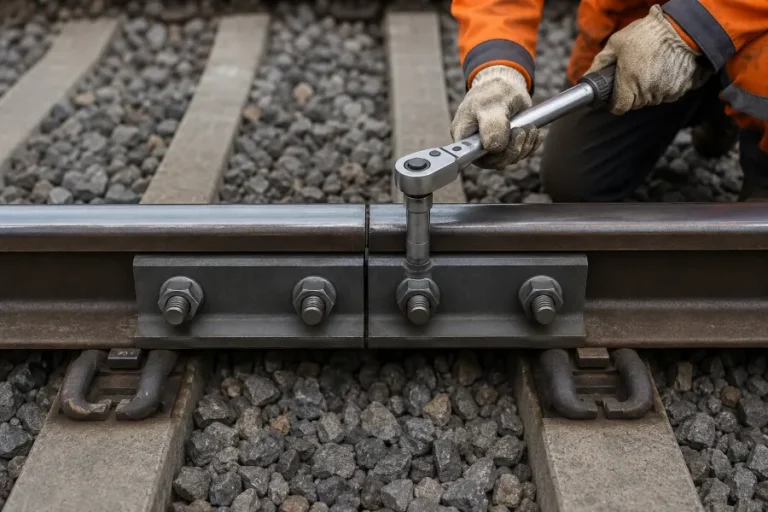
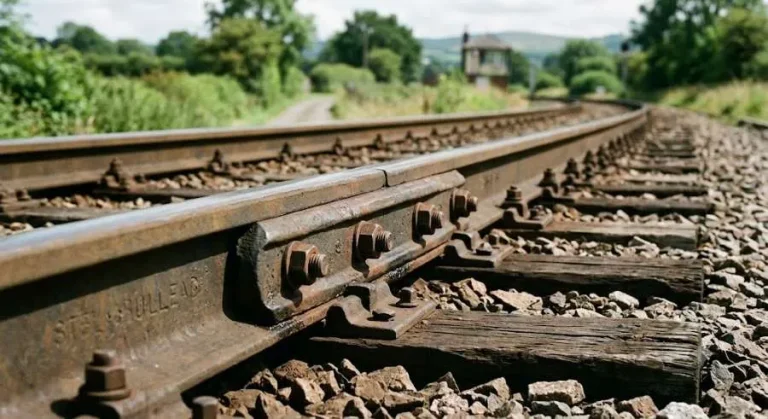
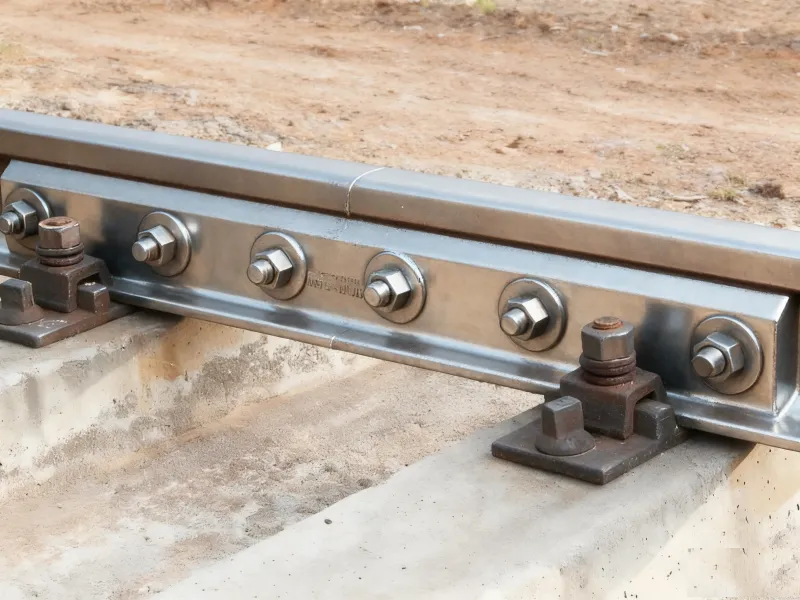
A rail fish plate is a steel bar with pre-drilled bolt holes, installed in pairs on both sides of a rail joint. It is secured with fish bolts and nuts, clamping two rail ends together to form a continuous running surface.
The primary functions of a rail fish plate include:
A poorly specified or poorly manufactured fish plate can lead to rail-end batter, bolt loosening, joint pumping, fatigue cracking, and ultimately increased maintenance costs.
Fonyo manufactures a wide range of standard and custom rail fish plates for railway, metro, industriel, and crane rail applications.
Common profiles include:
These products are widely used in railway projects throughout Europe, Asien, Afrika, og Mellemøsten.
Common North American profiles include:
AREMA joint bars are commonly used on freight railways, industrial spurs, and passenger rail networks.
For industrial and crane rail systems, vi fremstiller:
Vi leverer også:
Custom manufacturing is available according to customer drawings, skinneprofiler, og projektspecifikationer.
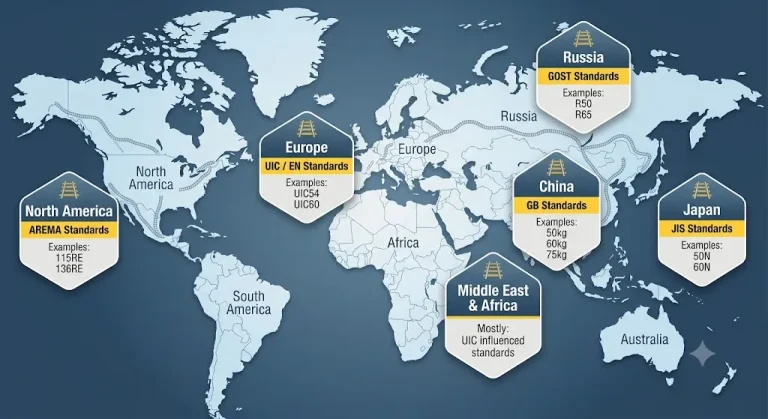
Rail fish plates are manufactured to different dimensional profiles depending on the rail section they connect. The three dominant standard systems are UIC (europæisk), AREMA (nordamerikansk), and DIN (industrial rail). Each system defines its own set of rail profiles and corresponding joint bar dimensions.
The International Union of Railways (UIC) standard covers the most widely used rail profiles in Europe, Asien, Africa and the Middle East. UIC fish plates are designed to match specific UIC rail sections and comply with UIC 864 præstationskrav.
Common UIC fish plate profiles include:
| UIC Rail Profile | Rail Weight (kg/m) | Typisk anvendelse | Fish Plate Section |
| UIC 60 | 60.21 | Mainline, høj hastighed, tunge træk | UIC 60 |
| UIC 54 | 54.43 | Secondary lines, metro, letbane | UIC 54 |
| UIC 50 | 50.00 | Regional and industrial railways | UIC 50 |
| S 49 | 49.39 | Light-duty sidings, yard tracks | S 49 |
UIC fish plates are typically available in 4-hole and 6-hole configurations, with 6-hole being the standard for mainline applications. They are manufactured from hot-rolled steel with minimum tensile strength of 550-700 MPa depending on the grade specified.
The American Railway Engineering and Maintenance-of-Way Association (AREMA) standard governs rail infrastructure in North America. AREMA joint bars are covered under Chapter 4 of the AREMA Manual and are designed for specific AREMA rail sections.
Common AREMA joint bar profiles include:
| AREMA Rail Section | Rail Weight (lbs/yd) | Typisk anvendelse |
| 136 RE | 136 | Heavy-haul mainline (North America standard) |
| 115 RE | 115 | Mixed freight and passenger lines |
| 100 RE | 100 | Branch lines, industrial spurs |
| 90 RA / 85 AS | 85-90 | Light-duty and yard tracks |
AREMA joint bars are typically 24-inch or 36-inch length, med 4 eller 6 bolt holes. The steel grade requirement per AREMA is typically Grade 55 (minimum yield strength 55 ksi / 380 MPa) eller højere, with Charpy impact testing required for certain applications.
| Aspect | UIC | AREMA |
| Rail weight unit | kg/m | lbs/yd |
| Key standard | UIC 864, I 13481 | AREMA kapitel 4 |
| Typical length | 500-800 mm | 24-36 tommer (610-914 mm) |
| Bolt hole configuration | Round holes, 4 eller 6 | Round or oval holes, 4 eller 6 |
| Primary markets | Europa, Asien, Afrika, Mellemøsten | Nordamerika, Latin America |
For industrial railways, crane runways, and specialized track systems, DIN standards define rail sections and corresponding fish plates. Common applications include overhead crane rails (A series), light crane rails (KS series), and mine railways.
DIN fish plates are generally lighter than mainline counterparts and may use different bolt patterns. They are specified by the DIN rail profile number — for example, a DIN A 65 fish plate matches an A 65 kranskinne. These components are often custom-manufactured due to the wide variety of crane rail profiles in service.
Fish plate dimensions vary according to rail profile, rail weight, driftsforhold, og gældende jernbanestandarder.
Typical specifications include:
| Fish Plate Type | Typical Length | Hole Configuration |
| UIC60 | According to UIC standard | 6-hole |
| UIC54 | According to UIC standard | 4-hole / 6-hole |
| UIC50 | According to UIC standard | 4-hole |
| 136RE | AREMA standard | 4-hole / 6-hole |
| 115RE | AREMA standard | 4-hole |
Dimension details should always be verified against the applicable railway standard or project drawings.
For non-standard applications, custom machining and OEM production are available.
Beyond the standard profile-based classification, fish plates are also categorized by their design features and intended use case.
The most common type, designed for general-purpose rail joints on plain line track. Four-hole bars are used on lighter rail sections and secondary lines; six-hole bars provide greater clamping force and are standard for mainline and heavy-haul applications. The additional bolt holes distribute the joint load more evenly and improve resistance to rail-end batter.
Insulated joint bars incorporate a layer of insulating material — typically epoxy-fiberglass composite — between the bar and the rail web. They electrically isolate two track sections for signaling and train detection purposes. The insulation must maintain integrity under cyclic loading, temperature extremes and moisture exposure. Insulated joints are critical components in modern signaling systems and require strict quality control during manufacture.
When two different rail sections need to be joined — for example, transitioning from UIC 60 to UIC 54 — a compromise joint bar is used. It has an asymmetric profile: one half matches the heavier rail section and the other half matches the lighter section. Compromise bars are precision-machined to ensure the running surface and gauge face align correctly across the transition.
Joggled fish plates feature an offset or crank in their profile, designed to fit around obstructions at the rail joint. They are commonly used at switch and crossing (S&C) assemblies, in tight-clearance locations, and where standard fish plates would interfere with adjacent track components. These are typically custom-fabricated items.
The material quality of a fish plate determines its fatigue life, wear resistance and safety margin. Rail fish plates operate under high-cycle fatigue conditions — every wheel pass applies a load cycle at the joint — so material selection is critical.
| Standard system | Typical Steel Grade | Min. Trækstyrke (MPa) | Min. Udbyttestyrke (MPa) |
| UIC / I | S355J2 / C45 / 55Q | 550-700 | 355-420 |
| AREMA | Grad 55 / Grad 65 | 517-655 | 380-450 |
| FRA | St 52-3 / C45 | 520-650 | 355 |
| Special (high-wear) | Heat-treated alloy steel | 800+ | 600+ |
Fish plates may be supplied with the following surface treatments depending on environmental conditions:
Corrosion protection selection should consider the full service environment: fugtighed, salt exposure, chemical exposure (industrielle sidespor), and maintenance accessibility.
Material selection directly affects fatigue resistance, slid ydeevne, og levetid. Similar material control principles are widely applied to other railway components such as railway wheels, skinne clips, bogie støbegods, and fastening system parts.
The manufacturing process plays a significant role in determining mechanical performance and dimensional accuracy.
A typical production process includes:
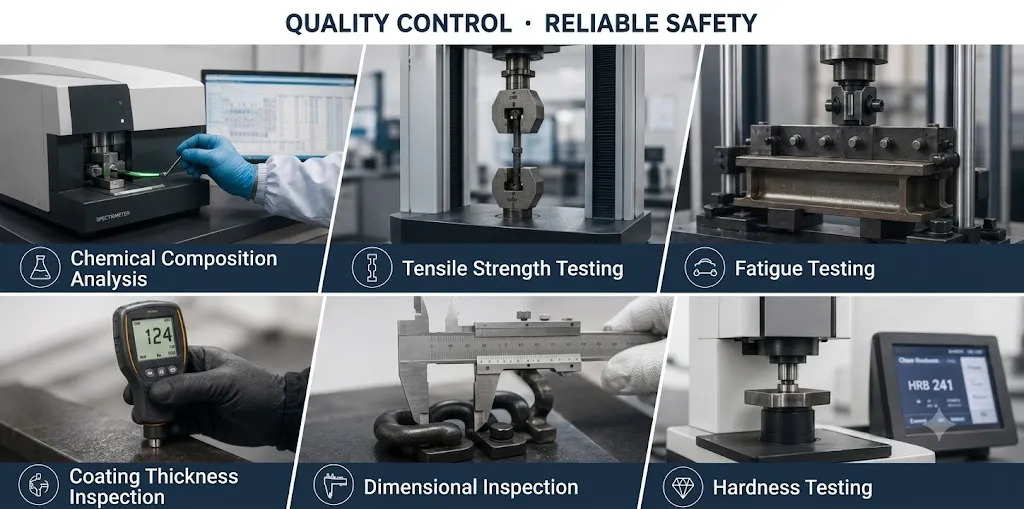
At Fonyo Heavy Industries, every production stage is controlled through documented inspection procedures and full material traceability.
Inspection typically includes:
Third-party inspections such as SGS, BV, and TÜV can also be arranged according to project requirements.
Selecting the correct fish plate is important, but selecting the right manufacturer is equally critical.
Key evaluation criteria include:
Manufacturers with experience in railway, metro, industrial rail, and international export projects are generally better equipped to meet project-specific requirements.
The fish plate must match the rail section exactly. Check your rail marking: UIC rails are stamped on the web with the profile designation (f.eks. “UIC 60”). AREMA rails carry similar markings (f.eks. “136 RE”). If the markings are worn, measure the rail height and head width or consult engineering drawings.
Your project specification will dictate whether UIC, AREMA or DIN standards apply. This is typically driven by geography — European-funded projects specify UIC/EN, North American projects specify AREMA — but may also be determined by the railway operator’s internal standards or the engineering consultant’s design basis.
Key factors to evaluate:
Match the fish plate bolt hole pattern to your fish bolt specification. The most common configurations are:
Bolt hole diameter must correspond to the fish bolt diameter. Common sizes: M22, M24, M27 for UIC systems; 7/8″, 1″ for AREMA systems.
Confirm that the manufacturer provides:
They are the same component. “Fisketallerken” is the term used in British and international English; “ledstang” is the North American (AREMA) term. Both refer to the steel bars used to connect two rail ends at a joint.
Ingen. UIC and AREMA rail sections have different profiles, and their fish plates are not interchangeable. Using the wrong standard will result in poor contact at the rail web and fishing angles, leading to accelerated wear and potential failure.
Two — one on each side of the rail web. A standard rail joint uses a pair of fish plates (one left, one right) secured by fish bolts.
Torque values depend on bolt size and grade. For M24 Grade 8.8 fiskebolte, typical torque is 250-350 Nm. For 1″ AREMA bolts, 400-600 ft-lbs is common. Always follow the project specification or manufacturer’s recommendation.
Ja. Fish plates are supplied and installed in matched pairs — the left and right bars are mirror images. Ordering is typically by the pair or by the set (pair + bolte).
Check the rail marking on the web, or measure the rail profile. Our engineering team can assist with profile identification from rail dimensions or photographs. CAD drawings are available for verification.
Six-hole fish plates provide more clamping force and better load distribution. They are commonly used on mainline and heavy-haul railways. Four-hole fish plates are typically used on lighter rail sections and secondary tracks.
Ja. Custom fish plates can be produced according to customer drawings, rail profile measurements, or project specifications. Engineering review and drawing verification are typically provided before production.
Luoyang Fonyo Heavy Industries manufactures UIC, AREMA, FRA, kranskinne, and custom rail fish plates for railway infrastructure projects worldwide.
Our engineering team can assist with:
In addition to fish plates, we also supply fiskebolte, skinne clips, skinnepuder, jernbanesveller, and other railway track components.
Contact us today for technical support, engineering consultation, and quotations.