Scan the WeChat code to contact us
Scan the WeChat code to contact us
Feel free to send us a email and we will reply to you as soon as possible.
Creating the future with heart and soul


When a custom railway wheels inquiry arrives, the first questions are about the basics. What is the wheel for? What diameter? What standard does the project call for? How many pieces?
Sometimes those answers are in the inquiry. Often they are not.
A railway wheel is not a standard catalogue part. It is designed around the vehicle, the track and the service it will see. If the manufacturer has to guess at the axle load, the braking type or the tread profile, the quote is built on assumptions. The delivered wheel may pass a dimensional check and still be the wrong wheel for the line.
This guide covers what a buyer should prepare before sending a custom railway wheels RFQ, and why each item matters. It is written from the manufacturer side, so you can send an inquiry that produces a useful answer the first time.
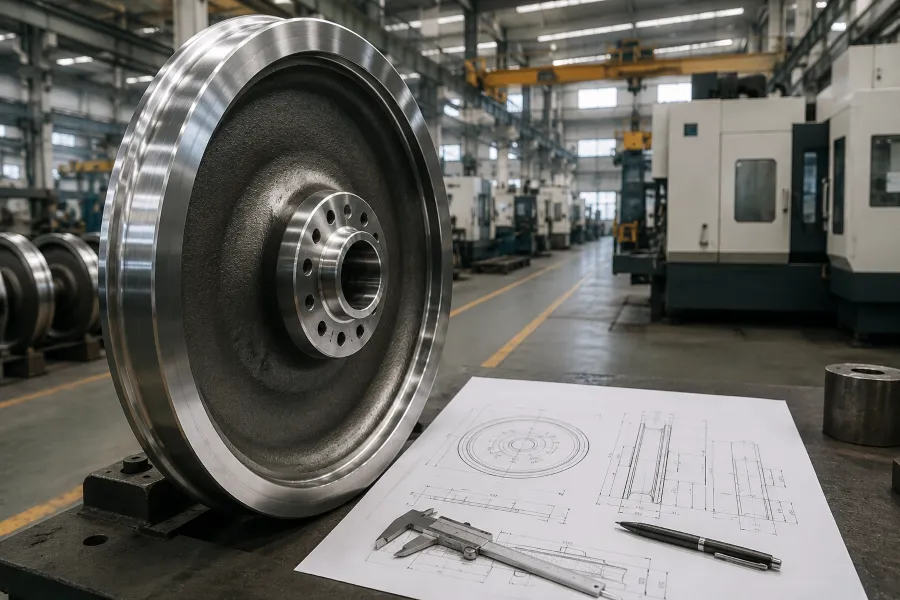
The single most useful piece of information in a custom railway wheels RFQ is what the wheel is for.
Custom railway wheels for a metro coach, a railway wheels of heavy-haul freight wagon, a locomotive railway wheel, a mining car or a crane travels completely different lives. The same nominal diameter can hide very different requirements.
Describe the vehicle and the line. Is it a passenger coach running at 160 km/h? A freight wagon with 25-tonne axle load? A mining locomotive on a tight-gauge industrial track? This context shapes the steel grade, the dimensions and the fatigue design.
If you are not sure what details matter, say that too. A manufacturer who understands the application can ask the right questions. A manufacturer who only quotes from a drawing may miss what the drawing does not show.
Beyond the application description, the following data points have the largest influence on wheel design and price:
What is the nominal rolling diameter? Typical values range from roughly 650 mm on some locomotive applications to 840 to 920 mm on many freight and passenger wheels, but the correct value depends on your vehicle and track.
If you have a tread and flange profile, send it. If you do not, indicate which standard profile applies, for example a profile from AAR, UIC or EN practice, or whether the custom railway wheels are straight-profile industrial wheel. For crane and industrial wheels, the profile is often simpler and defined by the rail section.
These two numbers influence the wheel cross-section, the steel grade and the fatigue requirements.
A wheel for a 20-tonne metro axle load is not the same as a wheel for a 30-tonne heavy-haul freight axle load, even when the diameter looks similar. Higher axle loads mean more contact stress, more heat input during braking, and a more demanding fatigue life requirement.
Operating speed matters for the same reason. A wheel that performs well at 80 km/h may not be suitable at 200 km/h, because the dynamic loads and the required margin differ.
This one is often forgotten, and it changes the custom railway wheels design.
Wheels designed for tread braking carry the braking heat through the tread and rim. Wheels designed for disc braking have a different thermal load path, and the hub and web design must be compatible with the brake disc mounting.
If the wheel will see tread braking on steep gradients, the rim thickness and steel grade need to be considered against thermal fatigue. Do not leave this detail out of the RFQ.
Which standard does the project require? Common ones include:
If the standard is not fixed, say so. The manufacturer can recommend a grade based on the application. If you specify a grade yourself, make sure it matches the standard and the service conditions. A steel grade is not a standalone item; it is defined by its standard.
What is the bore diameter and hub width? These dimensions connect the wheel to the axle and affect machining and fitting.
If the wheel is to be pressed onto an axle, the bore tolerance and the required surface finish matter. If you do not know the bore yet, state that the custom railway wheels will be supplied unmachined or semi-machined in the bore, so the manufacturer can plan accordingly.
How many pieces, and when are they needed?
Quantity affects the manufacturing route. A single prototype wheel is made differently from a production run of a thousand. Delivery time depends on forging, heat treatment, machining and inspection capacity. A realistic schedule makes the quote useful; an impossible one makes every bidder pad their price.
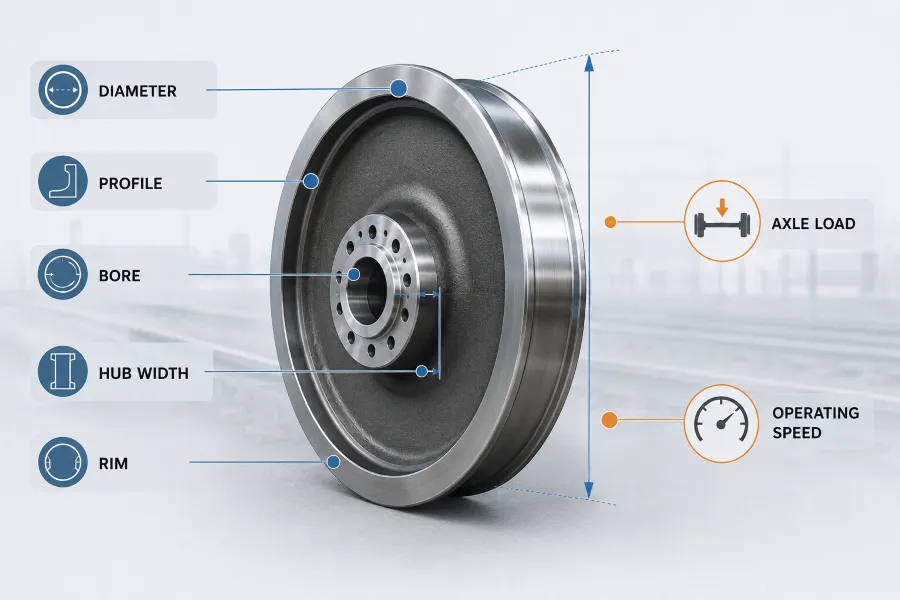
If you send a formal RFQ document, these are the sections worth including. Even a short email with these points answered is enough to produce a proper quote:
| Information | Why It Matters | If Not Provided |
| Application and vehicle type | Shapes grade, dimensions and fatigue design | Quote based on assumptions |
| Nominal wheel diameter and profile | Defines tread, flange and machining | Cannot confirm wheel-rail interface |
| Axle load and operating speed | Drives steel grade and cross-section | Risk of under-designed wheel |
| Braking type (tread or disc) | Changes thermal design and rim/hub design | Possible brake compatibility failure |
| Applicable standard and steel grade | Defines chemistry, properties and inspection | Standard cannot be certified |
| Hub bore, hub width and tolerances | Defines axle fit and machining | Machining stage uncertain |
| Quantity and delivery schedule | Determines manufacturing route and price | Unrealistic price or schedule |
| Required documentation | Defines certificates, reports and traceability | Compliance gaps at delivery |
Railway wheels are safety-critical components, and the documentation is part of the product.
State in the RFQ what documents you expect with the delivery. Typical requirements include a material test certificate with heat number traceability, ultrasonic testing results, hardness test data, and dimensional inspection reports. If the project requires third-party inspection or specific certification, name it in the RFQ.
If the requirement is only “certified quality”, the manufacturer will provide their standard paperwork, which may or may not match what your project actually needs. Saying it explicitly avoids a delay at delivery time.
A thin RFQ usually produces one of two outcomes.
The first is a quote with assumptions, sometimes stated and sometimes not. If the assumptions are wrong, the final price and the delivered product differ from what was quoted.
The second is a long back-and-forth, where the manufacturer asks questions one by one over several emails. This is not a sign of a bad supplier; it is the normal cost of missing information. It simply takes longer and leaves more room for misunderstanding.
Neither outcome helps the buyer. Preparing the information in advance is cheaper than discovering the gaps after the wheels are delivered.
Not every buyer has a completed custom railway wheels specification on hand. That is normal.
If you have the vehicle type, the axle load, the operating speed, the track gauge and the required standard, a manufacturer can work from those and propose a wheel design for approval. The drawing can be confirmed after the technical review, before production starts.
The key is to say what is known and what is not. A manufacturer who asks good questions and proposes a clear design review process is usually a better partner than one who quotes instantly from a sketch.
At Luoyang Fonyo Heavy Industries Co., Ltd., we review each wheel inquiry the same way: application first, then dimensions, then standard and grade, then quantity and documentation. If information is missing, we ask before we quote. Send us your inquiry with what you have, and we will tell you what else we need to prepare a specification that can be quoted correctly.
Technical note: Wheel standards, steel grades and dimensional requirements can vary by standard revision and project specification. Always verify the latest applicable standard and the project specification before procurement.
Not always. If you can provide the wheel diameter, tread and flange profile, hub bore and width, and the applicable standard, a manufacturer can work from those. If you have a drawing, send it in PDF or CAD format. If you do not, the manufacturer should ask the right questions and propose a design for approval before quoting.
Forged wheels are generally preferred for mainline passenger and freight service because forging improves grain flow and structural integrity, which helps fatigue life under repeated loading. Cast wheels are used in some industrial and low-speed applications where the operating demands are lower. The right choice depends on the standard your project requires and the actual service conditions.
Sending only a diameter and a quantity. Wheel design depends on axle load, speed, braking type, tread profile, standard and steel grade. Without these, a quote is built on assumptions, and if the assumptions are wrong, the delivered wheel can fail dimension checks or perform poorly in service.
Not without checking. AAR M-107/M-208 and EN 13262 differ in steel grades, mechanical property requirements, dimensional tolerances and inspection rules. A wheel that meets one standard may not meet the other. The applicable standard should be confirmed by the project specification or the engineering authority before procurement.
It depends on the manufacturing route. Forged and heat-treated wheels have setup costs, so small trial orders are possible but carry a higher unit price. Many projects start with a sample batch for approval, then move to production quantities. Discuss the quantity and delivery schedule with the manufacturer so the quote reflects the real cost structure.
Yes. Axle load and operating speed affect wheel dimensions, steel grade selection and fatigue design. A wheel designed for a 20-tonne metro axle load is not the same as a wheel for a 30-tonne heavy-haul freight application, even if the diameter looks similar. These data points are not optional extras in a wheel RFQ.